

Summary
A career change cover letter has one job: turn a pivot the hiring manager reads as a risk into something they read as an asset. That means naming the switch directly in the opening rather than hoping nobody notices, then spending almost no words on why you left and almost all of them on evidence that you have already started — a certification, a project, a result.
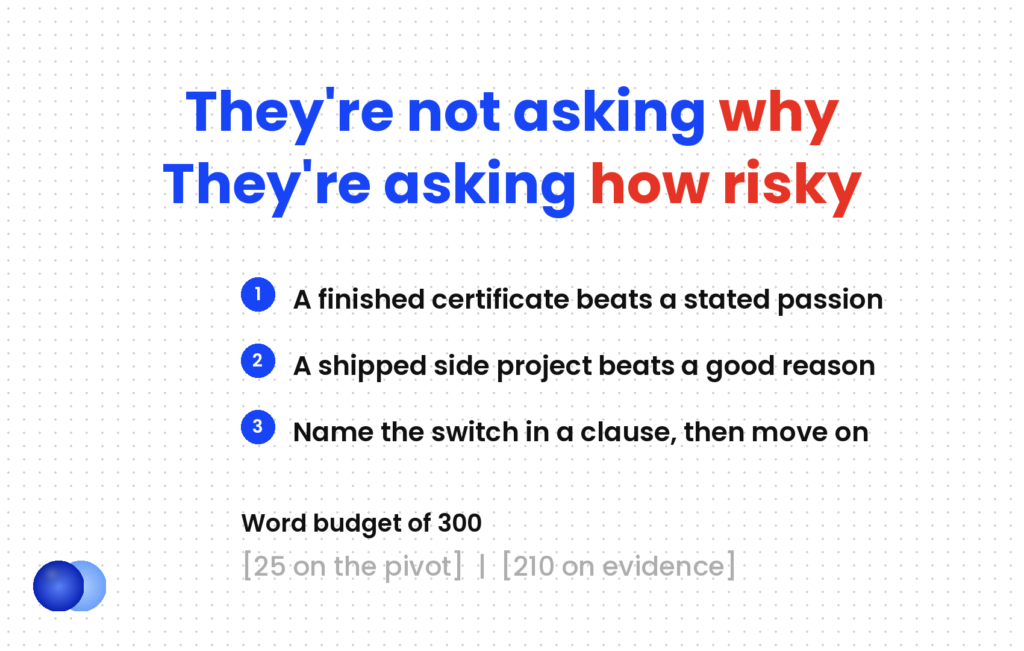
A career change cover letter is read with one calculation running: how risky is this?
Will they actually like the work. Will they stay. Can they contribute before the ramp costs more than the hire is worth. Those are the questions, and a career change cover letter exists to answer them — not to explain your journey.
That reframe changes what goes in the letter. Most of them spend their best paragraphs justifying the switch. The ones that work spend almost no words on why you left and almost all of them on evidence that you have already started.
What is the one job of a career change cover letter?
Getting a sceptical hiring manager to stop seeing the pivot as a liability. That is a harder task than the standard "here is why I am qualified" letter, and it requires different content — proof of preparation rather than a narrative about your motivations.
In practice, worth stating plainly, because it changes every decision that follows.
A standard cover letter argues relevance. A career change cover letter argues safety — that hiring you is not a gamble. The evidence that does that is specific and checkable:
- A completed certification directly relevant to the new field
- A freelance project, side project or volunteer role where you applied the new skills
- A concrete result from self-directed learning
- Genuine engagement with the field — an informational interview, a community, a body of work you follow
None of that is about passion. All of it is about de-risking, which is what the reader is actually weighing.
Career changes are also more normal than the anxiety suggests. BLS data puts the average person at around 12.9 jobs between ages 18 and 58, and hiring managers do not object to career changers — they object to ones who cannot articulate what they bring.
Should you address the switch directly?
Yes, in the opening paragraph. Hoping nobody notices the disconnect does not work, because the resume already showed it. Naming it early removes the question from the reader's mind and lets the rest of the letter answer it.
The instinct to bury it is understandable and wrong.
Your resume already made the pivot obvious. A letter that avoids the subject leaves the hiring manager doing the arithmetic alone, and readers answer unanswered questions pessimistically.
Name it in the opening, in a clause rather than a paragraph:
"I have spent six years running clinical operations and am now applying that domain knowledge to health-tech analytics — which is why the Senior Analyst role at BrightPath caught my attention."
Twenty-eight words. It names the switch, points forward, and never begins a sentence with "although."
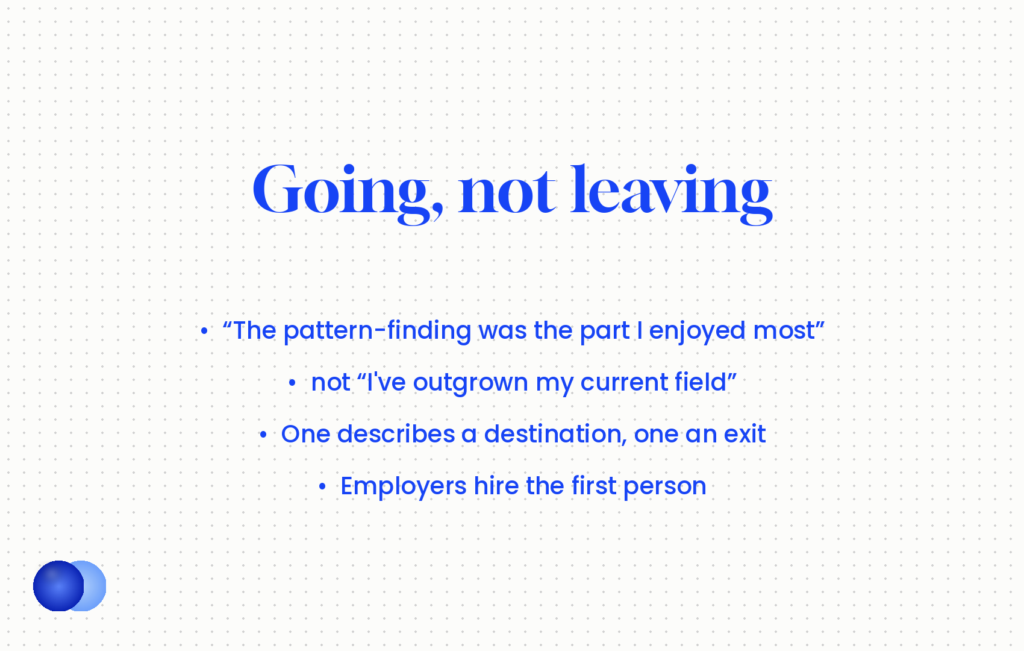
Say why you’re going, not why you’re leaving
There is a real difference between "I want to move into analytics because the pattern-finding is the part of operations I enjoyed most" and "I've outgrown clinical operations and want a new challenge." Both are honest. The first describes a destination and reads as direction; the second describes an exit and invites the question of whether you will outgrow this too. Employers hire the first person.
How much should you explain the reason?
One or two sentences, no more. Career changers routinely use the letter to justify the decision, which is writing for yourself rather than for the employer. The reason matters far less to the reader than the evidence that you can do the job.
This is where most career change cover letters lose their best space.
The reason for your switch is interesting to you. To a hiring manager it is background — what they need is confidence that you can do the work. A letter that spends two paragraphs on the journey has spent them on the wrong reader.
Here is the ratio that works in a 300-word letter:
| Element | Words | Job |
|---|---|---|
| Naming the pivot | ~25 | Removes the unspoken question |
| Transferable evidence | ~120 | Proves you can do the core tasks |
| Preparation you have done | ~90 | De-risks the hire |
| Close | ~50 | Proposes a next step |
Notice the reason for leaving does not have a row. It lives inside those first 25 words, as a clause.
What evidence carries the most weight?
Preparation, then transferable results, then motivation — in that order of persuasiveness. A completed certification or a shipped side project proves you have already begun. A quantified result from your old field proves you can deliver. Enthusiasm alone proves neither.
Broadly, three tiers — and most letters invert them:
Strongest: proof you have already started. "I built three data dashboards in SQL and Tableau as part of the Google Data Analytics certificate" is checkable, recent, and directly relevant. It converts "wants to switch" into "has switched, and is now looking for the role."
Strong: quantified results from your old field, translated. Not "managed a retail team" but "ran hiring, onboarding and scheduling for 22 staff across two sites, cutting turnover from 40% to 18%." That is the same translation discipline the career change resume is built on.
Why most letters invert this
Weakest: motivation. Necessary in one sentence, useless in three. Everyone applying is enthusiastic.
Justifying: "After six years in clinical operations, I realised my true passion lies in working with data. I have always been analytically minded, and I am excited by the opportunity to bring that curiosity to a new field where I can grow and develop."
De-risking: "I completed the Google Data Analytics certificate last year and have since built the reporting dashboard three clinical teams now use for weekly capacity planning — SQL, Tableau, and healthcare data I already understood. The analysis was the part of operations I kept volunteering for."
Same person, same pivot. The second paragraph is evidence; the first is a feeling. Only one of them reduces the hiring manager's risk.
Use the target field's vocabulary rather than your old one. "Stakeholder reporting" means something different in healthcare than in analytics, and using their words is part of proving you have done the reading.
Write "I am willing to start at a lower level and learn." It reads as a discount rather than a qualification, and it invites an offer built around that sentence.
What does the structure look like?
Four paragraphs — name the pivot and the role, transferable evidence with numbers, preparation you have completed, and a confident close. Same length as any cover letter at 250 to 400 words, with the emphasis moved.
The order matters because it front-loads the answer to the question the reader has:
1. The pivot and the role. One clause naming the switch, one sentence on why this company specifically.
2. Transferable evidence. One or two results from your previous field, in the new field's language, matched to the posting's top requirement.
3. Preparation. The certification, the project, the freelance work. This is the paragraph that separates a serious career changer from a curious one.
4. Close. A specific next step. How to end a cover letter covers the mechanics, and the rule is the same here — propose something concrete rather than hoping to hear back.
Length stays standard at 250 to 400 words. A pivot does not earn you extra space, and a longer letter is not a more convincing one.
What about the resume it goes with?
The resume translates, the letter explains. A career change resume should describe your past work in the target field's vocabulary without narrating the switch — there is no natural place for narrative in a document of evidence. The letter carries what the resume structurally cannot.
Finally, the division of labour is clean, and getting it wrong produces an awkward resume and a redundant letter.
The resume rewrites your history in the new field's terms. Hybrid format, skills near the top, no explanation of why you moved.
The letter supplies the explanation, the preparation evidence, and the reason this company rather than another.
For pivot letters written end to end, the cover letter examples library covers career changes by field.
Both need to survive the first gate, which is mechanical rather than editorial. An AI resume checker against the specific posting shows whether the translated vocabulary actually landed — a step that matters more for career changers than for most candidates, because you are relying on a match the reader will not construct on your behalf.
This isn't about checking boxes. It's about showing that you've de-risked the hire.
Frequently asked questions
How do you write a career change cover letter?
Four paragraphs at 250 to 400 words: name the pivot in a clause, prove transferable results in the new field's language, show concrete preparation you have completed, and close with a specific next step.
Should I explain why I'm changing careers?
In one or two sentences, and no more. The reason matters far less to a hiring manager than evidence that you can do the job, and a letter that justifies the decision has written for the wrong reader.
Should I address the career change directly?
Yes, in the opening paragraph. Your resume already made it obvious, and an unanswered question tends to get answered pessimistically.
What evidence matters most for a career changer?
Proof you have already started — a completed certification, a shipped side project, a freelance engagement where you applied the new skills. That converts "wants to switch" into "has switched."
How long should a career change cover letter be?
The standard 250 to 400 words. The pivot does not earn extra space, and a longer letter is not a more convincing one.
Should I say I'm willing to take a pay cut or start lower?
No. It reads as a discount rather than a qualification, and it invites an offer constructed around that sentence.
What goes in the letter versus the resume?
The resume translates your history into the target field's vocabulary. The letter explains the switch, shows your preparation, and says why this company — the narrative a document of evidence has no place for.
Are employers actually open to career changers?
Generally, yes. BLS data puts the average person at around 12.9 jobs between 18 and 58, and hiring managers object less to the switch itself than to candidates who cannot articulate what they bring.



Comments