
Summary
You rarely choose between them. A resume is the record every portal and recruiter expects; a portfolio is the proof of work that sits on top of it. In creative, design, writing and development roles you need both, and the resume's real job is to route the reader to the portfolio. One vendor study found hiring managers judge both together in about 55 seconds, yet Monster's 2026 survey found only 12% of job seekers link a portfolio from their resume.
The portfolio vs resume question usually arrives framed as a choice: build the showcase site, or polish the document. For most people in creative, design, writing and technical roles, that framing costs interviews, because the two do different jobs and a reviewer uses them in sequence.
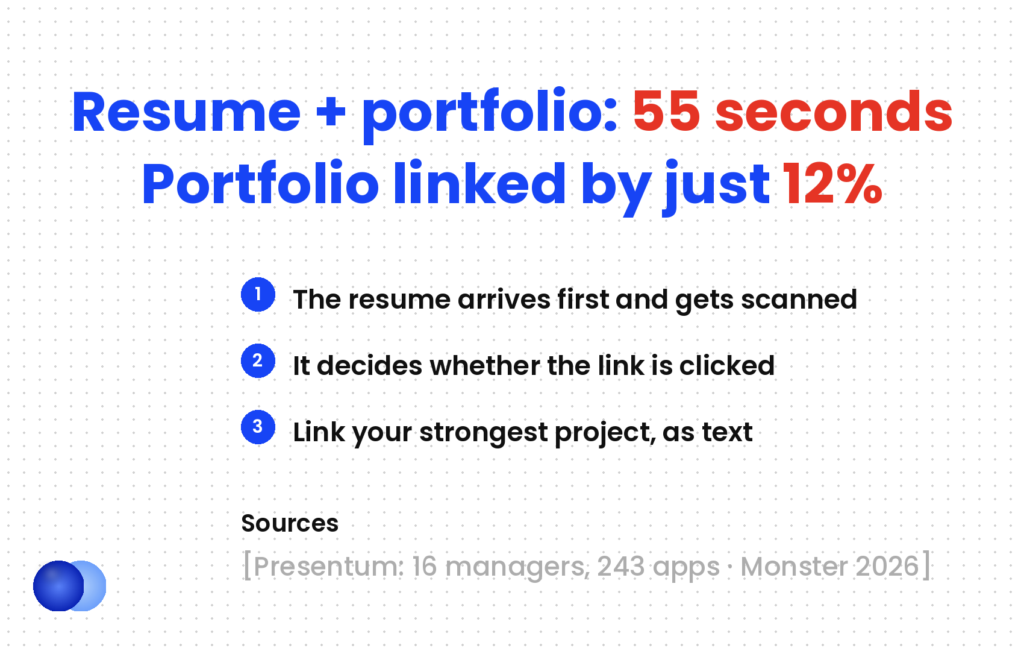
The sequence is the part nobody names. Presentum's review study, which asked 16 hiring managers to judge 243 design applications, found they took about 55 seconds to assess the resume and the portfolio together and decide on an interview. The portfolio does not get a separate, generous hearing. It gets whatever time the resume earns it.
And most candidates never connect the two. Monster's 2026 State of the Resume survey of 1,001 US job seekers found just 12% include a portfolio link on their resume. So the real question is not which one you need. It is whether your resume sends the reader to your best work in the first few seconds.
What is the difference in portfolio vs resume?
A resume is a record: employers, dates, scope and results, in a format software can parse and a recruiter can scan in seconds. A portfolio is evidence: the work itself, with the process behind it. The resume answers "has this person done it?" and the portfolio answers "how well?"
Both documents make claims about the same career, but they carry different kinds of information and reach different readers.
| Resume | Portfolio | |
|---|---|---|
| Core job | Record of roles, dates, scope and results | Proof of the quality of the work |
| First reader | Applicant tracking system, then a recruiter | Hiring manager or senior practitioner |
| Format | One file, text-based PDF or .docx, single column | Website, PDF deck, GitHub, Behance, Dribbble |
| Length | Under 600 words; page one must stand alone | 3–5 curated projects |
| Reading time | Seconds on first scan | Scanned, rarely read word for word |
| Required by portals | Almost always | Only where the posting asks |
| Answers | "Has this person done this, where and when?" | "How good is the work, and how do they think?" |
| Fails when | It lists duties with no results | It shows finished visuals with no context |
Notice the first-reader row. A resume has to survive a parser and a recruiter who may not be a practitioner. A portfolio is usually judged by someone who does the work, which is why it can carry detail a resume never could.
The consequence for the portfolio vs resume decision is simple: the resume opens the door, the portfolio wins the argument. Neither does the other's job well. The site's position, set out in is a resume still necessary, is that portfolios, LinkedIn profiles and skills tests all sit on top of a resume rather than replacing it.
When do you need both a portfolio and a resume?
Whenever the output of your work can be shown. Designers, UX researchers, writers, photographers, developers, marketers and architects need both. Finance, operations, healthcare and most corporate roles need only a resume, with results in the bullets doing the job a portfolio would.
The dividing line is not "creative versus corporate". It is whether a reviewer can look at the output and judge its quality directly.
| Field | Resume | Portfolio | Why |
|---|---|---|---|
| Graphic, product and UX design | Required | Required | The shortlist often turns on the work |
| UX research | Required | Expected | Shows method and how findings changed decisions |
| Copywriting, content, journalism | Required | Expected (clips) | Editors judge voice and range directly |
| Software development | Required | Strongly helpful (GitHub, live projects) | Code and shipped products are checkable |
| Marketing | Required | Helpful | Campaign case studies with results |
| Photography, film, illustration | Often secondary | Decisive | The work is the product |
| Finance, operations, sales | Required | Rarely | Results fit in bullets |
| Healthcare, education, trades | Required | Rarely | Licences and records carry the weight |
For design roles, Presentum's panel was blunt: a missing portfolio, or at least a personal site or professional profile, "most likely guarantees a rejection". Treat that as one vendor study's finding about design hiring, not a law for every field.
Freelancers sit in a special position. Clients often hire from the portfolio alone, but agencies, contract platforms and in-house roles still ask for a resume. The freelance resume guide covers how to present client work as dated roles so both documents tell the same story.
Which one does a hiring manager look at first?
Usually the resume, because it arrives first and decides whether the portfolio link gets clicked. Presentum's panel judged resume and portfolio together in about 55 seconds, so the portfolio does not get a second hearing. Your resume has to point at your best project immediately.
The portfolio vs resume order matters because attention is scarce at both stages.
Stage one: the resume. Applications land in a tracking system as files. The system extracts text; it does not click links or open websites. A recruiter then scans page one for a few seconds, the window covered in how long do recruiters look at a resume. If nothing on that page signals strong work, the portfolio link simply goes unclicked.
Stage two: the portfolio. A reviewer who does click is looking for a reason to say yes quickly. Nielsen Norman Group's Rachel Krause, drawing on a survey of 204 UX hiring managers, warned that reviewers rarely read a portfolio in full, which is why it needs to be scannable.
That produces the portfolio vs resume asymmetry. A weak resume hides a strong portfolio; a strong resume cannot rescue a weak portfolio. Invest in both, and make the resume do the routing.
Very rarely will hiring managers take the time to read your entire portfolio word for word — which is one reason why your portfolio should be scannable.
How do you link a portfolio from your resume?
Put the full URL as visible text in the contact line at the top of the body, not in the page header or footer. Name your strongest project in the summary, and link individual case studies from the bullets they prove. Use a short custom domain so the address survives printing.
Most people who do add a link bury it. Four rules keep it working.
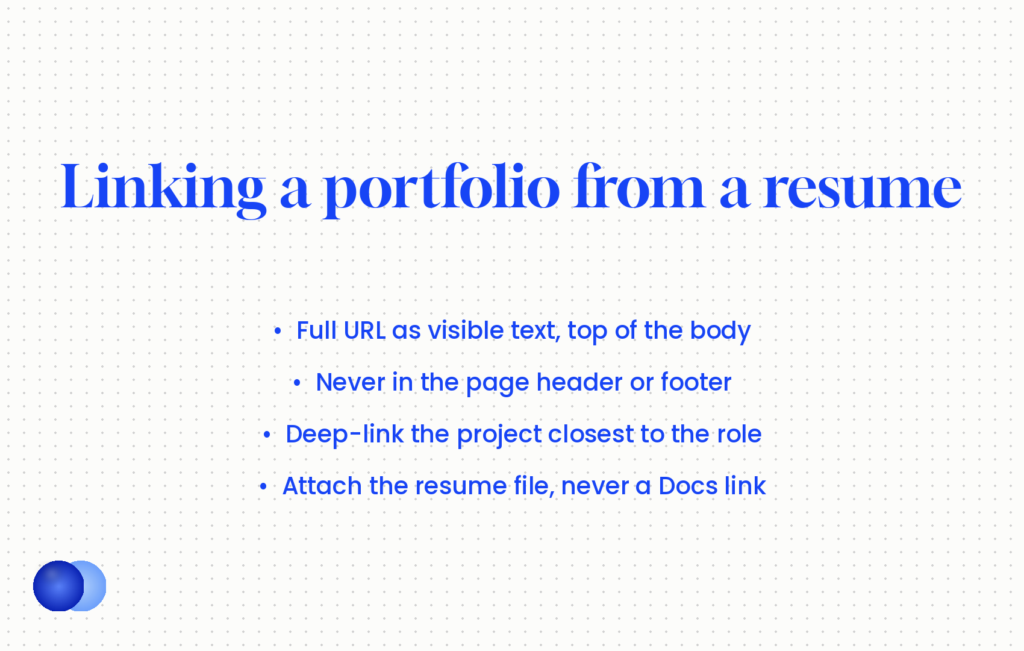
1. Top of the body, next to your email. Recruiters read the contact block first. A link at the bottom of page two will not be seen. Keep contact details in the document body, never in the Word or Google Docs page header, because some tracking systems skip header and footer areas.
2. Visible text, not just a hyperlink. Write portfolio: janedoe.design, not "My Portfolio" with a hidden hyperlink. Some older systems strip links entirely, and a printed resume has no clickable anything.
3. A short, owned address. A custom domain or a clean profile URL reads as deliberate. A 60-character Google Drive or Dropbox string reads as an afterthought and often breaks across lines.
4. Deep links where they prove a claim. If a bullet says you redesigned onboarding and lifted activation, link that case study from the bullet. The reader who doubts the claim can check it in one click.
Point the link at a project, not the homepage
In a 55-second review, a homepage costs the reader a decision about where to click. For each application, pick the one project closest to the posting and link it directly, with the homepage in the contact line as the fallback. A fintech role gets the payments case study; a healthcare role gets the clinical dashboard. It takes two minutes per application and removes the one step where a busy reviewer most often gives up.
What should the portfolio actually contain?
Three to five projects chosen for the roles you want, each showing the problem, your specific contribution, the process and a measurable result. Curate hard. A portfolio is judged by its weakest visible project, and reviewers scan rather than read.
Nielsen Norman Group suggests 3–5 projects as a rule of thumb for UX researcher portfolios, and warns that including everything you have ever worked on is a common mistake. The same logic holds for designers, writers and developers.
Each project should answer four questions in the first screen:
What was the problem? One or two sentences, with the business context.
What did you do? Your part, in the first person. Team projects are fine; vague ownership is not.
How did you get there? Sketches, research, drafts, trade-offs. Krause quotes hiring managers asking to see "the messy process", not just the finished product.
What changed? A number where you have one: conversion, time saved, readership, bugs closed.
Keep the two documents consistent
The portfolio and the resume make claims about the same career, and reviewers compare them. Dates, titles and employer names should match exactly, and the headline project on the portfolio should also appear as a result on the resume. The same rule applies to your profile: LinkedIn profile optimization should repeat the skills and projects both documents already claim.
Resume bullet: "Redesigned mobile checkout for a 40-store retailer, cutting abandonment from 71% to 58% in eight weeks (case study: janedoe.design/checkout)."
Portfolio case study: A problem statement naming the 71% abandonment rate, three rejected concepts with the usability findings that killed them, the final flow, and the 58% result with the eight-week timeline.
The bullet makes the claim in one line and hands the proof to the reader. The case study shows how the result happened. Neither repeats the other, and both use the same numbers.
Can a portfolio replace a resume?
Rarely. Application portals require a resume file, recruiters need dates and employers at a glance, and tracking systems cannot read a website. A portfolio can carry more weight than the resume in creative hiring, but it still needs the resume to get in front of the decision-maker.
There are real exceptions. Photographers and illustrators hired directly by clients, freelancers on platforms that show work first, and candidates with a warm referral to a creative director may never be asked for a resume. Outside those cases, the portfolio vs resume answer is both.
One trap is worth naming, because creative candidates walk into it more than anyone: sending a link in place of the resume file. A portfolio link belongs inside the resume. The resume itself should arrive as an attached, text-based PDF or .docx. A Google Docs or Drive share link defaults to restricted access, lands the recruiter on a request-access screen, and gives the tracking system nothing to parse. The Google Docs resume template guide covers the export steps.
A second trap sits in the design itself. Designers are tempted to make the resume a portfolio piece: two columns, icons, skill bars, a sidebar. That layout is exactly what breaks parsing. Keep the resume single column and plain, and let the portfolio carry the visual ambition. A text-based PDF with one accent colour is enough.
Attach a clean, single-column resume file and put your portfolio URL as visible text in its contact line.
Paste a Drive, Canva or Google Docs link into an application in place of the resume file, or turn the resume itself into a two-column design piece.
What neither document can fix
A portfolio of student briefs will not compete with shipped work, however well presented. A resume cannot manufacture results you did not get. And a link cannot help if the reviewer never clicks it. What pairing the two can do is make sure the best evidence you have reaches the reader inside the short window they give every application. If your portfolio is thin, one real project for a real client, even unpaid, will do more than any redesign of the site around it.
Frequently asked questions
What is the main difference between a portfolio and a resume?
A resume records where you worked, when, and what you achieved, in a format software and recruiters can scan. A portfolio shows the work itself and how you produced it. One proves you did it; the other proves how well.
Do I need a portfolio if I have a good resume?
Only if your work output can be shown: design, UX, writing, development, marketing, photography and similar fields. In finance, operations or healthcare, strong results in the resume bullets usually do the same job.
Do I need a resume if I have a portfolio?
Almost always. Application portals require a resume file, and recruiters need dates, employers and scope at a glance. The portfolio sits on top of the resume, not in place of it.
Where should I put my portfolio link on my resume?
In the contact line at the top of the document body, as visible text rather than a hidden hyperlink. Avoid the page header and footer, which some tracking systems skip, and link specific case studies from the bullets they support.
How many projects should a portfolio have?
Three to five, chosen for the roles you are applying for. Nielsen Norman Group calls including every past project a common mistake, and reviewers judge a portfolio partly by its weakest visible piece.
Can I send my resume as a Google Docs or Drive link?
No. Attach an exported PDF or .docx file. Shared links often default to restricted access, and a tracking system cannot parse a document behind a URL.
Should a designer's resume look like a portfolio piece?
No. Keep the resume single column and text-based so it parses cleanly, with modern typography and one accent colour at most. The portfolio is where visual ambition belongs.
How long do hiring managers spend on a portfolio?
Not long. In one vendor study, 16 hiring managers took about 55 seconds to judge resume and portfolio together before deciding on an interview, which is why the resume should link straight to your strongest project.



Comments