

Summary
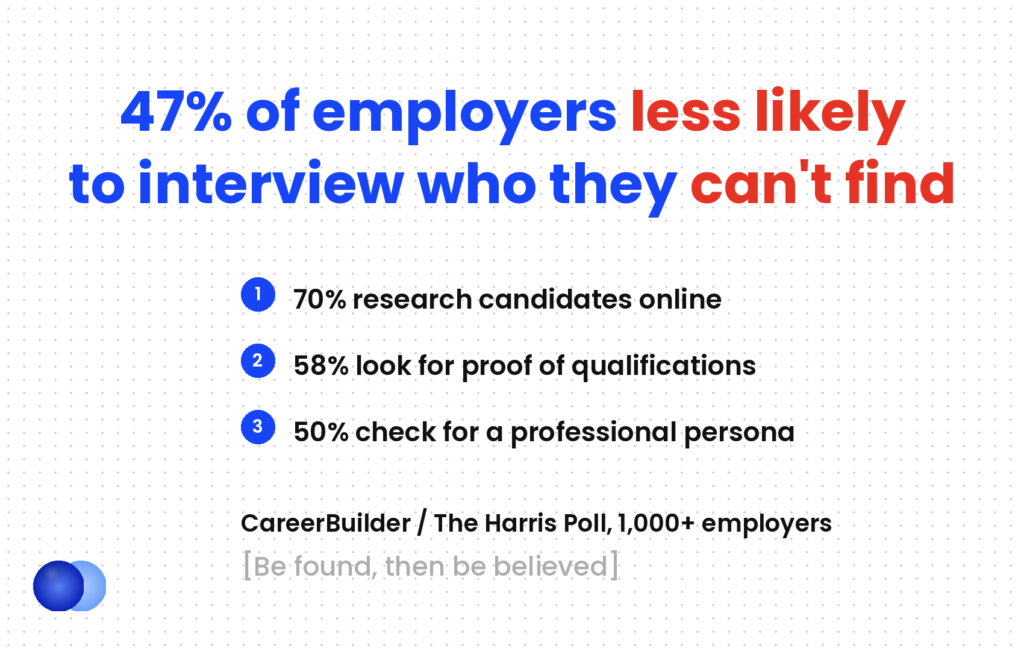
Personal branding for job seekers is mostly a verification test. In a CareerBuilder survey run by The Harris Poll, 70% of employers researched candidates online, 58% of them looking for information that supports the candidate's qualifications, and 47% said they were less likely to interview someone they could not find. So spend the first three weeks on being findable in LinkedIn search and consistent with your resume. Posting comes last, and lightly.
Most advice on personal branding for job seekers starts with content: post three times a week, build an audience. That is creator advice. A job seeker needs something narrower and faster.
When employers look you up, they mostly want to confirm what your resume already claims. A candidate who cannot be found, or who looks different online than on paper, loses before a single post matters.
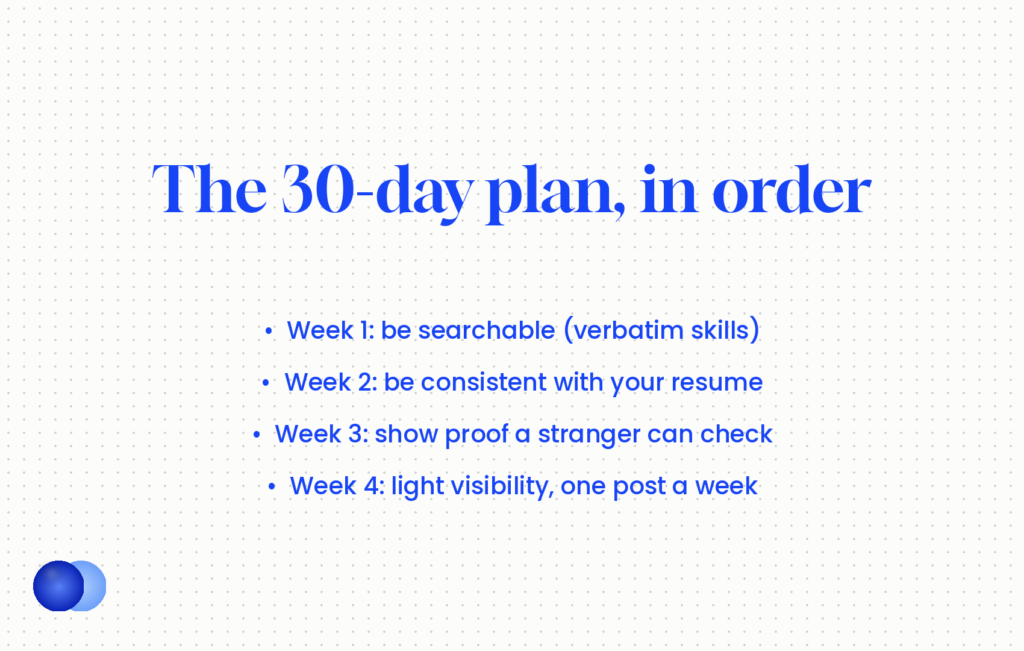
So this plan inverts the usual order. Weeks one and two make you findable and consistent. Week three adds proof. Week four adds a small amount of visibility.
What does personal branding for job seekers actually mean?
It means controlling what a recruiter finds in the two minutes they spend checking you: a LinkedIn profile that appears in their search, matches your resume, and proves the one strength you want to be hired for. Audience building is optional. Findability and consistency are not.
Strip the marketing language away and a job seeker's brand has three jobs.
Be found. Recruiters search before they read. If your profile does not surface for the title and skills they type, nothing else on it matters.
Be believed. Once a recruiter has your resume, they check whether the rest of the internet agrees with it. Dates, titles and the headline claim should line up.
Be remembered for one thing. A brand that tries to cover five strengths reads as none. Pick the strength a former manager would confirm — the same one you would lead with in tell me about yourself — and make every surface point at it.
The scale explains why the first job dominates. LinkedIn's own pressroom lists more than 1.3 billion members and roughly 8,200 job applications submitted every minute. At that scale, unsearchable means absent.
What do employers check when they look you up?
Mostly whether your qualifications hold up. In CareerBuilder's survey with The Harris Poll, 58% of employers who screened online looked for information supporting the candidate's qualifications, and 47% said they were less likely to interview someone they could not find online at all.
The most detailed public breakdown remains the CareerBuilder survey conducted by The Harris Poll of more than 1,000 hiring managers and HR professionals. It dates from 2018, so treat the exact percentages as directional, but the shape of the answer has held up in later surveys.
| What employers reported | Share |
|---|---|
| Use social media to research candidates | 70% |
| Look for information supporting qualifications | 58% |
| Check for a professional online persona | 50% |
| Less likely to interview a candidate they can't find online | 47% |
| Found content that caused them not to hire | 57% |
| Hired partly because background supported qualifications | 37% |
The top half is a confirmation test: does the online version of you support the paper version?
One later vendor survey, ResumeBuilder's 2023 poll reported by Business News Daily, puts the share of hiring managers using social media to evaluate applicants at 73%. Treat that as reported, not settled.
The practical conclusion for personal branding for job seekers: the default recruiter visit is a quick check, not a deep read. Your profile has to pass a skim.
How does LinkedIn search decide whether you are found?
LinkedIn Recruiter matches skills and titles verbatim, so the exact wording on your profile decides whether you appear. A search returns at most 1,000 profiles, and endorsements only rank you within those results. They cannot get you into them.
Four mechanics shape everything in weeks one and two.
Verbatim matching. LinkedIn Recruiter matches the words a recruiter types. "Project Management" does not match "Program Management", and "People Ops" does not match "Human Resources". Use the postings' term, not your old employer's label.
The 1,000-profile ceiling. A search returns at most 1,000 profiles. Every filter a recruiter adds to shorten the list is another verbatim match you meet or miss.
Endorsements rank, they don't include. Endorsements help you rank higher inside a result set you already belong to. Chasing endorsements for a skill you have not listed in the recruiter's exact words does nothing.
Pin for the job you want. Pin the skills that match the role you are targeting, not the role you currently hold. LinkedIn skills covers ordering and how many to list.
LinkedIn also says members who list at least five relevant skills get messaged up to 31 times more, and members with a photo receive up to 21 times more profile views, as Kinsta's roundup of LinkedIn's figures reports. Both are LinkedIn's own "up to" claims, not independent studies.
Run the recruiter’s search yourself
Open LinkedIn's ordinary people search, type the exact job title from three target postings, and add your city. Scroll until you find yourself, or stop at page five. If you are not there, compare the top ten profiles with yours and note which exact title and skill words they share that you lack. Repeat the same search on day 14 and day 30; the change in your position is the only branding metric that matters this month.
What is the 30-day personal branding plan for job seekers?
Four weeks in a fixed order: search foundations first, then consistency with your resume, then visible proof, then light visibility. Budget about 30–45 minutes a day. Each week has a done-when test, so you know when to stop polishing and move on to the next layer.
The order matters more than the tasks. Most job seekers start at week four, posting from a profile recruiters cannot find.
| Week | Days | Focus | Key tasks | Done when |
|---|---|---|---|---|
| 1 | 1–7 | Be searchable | Pick one target title; collect 3–5 postings; rewrite headline; list skills verbatim; pin target-role skills | You appear in your own title + city search |
| 2 | 8–14 | Be consistent | Match titles and month-year dates to your resume; rewrite About; add a photo; set Open to Work visibility | Resume and profile agree line by line |
| 3 | 15–21 | Show proof | Add 1–3 Featured items; put one result in each recent role; request 2 recommendations | A stranger could verify your headline claim |
| 4 | 22–30 | Be visible | Comment on 3 posts a week; publish 1 post; message 5 people at target companies | Two-week routine you can keep while applying |
Week 1: be searchable (days 1–7)
Choose one target title. A profile aimed at three roles ranks for none of them.
Paste three to five real postings into a document and highlight every skill and tool that appears twice. Those repeated words become your skills list and the backbone of your headline. LinkedIn headline examples shows the structure: target title, specialism, one piece of proof.
Week 2: be consistent (days 8–14)
Put your resume beside your profile and reconcile them. Same job titles, same employers, same month-and-year dates, because year-only dates also fail on several resume parsers and create exactly the mismatch a recruiter notices. Rewrite the About section around the one strength; LinkedIn summary examples has formats by career stage.
This is also the week to decide on the Open to Work signal and its visibility setting. LinkedIn Open to Work explains the recruiters-only option against the public frame.
What goes into weeks three and four?
Proof, then a modest amount of visibility. Week three turns claims into things a stranger can check: a featured project, a result in each role, recommendations. Week four adds a routine small enough to survive a job search: comments, one post, and direct messages to people at target companies.
Week 3: show proof (days 15–21)
Every headline claim needs something a recruiter can verify in under a minute.
Featured section. One to three items: a portfolio piece, a published report, a case study, a certificate that matches the target role.
One result per recent role. Your two most recent positions each need at least one line with a number or a named outcome. That line should match the corresponding resume bullet word for word.
Two recommendations. Ask former managers or clients, and tell them which strength to write about.
Week 4: be visible (days 22–30)
Now, and only now, add activity. Comment substantively on three posts a week from people at companies you want to join. Publish one post that shows how you think about a problem in your field. Send five short messages to people in the teams you are targeting.
That is enough: a routine you can hold for the whole search.
Do job seekers need to post content on LinkedIn?
No, and posting cannot compensate for a profile that is hard to find or inconsistent. LinkedIn's last published data suggested only about 1% of monthly users posted weekly. Occasional, specific posts help at the margin; a daily content habit is a creator strategy, not a job search one.
The posting habit gets attention because the people selling it are the ones posting. ContentIn's compilation notes that LinkedIn's most recent official figure, from 2019 session data, had around 1% of monthly active users posting weekly, and that LinkedIn has not updated it since.
Where posting helps, it helps as proof rather than reach. A thoughtful post about a problem in your field is one more piece of confirmation; daily motivational content is noise.
A useful rule: one post a week at most during an active search, each one showing a skill from your headline in action.
47% say that if they can't find a job candidate online, they are less likely to call that person in for an interview.
How do you keep your brand consistent with your resume and interviews?
Use one strength, one title and one set of dates everywhere. The headline, the About section, the resume summary and your interview opener should all make the same claim, in compatible words, backed by the same result. Inconsistency reads as inflation, even when it is innocent.
Personal branding for job seekers fails most often at the seams between documents: a recruiter opens LinkedIn beside the resume and spots a different title, shifted dates, or a specialism the resume never mentions.
Same title, or a clear bridge. If your official title was "Associate II" and the market calls the job "Data Analyst", use the market title with the official one in the description, identically on both documents.
Same result, same number. If the resume says you cut reporting time by 40%, the profile should not say 35%.
Same story out loud. Your interview opener should restate the headline claim. For a profile that already works, LinkedIn to resume runs the conversion in the other direction.
Before: Headline "Passionate professional | Team player | Open to opportunities". Skills include "Project" and "Coordination". Resume title reads "Operations Coordinator, Halden Freight, Mar 2021 – Jun 2024"; LinkedIn shows "Ops Lead, 2021–2024".
After: Headline "Program Manager, Supply Chain | Led a 3-site warehouse migration on time and under budget". Skills list "Program Management", "Supply Chain Management" and "Vendor Management", matching three target postings verbatim. Title and dates now read "Operations Coordinator (program lead, warehouse migration), Mar 2021 – Jun 2024" on both documents.
The second version appears in a "Program Manager" search, and a recruiter who cross-checks finds nothing to question.
Copy skill names exactly as they appear in your target postings, and pin the ones that match the role you want rather than the role you hold.
Let your LinkedIn title, dates or headline claim drift from your resume, because a recruiter reading both side by side sees inflation, not branding.
What can a personal brand not fix?
It cannot create qualifications you lack, overcome a closed hiring market, or replace tailored applications. A strong brand gets you found and believed; the resume, the application and the interview still decide the outcome. Treat the 30 days as foundations, not a strategy on their own.
It won't manufacture fit. If the target role needs skills you lack, a sharper headline surfaces you for searches you then fail at interview.
It won't beat market conditions. A good profile improves your odds inside the market; it doesn't change the market.
It won't replace applications. Inbound messages are a bonus. The plan exists to make your tailored applications survive the look-up that follows them.
What personal branding for job seekers does well is remove avoidable losses: the recruiter who never found you, and the one who found you and stopped believing the resume. After 30 days, keep the profile current and spend the rest of your time applying. LinkedIn profile optimisation goes section by section once the foundations are in place.
Frequently asked questions
What is personal branding for job seekers?
It is controlling what employers find when they look you up: a profile that appears in recruiter searches, matches your resume, and proves one clear strength.
How long does it take to build a personal brand for a job search?
About 30 days for the foundations, at 30–45 minutes a day.
Do employers really look up candidates online?
Yes. In a CareerBuilder survey run by The Harris Poll, 70% of employers used social media to research candidates and 47% said they were less likely to interview someone they could not find online.
Do I need to post on LinkedIn to get a job?
No. Posting helps at the margin, but it cannot fix a profile recruiters cannot find. One post a week is plenty.
Why does my LinkedIn profile not show up in recruiter searches?
Usually because your skills and title do not match the recruiter's words exactly. LinkedIn Recruiter matches verbatim, and a search returns at most 1,000 profiles, so near-synonyms leave you out.
Do LinkedIn endorsements help me get found?
Only after you are already in the results. Endorsements rank you within a result set; they cannot place you into a search for a skill you have not listed verbatim.
Should my LinkedIn match my resume exactly?
Titles, employers, month-and-year dates and key results should match. LinkedIn can carry more context, but nothing should contradict.
Which skills should I pin on LinkedIn?
The skills that match the role you want, taken word for word from target job postings.



Comments