

Summary
Yes. Skills-based hiring, LinkedIn profiles, portfolios and AI interviews are real, but none of them has replaced the resume. LinkedIn's modelling says a skills-first approach could widen talent pools 6.1 times, yet a Harvard and Burning Glass study found degree-requirement cuts changed fewer than 1 in 700 actual hires. The filter moved from credentials to evidence of skill, and the resume is still the document that carries that evidence. It just has to be built differently.
Whether a resume is still necessary in 2026 sounds like a fair question. Skills-based hiring is the phrase of the decade, recruiters search LinkedIn first, designers win work on portfolios, and software runs a growing share of first interviews.
The honest answer is yes, and the reason is more interesting than "tradition". Every one of those replacements either reads a resume, reads a copy of the same information, or only switches on after you have submitted one. The real question is what the resume has to prove now.
Two numbers settle it. One says skills-based hiring could make talent pools six times larger. The other says it changed fewer than 1 in 700 hires. Both are true, and the gap between them decides the question.
Is a resume still necessary in 2026?
Yes. No mainstream hiring channel has dropped it. Skills-based hiring, LinkedIn search, portfolios and AI interviews all sit on top of a resume or a resume-shaped record. What changed is the standard: a list of titles and duties no longer does the job, and evidence of specific skills does.
In almost every applicant tracking system, the thing you submit is still a resume upload, and the portal parses it into fields that recruiters filter and search. The alternatives change what happens around that step, not the step itself:
| Supposed replacement | What it adds | What it still depends on |
|---|---|---|
| Skills-based hiring | Drops degree filters, tests skills | Evidence of skills to screen on, usually from the resume |
| LinkedIn profile | Makes you findable before you apply | The same history and skills, restated |
| Portfolio | Shows the work itself | A route in: an application, a referral or a link |
| AI screening interview | Asks structured questions at scale | An application that triggered the invitation |
| Skills assessment | Measures ability directly | Someone deciding who gets sent the test |
None of these rows removes the need for a clean record of what you have done. Several raise the bar, because they compare your answers, profile or work sample against what your resume claims. So is a resume still necessary if you have a strong LinkedIn profile and a portfolio? For most roles, yes.
What is supposed to be replacing the resume?
Four things get named most often: skills-based hiring, LinkedIn profiles, portfolios and AI-led interviews. Each is real and growing. Each also works as a layer on top of the resume rather than a substitute for it, which is why the "resume is dead" headline keeps not coming true.
Skills-based hiring
Employers drop degree requirements and assess what candidates can do. It is the strongest candidate for "replacement", and the next section tests it.
LinkedIn profiles
Recruiters search profiles before a role is even posted. But the site's own guidance on LinkedIn skills applies here: LinkedIn Recruiter matches skills verbatim, and a search returns at most 1,000 profiles. The profile is a second copy of your evidence that has to agree with the first.
Portfolios
For designers, writers and developers, the work sample often outweighs any bullet. It still needs a route to the decision-maker. Monster's 2026 survey of 1,001 US job seekers found only 12% put a portfolio link on their resume at all, and only 18% included a LinkedIn URL. Most people build the "replacement" and never connect it to the resume.
AI interviews
One-way video and AI phone screens now handle early rounds at many large employers. They arrive after an application, and a good AI video interview answer sounds like the resume, told out loud with more detail.
Why did skills-based hiring change so few hires?
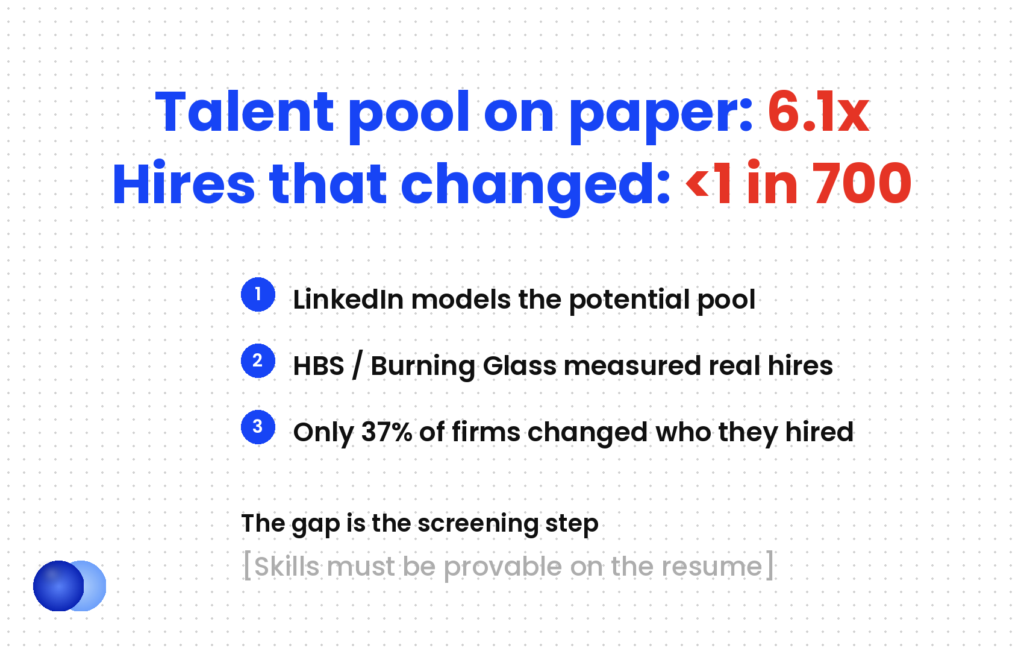
Because dropping a requirement is not the same as changing how people get screened. LinkedIn's modelling shows skills-first hiring could widen talent pools 6.1 times globally. A Harvard and Burning Glass study of real hiring found the reforms changed fewer than 1 in 700 hires.
These two findings sound incompatible. They measure different things.
LinkedIn's Economic Graph report from March 2025 models what would happen if employers screened on skills instead of titles and degrees. It defines the skills-based talent pool as workers holding at least half of the top skills for the target job. On that definition, the pool grows 6.1 times globally and 15.9 times in the United States. That measures potential.
Harvard Business School and the Burning Glass Institute, led by Joseph Fuller, looked at what actually happened. Across more than 11,000 job postings between 2014 and 2023, employers that removed degree requirements changed who they hired in only 37% of cases. Overall, fewer than 1 in 700 new hires benefited. The study's own summary: "Simply dropping stated requirements seldom opens jobs to those who don't have a college degree."
| Measure | Source | Finding | What it tells you |
|---|---|---|---|
| Potential pool | LinkedIn, 2025 | 6.1x globally, 15.9x US | How many people have the skills |
| Firms that changed hiring | HBS / Burning Glass | 37% | Most policy changes stayed on paper |
| Hires affected | HBS / Burning Glass | Fewer than 1 in 700 | How rarely the change reached a person |
The gap is the screening step. Fuller's point is that hiring managers never trained to assess people on their work experience fall back on familiar signals, and those signals live on the resume.
What does that gap mean for your resume?
The degree filter weakened, but the skills filter did not replace it automatically. Recruiters now need a resume that shows skill in context, in the posting's own words, with outcomes attached. A resume that lists duties gives a skills-based screen nothing to work with.
If a company says it hires on skills and then screens resumes the old way, the candidate who wins is the one whose resume makes the skills impossible to miss. That changes three things:
Skills appear inside results, not only in a list. "Python" in a skills block is a keyword. "Built a Python pipeline that cut weekly reporting from six hours to forty minutes" is evidence a skills-based screen can use.
The posting's vocabulary matters. If the job says "stakeholder management" and your resume says "worked with partners", a human might connect them and a search filter will not.
Outcomes carry the argument. Mary A. Rizzuti of Eisner Advisory Group, writing in HR Daily Advisor, describes a stack of HR resumes sharing the same broad phrases; measurable results were what set candidates apart.
Write the skill and its proof in one line
Take the five skills the posting lists first and check each one appears in your resume inside a bullet with a number, not only in a skills section. A skill that appears only in the list has to be taken on trust. Put the same five, in the same wording, into your LinkedIn skills so the two records agree.
Where does the "resume is dead" argument come from?
The sharpest recent version is a Forbes Human Resources Council column by Josh Millet, CEO of Criteria, which sells skills assessments. It deserves a fair hearing. Resumes exaggerate. The column cites a 2023 ResumeLab survey in which 70% of workers admitted lying on a resume. Credentials predict weakly. It points to research showing educational pedigree and years of experience are weak predictors of job performance. AI makes everything look polished. Criteria's 2026 candidate report found about 1 in 3 job seekers use AI when applying.
It also reports that 68% of job seekers would abandon resumes for skills assessments. Treat that as one vendor survey from a company that sells the alternative, not as a settled finding.
Every one of those points argues for a better resume, not for no resume. Interviews and references catch exaggeration. Weak experience signals mean leading with outcomes rather than tenure. And AI polish produces genericness, which recruiters spot, as the site's piece on whether employers can detect an AI resume explains.
Some of the anxiety is also built on a myth. Monster found 77% of job seekers worry about applicant tracking systems. The popular claim that 75% of resumes get rejected by an ATS before a human sees them has no primary study behind it, and the site covers why in do ATS systems reject resumes.
Resumes—in some form—will remain a valuable first step in connecting prospective candidates and potential employers.
What makes a resume well built now?
A single-column, text-based file under 600 words, where page one stands alone, skills sit inside measurable results, and the wording matches the posting and your LinkedIn profile. Every newer hiring channel checks the resume against something else, so consistency is now part of quality.
Single column, standard headings. Two-column layouts scramble text extraction. A hybrid or chronological format parses at 92–97%; functional layouts parse worst and read as concealment, as the site's guide to resume format types sets out.
Text, not image. A text-based PDF parses fine; an image-based PDF fails completely.
Short, with page one doing the work. TalentWorks found resumes over 600 words produced 43% fewer hires. Two pages suit experienced candidates, but the first scan rarely reaches page two, so page one has to stand alone.
Dates in month and year. Year-only ranges fail on several major parsers.
One story across every channel. Same titles, dates and skill names on the resume, LinkedIn and in interviews.
Old build: "Marketing Manager, Brightlane · 2021–2024. Responsible for campaigns, social media and working with sales. Skills: SEO, HubSpot, analytics."
New build: "Marketing Manager, Brightlane · Mar 2021 – Jun 2024. Rebuilt the HubSpot lead-scoring model with sales, lifting marketing-qualified to sales-qualified conversion from 14% to 22%. Grew organic sessions 61% in 18 months through an SEO content programme."
Same job. The second gives a skills-based screen three skills with proof and gives an AI interviewer something specific to ask about.
When is a resume not the main document?
In a few real cases: portfolio-led creative work, warm referrals, gig platforms, some trades and very senior search-led hires. Even then, someone usually asks for a resume before an offer, so keep a current one rather than building it in a hurry.
Creative and design roles. The portfolio often decides the shortlist. The resume confirms dates and scope.
Referrals. A strong referral gets you a conversation first, and the panel usually still asks for a resume.
Freelance and gig platforms. Profiles and reviews do the selling until you move towards contract or permanent roles.
In each case the resume stops being the first thing someone sees. So is a resume still necessary on these routes? Less for getting noticed, still for getting hired.
Keep one master resume current and build your LinkedIn profile, portfolio captions and interview stories from it, so every channel tells the same story in the same words.
Skip the resume because a job listing mentions skills-based hiring, since most employers that dropped degree requirements still screen applications the familiar way.
What should you build first?
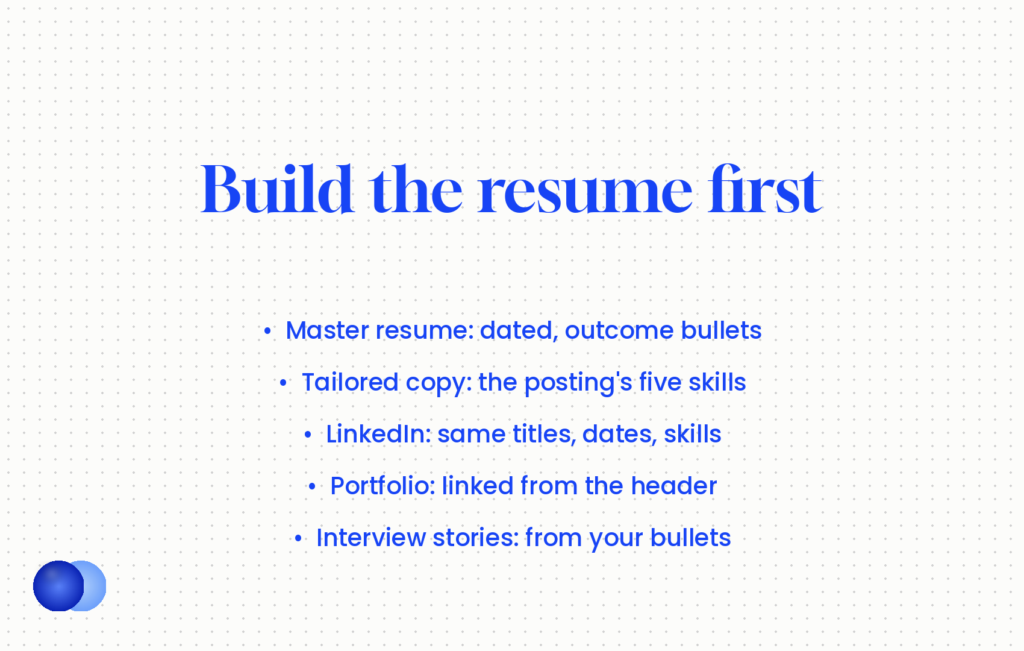
Build the resume first, because every other asset copies from it. Then align LinkedIn to it, link your portfolio from it, and prepare interview stories from its bullets. Building in that order keeps the records consistent without writing everything three times.
- The master resume. Every role, dated in month and year, with two to four outcome bullets each.
- The tailored version. For each application, keep the five skills from the posting prominent and cut what does not support them.
- LinkedIn. Copy titles, dates and skill names across exactly. The site's guide to LinkedIn to resume covers moving between the two.
- Portfolio or work samples. Link them from the resume header, which most job seekers skip.
- Interview stories. Turn your strongest bullets into two-minute stories for human and AI interviews alike.
If you are starting from scratch, the Rezoom resume builder sets up a single-column, parser-safe layout so you can spend the time on the evidence rather than the formatting.
What a resume cannot fix is worth saying plainly. It will not overcome a ghost posting, a licence you lack, or a skills-based policy that exists only on the careers page. It can make sure that when a real opening meets a real screen, the evidence for you is easy to find and easy to believe.
Frequently asked questions
Is a resume still necessary in 2026?
Yes. Almost every application portal still asks for one, and LinkedIn, portfolios and AI interviews sit on top of it. What changed is the standard: evidence of specific skills now outweighs titles and tenure.
Is skills-based hiring replacing resumes?
Not in practice yet. LinkedIn's modelling shows it could widen talent pools 6.1 times, but a Harvard and Burning Glass study found degree-requirement cuts changed fewer than 1 in 700 hires.
Can a LinkedIn profile replace a resume?
It helps recruiters find you but rarely replaces the application. Keep titles, dates and skill names identical to your resume, because recruiters compare the two.
Do I need a resume if I have a portfolio?
Usually, yes. The portfolio may decide a creative shortlist, but the resume confirms dates, scope and employers. Link one from the other.
Do AI interviews use your resume?
An AI screening interview almost always follows an application, so reviewers see your answers alongside what you submitted. Expand on your bullets rather than introduce new claims.
Is the resume dead because of AI?
No. AI has made generic resumes more common and easier to spot, which raises the value of specific, measurable evidence.
Do most resumes get rejected by ATS software?
The popular 75% figure is a myth with no primary study behind it. Parsing problems usually come from layout, such as two columns or image-based files.
What is the most important change to make to my resume now?
Put each key skill from the posting inside a bullet with a measurable result, in the posting's own wording. That one change serves search, skills screening and the human reader.
Comments