
Summary
To tailor your resume to a job description, sort the posting into required qualifications, preferred qualifications and duties, then map one piece of proof to each. Rewrite your title line, summary, top bullets and skills list in the employer's language, and leave the rest alone. A UKG recruiter puts the change at about 10 to 20 percent of the page. Finish by checking the match and reading it aloud.
To tailor your resume to a job description, sort the posting into required skills, preferred skills and duties, then rewrite your summary, top bullets and skills list to prove the ones you meet. You change about 10 to 20 percent of the page, not your whole story.
This guide is the full process, step by step. It covers the decision most guides skip: what to do with each requirement depending on whether you fully meet it, partly meet it or do not meet it at all.
If you want the short version, our guide to the targeted resume covers why tailored resumes win and a fast 25-minute routine. This page goes deeper on each step.
What does it mean to tailor your resume to a job description?
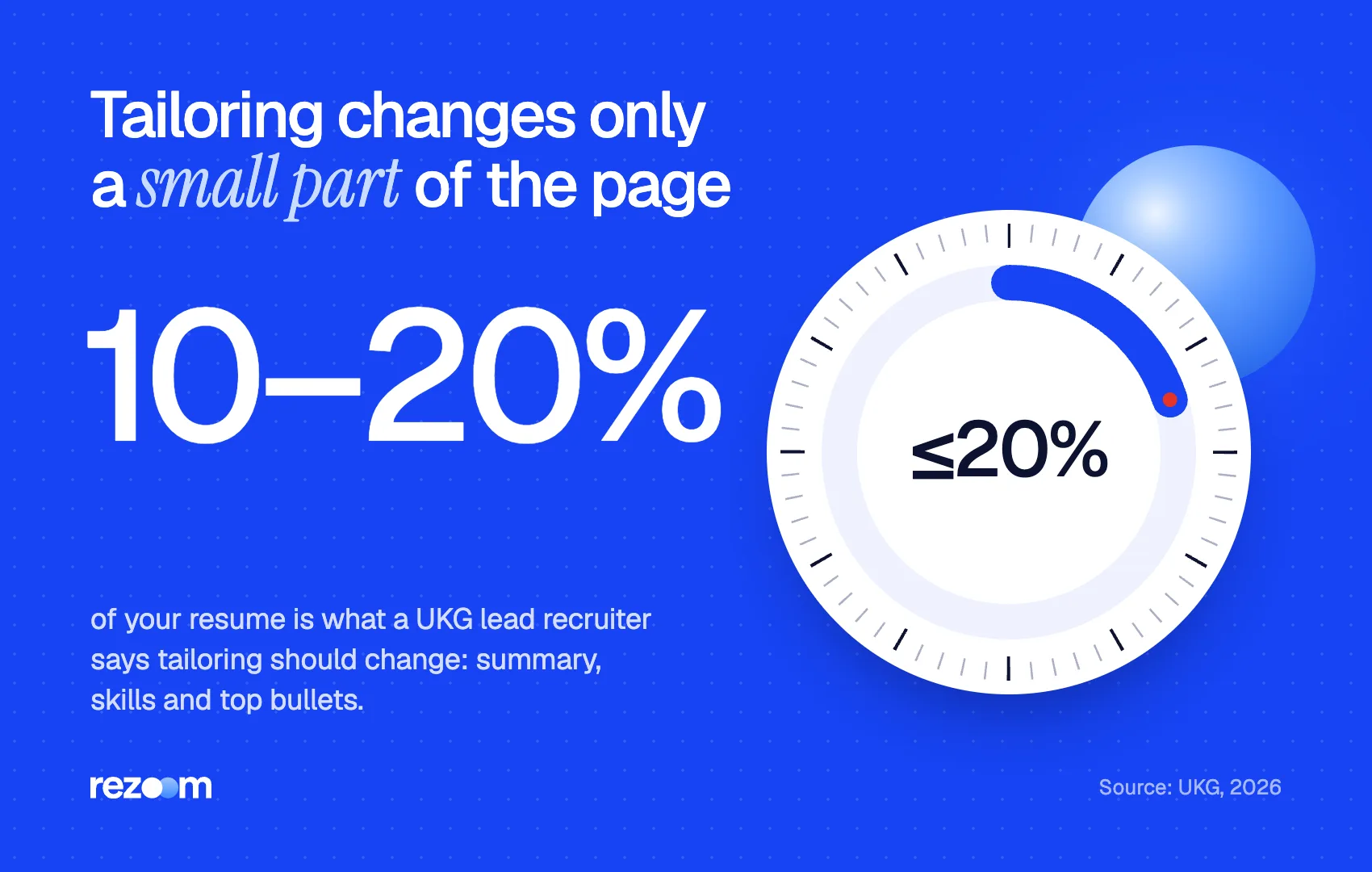
Tailoring means adjusting the parts of your resume a recruiter reads first so they match one posting. You keep the same jobs and facts, but you reorder bullets, mirror the employer's terms and lead with relevant results. A UKG lead recruiter describes it as changing about 10 to 20 percent of the resume.
Tailoring is not rewriting from scratch. Audra Lenox, a lead talent acquisition partner at UKG, defines it as adjusting about 10 to 20 percent of your resume, prioritizing the most relevant experience and aligning your language with the posting.
It matters because of how resumes get found. In Jobscan's research, 76.4% of recruiters said they search and rank candidates primarily by skills taken from the job description. If your resume uses different words for the same skill, a search can miss you.
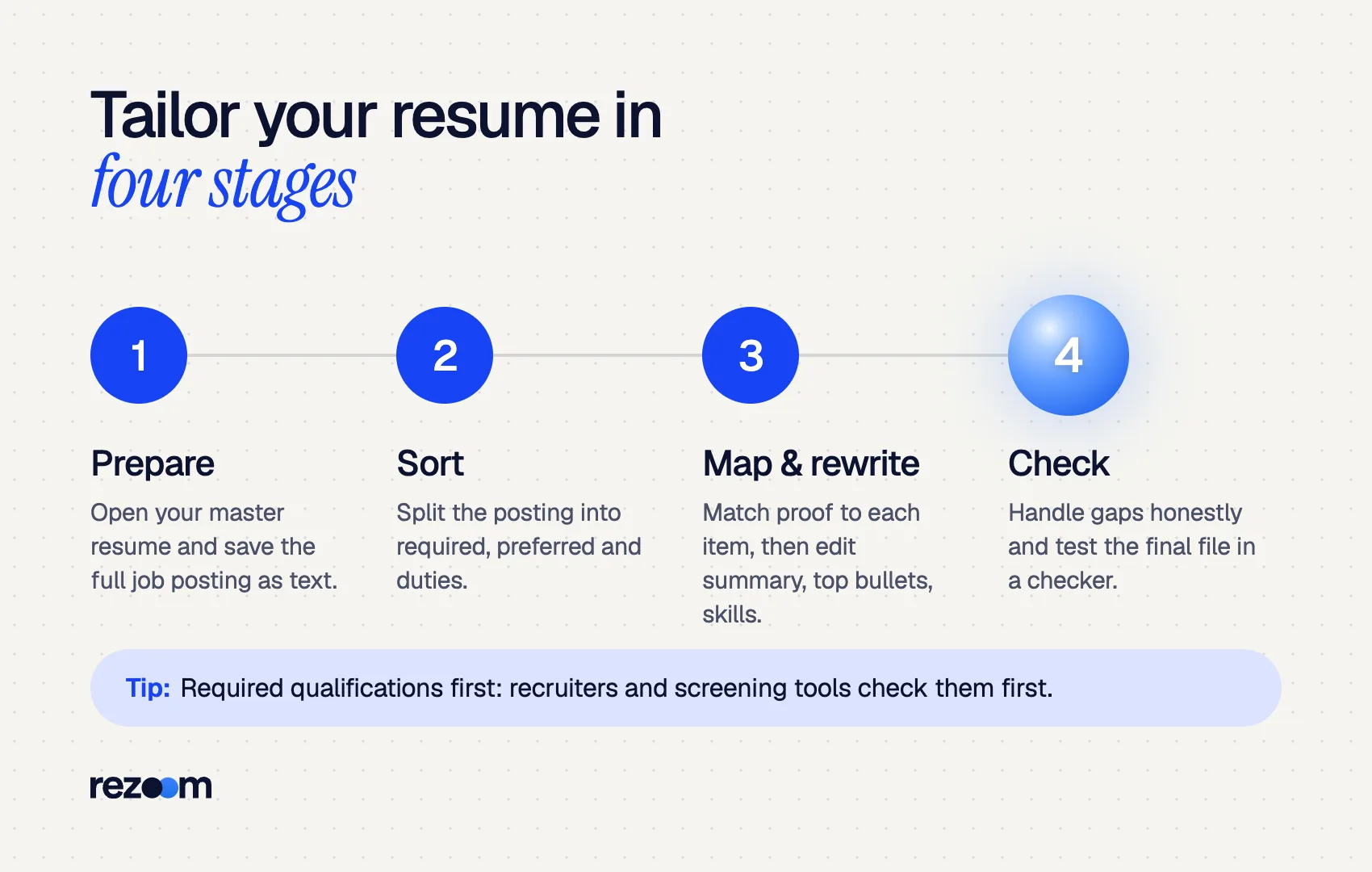
The eight steps fall into four stages:
- Prepare: start from a master resume and save the posting.
- Sort: split the posting into required, preferred and duties.
- Map and rewrite: match proof to each item, then edit the top third, bullets and skills.
- Check: handle gaps honestly and test the final file.
What should you do before you tailor your resume?
Start from a master resume that lists every job, project, skill and result you have, untailored. Then save the full job posting as text, because postings often disappear after they close. With both in front of you, tailoring becomes selecting and rewording, not remembering.
Step 1: Open your master resume and save the posting. The University of Southern Maine's career hub recommends starting with a comprehensive master resume of your experience, skills and education. Every tailored version is then a copy with choices made.
If you do not have one yet, our master resume guide shows how to build it. Then copy the full job posting into a document. You will mark it up in the next step, and you will want it again before the interview.
How do you sort a job description into what matters?
Split the posting into three lists: required qualifications, preferred qualifications and main duties. Required items come first, because employer screening tools and recruiters check them first. Within each list, note words that repeat, since repeated skills are usually the employer's priorities.
Step 2: Sort the posting into three lists. Duke's career hub puts it simply: read the description, then highlight key words and phrases. Sorting what you highlight is what makes it useful.
Required items deserve the most attention. Workday's HiredScore, an AI add-on some employers use, grades a B candidate as one who meets all basic qualifications. An A also meets most preferred ones. That ranking logic mirrors how recruiters read: required first, preferred second.
| List | Where to find it | Priority |
|---|---|---|
| Required qualifications | "Requirements," "Must have," "Minimum" | Cover every one you meet |
| Preferred qualifications | "Nice to have," "Bonus," "Preferred" | Cover the ones you meet |
| Main duties | "What you'll do," "Responsibilities" | Echo in bullets with results |
| Repeated terms | Any section, said two or more times | Use the exact wording |
For a detailed method to pull terms out, see our sibling guide on how to find keywords in a job description.
How do you map your experience to each requirement?
Build a two-column map: each requirement on the left, your best proof on the right. Proof means a specific job, project or result, not just a skill name. Mark each row as a full match, partial match or gap. The map tells you exactly what to rewrite and where.
Step 3: Map proof to each requirement. This is the step most people skip, and it is why tailored resumes often read like keyword lists. Employers want evidence. NACE's 2026 employer survey found that more than half of respondents cited 10 or more skills they look for, and NACE urged candidates to show concrete examples.
Your map also shapes what a parser picks up. Greenhouse's Talent Matching extracts skills, job titles, years of experience, employment dates and company names from resumes. Clear titles and dates are part of the match, not decoration.
Then decide what to do with each row:
| Your match | What to do | Where it goes |
|---|---|---|
| Full match | Use the posting's exact term plus a result | Summary and a top bullet |
| Partial match | Show the closest real example and name the skill | A bullet under the relevant job |
| Transferable | Name the shared skill in the posting's words | Bullet or summary |
| Gap | Leave it out; address it in the cover letter if key | Not on the resume |
How do you rewrite your resume for the job?
Rewrite three places and leave the rest: the title line and summary, the first two or three bullets under your most relevant job, and the skills list. Put the posting's job title and top required skills in the summary, move the strongest matching results up, and order skills by the posting's priorities.
This is where the 10 to 20 percent change happens. UKG's recruiter points to the summary, skills section and top bullets of recent roles, because those are what a reviewer scans first.
Step 4: Rewrite the title line and summary. Use the posting's job title if it truthfully fits. Add the two or three required skills you prove best. Our resume summary guide has more patterns.
Marketing Operations Manager with 6 years in B2B SaaS. Runs HubSpot and Salesforce lead routing for a 40-person sales team and cut lead response time from 9 hours to 45 minutes in 2025.
Step 5: Reorder and reword your top bullets. Move the bullet that proves the first required skill to the top. Swap your wording for the employer's where they mean the same thing. Duke also suggests adjusting action verbs so they highlight the overlapping skill.
Before: Sent monthly newsletters and promotional emails to customers
After: Built a 5-email lifecycle onboarding sequence in HubSpot and A/B tested subject lines, raising trial-to-paid conversion from 11% to 14%
Step 6: Reorder the skills list. Put the posting's required tools and skills first, in its exact spelling. Cut skills that are irrelevant to this role to keep the list scannable. Our resume keywords guide lists common terms by field.
Change headings only when the posting earns it
If a posting centers on research, Duke suggests renaming "Work Experience" to "Research Experience." Keep the heading standard otherwise. A relabeled section helps a human scan, but stick to familiar words so parsers still recognize it.
How do you handle requirements you do not meet?
Leave true gaps off the resume and never claim a skill you cannot discuss in an interview. For partial matches, show the closest real example and name the skill honestly, such as "exposure to" or a related project. If you miss most required qualifications, the role is probably not a fit yet.
Step 7: Handle gaps honestly. Partial matches are often stronger than they look. A course project, a volunteer role or a task you covered for a colleague can all count. Our guide to transferable skills shows how to frame them.
True gaps are different. Workday grades a candidate who does not meet most basic qualifications as a D, the lowest grade. Use this rule: if you meet most required items, apply and address one gap in your cover letter. If you miss most of them, spend your time on a better-fit posting.
AI tools can speed up rewording, but check every line against your master resume. Our sibling guide on whether it is bad to use AI for your resume covers where that goes wrong.
How do you check a tailored resume before you send it?
Run the final file through an ATS checker with the job description to confirm it parses and covers the required skills. Then read it aloud: every claim should match your master resume, and no line should read like copied posting text. Save it with the role in the file name.
Step 8: Check the match and the reading. A resume checker confirms two things at once: the file parses, and the required skills appear. Aim for a match in the range our sibling guide calls a good ATS score, then stop editing.
Cover every required qualification you genuinely meet do: Use the posting's exact names for tools and certifications do: Lead with the results that prove the top requirements do: Save each version with the company and role in the file name
Paste blocks of the job description into your resume dont: Claim skills you could not explain in an interview dont: Rebuild your layout for each application dont: Tailor only the skills list and leave bullets generic
The free Rezoom ATS resume checker compares your resume with a pasted job description, flags parsing problems and lists missing required keywords, so you can see what still needs work before you tailor your resume further.
Frequently asked questions
How long should it take to tailor a resume?
It takes far less time than writing a new resume. With a master resume ready, you only edit the summary, top bullets and skills. The first version for a new type of role takes longest.
Should I tailor my resume for every job?
Tailor for every role you genuinely want. For near-identical postings with the same title, one tailored version can cover several applications with small skills-list changes.
Is it okay to copy words from the job description?
Yes, for skills, tools, certifications and job titles that truthfully describe you. Do not copy full sentences or duty lists, which read as filler to a recruiter.
How many keywords should a tailored resume include?
There is no fixed number. Cover every required qualification you meet and the preferred ones you can prove, each backed by a result in a bullet.
Should I change my job titles to match the posting?
Keep your real titles. If your official title is unusual, add a clarifying descriptor in parentheses and put the posting's title in your summary instead.
Do I need to tailor my cover letter too?
Yes. The cover letter is the right place to explain a gap or a career change that the resume cannot show in a bullet.



Comments