
Summary
A good ATS score on most resume checkers is about 75% to 85% for a specific job description. Jobscan, for example, recommends a match rate of at least 75%. The score comes from the checker, not the employer: most applicant tracking systems do not show a universal 0–100 score. AI add-ons such as Workday HiredScore and Greenhouse Talent Matching rate fit instead, and neither rejects candidates on its own.
A good ATS score is roughly 75% to 85% on a resume checker, measured against one specific job description. Above that range, extra points rarely help and often signal keyword stuffing.
There is a catch most score guides skip. The "ATS score" is mostly a resume-checker concept. Employers' systems, such as Workday and Greenhouse, do not show recruiters a universal score out of 100. Some offer AI add-ons that grade or match candidates, and those work differently.
This guide explains what the number measures, what employer systems use instead, and how to decide when your score is good enough to apply.
What is a good ATS score for a resume?
On most resume checkers, a good ATS score is 75% to 85% against the job description you are applying to. Jobscan recommends at least 75%. Below 60% usually means missing core skills or a parsing problem. Above 90% often means the resume copies the posting and reads poorly to a human.
Checkers do not share one scale, so treat any range as a rule of thumb. Still, the guidance converges. Jobscan's own tutorial says, "We recommend aiming for a match rate of at least 75%." Most other tools land in the same band.
Use this table to decide what to do with the number you see. The ranges are Rezoom's practical guidance, not a vendor standard.
| Checker score | What it usually means | What to do |
|---|---|---|
| 85–100% | Strong match, possible over-fitting | Read it aloud; cut copied phrases |
| 75–84% | Good ATS score for most roles | Fix formatting flags, then apply |
| 60–74% | Real gaps in skills or titles | Add proof for missing required skills |
| Below 60% | Weak match or broken parse | Check the file parses, then reconsider fit |
A score is always relative to one posting. The same resume can score 82% for one job and 55% for another. That is expected, and it is the point of checking.
What does an ATS score actually measure?
An ATS score estimates how closely your parsed resume matches one job description. Most checkers combine keyword and skill overlap, job title match, section structure and formatting that parses cleanly. It is a proxy for how searchable your resume is, not a prediction of whether a recruiter will call you.
A checker does two things. First, it parses your file into text and fields, as an applicant tracking system would. Then it compares that text with the job description and turns the overlap into a percentage.
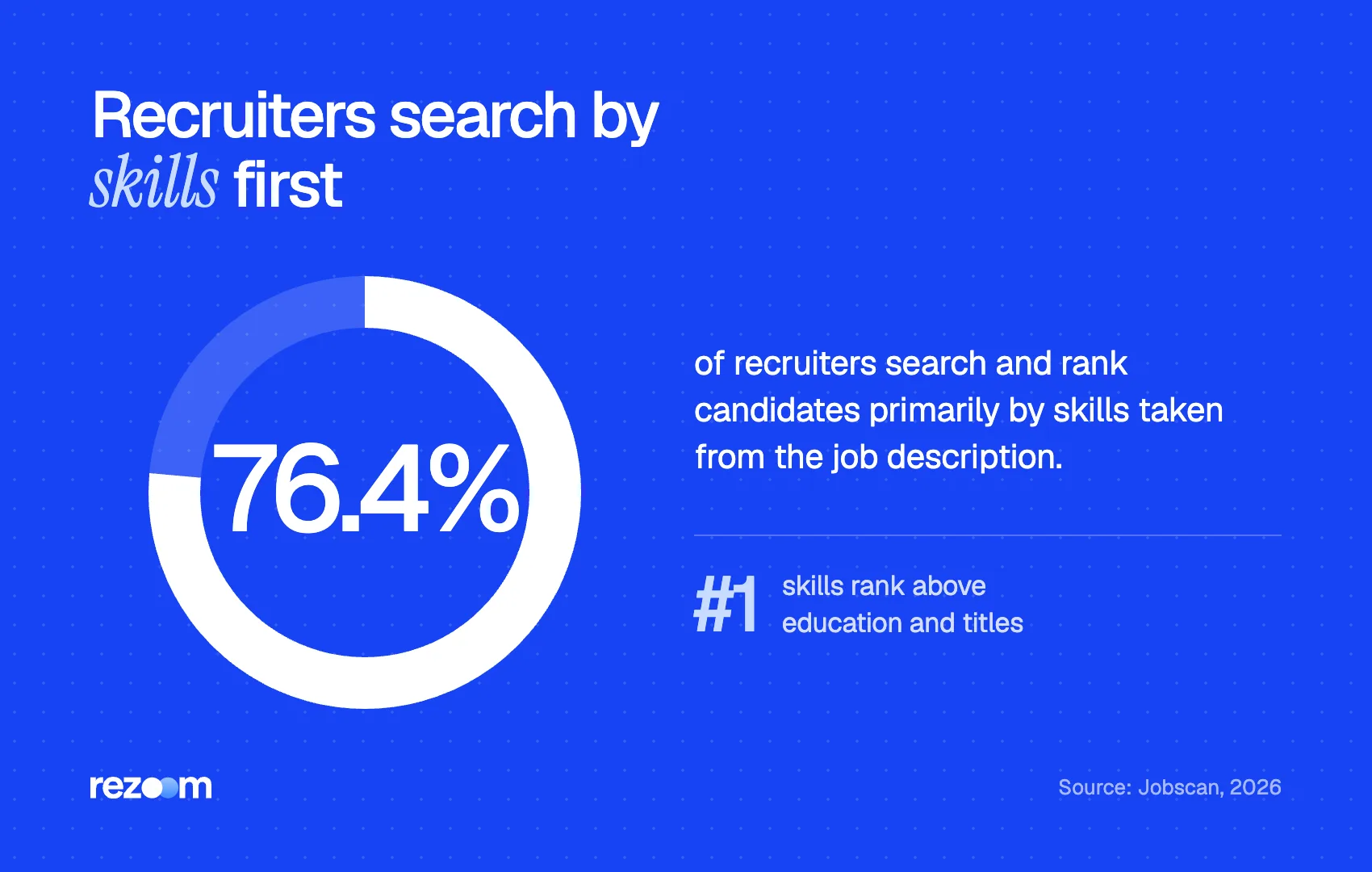
Skills carry the most weight for a good reason. In Jobscan's State of the Job Search research, 76.4% of recruiters said they search and rank candidates primarily by skills taken from the job description. Education, job titles, licenses and experience followed.
So a good ATS score mostly tells you one thing: a recruiter searching for this job's skills would likely find you. Our guide on how ATS works shows where that search happens in the process.
What the score cannot measure is quality. It does not know whether your results are impressive, whether your dates make sense, or whether a hiring manager will like your story. That part is still human.
Do Workday, Greenhouse and other ATSs give you a score?
Not a universal one. Most applicant tracking systems store and search resumes without a built-in 0–100 score. Some employers add AI matching: Workday HiredScore grades candidates A to D, and Greenhouse Talent Matching sorts them into match tiers. Both vendors say these ratings never reject anyone automatically.
Here is what the vendor documentation actually says.
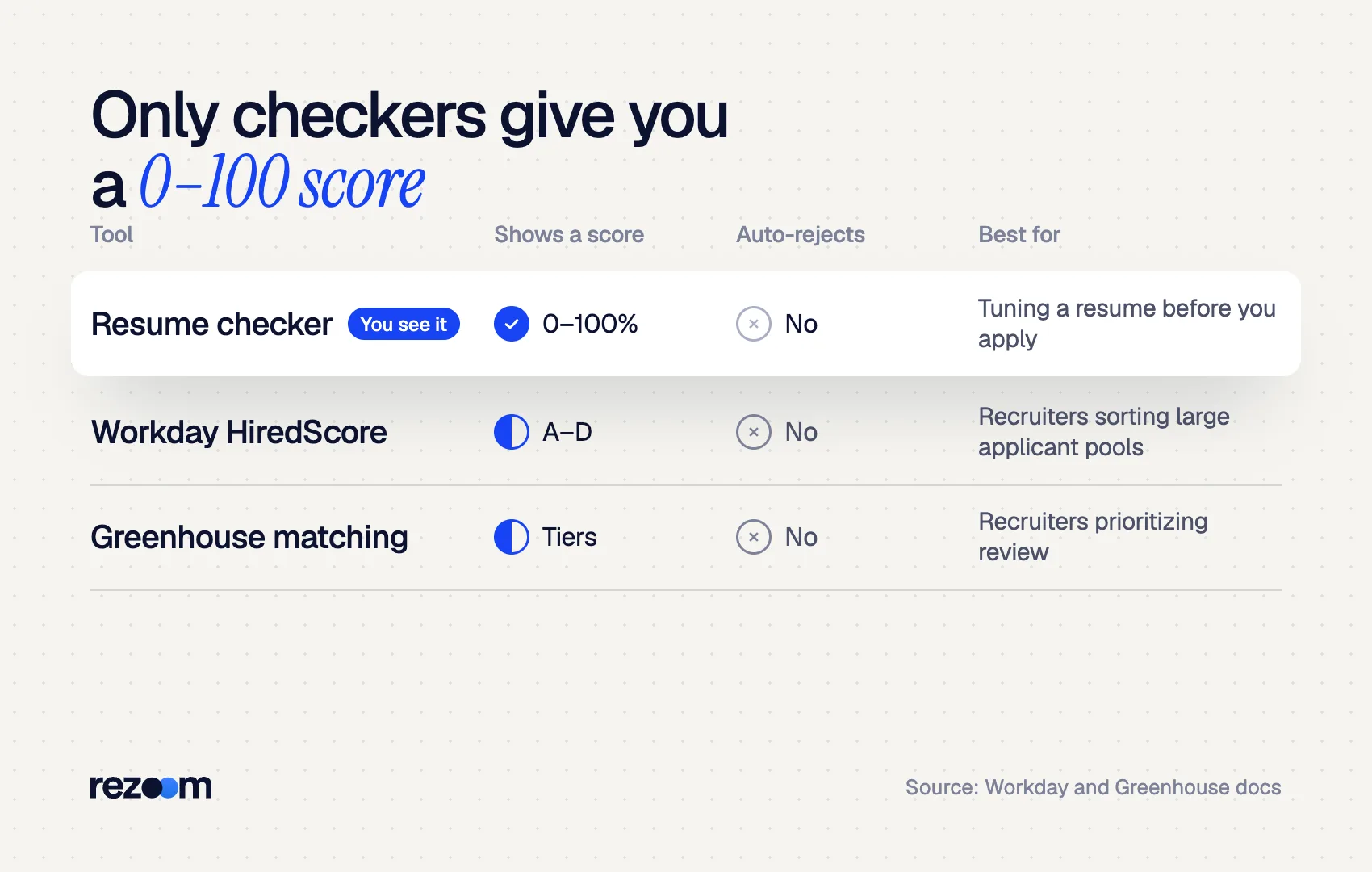
Workday HiredScore uses letter grades, not numbers. Workday's help docs grade candidates "based on how well their resumes match the skills and qualifications specified in the job description." An A means the candidate meets all basic qualifications and most preferred ones. A B means all basic qualifications. The same docs note that C and D candidates "might still be a great fit for the role."
Greenhouse Talent Matching places candidates in tiers: Strong Match, Good Match, Partial Match, Limited Match or "Needs manual review." Its data FAQ states there is "no mechanism that automatically takes action to advance or reject a candidate" based on an AI rating. Greenhouse also says recruiters define and weigh the job criteria themselves.
These tools are optional add-ons, so many employers never turn them on. When they are on, the logic rewards the same things a good ATS score rewards: required skills, relevant titles and clear experience. Our post on the ATS rejection myth covers why "the robot rejected me" is usually the wrong diagnosis.
Why does the same resume get different ATS scores?
Each checker uses its own parser, keyword list and weighting, so one resume can score quite differently on two tools. Scores also change with the job description you paste. Compare scores only within one tool and one posting, and track the change after each edit, not the absolute number.
Three things move the number.
- The tool. Each checker decides which words count as skills and how much titles or formatting matter. There is no shared formula.
- The posting. A short posting with ten skills is easier to match than a long one with forty.
- The parse. If the checker misreads a column or a header, your real content never gets counted.
That third point matters for employer systems too. Workday notes that HiredScore does not grade candidates without resumes or with unsupported file formats. A clean, parseable file is the floor for any score.
Score the change, not the number
Run your resume through one checker, note the score, then make one round of edits and run it again. A jump from 62% to 78% after adding proof for two required skills is meaningful. A gap between two different tools is not.
How do you raise your ATS score without keyword stuffing?
Add the job's required skills and exact job title where you can honestly back them up. Put each key skill in a bullet that shows a result, not only in the skills list. Fix any parsing problems first. Skip hidden text, pasted job descriptions and skills you cannot discuss in an interview.
Start with the job's required qualifications, because both HiredScore grades and recruiter searches lean on them. Our guide to how to find keywords in a job description shows how to pull them out. Then work each missing skill into a real bullet.
Before: Managed weekly reporting for the sales team
After: Built weekly Salesforce pipeline reports in Tableau for a 14-person sales team, cutting forecast prep from 6 hours to 2
Mirror the posting's job title when it truthfully fits your work. Use the posting's exact phrasing for tools and certifications, since search terms are literal.
Customer Success Manager with 5 years in B2B SaaS. Owns a $2.1M renewal book in Gainsight and Salesforce, with 94% gross retention in 2025.
For a full step-by-step method, see our sibling guide on how to tailor your resume to a job description. The resume keywords guide lists skill terms by field.
Fix parsing flags before chasing keyword points do: Add required skills inside bullets with a result do: Use the posting's exact tool and certification names do: Stop editing once you reach about 75% to 85%
Paste the job description in white text dont: List skills you have never used dont: Repeat one keyword five times to push the score up dont: Compare scores across different checkers
When is your ATS score good enough to apply?
Apply once your resume parses cleanly, covers every required qualification you genuinely meet, and scores about 75% or higher on your checker. If you are stuck below 60% after honest edits, the gap is usually your experience, not your wording. That is a signal to rethink fit, not to stuff keywords.
Use this three-part rule before you hit submit.
- It parses. Name, contact details, titles and dates all read correctly in the checker.
- Required skills are covered. Every required qualification you truly meet appears in a bullet or your summary.
- The score sits in range. Roughly 75% to 85% on your tool, and the resume still reads naturally aloud.
Past that point, extra edits have low returns. A recruiter still reads the resume, and a human reviewer can tell when a page was written for software. Our comparison of an ATS resume checker vs a human recruiter explains what each one catches.
The free Rezoom ATS resume checker shows your match against a pasted job description, flags formatting problems and lists missing keywords, so you can see when you have reached a good ATS score and stop.
Frequently asked questions
Is 70 a good ATS score?
It is close. A 70% match usually means one or two required skills or the job title are missing. Add honest proof for those, recheck, and you will often clear 75%.
Is a 100% ATS score possible?
On some checkers, yes, but it is rarely worth chasing. A perfect match usually means the resume repeats the posting word for word, which reads poorly to the recruiter who opens it.
Do recruiters see my ATS score?
Usually not a 0–100 score. Most systems show recruiters a list of applicants they can search and filter. If the employer uses an AI add-on, recruiters may see a letter grade or a match tier instead.
Does a low ATS score mean automatic rejection?
No. Workday and Greenhouse both document that their AI ratings do not reject candidates automatically. Knockout screening questions, such as work authorization, are the more common automatic filter.
What is a good ATS score for a career changer?
Expect a lower score than in your old field, because your past titles will not match. Focus on covering the required skills with transferable examples rather than forcing the old titles to fit.
Do I need a new ATS score for every job?
Yes. A score only measures one resume against one posting. Check it again whenever you apply to a role with a different title or skill list.


Comments