

Summary
Taleo works by turning your application into a structured candidate file, then sorting it with the employer's prescreening questions. Disqualification questions can end an application instantly. Required and asset answers decide whether you are flagged as an ACE candidate, which recruiters review first. Recruiters also run keyword and conceptual searches across your resume text. Your questionnaire answers matter at least as much as your resume layout.
Taleo works by turning your application into a structured candidate file and then sorting it with the employer's own prescreening questions. Your answers to those questions, not your resume design, decide whether you are exited, ranked low, or flagged as a top "ACE" candidate.
Taleo is Oracle's recruiting system. Oracle agreed to buy Taleo for about $1.9 billion in February 2012, and large employers still run their career sites on it.
This guide follows one application through Taleo Enterprise using Oracle's own documentation. It separates what Oracle documents from general ATS advice, so you know which tips are real.
How Taleo works, step by step
Taleo works in four stages. You create a profile and upload or paste a resume. You answer prescreening questions, where a wrong answer to a disqualification question can end the application. The system scores your required and asset answers. Recruiters then review flagged candidates first and search the database by keyword.
Here is the flow Oracle's documentation describes, in the order you experience it.
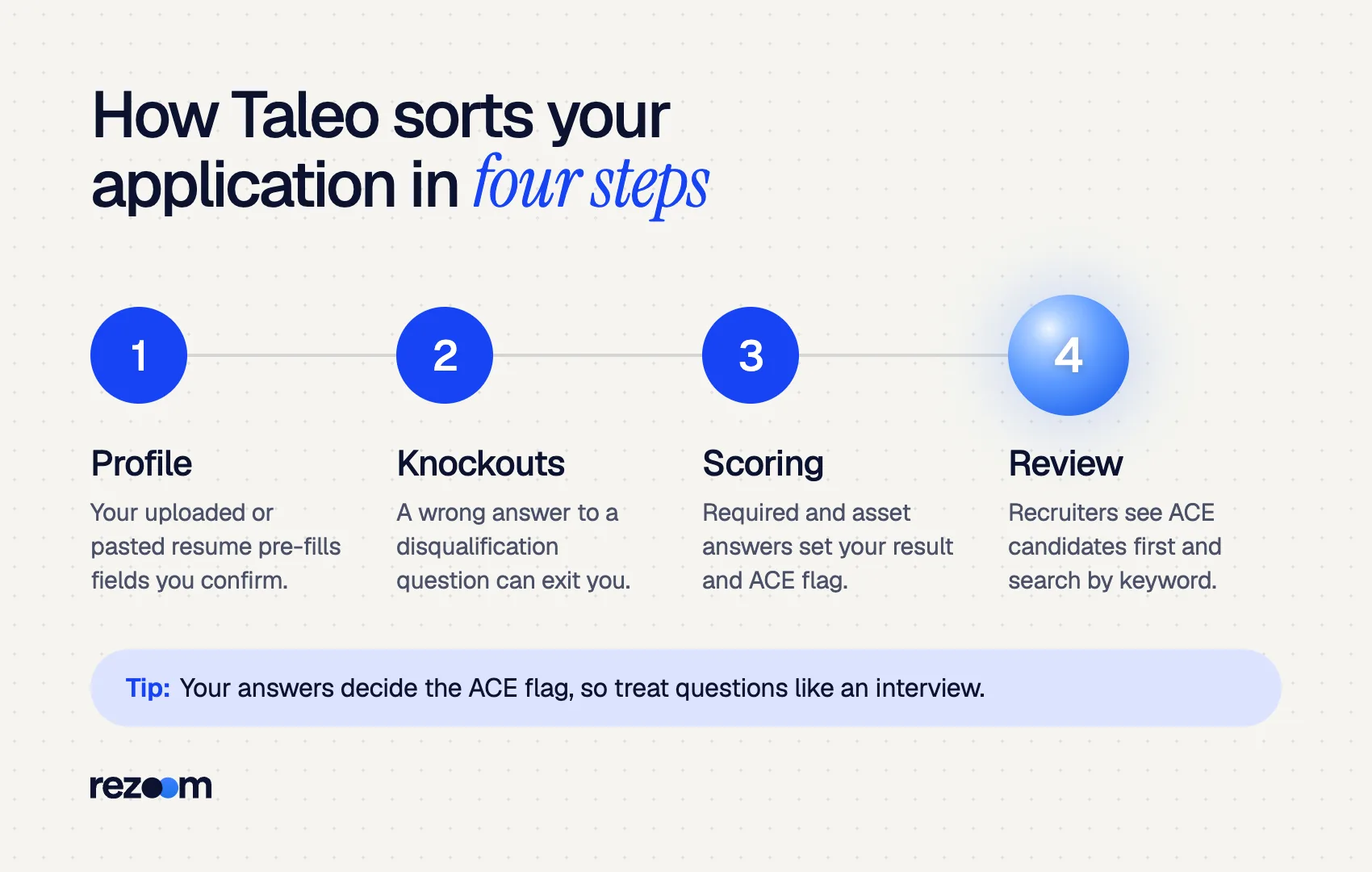
- Profile and resume. You apply through a "career section." The employer can let you upload a file or paste resume text, which Taleo uses to pre-populate application fields. You then confirm or correct those fields.
- Disqualification questions. These hold the minimum requirements. Oracle states that a candidate who misses the required response "can be instantly exited from the application process".
- Required and asset scoring. Your answers to competencies and questions are compared to what the recruiter marked as required or asset.
- Recruiter review and search. Recruiters sort the candidate list by requirements met, assets met and result, and search the wider database.
The rest of this article explains each stage and what you can control.
What are Taleo disqualification questions?
A disqualification question is a single-answer question that holds a minimum requirement, such as work authorization, a license or a required degree. If your answer does not match the required response, Taleo can remove you from the process on the spot. No resume keyword can override that answer.
Oracle defines a disqualification question as "a single-answer question that contains the minimum requirements for a candidate to be eligible for a job". The questions appear on a requisition when their locations and job fields match the job.
This is where most "the ATS rejected me" stories really start. The exit comes from a configured answer, written by the employer, not from a robot judging your resume.
Two practical rules follow. Read every question slowly, because the wording sets the bar. And answer truthfully, since a recruiter will check claims like licenses later anyway. Our piece on the ATS rejection myth covers why "auto-rejection" is usually a human-set rule.
Are you legally authorized to work in the United States? Yes / No
Do you hold an active RN license in Texas? Yes / No
Do you have a bachelor's degree or higher? Yes / No
Are you willing to work rotating weekend shifts? Yes / No
How does Taleo rank candidates with ACE scores?
Recruiters mark each question or competency as required, asset or weighted. Candidates who meet all required criteria and enough assets are flagged as ACE candidates and reviewed first. Candidates who meet only the required criteria are minimally qualified. Candidates who miss required criteria drop to the bottom.
This is the core of how Taleo works for most applicants. Oracle's prescreening guide sorts candidates into three groups:
| Group | What it means in Oracle's guide | What the recruiter does |
|---|---|---|
| ACE candidates | Meet all required criteria and some asset criteria | Consider first |
| Minimally qualified | Meet all required criteria, no asset criteria | Consider after ACE candidates |
| Other candidates | Do not meet required criteria | Do not consider |
Recruiters can also add weight to answers. Oracle calls weight an optional "third level filter," and the system normalizes the points to 100% across the questionnaire. That percentage becomes your "result."
The recruiter then sets the ACE threshold. According to Oracle's ACE flagging steps, it can be a minimum result percentage, a minimum number of assets, or both. ACE candidates get a star icon, and recruiters can be emailed a PDF of their files.
How strict is that bar? It varies by employer. Temple University's Taleo guide for its hiring teams suggests aiming for 15% or more ACE candidates on hard-to-fill roles, 10 to 15% on average roles and 5 to 10% on easy-to-fill roles.
Treat asset questions like interview answers
Asset questions are where you move from "minimally qualified" to ACE. When a question asks about proficiency or years with a skill, pick the honest level you can defend in an interview. Temple's guide reminds hiring teams that years do not equal proficiency, so the two are often asked separately.
Does Taleo read your resume or just your answers?
Both, but in different ways. The ACE flag comes from your answers to required and asset questions and competencies. Your resume text is parsed into fields and stays searchable, so recruiters can find you through keyword or conceptual search across your pasted resume and up to three attachments.
Oracle is clear that ACE candidates are identified from responses to the competencies and questions in the requisition. So a beautiful resume cannot earn an ACE flag on its own.
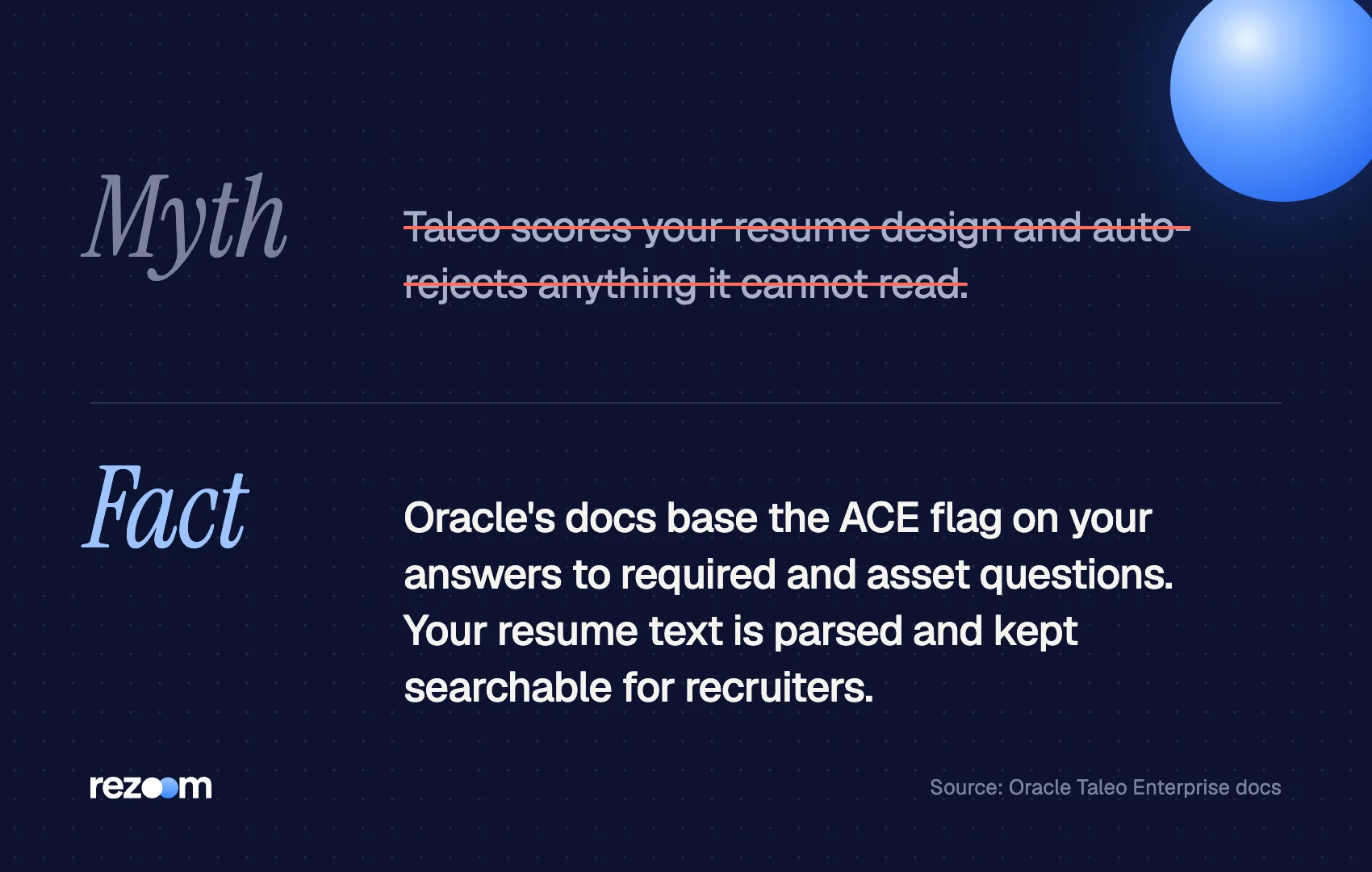
Your resume still matters for search. Taleo's Conceptual Search scans the pasted resume, work history, text answers and the last three attachments in formats including .doc, .docx, .pdf, .rtf and .txt. Results are sorted by relevancy to the text the recruiter enters.
Recruiters can also use Advanced Search, which combines keywords with structured fields like prescreening answers and skills. That is why the exact job title and skill terms from the posting belong in your resume. Our guide to resume keywords shows how to pick them.
What Oracle does not publish is how its parser handles every layout. So treat formatting advice as general ATS practice: a single column, standard headings and real text, not images. Our explainer on how ATS software works and today's guide to ATS resume format cover those basics.
Logistics Coordinator | Midwest Freight Co. | 03/2022 – Present
- Scheduled 120+ weekly shipments in SAP TM across 14 carriers, 98% on time
- Skills: SAP TM, Excel (VLOOKUP, pivot tables), carrier management, OSHA 10
How should you fill out a Taleo application?
Upload a clean, single-column PDF or Word file, then check every field Taleo pre-fills. Answer disqualification questions exactly and truthfully. Choose honest, specific levels on asset questions. Use the job title and skill terms from the posting in your resume, because recruiters search that text later.
Because Taleo works from both structured answers and resume text, you need to get both right. Use this order.
- Check the pre-filled fields. Fix job titles, employers and dates before you continue. Today's guide on how to write dates on a resume shows formats that read cleanly.
- Answer every question in full. Skipped or vague answers can cost you required or asset points.
- Match titles to the posting. If your official title differs, our guide to job title vs actual title explains how to show both honestly.
- Save your answers. Taleo pulls questions from an employer's shared library, so the same questions can repeat across jobs, so keep a document of your answers.
Read each disqualification question twice before answering do: Correct every field Taleo pre-fills from your resume do: Use the exact job title and core skills from the posting do: Keep a saved copy of your questionnaire answers for the next application
Inflate a required answer to get past the screen dont: Leave asset questions blank or pick "none" when you have the skill dont: Put key details only in headers, text boxes or images
Before you submit, run your file through the Rezoom ATS resume checker. It flags missing keywords and layout problems that make parsed fields harder to fix.
Is Taleo being replaced by Oracle Recruiting?
Oracle is moving customers toward Oracle Recruiting, part of Oracle Cloud HCM, and promotes the switch on its own site. It has not published a public retirement date for Taleo. Many employers still use Taleo, while others have moved, so you may meet either system.
Oracle runs a dedicated page for Taleo customers moving to Oracle Recruiting. It says customers who moved are "sourcing better quality candidates," and it highlights AI-powered tools and personalized career sites. The page gives no end date for Taleo.
For you as an applicant, the difference is mostly the screens. Oracle Recruiting uses a newer candidate experience, but the advice is the same: answer screening questions carefully and use the posting's language. If you apply at large employers, you will also meet Workday and SuccessFactors, which follow similar logic.

Frequently asked questions
Does Taleo automatically reject resumes?
Not on resume content alone. Oracle documents automatic exits through disqualification questions, which the employer configures. Other candidates are ranked and reviewed by a recruiter.
What is an ACE candidate in Taleo?
An ACE candidate meets all required criteria plus a set number of assets or a minimum result percentage. Recruiters see a star icon and usually review these candidates first.
Can I upload a PDF resume to Taleo?
Yes. Oracle lists .pdf among the attachment formats its Conceptual Search reads, alongside .doc, .docx, .rtf and .txt. Check the pre-filled fields after upload. See today's guide on [whether ATS can read a PDF](https://rezoom.io/does-ats-read-pdf/).
Why does Taleo ask me to retype my resume?
Taleo pre-fills fields from your file, but parsing is not perfect. Correcting those fields keeps your candidate file accurate for searches and screening.
Can I see my Taleo score?
Not usually. Oracle documents the result and ACE flag as recruiter-side tools, so candidates typically see only a status such as "under consideration." Our guide to [application status meanings](https://rezoom.io/application-status-meanings/) explains the common labels.
Is Taleo still used in 2026?
Yes. Oracle still promotes a migration path to Oracle Recruiting and gives no public end date, so many employers continue to run Taleo career sites.



Comments