

Summary
The best answer to "What is your management style?" describes how you actually run a team each week: how you set goals, hold 1:1s, delegate, give feedback and handle underperformance. Name your approach in one sentence, walk through two or three of those habits, and close with a result. Hiring teams probe this because managers shape most of a team's engagement, so concrete routines beat style labels.
When an interviewer asks "What is your management style?", they want to know how your team's week actually runs under you. Describe your management style through habits: how you set goals, run 1:1s, delegate, give feedback and deal with poor performance. Then prove it with one result.
Labels like "democratic" or "hands-off" are a start, not an answer. Hiring managers have heard them all. What they cannot fake-check is a routine: "Every Monday I…" sounds like someone who has done the job.
This guide is for current managers and people interviewing for their first manager role. If you have no direct reports, start with our guide to what is your leadership style, which covers influence without a title.
Why do companies care so much about management style?
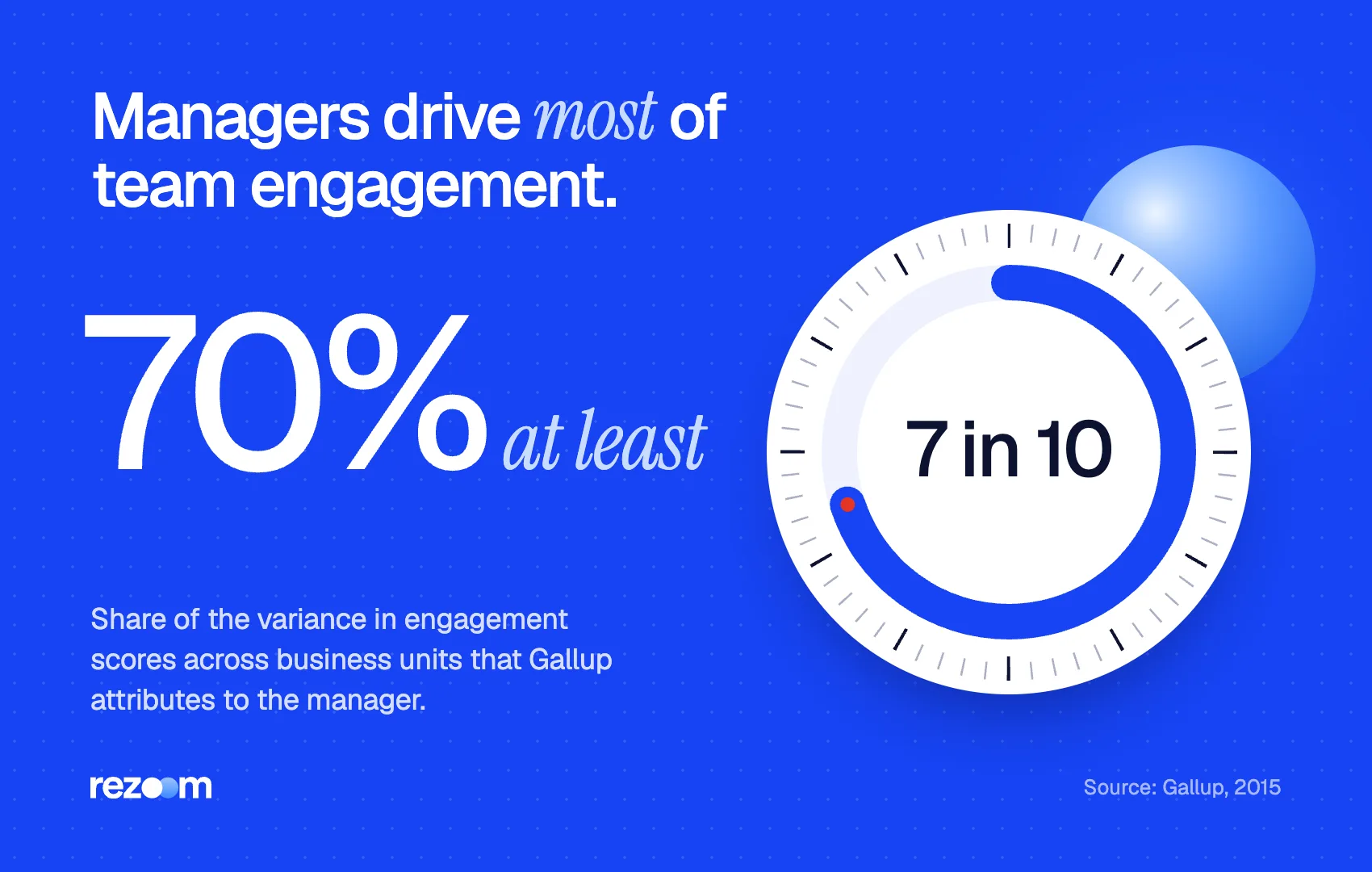
Because managers drive team engagement. Gallup estimates managers account for at least 70% of the variance in engagement scores across business units. Companies that hire the wrong manager feel it in turnover, morale and output, so the interviewer is checking your daily habits, not your vocabulary.
The data behind this question is strong. Gallup found that managers account for at least 70% of the variance in employee engagement scores across business units. The same research says companies miss on high managerial talent in 82% of hiring decisions.
Managers themselves are under strain. Gallup's latest State of the Global Workplace report puts manager engagement at 22% in 2025, down from 27% in 2024. Global employee engagement sits at 20%.
Workers notice the difference. In a 2024 SHRM study, 80% of workers with highly effective managers felt valued, versus 35% of workers whose managers were not highly effective. That is the gap an interviewer is trying to avoid hiring into.
What does "management style" mean in an interview?
Think of it as five levers. Interviewers listen for at least two or three of them.
| Lever | What they want to hear | Weak answer | Strong answer |
|---|---|---|---|
| Goals | How the team knows what matters | "I keep everyone aligned." | "Each quarter we agree on 3 goals and review them weekly." |
| 1:1s | Your cadence and agenda | "My door is always open." | "Weekly 30-minute 1:1s, their agenda first." |
| Delegation | How you hand off ownership | "I trust my team." | "I delegate outcomes with a check-in date, not tasks." |
| Feedback | How fast and how specific | "I give feedback in reviews." | "Same-week feedback, recognition in public, fixes in private." |
| Performance problems | How you act when it's not working | "I avoid micromanaging." | "Clear expectation, written plan, two-week check-ins." |
Gallup's research supports the 1:1 lever. It found that 80% of employees who got meaningful feedback in the past week were fully engaged. Short, frequent 15-to-30-minute conversations beat longer, rarer ones. Recognition ranked as the most meaningful topic, while discussing weaknesses ranked least.
How do you answer "What is your management style?"
- Headline. "My management style is coaching-first with clear goals."
- Habits. Two or three routines from the table above, with specifics.
- Result. Retention, a promotion, a target hit, a project shipped.
- Adaptation (optional). How you manage a new hire differently from a veteran.
Headline: "My management style is coaching-first, with very clear goals."
Habits: "Every quarter my team agrees on three priorities. I hold weekly 30-minute 1:1s where they set the agenda, and I delegate whole projects with a check-in date."
Result: "Over two years, I promoted two analysts to senior and kept the team fully staffed."
Adaptation: "New hires get more structure for their first 60 days."
Expect follow-ups such as "Tell me about a time you managed an underperformer." Prepare one STAR story for that, and one for a conflict on your team.
Bring your 1:1 template
Describe your actual 1:1 agenda in one breath: "wins, blockers, one growth topic." Concrete structure is the fastest way to sound like an experienced manager, and it invites a good follow-up conversation.
Management style sample answers by situation
Good sample answers sound like a week in your team's life. The examples below cover first-time managers, senior managers, remote team leads and specific functions such as sales, engineering and nursing. Each names a management style, gives two or three habits and ends with a result you should replace with your own numbers.
All numbers here are examples. Swap in yours.
1. First-time manager (promoted from the team) "I'm new to managing, so my management style is structured coaching. I've led our onboarding for a year and ran weekly check-ins with three new hires. When I manage the team, I'll keep weekly 1:1s, set three quarterly goals together and give feedback the same week. Two of the people I onboarded now train others."
2. First-time manager candidate (external hire) "I'd describe my approach as collaborative with clear ownership. As project lead, I split work by owner and deadline, then reviewed progress every Friday. We shipped two weeks early. As a manager, I'd keep that rhythm and add weekly 1:1s focused on each person's growth."
3. Senior manager (managing managers) "My style is to set direction and build managers. Each quarter, I align my four leads on goals and metrics. My 1:1s with them are coaching sessions on their teams, not status updates. I also hold skip-levels monthly. Last year, two of my leads were promoted and team attrition fell below the company average."
4. Remote team lead (distributed team) "I manage remotely by writing things down. Goals, decisions and owners live in one shared doc. I hold weekly video 1:1s and one short team call, and everything else is async. I recognize wins in our team channel. Across four time zones, we haven't missed a sprint commitment in two quarters."
"I name the gap privately and specifically, agree on two measurable goals, and check in every two weeks. I also ask what's getting in the way. Last year that plan turned a struggling rep into a steady performer within one quarter."
5. Sales manager (metrics-driven) "I'm transparent and numbers-driven, but I coach on behaviors, not just quota. Every rep sees the same pipeline dashboard. In 1:1s, we pick one call to review together. Our team reached its annual target two months early."
6. Engineering manager (delegation-heavy) "I delegate outcomes, not tasks. Senior engineers own projects end to end, and I protect their focus time. I hold weekly 1:1s and quarterly career talks. I step in on hiring, priorities and blockers. We cut our release cycle from monthly to weekly."
7. Nurse manager (safety and support) "My management style is supportive but firm on safety. I round with staff daily, and every shift huddle starts with one safety item. I schedule fairly and listen to complaints within the week. Our unit's turnover dropped over 18 months."
Describe specific weekly routines do: Mention how you handle poor performance do: Show how you develop people, not only deliver work do: Adapt to new hires versus veterans
Say "I'm hands-off" with no structure behind it dont: Say "My door is always open" as your whole answer dont: Criticize your current or past manager dont: Claim you have never had a performance problem
How do you align your management style with the company culture?
Research how the company works, then emphasize the habits that fit without inventing a new management style. A fast startup wants decisive delegation, a regulated firm wants process and documentation, and a remote company wants async communication. Ask the interviewer how managers run 1:1s and goals there, then connect your routines to that answer.
Start with the job post, the careers page and employee reviews. Our guide on what do you know about our company shows where to look.
Then use the interview itself. Ask, "How do managers here set goals and run 1:1s?" It shows maturity and lets you connect your habits to their system. Our list of questions to ask in an interview has more like it.
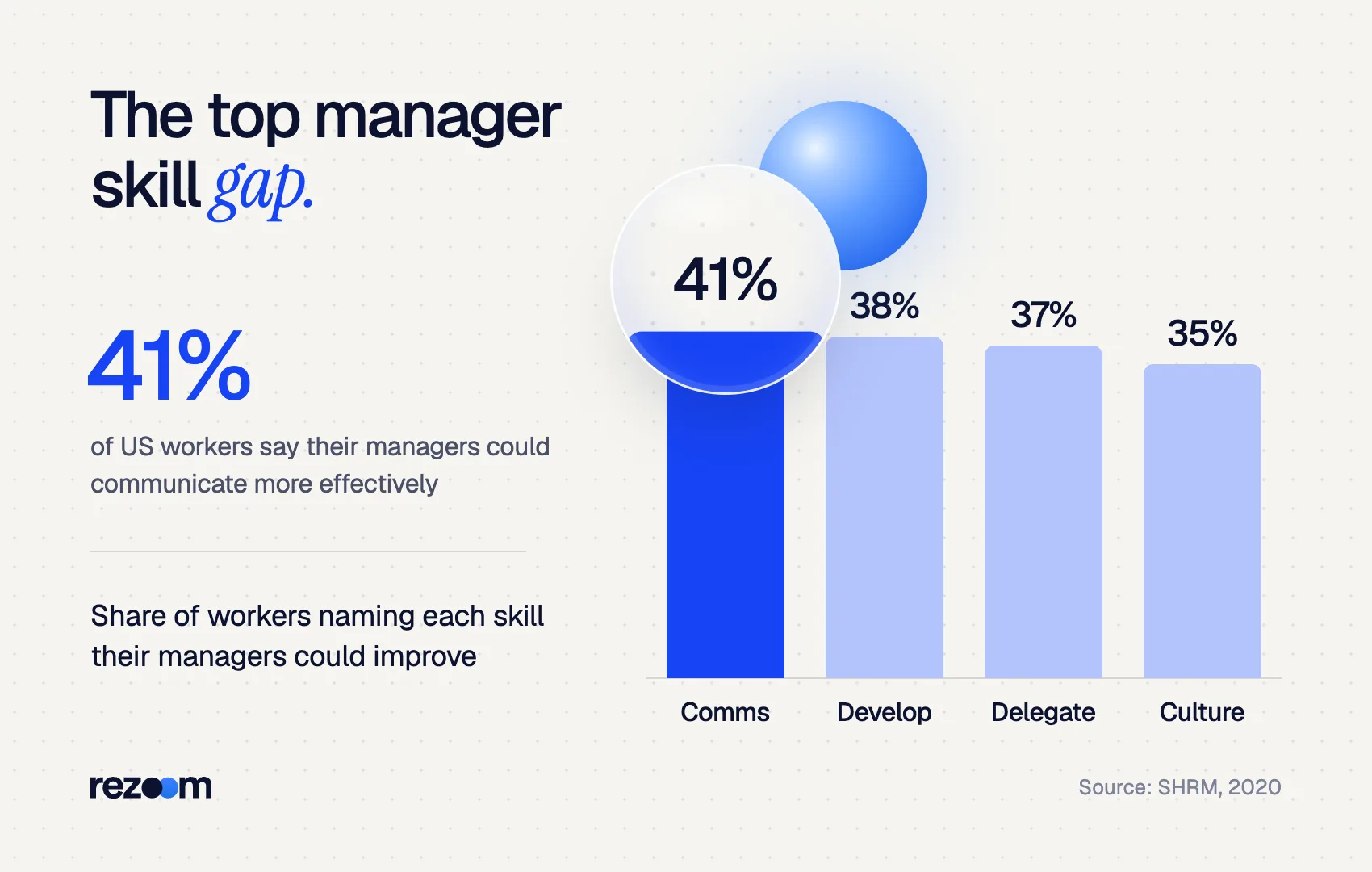
Know where managers usually fall short, too. In a 2020 SHRM survey, workers named communicating effectively (41%), developing the team (38%), and managing time and delegating (37%) as the top skills their managers could improve. If your answer covers those three, you address the most common weak spots.
Want to rehearse with follow-ups? Rezoom's AI mock interview runs manager-level questions and flags vague answers. In a final-round interview, expect this question from a senior leader, so keep a 30-second version ready.

Frequently asked questions
What is the best management style to describe in an interview?
The one your routines prove. Coaching with clear goals is a safe, honest default for many managers, but it must come with real habits and a result.
What if I have never managed anyone?
Use project, onboarding or mentoring experience, and say how you would run 1:1s and goals. Be upfront that it would be your first direct-report role.
How is management style different from leadership style?
Management style is how you run the team's work and people week to week. Leadership style is how you influence and motivate, with or without authority.
Should I mention micromanaging?
Only to show balance. Say how much structure you give new hires and when you step back, rather than declaring "I'm not a micromanager."
How long should my answer be?
About 90 seconds to two minutes. Lead with the headline so the interviewer can follow up on the habit they care about.
How do I describe managing a remote team?
Mention written goals, a fixed 1:1 cadence, async updates and visible recognition. Give one result that proves the system works across locations.



Comments