

Summary
To answer "What is your leadership style?", name one style in plain words, prove it with a short story, give the result, and show you adjust when the situation changes. You do not need a manager title. Interviewers ask everyone this because leadership includes influencing peers, running a project and setting an example. Pick the style your past behavior already shows, not the one that sounds best, and keep the answer to about 60 to 90 seconds.
When an interviewer asks "What is your leadership style?", they want one clear label, one real story that proves it, and proof that you can flex. The best answer names your leadership style in a sentence, backs it with a result, and ends with how you adapt. You do not need a manager title to give that answer.
This question shows up for interns, engineers, nurses and directors alike. It tests self-awareness more than seniority. Below you will find the main named styles, a way to pick yours, a four-part formula and eight sample answers, including several from people who never managed anyone.
If you are interviewing for a people-manager role, read this together with our guide to what is your management style. That question is about running a team day to day. This one is about how you influence people.
Why do interviewers ask "What is your leadership style?"
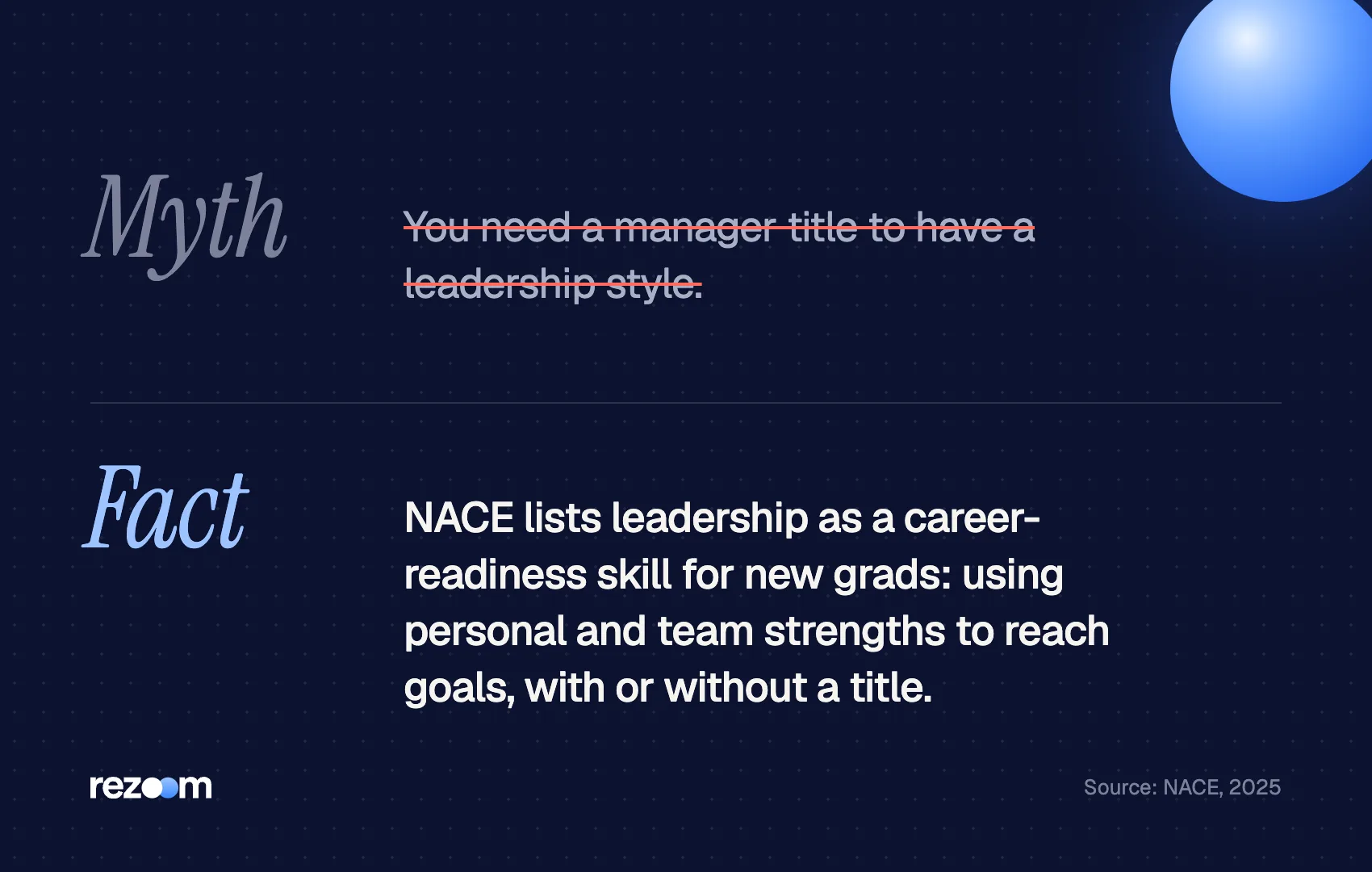
Leadership is not reserved for bosses. The National Association of Colleges and Employers lists leadership as a core career-readiness competency and defines it as the ability to "recognize and capitalize on personal and team strengths to achieve organizational goals." That definition fits a new grad running a class project as well as a VP.
So the interviewer is checking three things:
- Self-awareness. Can you describe how you actually behave?
- Evidence. Can you point to a real moment that proves it?
- Fit. Will your approach work with this team, this pace and this culture?
The question often sits next to behavioral interview questions such as "Tell me about a time you led a project." Prepare one story that can answer both.
What are the main leadership styles?
The best-known frameworks are Goleman's six styles (coercive, authoritative, affiliative, democratic, pacesetting, coaching), transformational leadership, servant leadership and situational leadership. You do not need to quote theory in an interview. Use these names as vocabulary to describe what you already do, then prove it with a story.
You do not need to cite a textbook. Still, knowing the real names helps you describe yourself precisely instead of saying "I'm a people person."
In a classic Harvard Business Review article, Daniel Goleman described six leadership styles drawn from research on more than 3,000 executives. He also found that the best leaders "use most of the styles in any given week." That line is your permission to say you flex.
| Style | What it looks like | Good interview phrasing |
|---|---|---|
| Authoritative (Goleman) | Rallies people around a shared vision | "I make sure everyone knows where we're heading and why." |
| Democratic (Goleman) | Builds consensus by involving people | "I gather input before big decisions." |
| Coaching (Goleman) | Develops people for the future | "I invest in helping teammates grow." |
| Affiliative (Goleman) | Builds harmony and trust | "I focus on trust first, especially in new teams." |
| Pacesetting (Goleman) | Sets high standards, expects self-direction | Use carefully; pair with support. |
| Coercive (Goleman) | Demands immediate compliance | Only for true emergencies; never your headline. |
| Transformational | Inspires change, encourages new ideas, invests in each person | "I connect daily work to a bigger goal." |
| Servant | Puts the team's growth and well-being first | "My job is to remove blockers for others." |
| Situational | Adjusts direction and support to each person's readiness | "I adjust how much I direct based on experience." |
Three of these come from outside Goleman's model. Transformational leadership traces to James MacGregor Burns's 1978 book and was extended by Bernard Bass, who described four components: idealized influence, inspirational motivation, intellectual stimulation and individualized consideration. Servant leadership comes from Robert Greenleaf, whose best test is: "Do those served grow as persons?" Situational Leadership, developed by Paul Hersey in 1969, moves through four styles: directing, coaching, collaborating and empowering.
How do you figure out your own leadership style?
Look at evidence, not aspiration. List three times you got people moving toward a goal, note what you did in each, and find the pattern. Then check it against feedback you have received. The style that shows up in all three stories is your leadership style for the interview.
Most candidates pick the style that sounds best. Interviewers notice, because the story then fails to match the label. Work backward instead.
- List three moments you led. A shift, a group project, a launch, a volunteer event, a code migration.
- Write what you did first. Did you set the goal, ask for ideas, coach someone or take a task off someone's plate?
- Find the repeat. If you asked for input in all three, you lean democratic. If you kept teaching, you lean coaching.
- Check against feedback. Performance reviews and peer comments are honest mirrors.
Pick a primary and a backup
Name one primary style and one you switch to under pressure. "Mostly coaching, but directive when a deadline is at risk" sounds real. Claiming every style at once sounds rehearsed.
How do you answer "What is your leadership style?"
The formula fits inside the STAR method, but it is shorter and opens with the label.
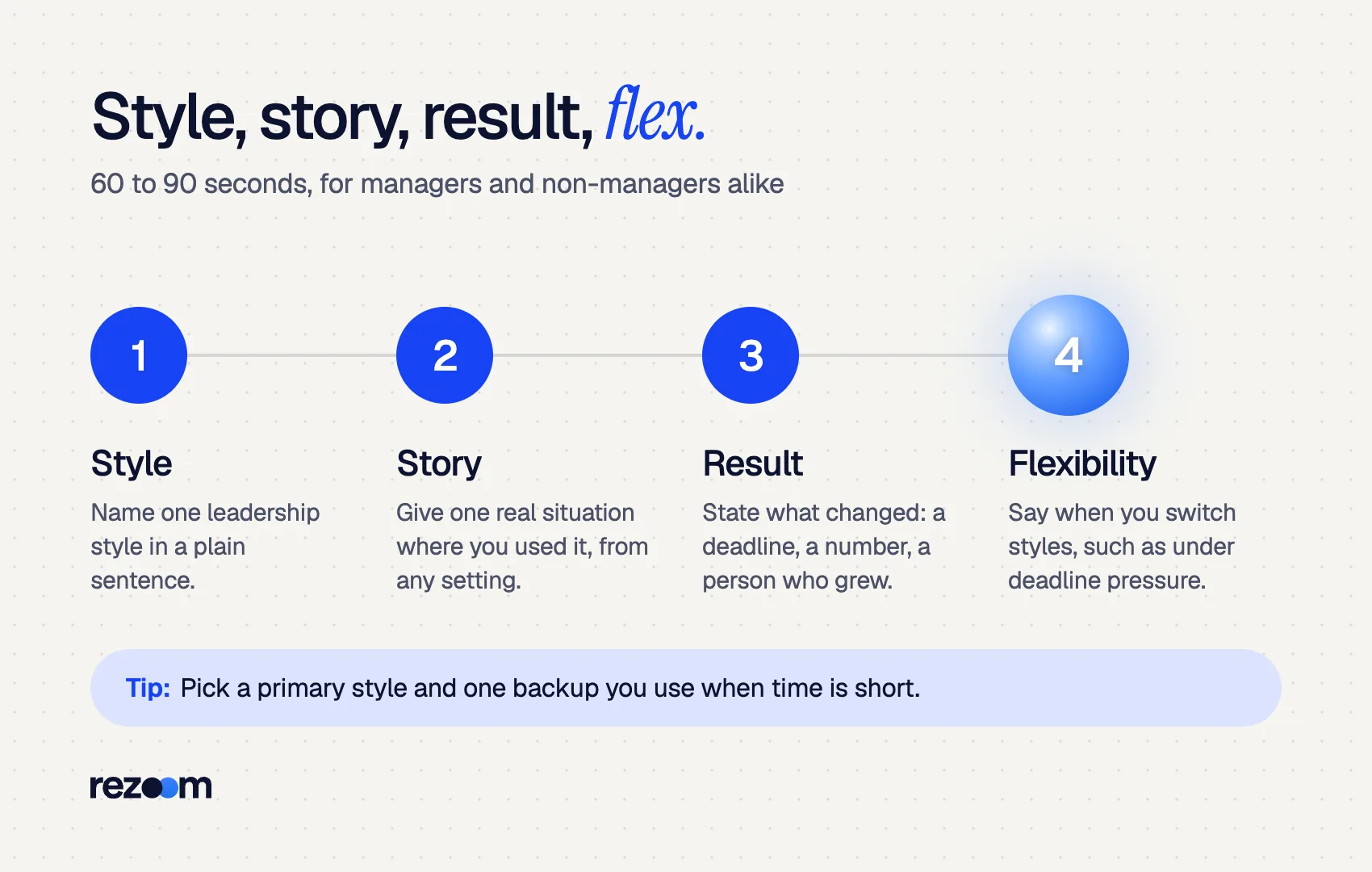
- Style. One sentence in plain words. "I'd describe my leadership style as coaching."
- Story. One situation where you used it. Keep the setup brief.
- Result. What changed: a number, a deadline met, a person promoted.
- Flexibility. When you switch styles and why.
Style: "My leadership style is mostly democratic. I get input before big calls."
Story: "On our capstone team, we were split on the research method, so I ran a 20-minute vote with pros and cons."
Result: "We committed in one meeting instead of three and finished a week early."
Flexibility: "When time is short, I'll make the call myself and explain why."
Name one leadership style and back it with one story do: Use examples from school, volunteering or shifts if you have no title do: Give a result, even a small one do: Show when you switch styles
Say "I don't really lead" or "I'm a natural leader" dont: List every style in Goleman's model dont: Lead with coercive or "my way or the highway" dont: Use the same story you plan for every other question
Leadership style sample answers for every level
Strong sample answers name a leadership style, prove it with a specific story and end with how the speaker adapts. The eight examples below cover new grads, individual contributors, frontline workers and managers. Several come from people with no formal title, showing that influence, not rank, is what interviewers want to hear about.
Adapt these to your own facts. Every number below is an example, so replace it with yours.
1. New grad, no work leadership (democratic) "I'd describe my leadership style as democratic. In my senior design project, our five-person team stalled on scope. I set up a shared doc where everyone ranked features, and we cut to the top three. We delivered on time and got the department's top grade. When a decision is urgent, though, I'll make the call and explain it."
2. Software engineer, no direct reports (coaching) "I lead mostly by coaching. When two junior engineers joined, I paired with each for an hour a week and turned my code review comments into short guides. Within two months, both were shipping features without my sign-off. If production is down, I switch to directing and assign tasks quickly."
3. Retail shift lead, no manager title (leading by example) "I lead by example. During holiday rush, I take the hardest register line first so the team sees I'm in it with them. Our store hit its weekend target for six straight weeks. With new hires, I slow down and show each step instead."
4. Charge nurse (situational) "My style is situational. With a new graduate nurse, I'm directive and check in every hour. With a 10-year nurse, I step back and stay available. That balance helped our unit onboard four new nurses in one quarter without missed handoffs."
"My leadership style is coaching. I help people get better at the work, like when I trained two new hires on our CRM and both hit quota in their second month. Under deadline pressure, I get more directive."
5. Customer support senior rep (servant) "I see my job as removing blockers for others, which is servant leadership. I noticed our team kept escalating the same billing issue, so I wrote a fix guide and got finance to approve a refund shortcut. Escalations on that issue dropped by half. I'm direct when a customer issue needs a fast owner."
6. Marketing team lead (transformational) "I'd call it transformational. When our team felt like a ticket queue, I tied each campaign to a quarterly growth goal and invited people to pitch tests. Two of those tests became our best-performing channels. On routine work, I stay hands-off."
7. Volunteer coordinator, career changer (affiliative) "I lead by building trust first. As a volunteer coordinator, I met each new volunteer for coffee before their first shift. Our six-month retention went from about half to most of the group. When an event day goes sideways, I give clear, fast instructions."
8. Experienced manager (authoritative, flexible) "My default is authoritative in Goleman's sense: I set a clear direction and give people freedom in how they get there. During a platform migration, I shared one goal and three guardrails, and the team chose its own plan. We cut over a week early. With a struggling team member, I shift to coaching."
Need practice saying these aloud? Rezoom's AI mock interview asks leadership and follow-up questions and scores how clearly your story lands.
How do you match your leadership style to the job?
Read the job post and company pages for words like "ownership," "collaborative" or "fast-paced," then lead with the side of your leadership style that fits. Do not invent a new style. Choose which true story to tell, and mention the flexibility that matters most for that team.
Matching is about emphasis, not reinvention. A startup that says "bias for action" wants to hear when you decide fast. A hospital that stresses safety wants to hear structure and checklists.
- Research first. Our guide on what do you know about our company shows how to find values worth echoing.
- Pick the story that fits. Same style, different example.
- Name the switch. "I'm collaborative, but I'm comfortable deciding quickly" covers a fast culture.
In panel interviews, expect a follow-up from a different panelist, such as "What would your team say is your weakness as a leader?" Prepare one honest answer.

Frequently asked questions
What if I have never been a leader?
You have, just not with a title. Use a class project, sports team, volunteer role or a time you trained a coworker. Interviewers care about influence, not rank.
Is "lead by example" a leadership style?
It is a fair way to describe your approach, but it is not a named framework. Pair it with a style such as pacesetting or coaching, and tell a story that shows it.
What is the best leadership style to say in an interview?
There is no single best one. Choose the style your stories actually prove, then show you adapt. Goleman's research found strong leaders use most styles in a given week.
How long should my answer be?
Aim for 60 to 90 seconds. That is enough for a one-line style, a short story, a result and a sentence on flexibility.
Is leadership style the same as management style?
No. Leadership style is how you influence and motivate people. Management style is how you run a team day to day. See our [management style guide](https://rezoom.io/what-is-your-management-style/).
Should I say I am an autocratic leader?
Avoid it as a headline. You can say you get directive in emergencies, but lead with a style that shows you involve and develop people.



Comments