Administrative Coordinator Jasleen Dhaliwal
Administrative Coordinator
[email protected] | (613) 555-2262 | Ottawa, ON, Canada
Profile
Administrative coordinator with three years supporting a 40-person consulting practice in Ottawa, covering scheduling, procurement and records for two directors. Rebuilt the contractor onboarding checklist, which cut the average time from signed agreement to first billable day from 11 days to 4. Bilingual in English and French, with a French Government of Canada oral interaction level of B. Eligible to work in Canada.
Work Experience
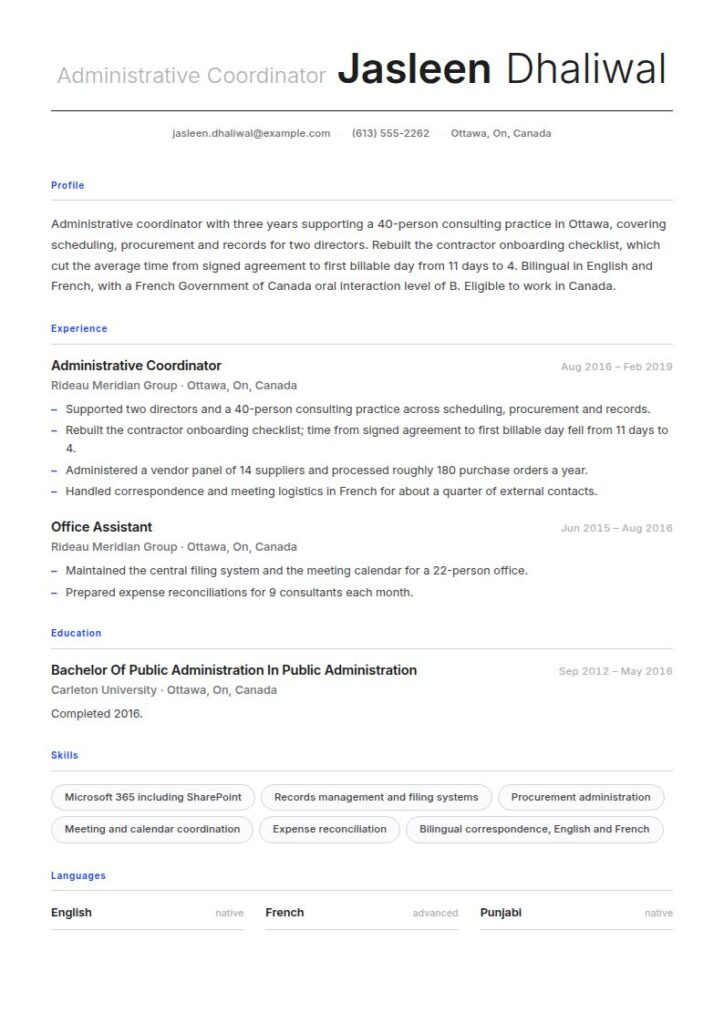
08/2016 - 02/2019, Administrative Coordinator, Rideau Meridian Group, Ottawa, ON, Canada
- Supported two directors and a 40-person consulting practice across scheduling, procurement and records.
- Rebuilt the contractor onboarding checklist; time from signed agreement to first billable day fell from 11 days to 4.
- Administered a vendor panel of 14 suppliers and processed roughly 180 purchase orders a year.
- Handled correspondence and meeting logistics in French for about a quarter of external contacts.
06/2015 - 08/2016, Office Assistant, Rideau Meridian Group, Ottawa, ON, Canada
- Maintained the central filing system and the meeting calendar for a 22-person office.
- Prepared expense reconciliations for 9 consultants each month.
Education
09/2012 - 05/2016, Bachelor of Public Administration, Public Administration, Carleton University, Ottawa, ON, Canada
Completed 2016.
Skills
Microsoft 365 including SharePoint, 85
Records management and filing systems, 75
Procurement administration, 70
Meeting and calendar coordination, 90
Expense reconciliation, 75
Bilingual correspondence, English and French, 80
Languages
English, native
French, advanced
Punjabi, native
Certificates
04/2019, Records and Information Management certificate, Algonquin College
Summary
A Canadian resume is a one or two page document that leaves out the personal details a Canadian employer is not permitted to consider, and matches the occupational language employers and the federal government actually use. This guide gives you three adaptable versions, the prohibited grounds behind the omissions, and current Statistics Canada figures on the Canadian job market.
Canadian Resume Format resume examples by experience level
In short, a Canadian resume is a one or two page reverse chronological document defined as much by what it leaves out as by what it contains.
That is what surprises people arriving from elsewhere. For example, in much of Europe, Latin America and Asia a resume opens with a photograph, a date of birth and a line about marital status. In Canada the law generally does not permit an employer to consider those categories, and volunteering them puts the reader in an awkward position before they have read a line about your work.
Resume guide for a Canadian resume format
To start, this guide and the corresponding Canadian resume example will cover:
- First, how to write a Canadian resume, section by section
- Then, what the document must not contain, and the federal legislation behind that
- Also, three adaptable summaries: coordinator, officer and manager
- How National Occupational Classification codes are used in postings and applications
- Finally, what Statistics Canada says about the Canadian labor market, and why US figures do not apply
How to write a Canadian resume
Five sections: contact header, summary, work experience, education, and skills. Two pages maximum. The Government of Canada Job Bank's resume guidance sets that ceiling and adds that material older than roughly fifteen years should be cut back or dropped (Job Bank, "Write a good resume", jobbank.gc.ca, date modified 30 May 2024, retrieved 17 September 2026).
| Section | What it is answering | Where it goes |
|---|---|---|
| Contact header | How do I reach this person, and are they able to work here? | Top of page one, no photograph |
| Summary | What do they do, and at what level? | Three or four lines under the header |
| Work experience | What have they owned, and what changed? | Reverse chronological, quantified |
| Education | What is the credential, and was it assessed in Canada? | Below experience, with any equivalency assessment named |
| Skills and languages | Which tools, and which official languages? | Grouped and named |
Say you are legally able to work, and say nothing more than that
One line in or just under the header: "Eligible to work in Canada." Or, if it is true and relevant to the posting, "Permanent resident" or "Canadian citizen."
That line answers the only status question an employer needs answered at screening. It costs nothing and removes a common reason a file from an internationally trained applicant is set aside without a reply.
Nothing further belongs there: not your visa category, not your permit expiry, not your country of origin, not your immigration history. The employer's legitimate question is whether they can hire you.
Run the finished file through the ATS resume checker before applying. Canadian employers of any size run applicant tracking systems, and a two-column template with a header block is where parsing breaks.
Choosing the best resume format
As a rule, reverse chronological, one column, one or two pages. In practice, Canadian readers expect chronological by default, and they read the functional format as readers do elsewhere: an attempt to obscure a timeline.
Even so, length is got wrong in both directions. One page is not a Canadian convention the way it is in the United States; two is normal for anyone with more than a few years of history. Job Bank's guidance is two pages maximum with emphasis on recent experience; therefore, the discipline belongs at the far end of the history rather than at the top.
Canadian employers also use resume and CV interchangeably in the private sector, where a CV usually still means a two-page document. By contrast, only university, research and some medical and legal roles call for the long academic CV. When a posting says CV and the employer is not a university, send the two-page resume.
Include your contact information
| ✅ Right | ❌ Wrong |
|---|---|
| Jasleen Dhaliwal | Jasleen Dhaliwal, age 34, married, two children |
| Administrative Officer, Corporate Services | Photograph, date of birth, place of birth |
| Ottawa, ON, (613) 555-2262, [email protected] | Full street address, Social Insurance Number |
| Eligible to work in Canada. English and French. | Passport number, marital status, religion |
Also, city and province is enough for the location line. A Social Insurance Number never belongs on a resume: Job Bank's guidance lists it among the items to leave off, alongside age, height, weight, marital status, religious preference and political views (Job Bank, "Write a good resume", date modified 30 May 2024, retrieved 17 September 2026).
Make use of a summary
Three or four lines: title, years, scope, and one result with a number. Job Bank's guidance advises avoiding personal pronouns, so write the summary in clipped phrases instead of "I" sentences.
Administrative coordinator with three years supporting a 40-person consulting practice in Ottawa, covering scheduling, procurement and records for two directors. Rebuilt the contractor onboarding checklist, which cut the average time from signed agreement to first billable day from 11 days to 4. Bilingual in English and French, with a French Government of Canada oral interaction level of B. Eligible to work in Canada.
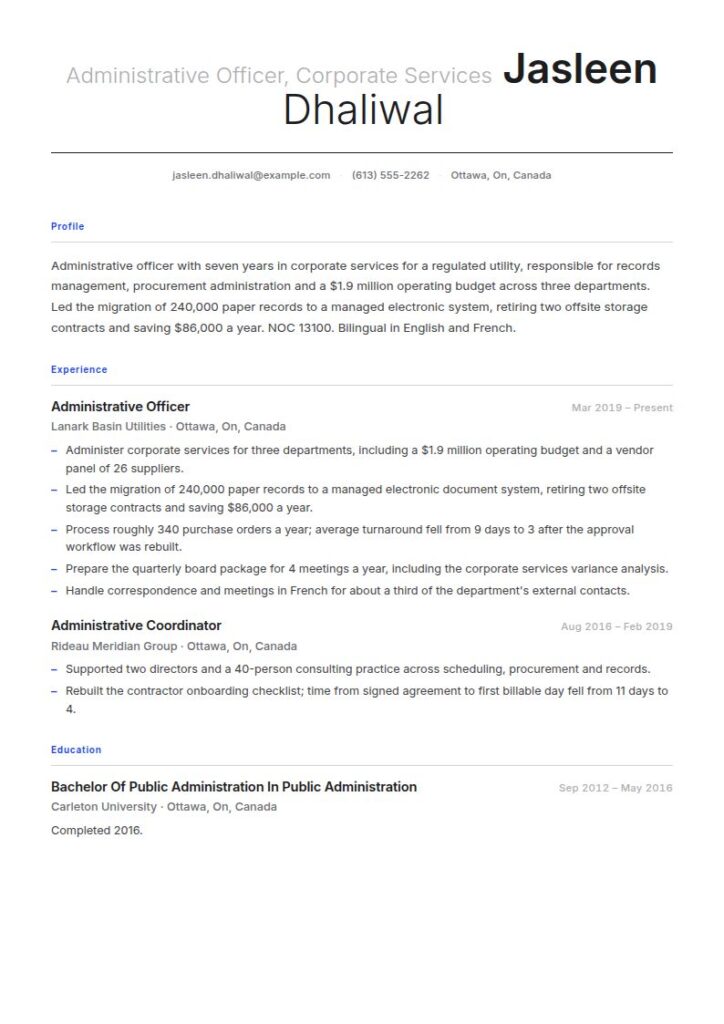
Administrative officer with seven years in corporate services for a regulated utility, responsible for records management, procurement administration and a $1.9 million operating budget across three departments. Led the migration of 240,000 paper records to a managed electronic system, retiring two offsite storage contracts and saving $86,000 a year. NOC 13100. Bilingual in English and French.
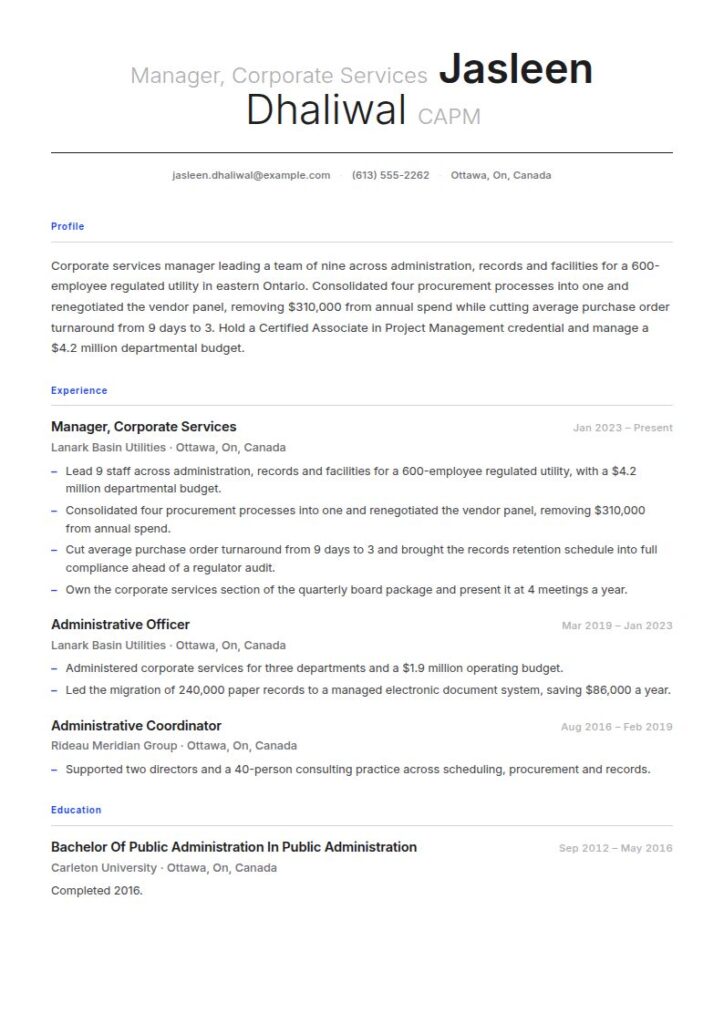
Corporate services manager leading a team of nine across administration, records and facilities for a 600-employee regulated utility in eastern Ontario. Consolidated four procurement processes into one and renegotiated the vendor panel, removing $310,000 from annual spend while cutting average purchase order turnaround from 9 days to 3. Hold a Certified Associate in Project Management credential and manage a $4.2 million departmental budget.
Right vs wrong: the same Canadian resume summary, twice
| ✅ Right | ❌ Wrong |
|---|---|
| Administrative officer with seven years in corporate services for a regulated utility. | I am a 34-year-old married woman with seven years of experience in administration. |
| Responsible for records management, procurement administration and a $1.9 million operating budget across three departments. | I am responsible for many administrative duties and I work very hard. |
| Led the migration of 240,000 paper records to a managed electronic system, saving $86,000 a year. | Photograph, date of birth and nationality in the header block. |
The right column is a resume. Meanwhile, the left column is a personal information form asking the reader to consider things the law tells them to ignore.
Outline your experience
Employer, title, city and province, dates, then three to five bullets. Similarly, Job Bank's guidance is to use action verbs and quantify what you accomplished rather than list duties. That is the standard everywhere, but duty lists remain the most common failure on Canadian applications.
| Instead of | Use |
|---|---|
| Responsible for office administration | Administer corporate services for three departments and a $1.9 million operating budget |
| Managed records | Led the migration of 240,000 paper records to a managed electronic system, retiring two offsite storage contracts |
| Handled procurement | Process 340 purchase orders a year against a vendor panel of 26, with average turnaround cut from 9 days to 3 |
| Supported senior management | Prepare the quarterly board package for 4 meetings a year, including the corporate services variance analysis |
Administrative Officer, Lanark Basin Utilities, Ottawa, ON, March 2019 to present
Administer corporate services for three departments, including a $1.9 million operating budget and a vendor panel of 26 suppliers.
Led the migration of 240,000 paper records to a managed electronic document system, retiring two offsite storage contracts and saving $86,000 a year.
Process roughly 340 purchase orders a year; average turnaround fell from 9 days to 3 after the approval workflow was rebuilt.
Prepare the quarterly board package for 4 meetings a year, and handle correspondence and meetings in French for about a third of the department's external contacts.
Administrative Coordinator, Rideau Meridian Group, Ottawa, ON, August 2016 to February 2019
Supported two directors and a 40-person consulting practice across scheduling, procurement and records.
Rebuilt the contractor onboarding checklist; time from signed agreement to first billable day fell from 11 days to 4.
What a Canadian resume must not contain, and the law behind it
This is what makes a Canadian resume different from the one you may have written at home, and the reason is legislative rather than stylistic.
Section 3(1) of the Canadian Human Rights Act sets out the prohibited grounds of discrimination: race, national or ethnic origin, color, religion, age, sex, sexual orientation, gender identity or expression, marital status, family status, genetic characteristics, disability, and a conviction for which a pardon has been granted or a record suspension ordered (Canadian Human Rights Act, R.S.C. 1985, c. H-6, section 3(1), Justice Laws Website, current to 21 July 2026, last amended 19 August 2024, retrieved 17 September 2026).
In particular, the Act applies to federally regulated employers: the federal public service, banks, airlines, rail and interprovincial trucking, telecommunications and broadcasting. Meanwhile, most other employers fall under their province's or territory's own human rights code, and every one covers substantially the same ground. As a result, the working rule is identical whichever regime applies, which is why one resume works for the whole country.
Personal details to leave off a Canadian resume
Now read that list with a resume in your hand. A photograph discloses race, color, sex, age and sometimes religion in one image. A date of birth discloses age. "Married, two children" discloses marital and family status. Of course, nothing forbids you from mentioning any of it. The law forbids the employer from weighing it, which means a page that volunteers it creates a problem for the reader rather than an advantage for you.
| Leave off | What it discloses | What to write instead |
|---|---|---|
| Photograph | Race, color, sex, age, sometimes religion or disability | Nothing; the space goes to a result |
| Date of birth, age, graduation years from long ago | Age | Recent dates only, with older history compressed |
| Marital status, number of children | Marital and family status | Nothing |
| Social Insurance Number | An identifier collected only after hire | Nothing; it is never a screening field |
| Nationality, place of birth, visa category | National or ethnic origin | "Eligible to work in Canada" |
| Religion, political affiliation, membership of a religious body | Religion, political belief | Only a role's transferable duties, if you list it at all |
| Height, weight, health information | Disability, sex | Nothing |
| A headshot in the file's document properties | The same as a photograph | Clear document metadata before sending |
In addition, two more items belong off the page. Job Bank's guidance says to leave off references, supplied separately when requested, and to leave off your reasons for leaving previous jobs, which is an interview conversation (Job Bank, date modified 30 May 2024, retrieved 17 September 2026).
Federal postings are screened against essential qualifications, not against your resume
If you are applying through GC Jobs, the federal public service portal, the resume is not the screening document. The screening questions are.
The Public Service Commission's guidance tells applicants to apply only if they have every essential qualification on the posting, since asset qualifications are beneficial rather than required, and is explicit about the answers: do not simply state that you have the experience or education, provide details or examples. It recommends structuring each answer as situation, task, action and result, using the exact keywords from the screening question, and writing in the first person, "I" rather than "we" (Public Service Commission of Canada, "Applying for Government of Canada jobs: How to apply", canada.ca, date modified 30 August 2026, retrieved 17 September 2026).
Note the conflict with Job Bank's advice to avoid personal pronouns in a resume. Both are correct in their place: the resume stays in clipped phrases, the screening questions are full first-person sentences. Mixing the two registers is a common failure on federal applications.
Build a snapshot of your key skills
For skills, list eight to twelve entries in three groups: systems, functional skills, and languages. Official language ability belongs here, in specifics, because it is a genuine differentiator in Ottawa, Quebec, New Brunswick and across the federal public service.
Systems: SAP Ariba, Microsoft 365 including SharePoint and Power Automate, OpenText Content Server, Excel with Power Query
Functional: Records management and retention scheduling, Procurement administration, Budget monitoring and variance reporting, Board package preparation, Contract administration
Languages: English (native), French (Government of Canada second language evaluation levels: reading C, writing B, oral interaction B)
Also, if you have federal second language evaluation levels, write the levels rather than "bilingual". After all, a manager filling a bilingual imperative position is matching a stated profile such as BBB or CBC, and "fluent in French" does not answer them.
List your education and certifications
Credential, field, institution, city and province, and the year completed. If you earned the credential outside Canada, name the assessment.
Bachelor of Public Administration, Carleton University, Ottawa, ON, 2016.
Certified Associate in Project Management (CAPM), Project Management Institute, 2021.
Records and Information Management certificate, Algonquin College, Ottawa, ON, 2019.
For internationally earned credentials: name the assessing body and the outcome on the same line, for example "Bachelor of Commerce, assessed as equivalent to a Canadian three-year bachelor's degree, World Education Services, 2024."
The equivalency line matters more than applicants expect. A Canadian reader who cannot place a foreign institution has no way to judge the credential; in contrast, a named assessment converts an unknown into a comparable one. Likewise, provincial regulators run separate processes for licensed professions; name the regulator and your current status where one applies.
Choose the right layout and design
As for layout, one column, one or two pages, 10 or 11 point, clear headings, no photograph, no graphics, no colored sidebars. PDF unless the posting asks for Word or the portal requires plain text.
Keep it to two pages with the emphasis on recent work. Write city and province rather than a street address. State that you are eligible to work in Canada. Give official language ability as levels. Name the assessing body for any credential earned outside Canada. Quantify accomplishments rather than listing duties. Use the posting's NOC title in your header where it fits.
Do not include a photograph, date of birth, age, marital status, family status or Social Insurance Number. Do not list references; supply them when asked. Do not explain why you left previous jobs. Do not use a European-style template with a photograph box, however well designed. Do not paste a federal screening answer into the resume, or a resume phrase into a screening answer.
Canadian job market and outlook
There is no US Bureau of Labor Statistics data on this page, and none would apply if there were. For instance, BLS publishes US employment levels, projections and wages, and it publishes nothing at all for "Canadian resume format", which is a document convention rather than an occupation. Instead, Canadian figures come from Statistics Canada's Labor Force Survey, released monthly.
| Measure, Canada | Value |
|---|---|
| Employment change, August 2026 | Down 42,000 (0.2 percent) |
| Employment change, year over year to August 2026 | Up 217,000 (1.0 percent) |
| Unemployment rate, August 2026 | 6.4 percent |
| Employment rate, August 2026 | 60.8 percent |
| Participation rate, August 2026 | 65.0 percent |
| Unemployment rate, youth aged 15 to 24 | 12.9 percent |
| Average hourly wages, August 2026 | $37.02, up 2.0 percent year over year |
Source: Statistics Canada, Labor Force Survey, August 2026, released 4 September 2026. In other words, all figures are Canadian and in Canadian dollars.
Canadian postings are indexed by a five-digit code, and it is worth knowing yours
The National Occupational Classification is the shared vocabulary of Canadian postings, federal programs and immigration streams. NOC 2021 Version 1.0 was issued by Statistics Canada on 14 September 2021 and arranges occupations in five tiers: 10 broad categories at one digit, 45 major groups at two, 89 sub-major groups at three, 162 minor groups at four, and 516 unit groups at five digits (Statistics Canada, National Occupational Classification 2021 Version 1.0, retrieved 17 September 2026).
The second digit is the TEER category, for Training, Education, Experience and Responsibilities, running from TEER 0 for management through TEER 1 for university-level occupations down to TEER 5 for those needing only short demonstration and no formal credential. TEER replaced the four skill levels used in earlier versions of the classification.
So NOC 13100, Administrative officers, is a TEER 2 occupation in broad category 1, business, finance and administration. Knowing your code tells you the official title language postings use, lets you read that unit group's profile, and gives you the identifier several federal and provincial immigration streams are built on.
Two consequences. The official NOC title is often not the title on your business card; for this reason, using the posting's occupational language in your header is the cheapest keyword alignment available. And at 6.4 percent unemployment with wage growth at 2.0 percent, this is a market where a file that fails a screening rule on a technicality gets no second look.
What salary you can expect in Canada
Indeed, there is no salary attached to "Canadian resume format", because it is a document rather than a job. What follows is Canadian population context, not a starting offer; moreover, US wage data does not translate into it.
Average hourly wages across Canada were $37.02 in August 2026, up 2.0 percent from a year earlier (Statistics Canada, Labor Force Survey, August 2026, released 4 September 2026). That is an all-industry average across every level of seniority, so treat it as a reading of the Canadian market rather than a number to quote in a negotiation.
Instead, for an actual figure, go to the occupation. Job Bank publishes wage data by NOC unit group and by province or territory, which is the right resolution for a Canadian offer conversation, because provincial spreads are wide and a national average conceals them.
Three points for anyone converting expectations from another country. Canadian employers quote salaries annually in Canadian dollars and gross of tax, so a figure that looks low against a US posting frequently is, and that is a real difference rather than a presentation one. Provincial income tax rates vary, so the same gross is not the same net across provinces. And in the federal public service and at most unionized employers, a published classification and level sets pay, with no negotiation.
Key takeaways for a Canadian resume
- Leave off the photograph, date of birth, age, marital status, family status and Social Insurance Number.
- The reason is legislative, since federal and provincial human rights law bars those grounds.
- Two pages maximum, reverse chronological, one column, with older history compressed.
- Write "Eligible to work in Canada" and nothing further about status.
- Give official language ability as levels, not as "bilingual".
- Name the assessing body for any credential earned outside Canada.
- Use the posting's NOC title in your header, and write federal screening answers in first-person STAR form rather than reusing resume phrasing.
Build your Canadian resume in 15 minutes with our AI resume builder.
Related resume examples
- General resume
- Career change resume
- Entry level resume
- One year experience resume
- Translator resume
- Work from home resume
- Part time job resume
- Volunteer resume
- Self employed resume
- Freelancer resume
- Technical writer resume
- Tour guide resume
Pair it with a matching Canadian resume format cover letter.
Canadian resume format questions, answered
Should I put a photo on a Canadian resume?
No. Job Bank's guidance lists a photograph among the items to leave off, and the reason is that an image discloses race, color, sex, age and sometimes religion, all prohibited grounds of discrimination under section 3(1) of the Canadian Human Rights Act and the equivalent provincial codes. A photograph does not make your file look polished to a Canadian reader; it makes it look like a compliance problem.
How long should a Canadian resume be?
Two pages maximum, with the emphasis on recent experience and with material older than roughly fifteen years cut back or dropped (Job Bank, "Write a good resume", date modified 30 May 2024, retrieved 17 September 2026). One page is fine early in a career, but the strict one-page convention of the United States is not a Canadian expectation.
Do I need to put my NOC code on my resume?
Not usually on a private-sector resume, though using the official NOC title in your header is worth doing. NOC codes matter most in federal and provincial immigration applications. NOC 2021 Version 1.0 has 516 unit groups in five tiers, with the second digit giving the TEER category (Statistics Canada, retrieved 17 September 2026).
What do I do about my foreign degree?
Name it, then name the assessment on the same line: the assessing body and the Canadian equivalency it produced. For regulated professions the provincial regulator runs its own process and its outcome is what matters, so state the regulator and your status. An unassessed foreign credential is not disqualifying, but it is unreadable to a Canadian reader.
Is a Canadian resume the same as a CV?
In the private sector the words are used interchangeably and both mean a one or two page document. The long academic CV, with publications, grants, teaching and conference presentations, is used for university, research and some medical and legal posts. If a private-sector posting asks for a CV, send the two-page resume.
Can I use US salary figures to set my expectations in Canada?
No. US Bureau of Labor Statistics data covers US occupations in US dollars and does not transfer. Use Statistics Canada and the Job Bank wage data for the relevant NOC unit group and province. For scale, average hourly wages across Canada were $37.02 in August 2026, up 2.0 percent year over year (Statistics Canada, Labor Force Survey, August 2026, released 4 September 2026), which is an all-industry average rather than any occupation's rate.