Ordinary Seaman, Deck Kaleo Mikkelsen
Ordinary Seaman, Deck
[email protected] | (251) 555-0859 | Mobile, United States
Profile
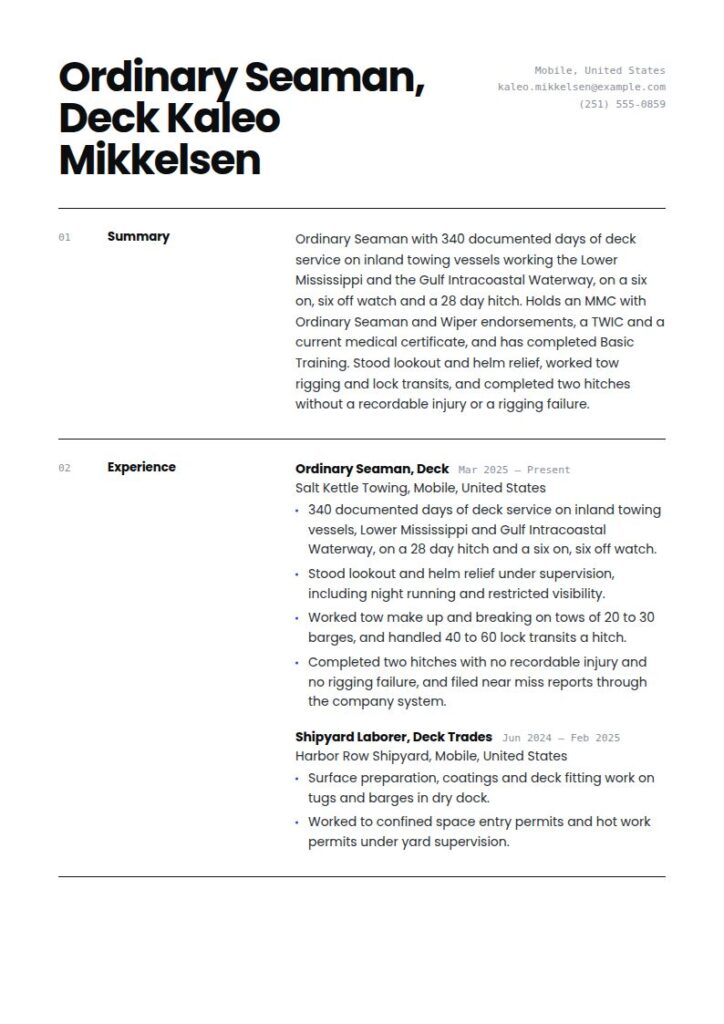
Ordinary Seaman with 340 documented days of deck service on inland towing vessels working the Lower Mississippi and the Gulf Intracoastal Waterway, on a six on, six off watch and a 28 day hitch. Holds an MMC with Ordinary Seaman and Wiper endorsements, a TWIC and a current medical certificate, and has completed Basic Training. Stood lookout and helm relief, worked tow rigging and lock transits, and completed two hitches without a recordable injury or a rigging failure.
Work Experience
03/2025 - Present, Ordinary Seaman, Deck, Salt Kettle Towing, Mobile, United States
- 340 documented days of deck service on inland towing vessels, Lower Mississippi and Gulf Intracoastal Waterway, on a 28 day hitch and a six on, six off watch.
- Stood lookout and helm relief under supervision, including night running and restricted visibility.
- Worked tow make up and breaking on tows of 20 to 30 barges, and handled 40 to 60 lock transits a hitch.
- Completed two hitches with no recordable injury and no rigging failure, and filed near miss reports through the company system.
06/2024 - 02/2025, Shipyard Laborer, Deck Trades, Harbor Row Shipyard, Mobile, United States
- Surface preparation, coatings and deck fitting work on tugs and barges in dry dock.
- Worked to confined space entry permits and hot work permits under yard supervision.
Education
08/2022 - 05/2024, Associate of Applied Science, Marine Transportation, Coastal Gulf Community College, Mobile, United States
Deck operations, navigation, marine safety and vessel construction, with Coast Guard approved courses toward entry ratings.
08/2018 - 05/2022, High School Diploma, General, Bay Shore High School, Mobile, United States
Skills
Helm and lookout, 70
Mooring and line handling, 80
Tow make up and breaking, 75
Lock transit procedures, 70
Deck preservation and coatings, 80
Enclosed space entry procedures, 65
Near miss reporting, 70
Languages
English, native
Certificates
09/2024, Merchant Mariner Credential, U.S. Coast Guard National Maritime Center, MMC valid to 03/2029
Endorsements: Ordinary Seaman, Wiper. Valid five years.
07/2023, Transportation Worker Identification Credential (TWIC), Transportation Security Administration, TWIC valid to 07/2028
Valid five years. Required for unescorted access to secure areas of maritime facilities and vessels.
05/2025, Merchant Mariner Medical Certificate (CG-719K), U.S. Coast Guard National Maritime Center, Valid to 05/2027
STCW medical certificate, valid two years from the date of examination.
02/2025, STCW Basic Training, Coast Guard approved training provider
Personal survival techniques, fire prevention and firefighting, elementary first aid, personal safety and social responsibility. Renewed 2025.
Summary
A seaman resume is a one to two page document led by your Merchant Mariner Credential and its endorsements, followed by sea time counted in days and the vessels, tonnage and waters behind it. This guide gives you three adaptable versions, the credential block a crewing office reads first, and current Bureau of Labor Statistics pay and outlook for water transportation work.
Seaman resume examples by experience level
A seaman resume is a one to two page document led by your Merchant Mariner Credential and the endorsements printed in it, then sea time counted in days and the vessels, tonnage, routes and waters that produced those days.
In short, nothing else on the page substitutes for that block. A crewing coordinator filling a rotation has a legal problem before a hiring problem: whoever steps aboard must hold the right endorsement, a valid medical certificate and a TWIC, or the vessel sails short.
Resume guide for a seaman resume
To that end, this guide and the corresponding seaman resume example will cover:
- First, how to write a seaman resume, section by section
- Then, the credential block, and why it goes above everything else
- Next, three adaptable summaries: entry rating, able seafarer and bosun
- How to count and document sea time so a crewing office can use it
- Finally, what the market pays, and why "seaman" is not a BLS occupation
How to write a seaman resume
Overall, six blocks: contact header, credential summary, endorsement list, sea service history, training certificates and skills.
The order matters more here than in almost any other occupation. Credentials are federal, not state, and they are checked before anyone reads a bullet.
| Block | What it is answering | Where it goes |
|---|---|---|
| Credential and endorsements | Can this person legally fill the billet today? | Directly under the header |
| TWIC and medical certificate | Can they board the facility and sail? | Same block, own lines |
| Sea service | How many days, on what, in which waters? | Reverse chronological, days totaled |
| Training certificates | Which courses will the company not pay for? | Its own block |
Put the expiry dates on the page, not just the credential names
A crewing office is not only checking that you hold something. They are checking that it will still be valid on the day you join and the day you are due to get off.
A Merchant Mariner Credential is valid for a term of five years, and adding an endorsement does not move the expiration date; only a renewal does (U.S. Coast Guard National Maritime Center, Merchant Mariner Credentials FAQ, dated 23 January 2026).
The medical certificate runs on its own clock. For a mariner serving under an STCW endorsement it is valid for up to two years from the date of examination, and for a national mariner not serving under STCW for up to five (National Maritime Center, Merchant Mariner Medical Certificate FAQ, dated 7 April 2026). A TWIC is valid for five years (Transportation Security Administration, accessed September 2026).
Three documents, three different clocks. Write the month and year each one expires, and you have answered the first three questions the reader has.
Run the file through the ATS resume checker first. Large operators take applications through a portal that parses the file before a crewing coordinator opens it.
Choosing the best resume format for a seaman resume
In practice: reverse chronological, with a credential block above the experience. Functional layouts fail here, because sea service is a running total and the reader needs continuity, gaps, hitch patterns and vessels in order. One page covers an entry rating; go to two when you hold several endorsements or service across more than two vessel types.
| Inland and river | Offshore and coastal | Deep sea | |
|---|---|---|---|
| Typical vessels | Towboats, barges, dredges, ferries | Platform supply vessels, crew boats, tugs | Container, tanker, bulk, roll on roll off |
| The resume leads with | Horsepower, tow size, river miles, locks | Vessel length and tonnage, transfer operations | Gross tonnage, trade route, STCW endorsements |
| Watch pattern | Usually six on, six off | Six on, six off, or twelve hour days | Often four on, eight off |
| Hitch | Counted in weeks, crew change by land | Commonly even time, crew change by boat or helicopter | Counted in months, joining by air |
Include your contact information
| ✅ Right | ❌ Wrong |
|---|---|
| Kaleo Mikkelsen | Kaleo Mikkelsen |
| Able Seafarer-Unlimited, RFPNW, Lifeboat Operator | Experienced hardworking deckhand |
| MMC valid to 03/2029, TWIC to 07/2028, medical certificate to 05/2027 | All documents current |
| (251) 555-0859, [email protected], Mobile, AL | (251) 555-0859, [email protected] |
By contrast, "All documents current" is the sentence that gets a file set aside, because it makes the reader do work they can do faster by calling the next candidate.
Make use of a summary
In short, four lines: your highest rating, total documented sea time in days, the vessel types and waters, and one thing about your safety or reliability record.
Ordinary Seaman with 340 documented days of deck service on inland towing vessels working the Lower Mississippi and the Gulf Intracoastal Waterway, on a six on, six off watch and a 28 day hitch. Holds an MMC with Ordinary Seaman and Wiper endorsements, a TWIC and a current medical certificate, and has completed Basic Training. Stood lookout and helm relief, worked tow rigging and lock transits, and completed two hitches without a recordable injury or a rigging failure.
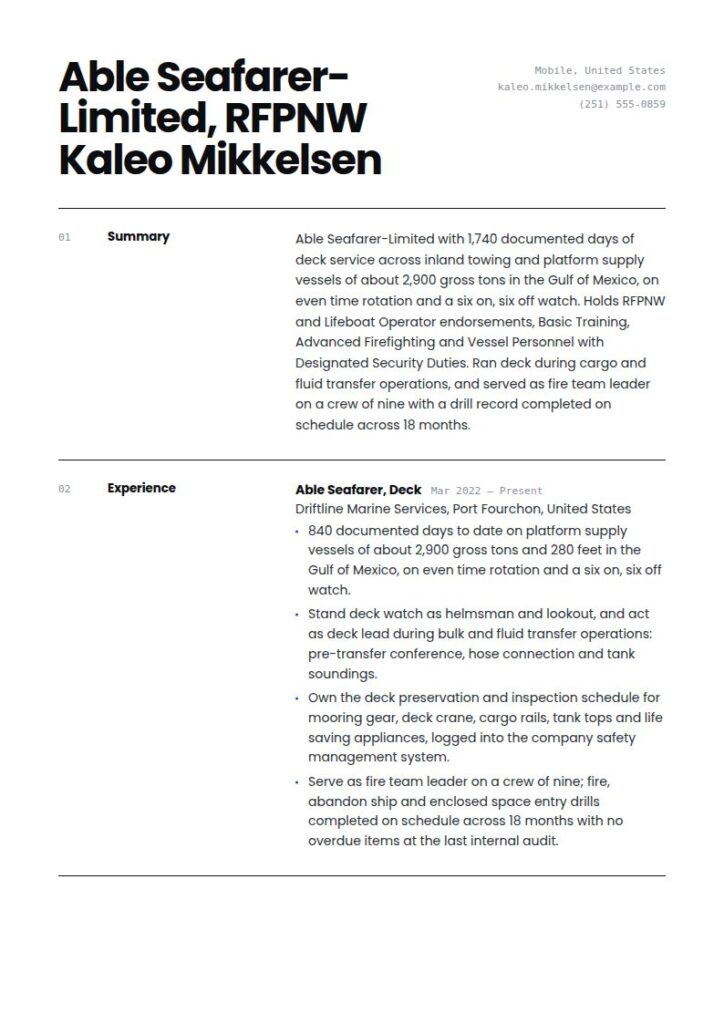
Able Seafarer-Limited with 1,740 documented days of deck service across inland towing and platform supply vessels of about 2,900 gross tons in the Gulf of Mexico, on even time rotation and a six on, six off watch. Holds RFPNW and Lifeboat Operator endorsements, Basic Training, Advanced Firefighting and Vessel Personnel with Designated Security Duties. Ran deck during cargo and fluid transfer operations, and served as fire team leader on a crew of nine with a drill record completed on schedule across 18 months.
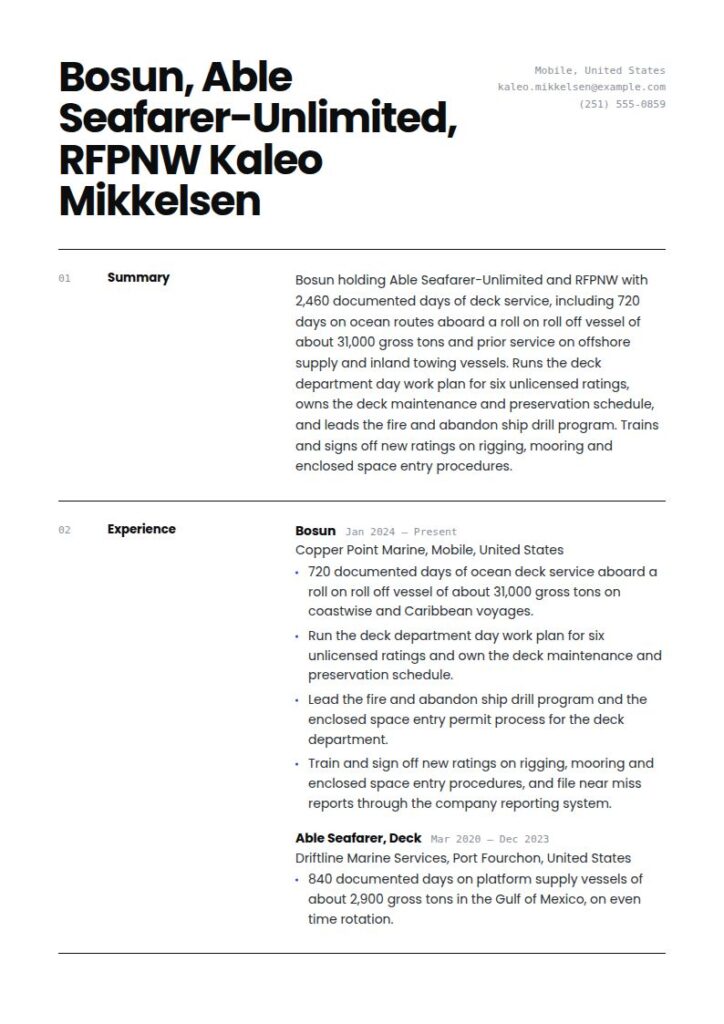
Bosun holding Able Seafarer-Unlimited and RFPNW with 2,460 documented days of deck service, including 720 days on ocean routes aboard a roll on roll off vessel of about 31,000 gross tons and prior service on offshore supply and inland towing vessels. Runs the deck department day work plan for six unlicensed ratings, owns the deck maintenance and preservation schedule, and leads the fire and abandon ship drill program. Trains and signs off new ratings on rigging, mooring and enclosed space entry procedures.
Right vs wrong: the same seaman summary, twice
| ✅ Right | ❌ Wrong |
|---|---|
| Able Seafarer-Limited with 1,740 documented days of deck service. | Experienced seaman with many years at sea. |
| Inland towing and platform supply vessels of about 2,900 gross tons in the Gulf of Mexico. | Worked on various types of vessels in different locations. |
| Fire team leader on a crew of nine, drill record completed on schedule across 18 months. | Safety-conscious team player with a strong work ethic. |
For example, the right column can be checked against a sea service letter in a minute. However, the left column cannot be checked at all, which is why it reads as filler to anyone who crews vessels.
Outline your sea service experience
Then list vessel type, tonnage or horsepower, waters, your capacity, the dates and the number of days. Then two to four bullets.
| Instead of | Use |
|---|---|
| Worked as a deckhand on boats | 340 days as Ordinary Seaman on inland towing vessels, Lower Mississippi and Gulf Intracoastal Waterway |
| Experience with mooring and line handling | Made up and broke tows of 20 to 30 barges and worked 40 to 60 lock transits a hitch |
| Participated in safety drills | Fire team leader on a crew of nine; fire, abandon ship and enclosed space drills completed on schedule across 18 months |
Able Seafarer, Driftline Marine Services, Port Fourchon, LA, March 2022 to Present. Platform supply vessels, about 2,900 gross tons, 280 feet, Gulf of Mexico. Even time rotation, six on and six off. 840 days to date.
Stand deck watch as helmsman and lookout, and act as deck lead during bulk and fluid transfer operations: pre-transfer conference, hose connection and tank soundings.
Own the deck preservation and inspection schedule for mooring gear, deck crane, cargo rails, tank tops and life saving appliances, logged into the company safety management system.
Serve as fire team leader on a crew of nine; fire, abandon ship and enclosed space entry drills completed on schedule across 18 months with no overdue items at the last internal audit.
Your credentials, endorsements and sea time are the resume
Everything above is how to write. This is what is actually read. Specifically, four things go in it, in this order.
One: the Merchant Mariner Credential and its endorsements. The MMC is a federal credential issued by the U.S. Coast Guard National Maritime Center and valid for a term of five years (NMC, Merchant Mariner Credentials FAQ, dated 23 January 2026). What matters to a crewing office is not the card but the endorsements printed inside it. Write them exactly as they appear.
In fact, the able seafarer ratings are a ladder made of days, and the days are set in regulation. The National Maritime Center's checklist for the national able seafarer endorsement under 46 CFR 12.401 requires 540 days of deck service on oceans or the Great Lakes for Able Seafarer-Unlimited, 360 days on vessels of 100 gross register tons or more for Able Seafarer-Limited, and 180 days on navigable waters of the United States for Able Seafarer-Special, OSV, Sail and Fishing Industry, with Able Seafarer-MODU at 360 days (NMC checklist MCP-FM-NMC5-53, revision dated 17 January 2025). Every applicant must also qualify as Lifeboat Operator or Lifeboat Operator-Limited and be at least 18.
Therefore, if you are partway up that ladder, say so: "Able Seafarer-Limited, 1,740 days deck service, eligible for Able Seafarer-Unlimited on completion of ocean service" tells a reader something useful about the next twelve months.
RFPNW: the navigational watch endorsement
Two: RFPNW. Rating Forming Part of a Navigational Watch is the STCW endorsement that lets you stand a navigational watch on a vessel to which STCW applies. Under 46 CFR 12.605 an applicant must be at least 16 and hold either six months of seagoing service including navigational watchkeeping under supervision, or Coast Guard approved training plus a minimum of two months of approved seagoing service; holders of Able Seafarer-Unlimited, Limited or Special need no further sea service (eCFR, 46 CFR 12.605, accessed September 2026). Say whether you hold it, because crewing offices filter on it.
TWIC, the medical certificate and your sea time
Three: TWIC and the medical certificate. The Transportation Security Administration issues the Transportation Worker Identification Credential to workers needing unescorted access to secure areas of maritime facilities and vessels, including most Coast Guard credentialed mariners; it is valid for five years and costs $128 for a new card (TSA, accessed September 2026). The medical certificate is issued separately on form CG-719K and runs on a two year or five year clock depending on whether you sail under STCW (NMC, Medical Certificate FAQ, dated 7 April 2026). Give both expiry months.
Four: sea time, in days, documented. Sea time is the currency of this career and it has a definition. A day is eight hours of watchstanding or dayworking, not counting overtime, and on vessels under 100 gross register tons a minimum of four hours credits a full day (National Maritime Center, sea service guidance dated 12 August 2024). That is why "five years at sea" is a weaker sentence than "1,740 days".
Write your sea service the way the sea service letter does
The Coast Guard does not take your word for sea time. It takes a letter on company or vessel letterhead carrying the vessel name, official number, vessel type, tonnage, horsepower where applicable, propulsion type, the start and end dates of service, and the number of underway days (National Maritime Center, sea service guidance dated 12 August 2024).
Build your resume entries from the same fields: vessel type, tonnage or horsepower, waters, capacity, dates, days. A crewing coordinator reading a resume in that shape can see at once that your paperwork will survive evaluation, which is a real anxiety when hiring a rating close to an upgrade.
Merchant Mariner Credential, U.S. Coast Guard, valid to 03/2029. Endorsements: Able Seafarer-Unlimited, Lifeboat Operator, RFPNW, Ordinary Seaman, Wiper.
TWIC, Transportation Security Administration, valid to 07/2028. Medical certificate (CG-719K), valid to 05/2027, STCW.
Documented sea service: 2,460 days deck service. 720 days oceans, roll on roll off, about 31,000 gross tons. 840 days offshore supply, about 2,900 gross tons, Gulf of Mexico. 900 days inland towing, Lower Mississippi and Gulf Intracoastal Waterway.
STCW training: Basic Training, Advanced Firefighting, Proficiency in Survival Craft, Vessel Personnel with Designated Security Duties.
Build a snapshot of your key seaman skills
Next, ten to fourteen entries in four groups. Above all, every line should be something a mate could watch you do.
Deck: Mooring and line handling, Tow make up and breaking, Rigging and cargo gear, Anchor work, Rescue boat operation
Watchkeeping: Helm and lookout, Radar observation, Collision regulations, Restricted visibility procedures
Cargo and transfer: Bulk and fluid transfer operations, Pre-transfer conference, Tank sounding and gauging, Hose handling and connection
Safety and maintenance: Fire team leadership, Enclosed space entry, Life saving appliance inspection, Deck preservation and coatings, Near miss reporting
List your education and training certificates
Formal education matters less here than the certificate list, because every course you already hold is one the company does not have to buy.
STCW: Basic Training (personal survival, fire prevention and firefighting, elementary first aid, personal safety and social responsibility), renewed 2025. Advanced Firefighting, 2023. Proficiency in Survival Craft, 2022. Vessel Personnel with Designated Security Duties, 2024.
Company and operational: Enclosed space entry and rescue, 2025. Rigging and crane signaling, 2024. Helicopter underwater escape training, 2023.
Associate of Applied Science, Marine Transportation, Coastal Gulf Community College, Mobile, AL, 2018
High School Diploma, Bay Shore High School, Mobile, AL, 2016
Choose the right layout and design
In addition: single column, plain type at 11 or 12 point, no photograph, no logos and no scanned certificates. Portals parse the file into a structured record before a person sees it, and images and columns are where that fails.
Put the credential and endorsements above the experience. Write endorsement names exactly as printed on the MMC. Give expiry months for the MMC, the TWIC and the medical certificate. Count sea time in days and total it. Give vessel type, tonnage or horsepower, and waters for every entry. State your hitch pattern and your watch pattern. Say what you are next eligible for and what service you still need.
Do not write "all documents current" instead of dates. Do not claim an endorsement you have applied for but not received; say "application submitted" and give the date. Do not describe sea time in years when the regulation counts days. Do not leave an unexplained gap between hitches; a line saying you were on rotation, in training or ashore for a stated reason closes it. Do not paste certificate images into the document.
Seaman job market and outlook
However, there is no Bureau of Labor Statistics occupation called "seaman" and no Occupational Outlook Handbook profile matching the title. Instead, the Handbook publishes water transportation workers as a group in four occupations, and an unlicensed deck rating sits in sailors and marine oilers, with captains, mates and pilots as the progression above it.
| Measure | Value |
|---|---|
| Water transportation workers, 2025 | 85,900 |
| Projected change, 2025-35 | 4 percent, +3,100 jobs |
| Projected annual openings | ~8,600 |
| Median annual wage, May 2025 | $71,860 ($34.55 per hour) |
| Lowest 10 percent / highest 10 percent | $37,810 / $145,560 |
Source: U.S. For reference: Bureau of Labor Statistics, Occupational Outlook Handbook, May 2025 wage data and 2025-35 projections, published 27 August 2026.
| Occupation within the group | Employment, 2025 | Median annual wage, May 2025 |
|---|---|---|
| Captains, mates and pilots of water vessels | 41,300 | $92,460 |
| Sailors and marine oilers | 33,000 | $51,520 |
| Ship engineers | 8,800 | $109,530 |
| Motorboat operators | 2,800 | $47,520 |
Source: U.S. For reference: Bureau of Labor Statistics, Occupational Outlook Handbook, May 2025 and 2025-35 projections.
The pay ladder in this occupation is a credential ladder
Sailors and marine oilers had a median annual wage of $51,520 as of May 2025, while captains, mates and pilots of water vessels had a median of $92,460 and ship engineers $109,530 in the same cycle (BLS Occupational Outlook Handbook, May 2025).
The group is also small and slow moving: 85,900 jobs in 2025, projected to grow 4 percent and add 3,100 jobs by 2035, with about 8,600 openings a year, most of them replacements (BLS, 2025-35 projections).
In an occupation that size, what moves your pay is not a better resume for the same job. It is documented sea time converted into a higher endorsement, and then into a license. That is why the credential block belongs at the top of the page and the days total belongs in the summary line.
Where the work sits:
| Industry | Share of employment | Median annual wage (May 2025) |
|---|---|---|
| Inland water transportation | 24 percent | $65,660 |
| Support activities for water transportation | 21 percent | $77,990 |
| Deep sea, coastal and Great Lakes water transportation | 14 percent | $79,420 |
| Scenic and sightseeing transportation, water | 8 percent | $51,190 |
| Federal government | 6 percent | $57,930 |
Source: U.S. Again, Bureau of Labor Statistics, Occupational Outlook Handbook, May 2025.
What salary you can expect as a seaman
Overall, water transportation workers as a whole had a median annual wage of $71,860 as of May 2025, with the lowest 10 percent under $37,810 and the highest 10 percent over $145,560 (BLS Occupational Outlook Handbook, May 2025). In other words, the spread is wide because the group runs from an entry rating to a ship's master. Meanwhile, for an unlicensed deck rating the relevant figure is sailors and marine oilers, at a median of $51,520 in May 2025 (BLS, May 2025).
Sector matters on top of that. For example, deep sea, coastal and Great Lakes water transportation pays a median of $79,420 and support activities for water transportation $77,990, against $65,660 in inland water transportation and $51,190 in scenic and sightseeing water transportation (BLS Occupational Outlook Handbook, May 2025). In practice, a resume can move you between those sectors, and the credential block is what makes the application credible.
Also, read any published figure as an annual wage, not a day rate. After all, time away is structural here: hitches run in weeks offshore and often in months deep sea, and a rotation is what you are agreeing to. Put your hitch pattern on the page, because a crewing office matching people to rotations is looking for it.
Key takeaways for a seaman resume
- To start, lead with the Merchant Mariner Credential and the endorsements exactly as printed.
- Then give expiry months for the MMC, the TWIC and the medical certificate; three clocks.
- Count sea time in days and total it, because the regulation counts days.
- Give vessel type, tonnage or horsepower, and waters for every entry.
- Say whether you hold RFPNW, and what endorsement you are next eligible for.
- Also state your watch pattern and your hitch pattern.
- Similarly, build entries from the same fields a sea service letter carries.
- Finally, keep it single column and free of pasted certificate images.
Build your seaman resume in 15 minutes with our AI resume builder.
Related transportation resume examples
- Transportation resume
- Train operator resume
- Pilot resume
- Flight attendant resume
- Aviation resume
- Driver resume
- Bus driver resume
- Truck driver resume
- Dispatcher resume
- Logistics coordinator resume
- Transport and logistics resume
- Supply chain resume
Pair it with a matching seaman cover letter.
Seaman resume questions, answered
How long should a seaman resume be?
One page for an entry rating. Two once you hold several endorsements or service across more than two vessel types. The credential block and the sea service totals earn the second page.
Is "seaman" a recognized job title for salary research?
Not at the Bureau of Labor Statistics. No Occupational Outlook Handbook profile carries that title, so use water transportation workers as a group, at a median of $71,860 in May 2025, and sailors and marine oilers as the closest match to an unlicensed deck rating, at $51,520 (BLS Occupational Outlook Handbook, May 2025).
How do I prove sea time if an old employer has closed?
Use your discharges and any Coast Guard record of your credential history first, then anything contemporaneous: pay records, crew lists, vessel logs. The standard evidence is a letter on company or vessel letterhead carrying the vessel name, official number, type, tonnage, propulsion, dates and underway days (National Maritime Center, sea service guidance dated 12 August 2024), so the closer your alternative comes to those fields, the better.
Do I need a TWIC before I apply?
In practice, yes, because most water transportation jobs require it along with the Merchant Mariner Credential (BLS Occupational Outlook Handbook, published 27 August 2026). It is valid for five years and costs $128 for a new card (Transportation Security Administration, accessed September 2026). A candidate who already holds one can join a rotation sooner.
How do I write the resume if I have never sailed?
Write the entry credentials and the training, then the transferable work. An MMC with Ordinary Seaman and Wiper endorsements, a TWIC, a medical certificate and Basic Training is a complete entry file, and BLS notes there are no educational requirements for entry-level sailors and marine oilers (BLS Occupational Outlook Handbook, published 27 August 2026). Then add anything physical, mechanical and shift based: rigging, welding, painting, machinery, work at height, confined spaces.
Should I put my hitch pattern on the resume?
Yes. Time away is a structural feature of the job rather than a detail, and a crewing office is matching people to rotations. Write it plainly, such as "28 and 14" or "even time", and say which rotations you will accept.