First Officer, EMB-170/190 Bashir Maktoum ATP
First Officer, EMB-170/190
[email protected] | (817) 555-1052 | Fort Worth, United States
Profile
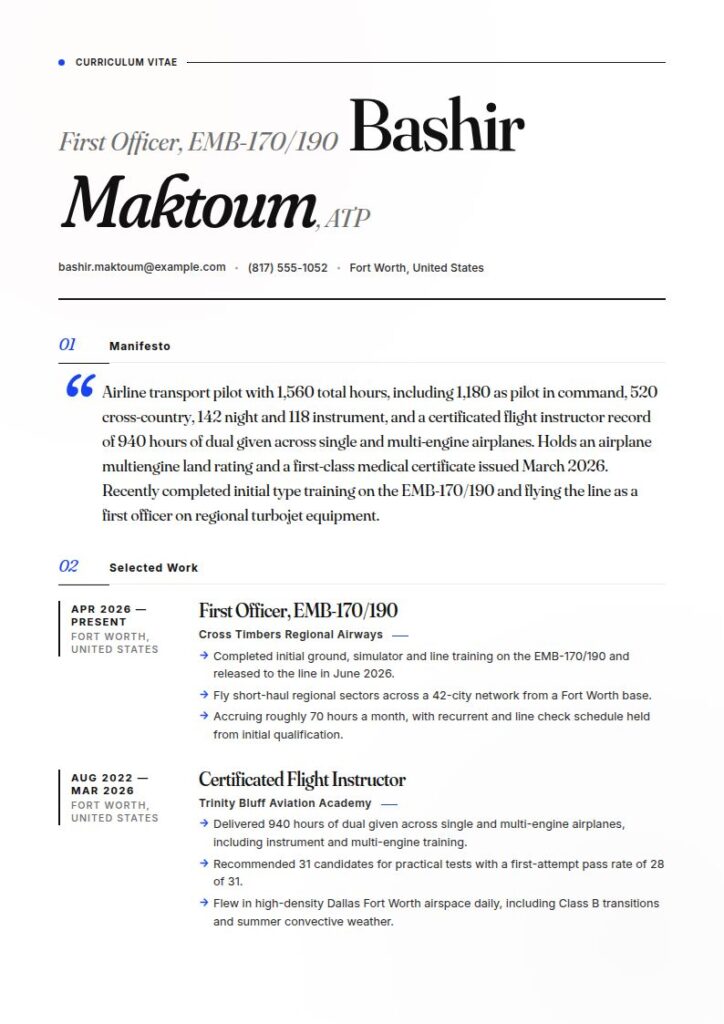
Airline transport pilot with 1,560 total hours, including 1,180 as pilot in command, 520 cross-country, 142 night and 118 instrument, and a certificated flight instructor record of 940 hours of dual given across single and multi-engine airplanes. Holds an airplane multiengine land rating and a first-class medical certificate issued March 2026. Recently completed initial type training on the EMB-170/190 and flying the line as a first officer on regional turbojet equipment.
Work Experience
04/2026 - Present, First Officer, EMB-170/190, Cross Timbers Regional Airways, Fort Worth, United States
- Completed initial ground, simulator and line training on the EMB-170/190 and released to the line in June 2026.
- Fly short-haul regional sectors across a 42-city network from a Fort Worth base.
- Accruing roughly 70 hours a month, with recurrent and line check schedule held from initial qualification.
08/2022 - 03/2026, Certificated Flight Instructor, Trinity Bluff Aviation Academy, Fort Worth, United States
- Delivered 940 hours of dual given across single and multi-engine airplanes, including instrument and multi-engine training.
- Recommended 31 candidates for practical tests with a first-attempt pass rate of 28 of 31.
- Flew in high-density Dallas Fort Worth airspace daily, including Class B transitions and summer convective weather.
- Maintained the school's stage-check standardization notes and briefed new instructors on them.
Education
08/2018 - 05/2022, Bachelor of Science, Aviation Science, Red River State University, Denton, United States
Commercial pilot certificate and instrument rating completed during the program; certificated flight instructor added 2022.
Skills
EMB-170/190 line operations, 65
Instrument flight procedures, 85
Flight instruction and stage checks, 90
High-density terminal airspace, 85
Crew resource management, 75
Weather analysis and flight planning, 85
Languages
English, native
Arabic, native
French, intermediate
Certificates
02/2026, Airline Transport Pilot, Airplane Multiengine Land, Federal Aviation Administration
Issued on meeting the aeronautical experience requirements of 14 CFR 61.159.
07/2022, Certificated Flight Instructor, Instrument and Multi-Engine, Federal Aviation Administration
03/2026, First-Class Medical Certificate, Federal Aviation Administration
Summary
An airline pilot resume is a one to two page document that has to clear two separate sets of minimums: the federal floor for the certificate the seat requires, and the competitive bar a particular airline is interviewing at this year. This guide gives you three adaptable versions, the qualifications block that answers both, and current Bureau of Labor Statistics pay and outlook.
Airline Pilot resume examples by experience level
An airline pilot resume is a one to two page document that two people read, each asking a different question.
In practice, the first reader is checking eligibility: does this applicant hold, or can this applicant hold, the certificate the seat legally requires. That question has a fixed answer written into federal regulation; as a result, it does not change with the hiring cycle. The second reader is deciding whether you are competitive against the other applications on the desk this month. Meanwhile, the airline sets that bar, it is nowhere in the regulations, and it moves.
However, most pilot resumes answer the first question well and the second by accident. The fix is not a longer document; it is knowing which fact answers which gate.
Resume guide for an airline pilot resume
This guide and the corresponding airline pilot resume example will cover:
- How to write an airline pilot resume, block by block
- The two sets of minimums your file is measured against, and where each is answered
- Three adaptable summaries: new regional first officer, regional captain and mainline captain
- What type ratings, currency and the medical certificate are worth on the page
- What the job market looks like and what you can expect to earn
How to write an airline pilot resume
Overall, it takes six blocks: contact header, summary, qualifications, flight experience, employment history, and education with training and awards. One page until you have flown for two carriers; two pages once you carry multiple type ratings, a check airman role or an instructor qualification.
Qualifications sit above employment because they are a gate rather than an achievement. An applicant who cannot hold the required certificate is a no before anyone reads about their airmanship.
| Block | What it answers for the reader | Where it goes |
|---|---|---|
| Qualifications | Can this applicant hold the certificate this seat requires? | Directly under the summary, never at the bottom |
| Flight experience | Is the composition of this time what we are hiring at? | A compact block above employment history |
| Employment history | Where has this been flown, on what equipment, and how long at each? | Reverse chronological |
| Training and awards | What has a previous operator already invested in, and vouched for? | Last, with dates |
Write the certificate, not a description of it
"Airline Transport Pilot, Airplane Multiengine Land" is a fact a recruiter can filter on in a database. "Highly experienced professional aviator" is not, and it is the first line on a surprising number of pilot resumes.
The same applies below the certificate. Write the type ratings by designation, the medical certificate with its class and its issue date, and the instructor or examiner qualifications by name. Every one of those is a field in the airline's applicant system, and a fact written as prose lands in the wrong field or in none.
Names, designations and dates in the qualifications block. Judgement and narrative in the employment bullets, where a human is reading.
Run the finished file through the ATS resume checker before you submit it. Airline recruitment portals read applications into a structured record before a human opens them.
Choosing the best resume format for an airline pilot resume
Reverse chronological, with a qualifications block ahead of it. In short, nothing else survives contact with airline recruitment.
Functional layouts fail here for a specific reason: a pilot's career, after all, is verified rather than described. Recruiters check employment dates, certificate numbers and training records against outside records, so a format that obscures the sequence reads as a sequence worth obscuring.
Gaps are normal here, so write them in plainly: a furlough, a medical, time instructing between airline jobs. As a result, a gap explained in six words never becomes a question.
Include your contact information
| ✅ Right | ❌ Wrong |
|---|---|
| Bashir Maktoum | Bashir Maktoum |
| Airline Transport Pilot, Airplane Multiengine Land | Experienced commercial aviator |
| Type ratings: A320 series, EMB-170/190. First-class medical, March 2026 | All required licenses and certifications current |
| (817) 555-1052, [email protected], Fort Worth, TX | (817) 555-1052, [email protected] |
Also, put the certificate and the type ratings in the header itself. That is because a recruiter filtering for a fleet is searching for a designation, and a designation that appears only on page two is a designation the search did not find.
Make use of a summary
Four lines: the certificate, the equipment and the seat, the shape of your time, and one thing you have been trusted with beyond flying the line.
Airline transport pilot with 1,560 total hours, including 1,180 as pilot in command, 520 cross-country, 142 night and 118 instrument, and a certificated flight instructor record of 940 hours of dual given across single and multi-engine airplanes. Holds an airplane multiengine land rating and a first-class medical certificate issued March 2026. Recently completed initial type training on the EMB-170/190 and flying the line as a first officer on regional turbojet equipment.
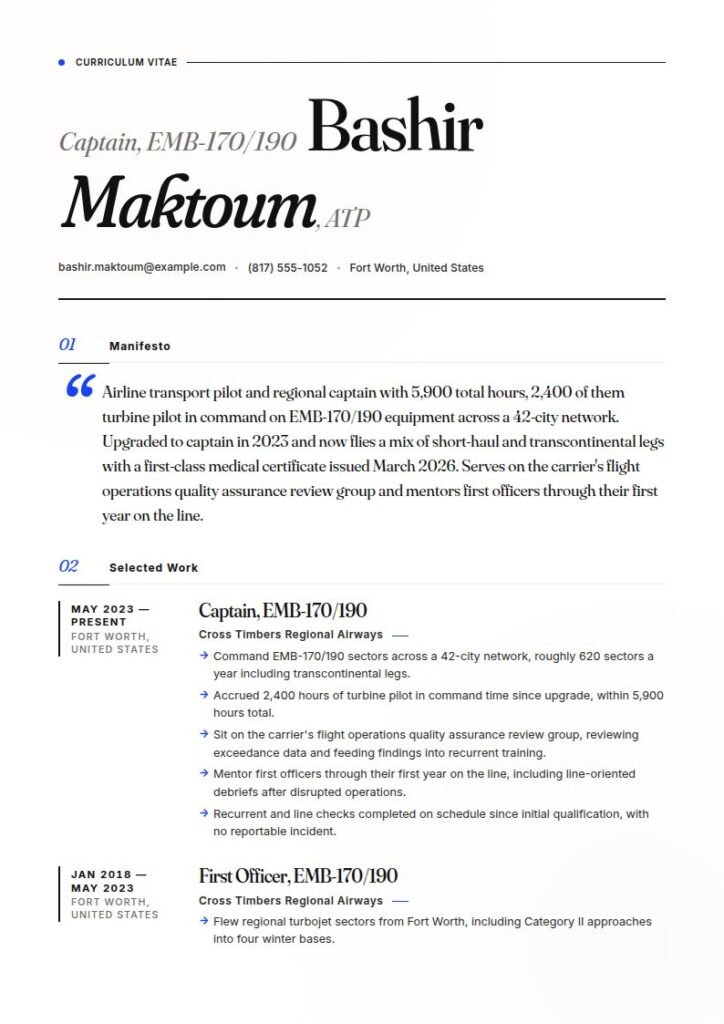
Airline transport pilot and regional captain with 5,900 total hours, 2,400 of them turbine pilot in command on EMB-170/190 equipment across a 42-city network. Upgraded to captain in 2023 and now flies a mix of short-haul and transcontinental legs with a first-class medical certificate issued March 2026. Serves on the carrier's flight operations quality assurance review group and mentors first officers through their first year on the line.
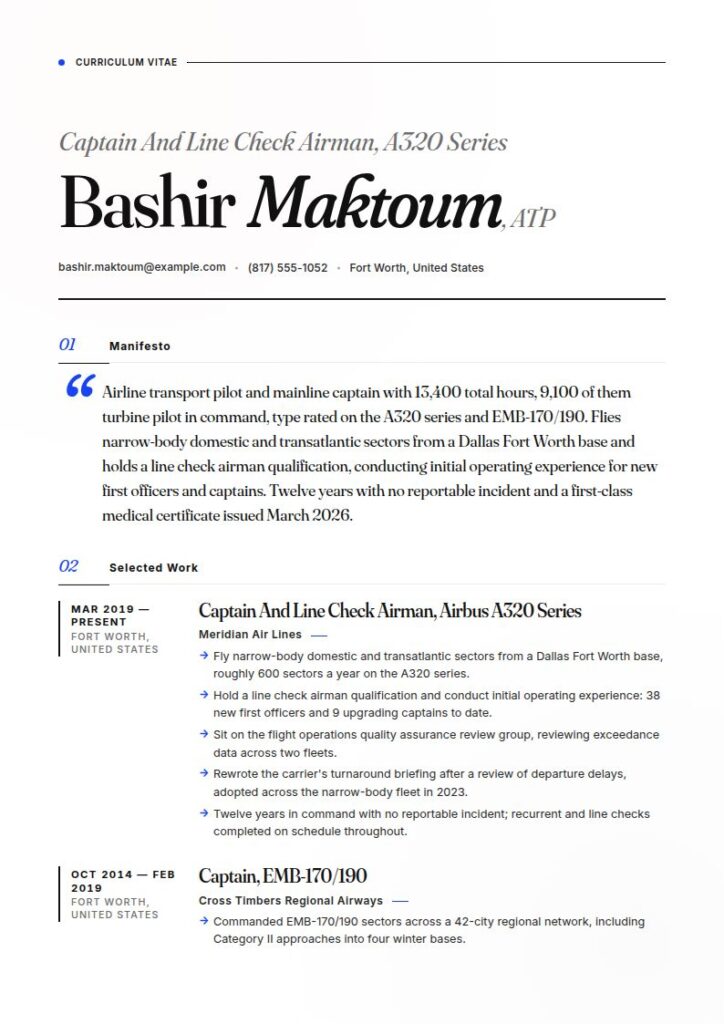
Airline transport pilot and mainline captain with 13,400 total hours, 9,100 of them turbine pilot in command, type rated on the A320 series and EMB-170/190. Flies narrow-body domestic and transatlantic sectors from a Dallas Fort Worth base and holds a line check airman qualification, conducting initial operating experience for new first officers and captains. Twelve years with no reportable incident and a first-class medical certificate issued March 2026.
Right vs wrong: the same airline pilot summary, twice
| ✅ Right | ❌ Wrong |
|---|---|
| Airline transport pilot and regional captain with 5,900 total hours, 2,400 turbine pilot in command on EMB-170/190. | Experienced airline pilot with thousands of hours and an excellent safety record. |
| Upgraded to captain in 2023; flies short-haul and transcontinental legs across a 42-city network. | Flies a variety of routes for a major regional carrier. |
| Serves on the carrier's flight operations quality assurance review group and mentors first officers. | A strong team player committed to the highest standards of safety. |
For example, the left column can be measured against an airline's own minimums in ten seconds. The right column needs a phone call first, and recruiters read the files that need phone calls last.
Outline your flying experience
Then put carrier, base, equipment, seat and dates in the header line. Then three to five bullets each carrying something verifiable: a network, a sector length, a fleet, a qualification, a training role, a program you sat on.
Here, the temptation is to describe flying itself. Resist it: every applicant flies, and the reader has flown too. What distinguishes files is the work around the flying, such as the check airman qualification, the safety program, the upgrade or the new type.
| Instead of | Use |
|---|---|
| Operated aircraft safely in all weather conditions | Flew 620 sectors a year across a 42-city network, including Category II approaches into four winter bases |
| Followed standard operating procedures | Served on the flight operations quality assurance review group, reviewing exceedance data on two fleets |
| Trained junior pilots | Conducted initial operating experience for 38 new first officers and 9 upgrading captains as a line check airman |
| Maintained currency and qualifications | Completed recurrent and line checks on schedule for 12 consecutive years across three types |
| Worked well with crew | Rewrote the carrier's turnaround briefing after a review of departure delays on the E175 fleet |
Captain and Line Check Airman, Airbus A320 Series, Meridian Air Lines, Dallas Fort Worth Base, March 2019 to Present
Fly narrow-body domestic and transatlantic sectors from a Dallas Fort Worth base, roughly 600 sectors a year on the A320 series.
Hold a line check airman qualification and conduct initial operating experience for new first officers and upgrading captains: 38 first officers and 9 captains to date.
Sit on the flight operations quality assurance review group, reviewing exceedance data across two fleets and feeding findings into recurrent training.
Twelve years in command with no reportable incident and recurrent and line checks completed on schedule throughout.
Two sets of minimums are checked against your resume
In short, recruiters measure your file against two separate numbers, and they come from different places. Almost every avoidable rejection in airline hiring is a file that answered one of them and left the reader to work out the other.
| Gate | Who sets it | What it actually checks | Where your resume answers it |
|---|---|---|---|
| The federal floor | Federal regulation, fixed | Whether you are eligible to hold the certificate the seat requires | The certificate line in the qualifications block |
| The airline's minimums | The carrier, revised with hiring conditions | Whether you are competitive against this month's applicant pool | The composition of your time, your type ratings and your currency |
First, federal regulation writes down the first gate, and it does not move. Under 14 CFR 61.159, an airline transport pilot certificate with an airplane category and multiengine class rating requires at least 1,500 hours of total time as a pilot, 500 hours of cross-country time, 100 hours of night flight time, 75 hours of instrument flight time in actual or simulated instrument conditions, and 250 hours of flight time in an airplane as pilot in command, or as second in command performing the duties of pilot in command under supervision, or a combination of the two, of which at least 100 hours must be cross-country and 25 hours at night.
Eligibility numbers versus airline minimums
Those are eligibility numbers, not quality numbers. Once you hold the certificate, they have done their job, and the single line "Airline Transport Pilot, Airplane Multiengine Land" answers the entire first gate. For this reason, a resume that reprints the regulation's categories as if they were achievements is answering a question that the certificate already closed.
By contrast, the second gate is the one that decides. An airline publishes its own minimums, they sit above the federal floor by a margin that widens and narrows with the hiring cycle, and they usually use a different currency: total time, turbine time, turbine pilot in command, time in the last twelve months, and sometimes a type rating on the fleet being staffed. Two applicants can both hold the certificate and be nowhere near each other against that bar.
So write the composition, not just the total. Turbine pilot in command is the figure most carriers actually screen on for a command seat, and it is the one applicants most often leave implicit inside a total. If you have 5,900 hours and 2,400 of them are turbine pilot in command, the second number is the one doing the work, and burying it inside the first is throwing it away.
Three more items belong in the same block because the second reader looks for them.
Type ratings, currency and the medical
The type rating is aircraft specific and it tells a carrier two things at once: what you have been trusted to operate, and what training they would not have to pay for. Write it by designation rather than by aircraft nickname, and list every one you hold even if the fleet is gone from your logbook, because a rating is a qualification you keep.
Currency is the quiet one. Recurrent training, line checks and the date of your last proficiency event tell a reader whether your experience is live or historic. A pilot with 9,000 hours who has not flown for two years is a different application from a pilot with 9,000 hours who flew last week, and the resume is where you say which one you are.
Similarly, the medical certificate is a date, not an adjective. Write the class and the month of issue. "Medical current" is a claim a reader cannot check; "first-class medical certificate issued March 2026" is one they do not need to.
Certificate: Airline Transport Pilot, Airplane Multiengine Land
Type ratings: A320 series (2019), EMB-170/190 (2014)
Flight time: 13,400 total; 9,100 turbine pilot in command; 4,100 in the last five years; 720 in the last twelve months
Currency: Recurrent and line check completed February 2026. Line check airman qualification held since 2021.
Medical: FAA first-class medical certificate, issued March 2026
Other: Certificated Flight Instructor, Instrument and Multi-Engine (2012). Restricted radiotelephone operator permit. Valid passport, no travel restrictions.
Finally, if you are below an airline's published bar, say what you have and when you expect to reach it, with the rate that gets you there. A first officer with 1,560 hours accruing 70 a month is a knowable quantity. A first officer whose file leaves the reader to guess is not, and guessing takes longer than moving to the next application.
Build a snapshot of your key skills
For skills, list ten to fourteen entries in three groups: equipment and operations, safety and training systems, and the qualifications that are not certificates.
Equipment and operations: A320 series, EMB-170/190, Category II approach operations, transatlantic and extended overwater procedures, high-density terminal operations, winter and contaminated runway operations
Safety and training systems: Flight operations quality assurance data review, line oriented flight training, crew resource management facilitation, initial operating experience delivery, incident and hazard reporting
Other qualifications: Line check airman, certificated flight instructor with instrument and multi-engine ratings, dangerous goods awareness, first aid and emergency equipment training
List your education and certifications
Airlines verify certificates and training records rather than degrees, but a degree still appears on most successful files. Write the certificates first with their dates, then the degree, then the training you have received from operators.
Airline Transport Pilot Certificate, Airplane Multiengine Land, Federal Aviation Administration, 2014
Type Ratings: A320 series, 2019; EMB-170/190, 2014
Certificated Flight Instructor, Instrument and Multi-Engine, Federal Aviation Administration, 2012
Bachelor of Science, Aviation Science, Red River State University, Denton, TX, 2011
Operator training: A320 initial and recurrent, Meridian Air Lines, 2019 to 2026. Line check airman course, 2021. Crew resource management facilitator course, 2022.
Medical: FAA first-class medical certificate, issued March 2026
Choose the right layout and design
For layout, use one column, 11 or 12 point type, clear headings, no photograph and no graphics. Airline recruitment portals read the file into fields before anyone opens it, and two-column layouts, tables of hours built as images and decorative headers are where that reading breaks.
In addition, keep designations in their standard written form. A fleet written as a nickname may not match the term the recruiter's search is using.
Put the certificate and the type ratings in the header. Give turbine pilot in command as its own figure rather than leaving it inside a total. Date the medical certificate and the last recurrent event. Name the base, the fleet and the seat for every carrier. Write the work around the flying: check airman roles, safety programs, upgrades, training delivery. Explain any gap in one line.
Do not describe flying in general terms that any pilot could write. Do not claim currency without a date behind it. Do not leave a type rating off because the fleet has retired; a rating is a qualification you keep. Do not round your hours upward, because the logbook is checked. Do not use a two-column template for an airline portal.
Airline pilot job market and outlook
A small, high-paid occupation growing much faster than average, with a hiring pipeline that runs almost entirely through regional and commercial flying before it reaches the mainline seat.
| Measure | Value |
|---|---|
| Airline and commercial pilot jobs, 2025 | 154,900 |
| Projected change, 2025-35 | 7% (much faster than average), +11,300 |
| Projected annual openings | ~16,400 |
| On-the-job training | Moderate-term on-the-job training |
| Median annual wage, airline pilots, copilots and flight engineers, May 2025 | $232,140 |
| Median annual wage, commercial pilots, May 2025 | $123,220 |
| Median annual wage, occupation overall, May 2025 | $210,020 |
Source: U.S. Bureau of Labor Statistics, Occupational Outlook Handbook, Airline and Commercial Pilots, May 2025 wage data and 2025 to 2035 projections, published 27 August 2026.
The gap between the two pilot jobs is the whole career ladder
Airline pilots, copilots and flight engineers had a median annual wage of $232,140 as of May 2025, against $123,220 for commercial pilots, with the occupation overall at $210,020 (BLS Occupational Outlook Handbook, published 27 August 2026).
The occupation held 154,900 jobs in 2025 and is projected to grow 7 percent through 2035, much faster than the average for all occupations, with about 16,400 openings a year (BLS, published 27 August 2026).
That difference of more than $100,000 between the two halves of one occupation is not a pay dispute. It is the ladder. Nearly everyone in the upper figure spent years in the lower one, which is why the composition of your time matters more on this resume than on almost any other: it is the evidence of where on the ladder you currently stand.
Where airline pilots, copilots and flight engineers work, and what it pays there:
| Industry | Share of employment | Median annual wage (May 2025) |
|---|---|---|
| Scheduled air transportation | 88% | $293,240 |
| Couriers and express delivery services | 5% | $334,930 |
| Federal government | 3% | $141,140 |
| Support activities for transportation | 2% | $202,680 |
Source: U.S. Bureau of Labor Statistics, Occupational Outlook Handbook, May 2025.
What salary you can expect as an airline pilot
Airline pilots, copilots and flight engineers had a median annual wage of $232,140 as of May 2025, against $123,220 for commercial pilots and $210,020 for the occupation as a whole (BLS Occupational Outlook Handbook, published 27 August 2026).
In short, the industry table above shows where the money sits: $334,930 in couriers and express delivery services and $293,240 in scheduled air transportation, against $141,140 in the federal government (BLS, May 2025). In fact, almost nine in ten of these pilots work in scheduled air transportation.
What a resume moves is the seat you are considered for, and pay in this profession is largely a function of seat, fleet and seniority rather than of negotiation. That makes the qualifications block unusually valuable: turbine pilot in command decides whether a command seat is open to you, a type rating on the fleet being staffed decides whether you are cheaper to hire than the next applicant, and a check airman or instructor qualification is one of the few lines that reads as leadership in a profession that does not use the word.
Key takeaways for an airline pilot resume
- First, answer two gates: the federal floor with the certificate, the airline's bar with the composition of your time.
- Write "Airline Transport Pilot, Airplane Multiengine Land" rather than a description of it.
- Then give turbine pilot in command as its own figure, not buried inside a total.
- List every type rating by designation, including retired fleets.
- Date your currency: last recurrent, last line check, medical class and month.
- Also, spend the employment bullets on the work around the flying, not on flying itself.
- If you are under a published bar, state what you have and when you will reach it.
Build your airline pilot resume in 15 minutes with our AI resume builder.
Related transportation resume examples
- Pilot resume
- Flight attendant resume
- Aviation resume
- Transportation resume
- Train operator resume
- Bus driver resume
- Driver resume
- Seaman resume
- School bus driver resume
- Uber driver resume
- Dispatcher resume
- Logistics coordinator resume
Pair it with a matching airline pilot cover letter.
Airline pilot resume questions, answered
How long should an airline pilot resume be?
One page until you have flown for two carriers. Two once you hold multiple type ratings, a check airman or instructor qualification, and a history long enough that listing it carrier by carrier is the point. Never three.
Do I put all my flight time categories on the resume?
Put the ones that answer a question the reader has. Total time, turbine pilot in command, recent time and time on the type being staffed do work. Reprinting every category from the regulation does not, because once you hold the airline transport pilot certificate the eligibility numbers in 14 CFR 61.159 have already been satisfied and verified.
What if I am below an airline's published minimums?
Apply anyway, and make the arithmetic easy. State the figure you hold, the rate you are accruing at, and the month you expect to cross the bar. Published minimums move with the hiring cycle, and a file that lets a recruiter see exactly when you become eligible is a file worth keeping.
Does a degree matter for an airline pilot resume?
It appears on most successful files and it is not the gate. The Handbook lists moderate-term on-the-job training for airline and commercial pilots (BLS Occupational Outlook Handbook, published 27 August 2026), and the certificates, ratings and flight time are what determine eligibility. Put the degree on the page, below the certificates.
How do I show experience if most of my hours are instructing?
Write the instruction as flying that produced judgement, because it did: the hours of dual given, the ratings your students completed, the airspace and weather you worked in, and the check ride pass record. Then present the totals that matter for the seat you want. A pilot with 940 hours of dual given and 1,180 as pilot in command has a shape a recruiter recognizes immediately.