Delivery Driver, Light Truck Dashiell Nyhagen
Delivery Driver, Light Truck
[email protected] | (419) 555-1040 | Toledo, United States
Profile
Delivery driver with 14 months on a city parcel route running 95 to 120 stops a day in a 16 foot box truck, holding an Ohio driver license and a current DOT medical examiner's certificate with no accidents or moving violations on record. Load and sequence my own truck each morning and held a 98% on-time delivery rate through the winter peak. Trained in Smith System defensive driving and certified on pallet jack and sit-down forklift.
Work Experience
03/2025 - Present, Delivery Driver, Light Truck, Portside Parcel Services, Toledo, United States
- Run a city parcel route of 95 to 120 stops a day in a 16 foot box truck, roughly 70 miles and 9 hours on duty.
- Held a 98% on-time delivery rate through the November to January peak, against a station target of 95%.
- Load and sequence my own truck each morning against the delivery order, which cut about 25 minutes off the route.
- No accidents, moving violations or roadside inspection findings since starting.
- Complete pre-trip and post-trip inspection reports and handheld proof of delivery for every stop.
06/2023 - 03/2025, Warehouse Order Selector, Blue Heron Foodservice Distribution, Toledo, United States
- Selected and palletised about 1,100 cases a shift for outbound wholesale routes, including frozen and chilled product.
- Certified on walkie and sit-down forklift; no recordable injuries or product damage findings in 21 months.
Education
08/2019 - 05/2023, High School Diploma, General, Whitmer High School, Toledo, United States
Ohio driver license held since 2021, no violations on record.
Skills
City multi-stop route delivery, 80
Route sequencing and load order, 75
Box truck and cargo van operation, 80
Pallet jack and sit-down forklift, 85
Pre-trip and post-trip inspection, 80
Proof of delivery and exception handling, 75
Liftgate and hand truck stair work, 80
Languages
English, native
Spanish, beginner
Certificates
03/2025, DOT Medical Examiner's Certificate, FMCSA certified medical examiner
Valid through March 2027.
04/2025, Smith System Driver Improvement, Smith System
Five keys defensive driving, completed during new hire training.
02/2024, Powered Industrial Truck Operator, Blue Heron Foodservice Distribution, OSHA compliant program
Sit-down and walkie.
Summary
A driver resume is a one page document naming the vehicles you drove, the routes you ran, the volume you moved, and the record a carrier will pull on you before anyone calls. This guide gives you three adaptable versions, the motor vehicle record and safety performance history a DOT-regulated employer is required to obtain, and current Bureau of Labor Statistics pay and outlook for delivery drivers and driver/sales workers.
Driver resume examples by experience level
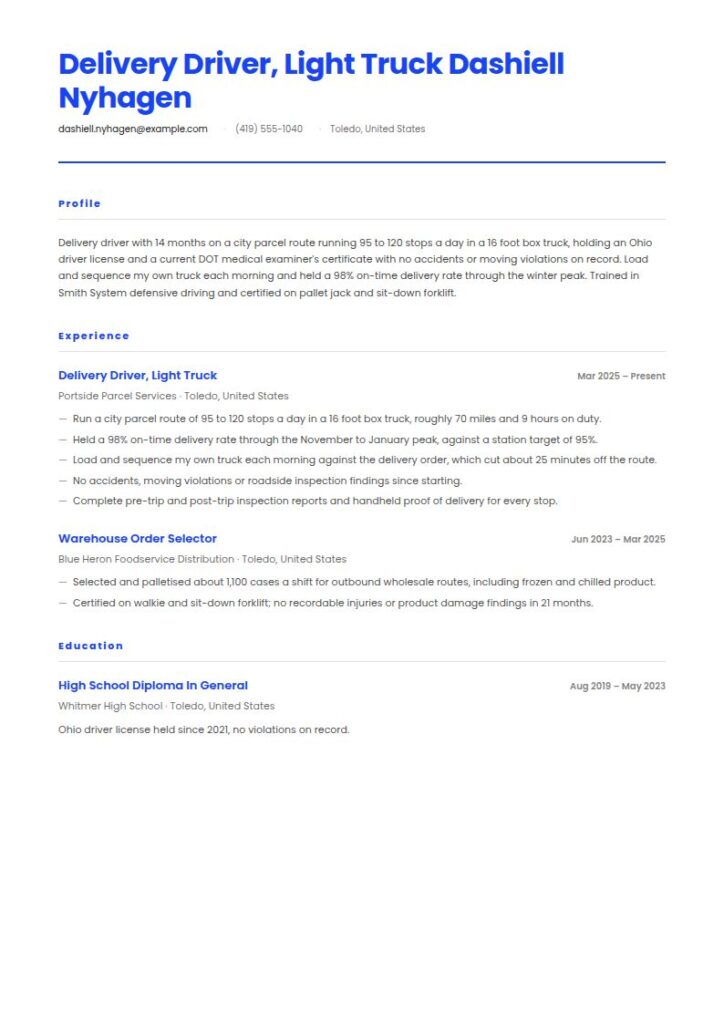
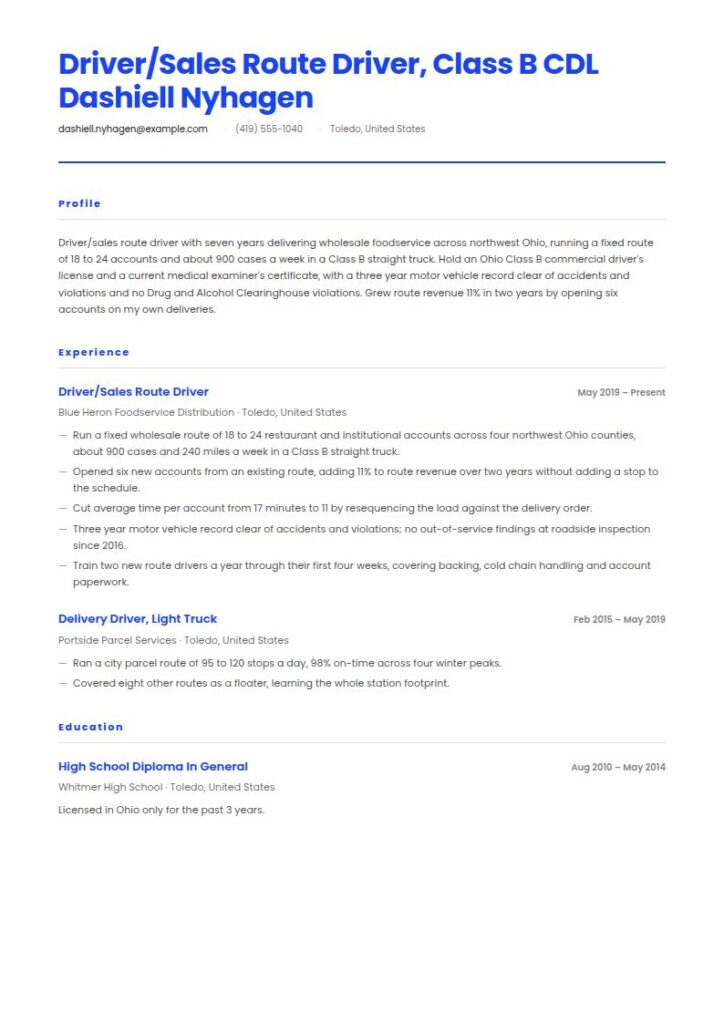
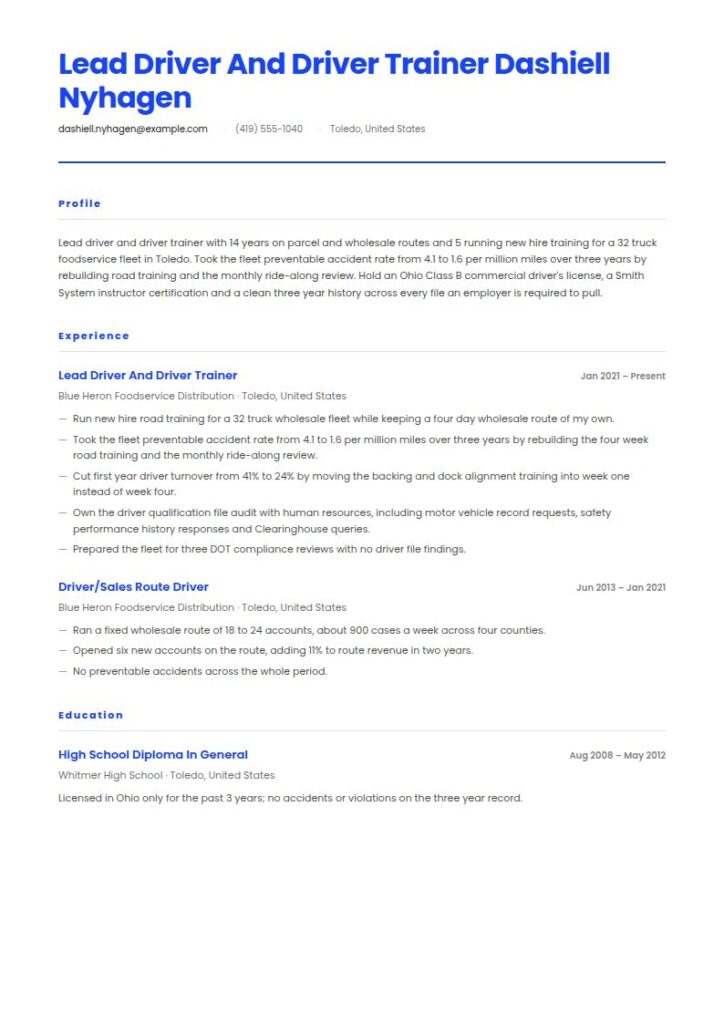
A driver resume is a one page document that names the vehicles you drove, the routes you ran, the volume you moved, and the record a hiring employer will pull on you whether or not you mention it.
That last part is what makes driver hiring unlike most other hiring. A recruiter reading your application already knows they are going to open files you have never seen: a motor vehicle record from every state you have held a license in, a written safety performance history from every DOT-regulated employer you worked for in the last three years, and a query against a federal drug and alcohol database. Those files are coming. All your resume decides is whether they confirm what you wrote or correct it.
Resume guide for a driver resume
In short, this guide and the corresponding driver resume example will cover:
- First, how to write a driver resume, section by section
- Then, the record an employer is required to pull, and how to get in front of it
- Next, three adaptable summaries: new driver, route driver and lead driver
- The numbers a dispatcher actually reads: stops, cases, miles and on-time rate
- Finally, what the job market looks like and what you can expect to earn
How to write a driver resume
Overall, six sections: contact header, summary, license and record line, driving experience, skills, and education and training. One page. In fact, a driver resume that runs to two is usually describing the same route three times.
However, employment history carries the most weight, and not for the reason most applicants assume. It carries that weight because it is the one section an employer checks against paperwork, month by month, three years back.
| Section | What it is answering | Where it goes |
|---|---|---|
| License and record line | Can this person be put in the vehicle, and will the file be clean? | Directly under the summary |
| Driving experience | What did they drive, where, how much, and exactly when? | Reverse chronological, months shown, no gaps |
| Volume and results | Stops, cases, miles, on-time rate, accident record | Inside every experience block |
| Education and training | Defensive driving, equipment, product handling | Short, at the foot of the page |
Write the last three years month by month, with nothing missing
Under 49 CFR 391.23, a motor carrier must investigate your safety performance history with every DOT-regulated employer you worked for in the three years before your application, and those employers have 30 days to answer. The recruiter builds that request from the employment history you handed them.
Two things follow. A gap you left out gets found, because the dates on either side of it do not meet. And an employer you left off is the first thing you will be asked about.
So write months, not just years, and account for time out of driving in one plain line: "January to June 2024, warehouse order selection during recovery from a shoulder injury". A stated gap costs nothing. A discovered one costs the job.
Run the finished file through the ATS resume checker before you send it. Large delivery and distribution employers take applications through a portal that parses the file before a recruiter reads a word of it.
Choosing the best resume format for a driver resume
Reverse chronological, single column, one page. Anything else reads as a timeline somebody is hiding; after all, in driving the timeline is the thing the employer checks.
Functional formats fail hardest here. A recruiter who has to reconstruct three years from a skills list cannot open the safety performance history request at all, so the file waits while the others move.
Also keep each job header dense: employer, city, vehicle, route type, dates. A reader should be able to tell from that line whether you ran a 120 stop parcel route inside a city or an 18 stop wholesale route across three counties. After all, those are different jobs, and the difference is invisible if the page only says "Delivery Driver".
Include your contact information
| ✅ Right | ❌ Wrong |
|---|---|
| Dashiell Nyhagen | Dashiell Nyhagen |
| Driver/Sales Route Driver, Ohio Class B CDL, medical card valid to 03/2028 | Hard-working driver with a clean record |
| Toledo, OH. Licensed in Ohio only for the past 3 years. No preventable accidents since 2016. | Toledo, OH |
| (419) 555-1040, [email protected] | (419) 555-1040, [email protected] |
In particular, the third line is the unusual one and it is the one that works. It answers, before anybody asks, the two questions the background file is about to answer anyway: how many states the employer must check, and what the check is going to say.
Make use of a summary
In short, four lines: what you drive, what kind of route, the volume, and one record fact with a period attached to it.
Delivery driver with 14 months on a city parcel route running 95 to 120 stops a day in a 16 foot box truck, holding an Ohio driver license and a current DOT medical examiner's certificate with no accidents or moving violations on record. Load and sequence my own truck each morning and held a 98% on-time delivery rate through the winter peak. Trained in Smith System defensive driving and certified on pallet jack and sit-down forklift.
Driver/sales route driver with seven years delivering wholesale foodservice across northwest Ohio, running a fixed route of 18 to 24 accounts and about 900 cases a week in a Class B straight truck. Hold an Ohio Class B commercial driver's license and a current medical examiner's certificate, with a three year motor vehicle record clear of accidents and violations and no Drug and Alcohol Clearinghouse violations. Grew route revenue 11% in two years by opening six accounts on my own deliveries.
Lead driver and driver trainer with 14 years on parcel and wholesale routes and 5 running new hire training for a 32 truck foodservice fleet in Toledo. Took the fleet preventable accident rate from 4.1 to 1.6 per million miles over three years by rebuilding road training and the monthly ride-along review. Hold an Ohio Class B commercial driver's license, a Smith System instructor certification and a clean three year history across every file an employer is required to pull.
Right vs wrong: the same driver summary, twice
| ✅ Right | ❌ Wrong |
|---|---|
| Driver/sales route driver with seven years delivering wholesale foodservice across northwest Ohio. | Reliable driver with several years of delivery experience in the local area. |
| Fixed route of 18 to 24 accounts and about 900 cases a week in a Class B straight truck. | Responsible for making deliveries to customers in a safe and timely manner. |
| Three year motor vehicle record clear of accidents and violations, no Clearinghouse violations. | Excellent driving record and strong work ethic. |
For example, the right column can be verified on Monday morning. In contrast, the reader has to take the left column on trust, and in an industry where the law requires the employer to go and check, nobody takes anything on trust.
Outline your driving experience
Then list the employer, city, vehicle class, route type and dates. Then three to five bullets, each with a number in it.
| Instead of | Use |
|---|---|
| Delivered packages to customers on a daily route | Ran a city parcel route of 95 to 120 stops a day in a 16 foot box truck, 98% on-time through winter peak |
| Responsible for loading and unloading the vehicle | Loaded and sequenced about 900 cases a week by stop order, cutting average dwell time per account to 11 minutes |
| Maintained a clean driving record | No preventable accidents in 9 years and no roadside inspection out-of-service violations |
| Provided excellent customer service | Opened six new accounts on an existing route, adding 11% to route revenue in two years |
| Completed daily paperwork | Completed pre-trip and post-trip inspection reports and daily logs with no compliance findings across three DOT audits |
Driver/Sales Route Driver, Blue Heron Foodservice Distribution, Toledo, OH, Class B straight truck, May 2019 to Present
Run a fixed wholesale route of 18 to 24 restaurant and institutional accounts across four northwest Ohio counties, about 900 cases and 240 miles a week.
Opened six new accounts from the seat of an existing route, adding 11% to route revenue over two years without adding a stop to the schedule.
Cut average time per account from 17 minutes to 11 by resequencing the load against the delivery order, which brought the route back inside its window on four days a week rather than two.
Hold a three year motor vehicle record clear of accidents and violations, with no roadside inspection out-of-service findings since 2016.
Train two new route drivers a year through their first four weeks, including backing, product handling and account paperwork.
The record an employer pulls before they call you
Before anyone calls you, a DOT-regulated employer assembles four documents about you, and three of them come from somebody other than you.
| The file | What is in it | Who produces it |
|---|---|---|
| Motor vehicle record | Your license status and driving history in every state where you held a license in the previous 3 years, obtained within 30 days of the date employment begins (49 CFR 391.23) | Each state licensing authority |
| Safety performance history | Accidents, and drug and alcohol testing violations, over the preceding 3 years (49 CFR 391.23) | Your previous DOT-regulated employers, who must respond within 30 days |
| DOT drug and alcohol testing record | The testing record for the two years before your application or transfer date, obtained with your written consent and reviewed before you first perform a safety-sensitive function (49 CFR 40.25) | Previous DOT-regulated employers |
| Clearinghouse query | Federal drug and alcohol program violations and return-to-duty status; carriers have been required to query since 6 January 2023 (49 CFR 391.23) | FMCSA Drug and Alcohol Clearinghouse |
None of that is optional for the employer, and only the testing record waits for you: under 49 CFR 40.25 you must consent in writing, and an applicant who refuses may not perform safety-sensitive duties at all, so refusing is withdrawing.
Four lines that get ahead of your driving record
Once you know what is being read, four lines do most of the work.
Name every state. "Licensed in Ohio only for the past 3 years" tells a recruiter there is one authority to query rather than three, and one query returns faster than three. If you have moved, say so: "Licensed in Michigan to 2023, Ohio since".
Close every month. The safety performance history request goes to the employers you list, so a missing employer is a missing response and a missing response is a stalled file.
State the record in your own words. "No preventable accidents since 2016, no out-of-service violations" reads as a candidate who has looked at their own file. Silence reads as a candidate who has not.
Say the consent is ready. One line, "Clearinghouse query and drug and alcohol record release consent available on request", removes a step from a process that has a 30 day clock on it.
Pull your own motor vehicle record before you apply, not after
Order your own record from every state that will be queried, and read it line by line against your memory. Records carry errors: a violation dismissed in court that was never cleared from the abstract, a citation recorded against the wrong license number, an accident logged as preventable that the employer coded otherwise.
You have a right to act on what you find. Under 49 CFR 391.23 you may review the information reported about you, request that a previous employer correct it, and submit a rebuttal statement if the employer will not.
That takes weeks, which is why it is done before you apply rather than while a recruiter waits on a 30 day clock with other applicants in the folder.
One qualification. However, this process attaches to safety-sensitive driving under federal motor carrier rules, and plenty of driving work sits outside it. If your target job is not DOT-regulated the employer still pulls a motor vehicle record, so the same four lines help; they just do less work.
Build a snapshot of your key driver skills
Next, twelve to fifteen entries in four groups. In practice, a dispatcher reads this block for what you can be assigned to tomorrow.
Vehicle and route: Class B straight truck, 16 to 26 foot box truck, cargo van, city multi-stop routes, fixed wholesale routes, route sequencing, backing and dock alignment
Handling and equipment: Pallet jack, sit-down and walkie forklift, liftgate and ramp operation, load securement and weight distribution, cold chain and frozen product handling, hand truck stair work
Compliance and records: Pre-trip and post-trip inspection, hours of service and electronic logging, roadside inspection readiness, DOT medical certification, defensive driving
Customer and account: Proof of delivery and exception handling, invoice and cash on delivery reconciliation, account ordering, returns and credits, handheld scanner and route software
List your education and certifications
Certifications and training first, because that is what changes what you can be assigned. Formal education after, briefly.
Ohio Class B Commercial Driver's License, issued 2019, valid through 2027
DOT Medical Examiner's Certificate, valid through March 2028
Smith System Driver Improvement, instructor certification 2021, driver certification 2016
Powered Industrial Truck Operator, sit-down and walkie, employer certified 2024
ServSafe Food Handler, National Restaurant Association, 2025
High School Diploma, Whitmer High School, Toledo, OH, 2012
Choose the right layout and design
Above all: single column, plain type at 11 or 12 point, one page, no photograph and no graphics. That matters because distribution and courier employers push applications through portals that read the file into a structured record, and columns, text boxes and icons are where that reading fails.
Therefore, put dates on the right of each job header in a consistent format and never abbreviate a month to a season. After all, the reader is going to transcribe those dates into a form.
Write months and years for every job across the last three years. Name the state or states you have been licensed in. State your accident and violation record in a sentence rather than calling it clean. Put vehicle class and route type in the header line of each job. Give one number per bullet: stops, cases, miles, minutes or percentage. Say the consent forms are ready.
Do not write "excellent driving record" and leave it there, because the abstract arrives in a fortnight either way. Do not leave an employer off because the job was short or ended badly. Do not round a volume upward; a route driver reading it will know. Do not list an expired medical certificate without the renewal date. Do not send two pages when the second one repeats the first.
Driver job market and outlook
Delivery driving is a large, steadily growing occupation that turns over fast, which is why openings run so far ahead of new jobs.
| Measure | Value |
|---|---|
| Delivery truck driver and driver/sales worker jobs, 2025 | 1,511,400 |
| Projected change, 2025-35 | 7%, +103,000 |
| Projected annual openings | ~152,700 |
| Typical entry-level education | High school diploma or equivalent |
| Typical on-the-job training | Short-term on-the-job training |
| Median annual wage, May 2025 | $43,950, or $21.13 an hour |
Source: U.S. For reference: Bureau of Labor Statistics, Occupational Outlook Handbook, delivery truck drivers and driver/sales workers, May 2025 wage data and 2025 to 2035 projections, published 27 August 2026.
The job title splits in two, and the two halves pay $6,090 apart
The occupation contains two jobs that share a vehicle and not much else. Light truck drivers had a median annual wage of $44,860 in May 2025; driver/sales workers, who also sell, merchandise or take orders on the route, had $38,770 (BLS Occupational Outlook Handbook, published 27 August 2026).
The industries behind those medians explain the gap. Light truck drivers sit mainly in couriers and messengers, 37 percent of them, where the May 2025 median was $47,700. Driver/sales workers sit mainly in food services, 39 percent of them, where the May 2025 median was $30,580, and in wholesale trade, 25 percent, where it was $49,090.
So the same driver/sales job pays a May 2025 median of $49,090 in wholesale and $30,580 in food services, a spread of $18,510 (BLS, May 2025). Which industry you name on the page matters more to your pay than almost anything else on it, and it is the easiest thing in the world to leave off.
Meanwhile, where the work sits, and what each part of it pays:
| Where the work sits | Share of that job | Median annual wage, May 2025 |
|---|---|---|
| Light truck drivers, couriers and messengers | 37% | $47,700 |
| Light truck drivers, retail trade | 17% | $34,350 |
| Light truck drivers, wholesale trade | 14% | $44,740 |
| Driver/sales workers, food services | 39% | $30,580 |
| Driver/sales workers, wholesale trade | 25% | $49,090 |
| Driver/sales workers, transportation and warehousing | 6% | $45,690 |
Source: U.S. For reference: Bureau of Labor Statistics, Occupational Outlook Handbook, May 2025.
Notably, all delivery drivers need a driver's license from the state in which they work and a clean driving record, which is the Handbook's own way of saying what the rest of this page has been saying: the record is a qualification, not a formality.
What salary you can expect as a driver
Overall, the median annual wage for delivery truck drivers and driver/sales workers was $43,950 in May 2025, or $21.13 an hour (BLS Occupational Outlook Handbook, published 27 August 2026). That sits just under the $44,350 median for transportation and material moving occupations as a whole, and well under the $50,980 median for all occupations, both May 2025.
Even so, inside the occupation the split is what matters. For instance, light truck drivers were at $44,860 and driver/sales workers at $38,770 in May 2025. A move from retail delivery at $34,350 to courier work at $47,700, both light truck driver medians for May 2025, is worth more than any number of years in the seat.
In practice, two levers show up on a resume. The first is industry: name it, because wholesale and courier work pay a long way above retail and food service delivery. The second is scope, since routes carrying ordering or account responsibility, and lead driver or trainer roles, sit above the plain route band in most fleets. Yet neither is visible if the page says "Delivery Driver, 2019 to present" and stops.
Key takeaways for a driver resume
- Write the last three years month by month, because the law requires a carrier to check them.
- To start, name every state that licensed you over those three years.
- State your accident and violation record in a sentence instead of calling it clean.
- Then put vehicle class, route type and volume in the header line of every job.
- Finally, pull your own motor vehicle record first and use your correction and rebuttal rights early.
- Name the industry you delivered in, since that is where the pay difference lives.
- Keep it one page, single column and parseable, because a portal reads it first.
Build your driver resume in 15 minutes with our AI resume builder.
Related transportation resume examples
- Delivery driver resume
- Truck driver resume
- Bus driver resume
- School bus driver resume
- Uber driver resume
- Tractor driver resume
- Transportation resume
- Dispatcher resume
- Logistics coordinator resume
- Warehouse worker resume
- Package handler resume
- Transport and logistics resume
Pair it with a matching driver cover letter.
Driver resume questions, answered
How long should a driver resume be?
One page. Driving work is repetitive by design, so a second page almost always restates the first. The exception is a driver with a genuine training, supervisory or compliance record to show, and even then the second page should be short.
What if my motor vehicle record is not clean?
Put the facts on the page before the abstract does it for you, in one line with dates: "One at-fault collision, March 2021, no injuries, no citation since". A recruiter who reads it from you is assessing a candidate. A recruiter who finds it in the file after reading a resume that said "excellent driving record" is assessing honesty, which is a much shorter conversation.
Do I need a commercial driver's license for delivery work?
It depends on the vehicle, not the job title. A great deal of delivery work runs on vehicles that need only an ordinary state license, which is why the Bureau of Labor Statistics lists a high school diploma or equivalent and short-term on-the-job training as the typical entry route for the occupation (BLS Occupational Outlook Handbook, published 27 August 2026). Write the license you hold and the heaviest vehicle you have driven, and let the reader match it.
How far back should my employment history go?
At least three years unbroken, because that is the window a DOT-regulated employer must investigate under 49 CFR 391.23. Beyond three years you can summarize, but do not create a gap inside the window to make the page tidier.
What numbers should I use if my employer never gave me any?
Count them yourself for a week. Stops completed, cases or parcels handled, miles driven, accounts served, minutes per stop, deliveries inside the window. A figure you measured over a named period beats every adjective available to you.
Does a resume matter if the application is an online portal?
Yes. The portal parses it to prefill the employment history a recruiter builds the background check from, and the summary is the only place you get to say what the record will show before anyone opens it.