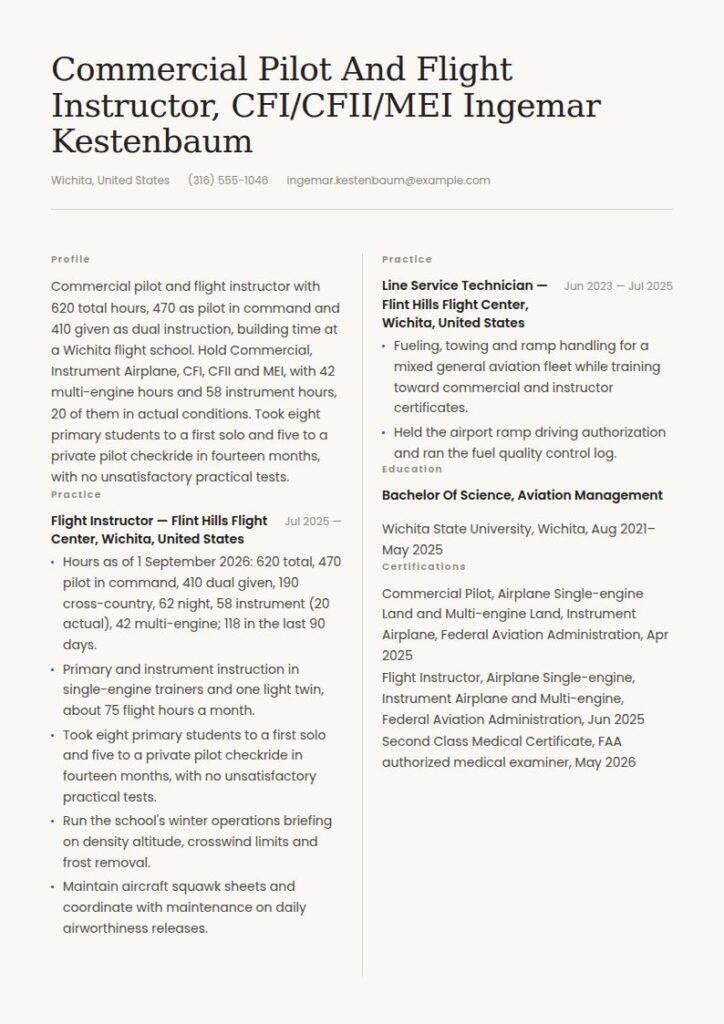
Commercial Pilot and Flight Instructor, CFI/CFII/MEI Ingemar Kestenbaum
Flight Instructor
[email protected] | (316) 555-1046 | Wichita, United States
Profile
Commercial pilot and flight instructor with 620 total hours, 470 as pilot in command and 410 given as dual instruction, building time at a Wichita flight school. Hold Commercial, Instrument Airplane, CFI, CFII and MEI, with 42 multi-engine hours and 58 instrument hours, 20 of them in actual conditions. Took eight primary students to a first solo and five to a private pilot checkride in fourteen months, with no unsatisfactory practical tests.
Work Experience
07/2025 - Present, Flight Instructor, Flint Hills Flight Center, Wichita, United States
- Hours as of 1 September 2026: 620 total, 470 pilot in command, 410 dual given, 190 cross-country, 62 night, 58 instrument (20 actual), 42 multi-engine; 118 in the last 90 days.
- Primary and instrument instruction in single-engine trainers and one light twin, about 75 flight hours a month.
- Took eight primary students to a first solo and five to a private pilot checkride in fourteen months, with no unsatisfactory practical tests.
- Run the school's winter operations briefing on density altitude, crosswind limits and frost removal.
- Maintain aircraft squawk sheets and coordinate with maintenance on daily airworthiness releases.
06/2023 - 07/2025, Line Service Technician, Flint Hills Flight Center, Wichita, United States
- Fueling, towing and ramp handling for a mixed general aviation fleet while training toward commercial and instructor certificates.
- Held the airport ramp driving authorization and ran the fuel quality control log.
Education
08/2021 - 05/2025, Bachelor of Science, Aviation Management, Wichita State University, Wichita, United States
Coursework in aviation safety, meteorology and airport operations.
Skills
Primary and instrument flight instruction, 85
Single-engine and light twin operations, 80
Weight and balance and performance calculation, 85
Weather analysis and go/no-go decisions, 80
Crosswind and short field technique, 80
Electronic flight bag and charting, 85
Airworthiness release coordination, 75
Languages
English, native
German, intermediate
Certificates
04/2025, Commercial Pilot, Airplane Single-engine Land and Multi-engine Land, Instrument Airplane, Federal Aviation Administration
Instrument airplane rating issued 2024.
06/2025, Flight Instructor, Airplane Single-engine, Instrument Airplane and Multi-engine, Federal Aviation Administration
CFI, CFII and MEI.
05/2026, Second Class Medical Certificate, FAA authorized medical examiner
Summary
A pilot resume is a one to two page document whose most important section is a short table of logged hours placed above your experience. This guide gives you three adaptable versions, the layout of an hours block a chief pilot can read in seconds, how to show a thin category honestly, and current Bureau of Labor Statistics pay and outlook for commercial and airline flying.
Pilot resume examples by experience level
A pilot resume is a one to two page document, and unlike almost every other resume in the world, its most important section is a table of numbers.
In practice, a chief pilot opening your file looks for the hours block first. That means not the summary, not the employers, not the education. Specifically, they want total time, pilot in command, multi-engine, instrument and recency, in that general order, and they want it in about four seconds. If those numbers are scattered through your job bullets, the reader has to add up your career by hand, and most will not.
In short, this guide is about how to put a logbook on a page.
Resume guide for a pilot resume
To that end, this guide and the corresponding pilot resume example will cover:
- How to write a pilot resume, section by section
- How to lay out an hours block, and which lines to put in it
- Three adaptable summaries: flight instructor, charter pilot and chief pilot
- How to show a thin hours category honestly instead of hiding it
- What the job market looks like and what you can expect to earn
How to write a pilot resume
Overall, it takes six sections: contact header, summary, hours block, certificates and ratings, flying experience, and education and training. One page while you are building time; two once the experience section carries real operational responsibility.
However, the unusual part of the order is that two blocks of structured facts sit above the narrative. That is deliberate, and it matches how the file is read.
| Section | What it is answering | Where it goes |
|---|---|---|
| Hours block | What does this pilot's logbook total, by category? | Directly under the summary, as a table |
| Certificates and ratings | What are they legally allowed to fly, and in what conditions? | Immediately after the hours block |
| Flying experience | What kind of operation, what equipment, what responsibility? | Reverse chronological, aircraft named in the header |
| Education and training | Type courses, recurrent training, upset and CRM courses | Short, at the foot of the page |
Date the hours block, because an undated one is treated as old
Write one line above or below the table: "Hours as of 1 September 2026". Logbooks move, and a reader who cannot tell how fresh the totals are will assume the worst case, which is that they were true some months ago.
Two habits follow from the same idea. Update the block before every application rather than once a year, and keep the totals in whole hours with no rounding upward. A pilot writing 1,500 when the logbook says 1,462 has said something checkable and wrong, and the logbook is checked.
If you are actively building time, add a recency line: hours in the last 90 days and the last 12 months. It tells the reader you are current in practice, not just on paper.
Run the finished file through the ATS resume checker before you send it. Operators and flight departments increasingly collect applications through portals that read the file into fields before a chief pilot sees it.
Choosing the best resume format for a pilot resume
For format, use reverse chronological, single column, with one plain table near the top. In fact, that table is the only structural difference between a pilot resume and any other professional resume, and it earns its place.
Even so, keep the table simple: two columns, category on the left and hours on the right, no shading, no graphics, no logbook screenshots. After all, a scanned logbook page is not a resume section and it does not parse.
As for length, two pages are normal once you have several types and a training or management line. On the other hand, what is not normal is a page of hours in twenty categories. Instead, pick the ten or twelve that matter for the flying you are applying to, and keep the rest in the logbook where they live.
Include your contact information
| ✅ Right | ❌ Wrong |
|---|---|
| Ingemar Kestenbaum | Ingemar Kestenbaum |
| Commercial Pilot, ASEL, AMEL, Instrument Airplane. First Class Medical, valid. | Professional pilot with a love of aviation |
| Wichita, KS. 3,140 total, 2,050 PIC, 1,620 multi-engine as of 1 Sep 2026. | Wichita, KS |
| (316) 555-1046, [email protected] | (316) 555-1046, [email protected] |
Also, three numbers in the header is not a gimmick. It means a reader who is only screening for a threshold can finish with your file in four seconds and either keep it or move on, and being screened out quickly by the wrong operator is better than being lost in the middle of a stack.
Make use of a summary
First, write four lines: what you fly, the operation you fly it in, one number from the hours block, and one thing you are responsible for beyond the controls.
Commercial pilot and flight instructor with 620 total hours, 470 as pilot in command and 410 given as dual instruction, building time at a Wichita flight school. Hold Commercial, Instrument Airplane, CFI, CFII and MEI, with 42 multi-engine hours and 58 instrument hours, 20 of them in actual conditions. Took eight primary students to a first solo and five to a private pilot checkride in fourteen months, with no unsatisfactory practical tests.
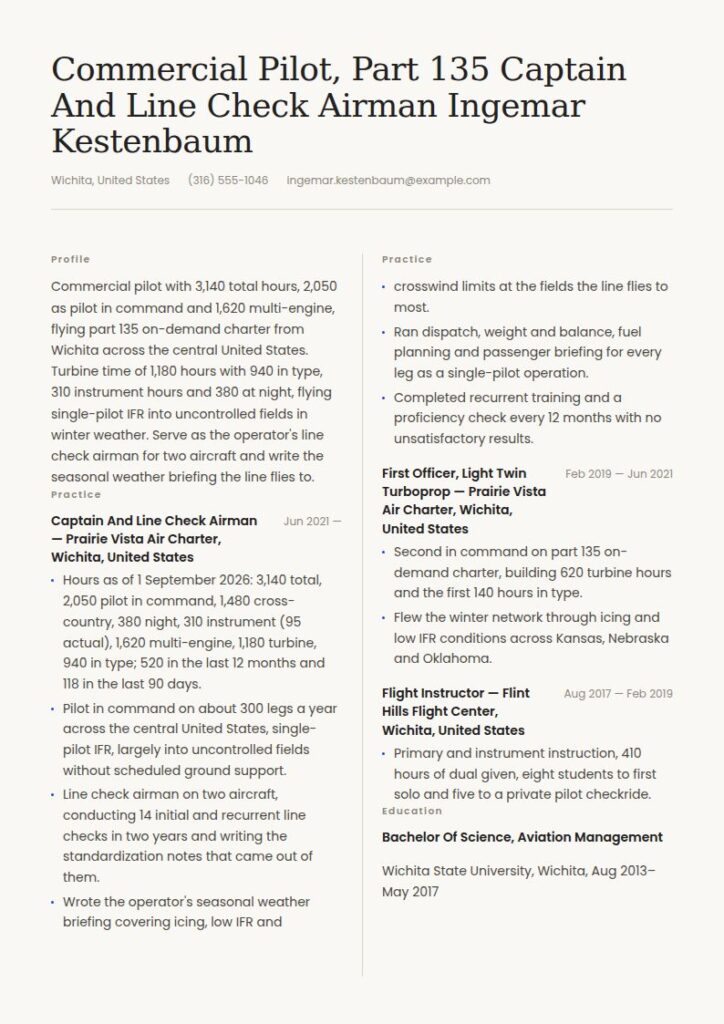
Commercial pilot with 3,140 total hours, 2,050 as pilot in command and 1,620 multi-engine, flying part 135 on-demand charter from Wichita across the central United States. Turbine time of 1,180 hours with 940 in type, 310 instrument hours and 380 at night, flying single-pilot IFR into uncontrolled fields in winter weather. Serve as the operator's line check airman for two aircraft and write the seasonal weather briefing the line flies to.
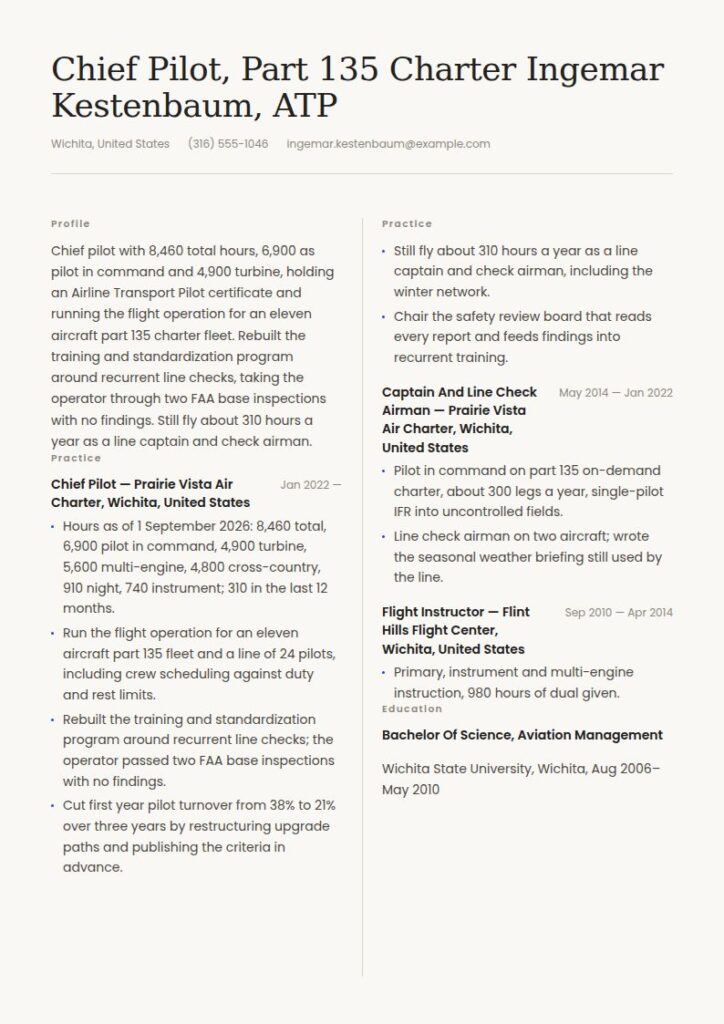
Chief pilot with 8,460 total hours, 6,900 as pilot in command and 4,900 turbine, holding an Airline Transport Pilot certificate and running the flight operation for an eleven aircraft part 135 charter fleet. Rebuilt the training and standardization program around recurrent line checks, taking the operator through two FAA base inspections with no findings. Still fly about 310 hours a year as a line captain and check airman.
Right vs wrong: the same pilot summary, twice
| ✅ Right | ❌ Wrong |
|---|---|
| 3,140 total hours, 2,050 PIC, 1,620 multi-engine, 1,180 turbine, as of 1 September 2026. | Thousands of hours of flight experience in a variety of aircraft. |
| Part 135 on-demand charter, single-pilot IFR into uncontrolled fields in winter weather. | Extensive experience flying in challenging conditions and diverse environments. |
| Line check airman on two aircraft; wrote the seasonal weather briefing the line flies to. | Strong commitment to safety and professionalism at all times. |
By contrast, the wrong column is not modest, it is unreadable. As a result, a reader cannot screen on it, cannot compare it and cannot repeat it to anyone else in the room.
Outline your flying experience
Then put operator, part of the regulations you flew under, aircraft, role and dates in the header. Then three to five bullets, each naming a kind of flying or a responsibility rather than a number you already gave in the table.
| Instead of | Use |
|---|---|
| Flew charter flights for a regional operator | Flew part 135 on-demand charter, single-pilot IFR, in a light twin turboprop across the central United States |
| Accumulated significant flight time | See hours block; in the job bullets, name the operation and the responsibility instead |
| Responsible for the safety of passengers and crew | Pilot in command on about 300 legs a year into uncontrolled fields with no scheduled ground support |
| Performed pre-flight checks and planning | Ran dispatch, weight and balance, and fuel planning for every leg as a single-pilot operation |
| Trained other pilots | Line check airman on two aircraft; conducted 14 initial and recurrent line checks in two years |
Captain and Line Check Airman, Prairie Vista Air Charter, part 135 on-demand, Wichita, KS, light twin turboprop, June 2021 to Present
Pilot in command on about 300 legs a year across the central United States, single-pilot IFR, largely into uncontrolled fields without scheduled ground support.
Line check airman on two aircraft, conducting 14 initial and recurrent line checks in two years and writing the standardization notes that came out of them.
Wrote the operator's seasonal weather briefing covering icing, low IFR and crosswind limits at the fields we fly to most, now used by the whole line.
Ran dispatch, weight and balance, fuel planning and passenger briefing for every leg as a single-pilot operation.
Completed recurrent training and a proficiency check every 12 months with no unsatisfactory results.
The hours block: how to lay out total time, PIC, multi-engine and instrument
In short, the hours block is a short table, placed directly under your summary, that tells a reader what your logbook totals without making them read your career.
First, use the category names a reader already has in their head. Those names come from the way flight time is counted in the regulations: 14 CFR 61.159, which sets out the aeronautical experience for an airline transport pilot certificate with an airplane category rating, counts total time as a pilot, cross-country time, night flight time, instrument flight time in actual or simulated instrument conditions, and flight time in an airplane as pilot in command. Everyone in the industry reads hours in those words, so write them in those words.
For example, a block that works looks like this:
| Category | Hours |
|---|---|
| Total time | 3,140 |
| Pilot in command | 2,050 |
| Cross-country | 1,480 |
| Night | 380 |
| Instrument, actual and simulated | 310 (95 actual) |
| Multi-engine | 1,620 |
| Turbine | 1,180 |
| Time in type, light twin turboprop | 940 |
| Last 12 months | 520 |
| Last 90 days | 118 |
Hours as of 1 September 2026.
Why this pilot hours layout works
Four things about that layout are doing the work.
Order. Total time, then pilot in command, then the category the job cares about. A reader checks total time to see whether you are in range, then pilot in command to see what kind of time it is, then the specific category their operation runs on.
Equipment lines, not aircraft lists. Multi-engine, turbine and time in type answer questions a list of aircraft models does not. Keep the model list in the experience section.
Recency. Last 12 months and last 90 days matter more than most applicants think, particularly if your totals were mostly built years ago. Two pilots with 3,000 hours are not the same candidate if one flew 500 hours last year and the other flew 40.
A date. Undated totals read as stale, and a reader assumes the number was true whenever the resume was last touched.
Write a thin category as a number, not as a silence
Every logbook is thin somewhere. The common gaps are actual instrument, night, multi-engine and turbine, and each of them is thin for an ordinary reason.
The wrong move is to leave the line out, because a reader who cares about it will notice the absence faster than they would have read the number. The second wrong move is to merge categories to make a total look better, such as folding simulated instrument into actual, which is the one thing on the page that reads as dishonest rather than inexperienced.
Write it plainly and add what you are doing about it: "Actual instrument 95 hours; flying 6 to 8 hours a month in IMC and scheduled for the operator's icing and low IFR recurrent in November". A named plan with a date beats an absence, and it gives the interviewer something to ask about that you have an answer to.
Never estimate a category you did not log, and never round a total upward. The logbook is produced at interview, and a number on the resume that the logbook does not support ends the conversation immediately.
In addition, the block does one more thing: it stops you repeating hours in the bullets. Once the table holds the numbers, every experience bullet is free to describe the flying instead, which is where the interesting part of a pilot resume actually lives.
Build a snapshot of your key pilot skills
For skills, list ten to fourteen entries in three groups. Keep it operational, because a chief pilot reads this block for what you can be put on the line doing.
Flying: Single-pilot IFR, multi-engine turbine operations, uncontrolled field operations, winter and icing operations, mountain and high density altitude flying, crosswind and short field technique
Operational: Dispatch and flight release, weight and balance, fuel planning and tankering, performance calculation, passenger and cargo briefing, duty and rest tracking
Systems and standards: Line check airman duties, recurrent training and proficiency checks, safety management system reporting, crew resource management, flight data and trend monitoring, electronic flight bag and charting
List your education and certificates
Certificates and ratings first with the issuing authority, then medical class and date, then type and recurrent training, then formal education.
Airline Transport Pilot, Airplane Multi-engine Land, Federal Aviation Administration, 2023. Commercial privileges, Airplane Single-engine Land.
Flight Instructor, Airplane Single and Multi-engine, and Instrument Airplane, Federal Aviation Administration, 2019
First Class Medical Certificate, FAA authorized medical examiner, issued August 2026
Recurrent ground and flight training, part 135 operator program, completed annually, last May 2026
Upset Prevention and Recovery Training, 2024
Bachelor of Science, Aviation Management, Wichita State University, Wichita, KS, 2018
Choose the right layout and design
For layout, use a single column, plain type at 11 or 12 point, one table, no photograph and no graphics. That is because aviation employers read documents for a living and the aesthetic they respond to is the aesthetic of a checklist: aligned, dated, unambiguous.
For this reason, keep the hours table as a real table with two columns. Do not put hours in a sidebar, a chart or an infographic; those are exactly the constructions a portal drops when it parses the file, and the hours are the part you cannot afford to lose.
Put a dated hours block under the summary. Use the standard category names. Include recency lines for the last 12 months and 90 days. Give time in type as its own line. Name the part of the regulations each job was flown under. State your medical class and when it was issued. Keep totals in whole hours exactly as logged.
Do not round a total upward, ever. Do not merge simulated instrument into actual. Do not repeat the hours inside your job bullets. Do not attach a scanned logbook page in place of a table. Do not list twenty categories when ten answer the job. Do not leave the block undated.
Pilot job market and outlook
Note that airline and commercial pilots are counted together by the Bureau of Labor Statistics, and the two halves of that occupation are very different jobs with very different pay.
| Measure | Value |
|---|---|
| Airline and commercial pilot jobs, 2025 | 154,900 |
| Projected change, 2025-35 | 7% (much faster than average), +11,300 |
| Projected annual openings | ~16,400 |
| Typical on-the-job training | Moderate-term on-the-job training |
| Median annual wage, commercial pilots, May 2025 | $123,220 |
| Median annual wage, airline pilots, copilots and flight engineers, May 2025 | $232,140 |
| Median annual wage, occupation overall, May 2025 | $210,020 |
Source: U.S. Bureau of Labor Statistics, Occupational Outlook Handbook, airline and commercial pilots, May 2025 wage data and 2025 to 2035 projections, published 27 August 2026.
Commercial pilots work in five industries, and four of them are nothing like an airline
Commercial pilot employment sits mainly in nonscheduled air transportation, 38 percent, then technical and trade schools at 11 percent, healthcare services at 10 percent, support activities for air transportation at 8 percent and professional, scientific and technical services at 5 percent (BLS Occupational Outlook Handbook, published 27 August 2026).
The May 2025 medians for those industries were $133,150 in nonscheduled air transportation, $129,610 in professional, scientific and technical services, $123,090 in support activities for air transportation, $100,330 in healthcare services and $93,820 in private technical and trade schools (BLS, May 2025).
For a resume this is a targeting instruction rather than a salary table. Charter, flight instruction, air medical, aerial survey and corporate flying read a logbook differently: one wants turbine PIC, another wants dual given, another wants night and actual instrument. Build the hours block so the category that operator cares about is in the top half of it.
Meanwhile, the Handbook's certificate ladder is the other useful map: student pilot, private pilot, instrument rating, commercial pilot, multi-engine rating, and airline transport pilot (BLS Occupational Outlook Handbook, published 27 August 2026). Say where you are on it, in those words, because they are the words the industry uses.
What salary you can expect as a pilot
Commercial pilots had a median annual wage of $123,220 in May 2025, while airline pilots, copilots and flight engineers had $232,140, and the combined occupation sat at $210,020 (BLS Occupational Outlook Handbook, published 27 August 2026). The gap between the two halves is larger than the median wage for most occupations in the country.
Inside commercial flying, however, industry is the main lever. For example, nonscheduled air transportation paid $133,150 in May 2025, professional, scientific and technical services $129,610, support activities for air transportation $123,090, healthcare services $100,330 and private technical and trade schools $93,820 (BLS, May 2025).
None of that is negotiated on a resume, but the resume decides which of those markets reads you as a serious candidate. Similarly, turbine PIC opens charter and corporate flying. Dual given opens instruction. In the same way, night and actual instrument, with recency, open air medical. Finally, multi-engine and cross-country time open the route toward airline flying. The hours block is where all four of those conversations start, which is why it belongs at the top of the page rather than in the middle of it.
Key takeaways for a pilot resume
- First, put a dated hours block directly under your summary, as a plain two column table.
- Then use the standard categories: total, PIC, cross-country, night, instrument, multi-engine, turbine, time in type.
- Add recency lines for the last 12 months and the last 90 days.
- Also, name the part of the regulations each job was flown under, and the aircraft.
- Write a thin category as a number with a plan attached, never as a silence.
- Above all, never round upward or merge categories; the logbook comes out at interview.
- Keep the hours out of the bullets so the bullets can describe the flying.
Build your pilot resume in 15 minutes with our AI resume builder.
Related transportation resume examples
- Airline pilot resume
- Aviation resume
- Flight attendant resume
- Transportation resume
- Train operator resume
- Seaman resume
- Truck driver resume
- Driver resume
- Bus driver resume
- Uber driver resume
- Dispatcher resume
- Transport and logistics resume
Pair it with a matching pilot cover letter.
Pilot resume questions, answered
How long should a pilot resume be?
One page while you are building time, two once you have several types, a check airman or management line, and operational responsibility worth describing. The hours block should never move to page two.
Where exactly does the hours block go?
Directly under the summary and above your experience. That is the first place a reader looks, and putting it there saves them the work of assembling your totals from your job history. Keep it to ten or twelve lines chosen for the flying you are applying to.
Should I include simulator time?
List it separately and label it, never inside a flight time category. Simulated instrument time is already a standard category and belongs on its own line or in a parenthesis beside actual instrument. Full flight simulator or training device time goes in the training section with the device and the program named.
What if my hours are mostly old?
Show the totals honestly and put the recency lines right beneath them, then say in the experience section what you have been doing since. An interviewer's real question is whether you are current and proficient, so answer that directly rather than hoping they read past the totals.
How do I write a pilot resume for a job outside the airlines?
Reorder the hours block. An air medical operator reads night and actual instrument first; a charter operator reads turbine PIC and time in type; a flight school reads dual given and instructor certificates. The same logbook, presented in the order the reader cares about, is the only tailoring most pilot resumes need.