Ingemar Kestenbaum Commercial Pilot, Part 135 Captain and Line Check Airman Wichita, 67208, United States [email protected] · (316) 555-1046
11 September 2026
Mr. Terrence Blaylock Flight Operations Cedar Bluff Air Medical Hays, United States
Application for Line Captain, Cedar Bluff Air Medical
Dear Mr. Blaylock,
I am applying for the line captain post at Cedar Bluff Air Medical. My logbook stands at 3,140 total hours as of 1 September 2026, with 2,050 as pilot in command, 380 at night, 310 instrument of which 95 are actual, and 1,180 turbine hours with 940 in a light twin turboprop. I have flown 520 of those hours in the last twelve months.
Most of that time is single-pilot IFR on part 135 on-demand charter out of Wichita, roughly 300 legs a year into uncontrolled fields across Kansas, Nebraska and Oklahoma, usually without ground support waiting at the other end. That is the part I would bring over: night arrivals at unattended fields, self-briefed weather, my own dispatch, weight and balance and fuel planning, and a decision to go or not that nobody else is going to make. I am a line check airman on two aircraft and I wrote the seasonal briefing our line flies to on icing, low IFR and crosswind limits.
Air medical flying is the mission I have been aiming at, and I know the two categories you will look at hardest are night and actual instrument. Mine are 380 and 95. I have been flying six to eight hours a month in instrument conditions and I am booked on icing and low IFR recurrent in November, so both numbers will keep moving in the direction you need them to.
I hold a First Class Medical issued August 2026, my last proficiency check was May 2026 with no unsatisfactory results, and I can give my current operator four weeks' notice. Thank you for your time.
Sincerely, Ingemar Kestenbaum
Summary
A pilot cover letter names the four hours figures the operator you are writing to actually cares about, describes the flying behind them, and says what you are current and qualified on. This guide gives you a full adaptable letter, the openings that work, how to write about a thin category, and how the letter changes between charter, instruction and air medical flying.
Pilot cover letter examples by experience level
A pilot cover letter is a one page letter that picks four numbers out of your logbook and explains the flying behind them.
The reader is usually a chief pilot who has already seen your hours block on the resume. The letter adds what a table cannot carry: what those hours were like, what you were responsible for, and why this operator's flying is flying you have already done.
Guide to a pilot cover letter
This guide and the corresponding pilot cover letter example will cover:
- How to structure the letter, paragraph by paragraph
- Which four hours figures to name, and how to choose them per operator
- How to write about a thin category without apologizing for it
- What changes between charter, instruction, survey and air medical letters
- The closing line that answers a chief pilot's real question
How to write a pilot cover letter
| Paragraph | Its job | Length |
|---|---|---|
| Opening | The post, and the four hours figures this operator screens on | 2 to 3 sentences |
| Evidence | The flying behind those hours: operation, conditions, responsibility | 4 to 5 sentences |
| Fit | Their network or mission, and the category of yours that matches it | 3 to 4 sentences |
| Close | Currency, medical, training status, availability, thank you | 2 sentences |
Choose the four figures for the operator, not for yourself
Nearly every pilot letter opens with total time and stops there. Total time is the least informative number you own, because it says nothing about what kind of flying built it.
Pick four that this operator screens on. A charter operator reads turbine pilot in command and time in type. An air medical operator reads night and actual instrument, and then recency. A flight school reads dual given and instructor certificates. A survey operator reads single-pilot hours and low-level experience.
The categories themselves are standard, which is why a reader knows them without explanation: total time, cross-country, night, instrument in actual or simulated conditions, and pilot in command time are the terms used to count aeronautical experience in 14 CFR 61.159. Use those words and nobody has to translate.
A pilot cover letter example you can adapt
Dear Mr. Blaylock,
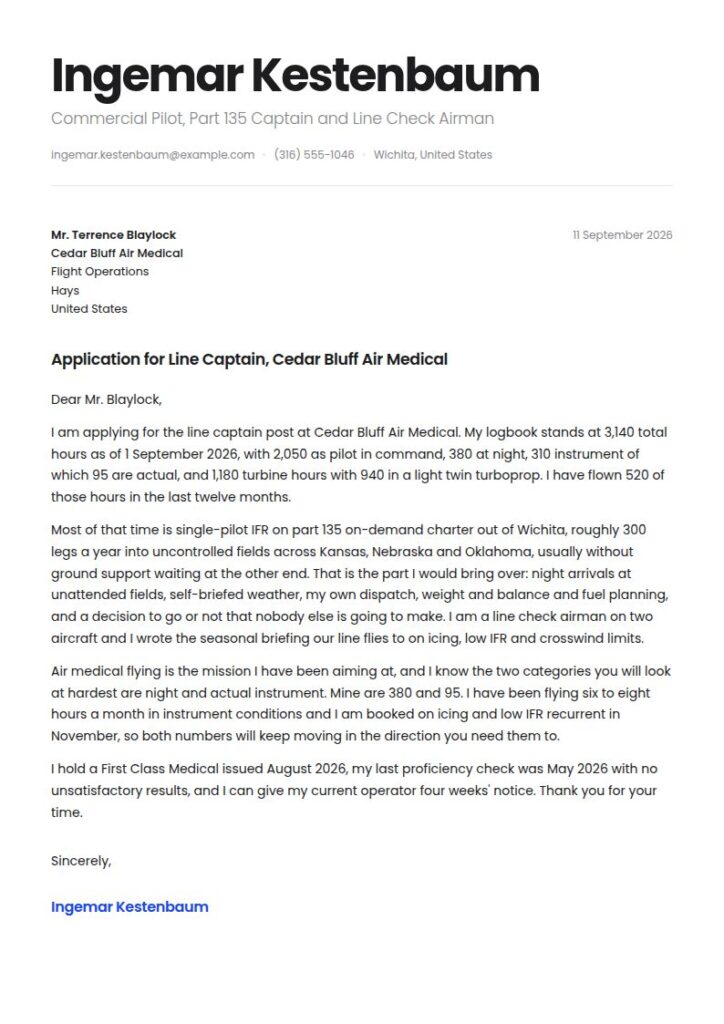
I am applying for the line captain post at Cedar Bluff Air Medical. My logbook stands at 3,140 total hours as of 1 September 2026, with 2,050 as pilot in command, 380 at night, 310 instrument of which 95 are actual, and 1,180 turbine hours with 940 in a light twin turboprop. I have flown 520 of those hours in the last twelve months.
Most of that time is single-pilot IFR on part 135 on-demand charter out of Wichita, roughly 300 legs a year into uncontrolled fields across Kansas, Nebraska and Oklahoma, usually without ground support waiting at the other end. That is the part I would bring over: night arrivals at unattended fields, self-briefed weather, my own dispatch, weight and balance and fuel planning, and a decision to go or not that nobody else is going to make. I am a line check airman on two aircraft and I wrote the seasonal briefing our line flies to on icing, low IFR and crosswind limits.
Air medical flying is the mission I have been aiming at, and I know the two categories you will look at hardest are night and actual instrument. Mine are 380 and 95. I have been flying six to eight hours a month in instrument conditions and I am booked on icing and low IFR recurrent in November, so both numbers will keep moving in the direction you need them to.
I hold a First Class Medical issued August 2026, my last proficiency check was May 2026 with no unsatisfactory results, and I can give my current operator four weeks' notice. Thank you for your time.
Sincerely, Ingemar Kestenbaum
Openings that work
| Instead of | Use |
|---|---|
| I have loved aviation since I was a child | 3,140 total as of 1 September 2026, 2,050 PIC, 380 night, 95 actual instrument |
| I have extensive experience flying in challenging conditions | Single-pilot IFR into uncontrolled fields across Kansas, Nebraska and Oklahoma |
| I am a safe and professional pilot | Last proficiency check May 2026, no unsatisfactory results, 520 hours in the last twelve months |
| I would love the opportunity to fly for your company | Night and actual instrument are the two categories you will read first; mine are 380 and 95 |
The pattern is the same in every row: replace a feeling with a figure, then say what the figure was like to fly.
What counts as evidence in a pilot letter
| Kind of evidence | What it looks like in a sentence |
|---|---|
| Hours, chosen | 2,050 PIC, 1,180 turbine, 940 in type, as of 1 September 2026 |
| Recency | 520 hours in the last twelve months, 118 in the last 90 days |
| Conditions | Night arrivals at unattended fields, self-briefed weather, winter icing network |
| Responsibility | Line check airman on two aircraft, 14 line checks conducted in two years |
| Standards | Last proficiency check May 2026, no unsatisfactory results |
| Written work | Wrote the seasonal weather briefing the line flies to |
A chief pilot is working out what you do on a bad night with nobody to ask. Everything above helps them answer that; adjectives do not.
Writing about a thin category
Name the thin category before the reader finds it, with the real number. Say what you are doing about it and put a date on the plan. Keep total time in the same sentence as the category that matters, so the reader gets scale and relevance together. Give your medical class and issue date. Say when your last proficiency or line check was. State your notice period.
Do not round a total upward, since the logbook is produced at interview and the letter is checked against it. Do not merge simulated instrument into actual, or dual received into pilot in command. Do not apologize for hours you have not flown yet. Do not send the same four figures to every operator. Do not exceed one page.
Commercial flying is five industries, and each reads a different line of your logbook
Commercial pilots work mainly in nonscheduled air transportation, 38 percent of them, then technical and trade schools at 11 percent, healthcare services at 10 percent, support activities for air transportation at 8 percent and professional, scientific and technical services at 5 percent (BLS Occupational Outlook Handbook, published 27 August 2026).
Those industries paid May 2025 medians of $133,150, $93,820, $100,330, $123,090 and $129,610 respectively, against a commercial pilot median of $123,220 and an occupation-wide median of $210,020 that includes airline flying (BLS, May 2025).
The practical point is not the pay ladder, it is that each of those employers screens a different line of the same logbook. One letter with one set of four figures cannot serve them all, and the rewrite takes about ten minutes.
Length, format and sending it
One page, four paragraphs, 250 to 400 words. PDF, named for the post: ingemar-kestenbaum-line-captain-cover-letter.pdf.
Address a person. Chief pilots and directors of operations are usually named in the posting, and a letter precise about hours and vague about who it is for reads oddly in an industry built on precision.
Make every figure match your resume exactly, including the as-of date. Two different totals across two documents invites the question of which logbook the reader is being shown. Our pilot resume example uses the same hours block as this letter.
Key takeaways
- Open with four hours figures chosen for this operator, not with total time alone.
- Give the as-of date for the numbers, in the letter as well as the resume.
- Describe the flying behind the hours: operation, conditions, responsibility.
- Name a thin category yourself, with the number and a dated plan.
- Add recency: hours in the last twelve months and the last 90 days.
- Close with medical class, last check, and notice period.
- Address a named person and keep it to one page.
Write your pilot cover letter in 10 minutes with our AI cover letter builder.
Pilot cover letter questions, answered
How long should a pilot cover letter be?
One page, four paragraphs, 250 to 400 words. A chief pilot reads it beside an hours block they have already scanned, so the letter's job is to add the flying, not to repeat the table.
Should I put hours in the letter if they are already on the resume?
Yes, but only four of them, and only the four this operator screens on. The resume carries the full block; the letter shows that you know which lines of it matter to the reader.
How do I write about a category where I am short?
Name it, give the real number, and attach a dated plan: "Actual instrument 95 hours; flying six to eight hours a month in instrument conditions and booked on icing and low IFR recurrent in November". Honest and moving beats silent, and it gives the interview somewhere useful to go.
What do I write as a low-time pilot?
Write the flying you have actually done rather than the flying you want. Dual given, students to checkride, cross-country legs planned and flown, the weather you turned down, the recurrent training you paid for yourself. The Handbook's certificate ladder runs student, private, instrument rating, commercial, multi-engine rating, airline transport pilot (BLS Occupational Outlook Handbook, published 27 August 2026); say exactly where you are on it and what you are working on next.
Does the letter change between charter, instruction and air medical?
Yes, and mostly in the first paragraph. Swap the four figures, then swap the example of the flying behind them. The middle paragraph of a charter letter is about single-pilot decision making, an instruction letter is about student outcomes, and an air medical letter is about night, weather and the discipline of turning a flight down.