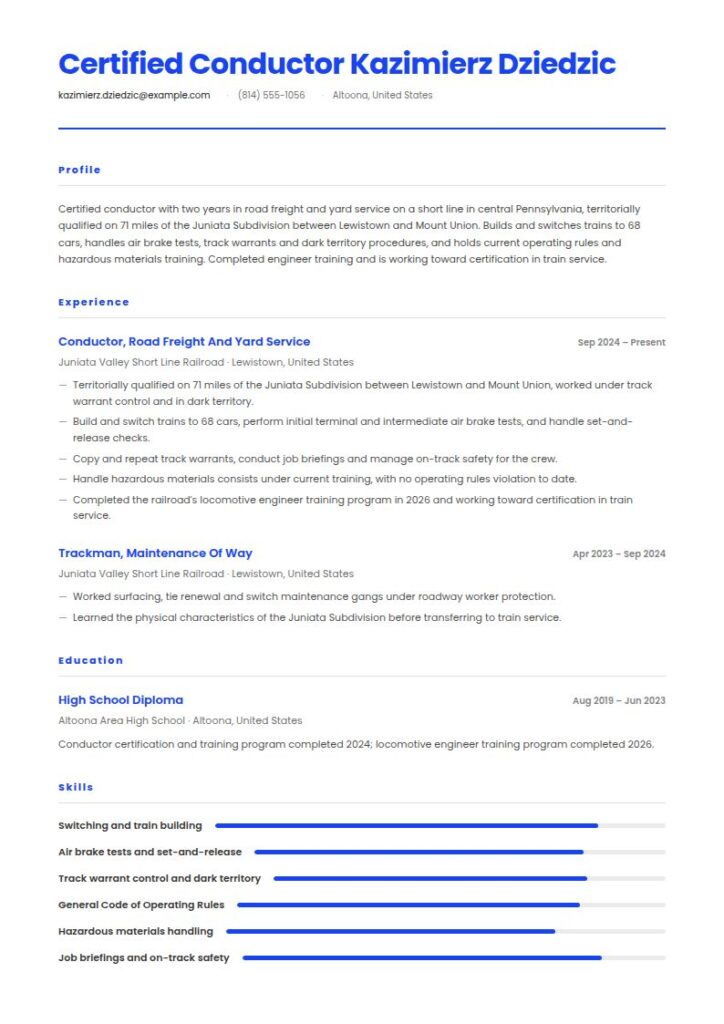
Certified Conductor Kazimierz Dziedzic
Conductor, Road Freight and Yard Service
[email protected] | (814) 555-1056 | Altoona, United States
Profile
Certified conductor with two years in road freight and yard service on a short line in central Pennsylvania, territorially qualified on 71 miles of the Juniata Subdivision between Lewistown and Mount Union. Builds and switches trains to 68 cars, handles air brake tests, track warrants and dark territory procedures, and holds current operating rules and hazardous materials training. Completed engineer training and is working toward certification in train service.
Work Experience
09/2024 - Present, Conductor, Road Freight and Yard Service, Juniata Valley Short Line Railroad, Lewistown, United States
- Territorially qualified on 71 miles of the Juniata Subdivision between Lewistown and Mount Union, worked under track warrant control and in dark territory.
- Build and switch trains to 68 cars, perform initial terminal and intermediate air brake tests, and handle set-and-release checks.
- Copy and repeat track warrants, conduct job briefings and manage on-track safety for the crew.
- Handle hazardous materials consists under current training, with no operating rules violation to date.
- Completed the railroad's locomotive engineer training program in 2026 and working toward certification in train service.
04/2023 - 09/2024, Trackman, Maintenance of Way, Juniata Valley Short Line Railroad, Lewistown, United States
- Worked surfacing, tie renewal and switch maintenance gangs under roadway worker protection.
- Learned the physical characteristics of the Juniata Subdivision before transferring to train service.
Education
08/2019 - 06/2023, High School Diploma, Altoona Area High School, Altoona, United States
Conductor certification and training program completed 2024; locomotive engineer training program completed 2026.
Skills
Switching and train building, 85
Air brake tests and set-and-release, 80
Track warrant control and dark territory, 80
General Code of Operating Rules, 80
Hazardous materials handling, 75
Job briefings and on-track safety, 85
Languages
English, native
Polish, native
Certificates
08/2024, Certified Conductor, Juniata Valley Short Line Railroad, under Federal Railroad Administration certification requirements
Territorially qualified on the Juniata Subdivision, Lewistown to Mount Union.
02/2026, Hazardous Materials Training, Juniata Valley Short Line Railroad
Summary
A train operator resume is a one to two page document whose two most valuable lines are your Federal Railroad Administration certification class and the named subdivisions you are territorially qualified on. Together they tell a railroad what it can assign you to without re-qualifying you first. This guide gives you three adaptable versions, the qualification block most applicants leave out, and current Bureau of Labor Statistics pay and outlook for railroad workers.
Train Operator resume examples by experience level
In short, a train operator resume is a one to two page document, and two lines on it decide almost everything: the class of your federal certification, and the names of the subdivisions you are qualified to run over.
Notably, neither line is about how well you operate a train. Instead, they are about what a railroad can legally and immediately do with you. In practice, a railroad can put a candidate certified in the right class and already qualified on the territory being crewed on a job in days. By contrast, one with the same years and no territory has to be re-qualified first, which costs a railroad weeks of a supervisor's time.
Resume guide for a train operator resume
To help, this guide and the corresponding train operator resume example will cover:
- How to write a train operator resume, block by block
- Why the certification class and the named territory belong above your experience
- Three adaptable summaries: conductor, locomotive engineer and road foreman
- How the prior conduct review and the vision standard affect what you write
- What the job market looks like and what you can expect to earn
How to write a train operator resume
Overall, it takes six blocks: contact header, summary, certification and territorial qualification, operating experience, equipment and rules, and education with training. As for length, use one page as a conductor, two once you carry engineer certification, multiple territories and a supervisory or instructing role.
The certification block goes above experience because it is a legal gate. In fact, the Bureau of Labor Statistics records that locomotive engineers and conductors must be certified by the Federal Railroad Administration (BLS Occupational Outlook Handbook, Railroad Workers, published 27 August 2026), and a railroad cannot put an uncertified operator on a train whatever their history says.
| Block | What it answers for the reader | Where it goes |
|---|---|---|
| Certification and territory | What can this railroad legally assign, and where, without re-qualifying them? | Directly under the summary |
| Operating experience | What service, what tonnage, what grade, what territory type? | Reverse chronological, territory named |
| Equipment and rules | Which locomotives, which signal systems, which rule book? | Its own short block |
| Education and training | What has a railroad already spent on this person? | Last, with program names and dates |
Write the subdivision by name, not the region
"Qualified on multiple territories in central Pennsylvania" is a sentence a road foreman cannot use. "Territorially qualified on the Summit Subdivision, the Juniata Subdivision and the Tyrone Secondary" is one they can act on immediately, because they know which of those overlaps with the jobs they are trying to fill.
Give each territory its mileposts or end points, its ruling grade if it has one, and the signal system. A 1.8 percent descending grade worked with dynamic braking and retainer practice is a different professional life from flat centralized traffic control territory.
If you have let a territory lapse, say so with the year. A lapsed qualification is a shorter re-qualification than a new one.
Run the finished file through the ATS resume checker before you submit it. Railroads read applications into a structured record before a human opens them.
Choosing the best resume format for a train operator resume
For format, use reverse chronological, with the certification block ahead of it. Railroading is a seniority profession and the dates are the substance, so any format that hides the sequence reads as concealment.
Note that people use the phrase train operator for rail transit as well as for railroad service. Note that this guide is written for the railroad side, where operators hold federal certification under 49 CFR part 240 and work under a railroad's operating rules. If you have worked both, write each separately and name the rule book, because the qualifications do not transfer.
Also, write gaps in plainly: a furlough, a medical leave, time on a different craft. Railroads verify service records, so a silence on the page becomes a question in the interview.
Include your contact information
| ✅ Right | ❌ Wrong |
|---|---|
| Kazimierz Dziedzic | Kazimierz Dziedzic |
| Certified Locomotive Engineer, Train Service | Experienced railroad professional |
| Qualified: Summit Sub, Juniata Sub, Tyrone Secondary | Familiar with multiple territories |
| (814) 555-1056, [email protected], Altoona, PA | (814) 555-1056, [email protected] |
First, put the certification class and the territory list in the header. That is because a road foreman filling a job on one subdivision is scanning for that subdivision's name, and a name that appears only on page two is a name the scan missed.
Make use of a summary
Then write four lines: the craft and certification class, the years and the service, the territories by name, and one operating fact with a number attached.
Certified conductor with two years in road freight and yard service on a short line in central Pennsylvania, territorially qualified on 71 miles of the Juniata Subdivision between Lewistown and Mount Union. Builds and switches trains to 68 cars, handles air brake tests, track warrants and dark territory procedures, and holds current operating rules and hazardous materials training. Completed engineer training and is working toward certification in train service.
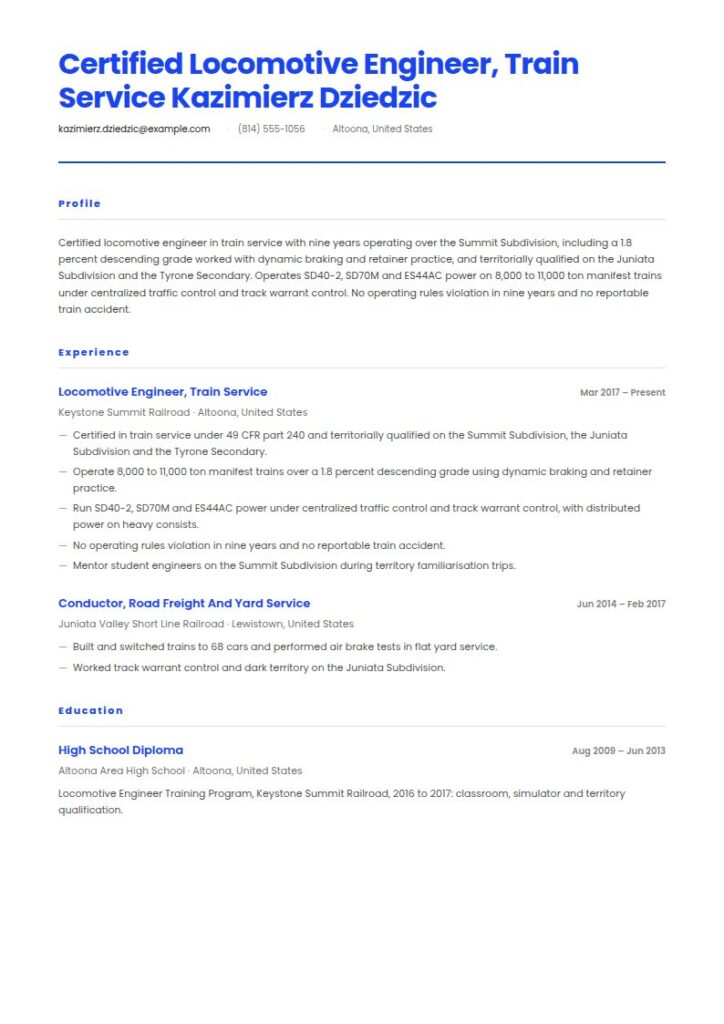
Certified locomotive engineer in train service with nine years operating over the Summit Subdivision, including a 1.8 percent descending grade worked with dynamic braking and retainer practice, and territorially qualified on the Juniata Subdivision and the Tyrone Secondary. Operates SD40-2, SD70M and ES44AC power on 8,000 to 11,000 ton manifest trains under centralized traffic control and track warrant control. No operating rules violation in nine years and no reportable train accident.
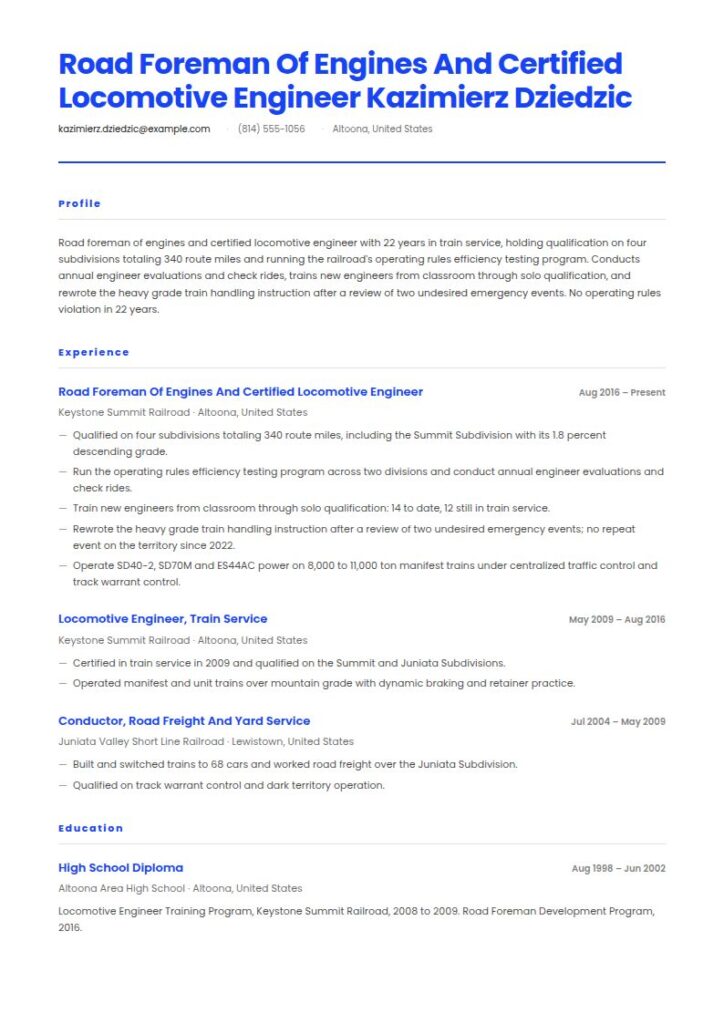
Road foreman of engines and certified locomotive engineer with 22 years in train service, holding qualification on four subdivisions totaling 340 route miles and running the railroad's operating rules efficiency testing program. Conducts annual engineer evaluations and check rides, trains new engineers from classroom through solo qualification, and rewrote the heavy grade train handling instruction after a review of two undesired emergency events. No operating rules violation in 22 years.
Right vs wrong: the same train operator summary, twice
| ✅ Right | ❌ Wrong |
|---|---|
| Certified locomotive engineer in train service with nine years over the Summit Subdivision. | Experienced train operator with a strong safety record and a good work ethic. |
| Qualified on the Juniata Subdivision and the Tyrone Secondary; 1.8 percent descending grade worked with dynamic braking. | Familiar with a variety of territories and equipment. |
| SD40-2, SD70M and ES44AC power on 8,000 to 11,000 ton manifest trains under CTC and track warrant control. | Operates locomotives safely in accordance with all applicable rules. |
For example, the left column can be crewed on a job next week. By contrast, the right column needs an interview to find out what it means, and a railroad short of crews is not short of applications.
Outline your operating experience
Then put railroad, craft, service, territory and dates in the header line. Then three to five bullets, each carrying something a railroader would recognize: tonnage, car counts, grade, signal system, equipment, a program, a training role.
| Instead of | Use |
|---|---|
| Operated trains safely and efficiently | Operated 8,000 to 11,000 ton manifest trains over a 1.8 percent descending grade using dynamic braking and retainer practice |
| Followed all railroad rules and regulations | No operating rules violation in nine years and no reportable train accident |
| Worked in yard and road service | Built and switched trains to 68 cars in flat yard service, then moved to road freight over three subdivisions |
| Trained other employees | Trained 14 engineers from classroom through solo qualification; 12 still in train service |
Road Foreman of Engines and Certified Locomotive Engineer, Keystone Summit Railroad, Altoona, PA, August 2016 to Present
Qualified on four subdivisions totaling 340 route miles, including the Summit Subdivision with its 1.8 percent descending grade, and hold engineer certification in train service.
Run the operating rules efficiency testing program across two divisions and conduct annual engineer evaluations and check rides.
Train new engineers from classroom through solo qualification: 14 to date, 12 still in train service.
Rewrote the heavy grade train handling instruction after a review of two undesired emergency events; no repeat event on the territory since 2022.
Operate SD40-2, SD70M and ES44AC power on 8,000 to 11,000 ton manifest trains under centralized traffic control and track warrant control.
Name the territory you are qualified on and your certification class
In short, these are the two facts a railroad reader looks for, in that order, and they are the two most railroad resumes never state outright.
Start with the class. The Federal Railroad Administration certifies locomotive engineers under 49 CFR part 240, and § 240.107 sets out three classes of certification: train service, locomotive servicing, and student. However, they are not ranks and they are not interchangeable. For example, a train service certification is what a road or yard job requires. Locomotive servicing, on the other hand, covers movement of locomotives without cars in and around servicing facilities. Student is the certification you hold while qualifying. Writing "certified engineer" leaves a reader to work out which of the three you mean; instead, writing "certified locomotive engineer, train service" closes the question in four words.
Territorial qualification for train operators
Then the territory, which is the line that actually moves your file. Under § 240.7, territorial qualification means possessing the necessary knowledge of a railroad's operating rules and timetable special instructions, including familiarity with the applicable physical characteristics of main track and of track other than main track. In practice you learn that by riding the territory, studying the timetable and passing a check on it, and it is why a railroad values a candidate who already holds it. Qualification is railroad-specific and territory-specific, so it does not travel with you between railroads, but a candidate who has qualified on four subdivisions has demonstrated they can learn a fifth.
| What to write | Why it is read |
|---|---|
| Certification class in the words of § 240.107: train service, locomotive servicing or student | Says which jobs you can legally hold from day one |
| Each subdivision or branch by name, with end points or mileposts | Matches directly against the jobs being crewed |
| Ruling grade and the handling it demands | Distinguishes mountain railroading from flat territory |
| Signal and authority systems: centralized traffic control, track warrant control, automatic block, dark territory | Tells a reader what rules environment you have worked |
| Lapsed territories, with the year | A shorter re-qualification than a new territory |
| The rule book you were examined on, and the year | Rule books differ by railroad; recency matters |
Conduct review and vision standard
Two further parts of part 240 belong on a resume because a railroad will check them anyway.
The first is the prior safety conduct review. Section 240.109 requires a railroad to evaluate a candidate's prior safety conduct before certifying them, and the sections underneath it name what is looked at: the motor vehicle driving record under § 240.115, operating rules compliance under § 240.117, and substance abuse disorders and alcohol or drug rules compliance under § 240.119. A resume cannot pre-empt that review, but it can state the facts plainly rather than leaving a silence. If your operating record is clean, say so with a number of years attached. If it is not, an honest line on the page is better than a surprise in a file.
The second is the vision standard. Section 240.121 requires distant visual acuity of at least 20/40 (Snellen) in each eye, separately, a field of vision of at least 70 degrees in the horizontal meridian in each eye, and the ability to distinguish railroad signal colors. Most candidates meet it without thinking about it, and the place to discuss any conditional certificate is the medical process rather than the resume.
Certification: Certified Locomotive Engineer, Train Service, under 49 CFR part 240, Keystone Summit Railroad, recertified June 2025
Territorial qualification: Summit Subdivision, Altoona to Johnstown, MP 0.0 to MP 38.4, ruling grade 1.8 percent descending westward, centralized traffic control. Juniata Subdivision, Altoona to Harrisburg, MP 0.0 to MP 132.7, centralized traffic control. Tyrone Secondary, MP 0.0 to MP 24.1, track warrant control. Bald Eagle Branch, MP 0.0 to MP 41.6, dark territory, qualification lapsed 2021.
Rules: General Code of Operating Rules, examined June 2025. Air brake and train handling rules, June 2025. Hazardous materials, February 2026.
Record: No operating rules violation in 22 years, no reportable train accident, no decertification event.
Build a snapshot of your key skills
For skills, list twelve to sixteen entries in four groups: operating, equipment, rules and authority, and safety systems.
Operating: Heavy grade train handling, dynamic braking and retainer practice, distributed power operation, air brake tests and set-and-release, slow order and restricted speed compliance, undesired emergency recovery
Equipment: SD40-2, SD70M, ES44AC, end-of-train devices, positive train control displays, locomotive event recorder downloads
Rules and authority: General Code of Operating Rules, centralized traffic control, track warrant control, automatic block signals, dark territory, on-track safety and roadway worker protection
Safety and training: Operating rules efficiency testing, engineer check rides and annual evaluations, undesired emergency investigation, hazardous materials handling, job briefings
List your education and certifications
Railroads train their operators in-house. Meanwhile, the Bureau of Labor Statistics records a high school diploma or equivalent as the typical entry-level education for railroad workers, with moderate-term on-the-job training after hire (BLS Occupational Outlook Handbook, published 27 August 2026). As a result, what matters on the page is the program, the railroad that ran it, and the dates.
Locomotive Engineer Certification, Train Service, under 49 CFR part 240, Keystone Summit Railroad, first certified 2009, recertified June 2025
Locomotive Engineer Training Program, Keystone Summit Railroad, Altoona, PA, 2008 to 2009. Classroom, simulator and territory qualification.
Conductor Certification and Training Program, Juniata Valley Short Line Railroad, Lewistown, PA, 2004
Road Foreman Development Program, Keystone Summit Railroad, 2016
High School Diploma, Altoona, PA, 2002
Additional: Hazardous materials training, February 2026. Roadway worker protection, 2025. First aid and CPR, American Red Cross, 2026.
Choose the right layout and design
For layout, use one column, 11 or 12 point type, clear headings, no photograph and no graphics. Railroad applicant systems read the file into fields before anyone opens it, and multi-column layouts and boxed sidebars are where that breaks.
Spell out abbreviations once. CTC, TWC, GCOR and PTC are second nature inside the industry, but the first reader may be a recruiter rather than a road foreman.
Write the certification class in the words of § 240.107. Name every territory with end points or mileposts. Give the ruling grade and the signal system. State the rule book and the year you were last examined on it. Put tonnage, car counts and power on the page. Say how long your operating record has been clean. List lapsed territories with the year they lapsed.
Do not write "certified engineer" without the class. Do not summarize territories as a region. Do not describe operating a train in words any applicant could use. Do not omit yard or short line service; switching experience is read as an asset, not a lesser craft. Do not use a two-column template for a railroad portal.
Train operator job market and outlook
A small occupation with very little growth, a steady replacement flow, and hiring that is regional because the work is.
| Measure | Value |
|---|---|
| Railroad worker jobs, 2025 | 80,500 |
| Projected change, 2025-35 | 1% (slower than average), +600 |
| Projected annual openings | ~6,100 |
| Typical entry-level education | High school diploma or equivalent |
| On-the-job training | Moderate-term on-the-job training |
| Median annual wage, railroad workers, May 2025 | $78,820 ($37.90 per hour) |
| Median annual wage, locomotive engineers, May 2025 | $81,410 |
| Median annual wage, railroad conductors and yardmasters, May 2025 | $78,000 |
Source: U.S. Bureau of Labor Statistics, Occupational Outlook Handbook, Railroad Workers, May 2025 wage data and 2025 to 2035 projections, published 27 August 2026.
A small occupation pays well and hires rarely
Railroad workers held 80,500 jobs in 2025, with employment projected to grow 1 percent through 2035, which is slower than the average for all occupations, and about 6,100 openings a year on average over the decade (BLS Occupational Outlook Handbook, Railroad Workers, published 27 August 2026).
The median annual wage was $78,820, or $37.90 an hour, with locomotive engineers at $81,410 and railroad conductors and yardmasters at $78,000 as of May 2025 (BLS, published 27 August 2026).
Around 6,100 openings a year against 80,500 jobs is a narrow door into a well paid occupation. When a railroad does hire, it is filling a specific job on a specific territory, which is why a resume that names the territory is answering the only question that is actually open.
For reference, here is where the work sits, and what it pays there:
| Industry | Median annual wage (May 2025) |
|---|---|
| Local government | $80,000 |
| Rail transportation | $79,000 |
| Support activities for rail transportation | $49,770 |
Source: U.S. Bureau of Labor Statistics, Occupational Outlook Handbook, May 2025.
Even so, the third row is the one worth reading twice. Support activities for rail transportation pays a median of $49,770 against $79,000 in rail transportation itself; as a result, a resume that does not distinguish which side of that line your service was on invites the reader to assume the cheaper one.
What salary you can expect as a train operator
The median annual wage for railroad workers was $78,820 as of May 2025, or $37.90 an hour, with locomotive engineers at $81,410, railroad conductors and yardmasters at $78,000, brake, signal and switch operators and locomotive firers at $68,840, and rail yard engineers, dinkey operators and hostlers at $60,600 (BLS Occupational Outlook Handbook, published 27 August 2026).
In other words, that ladder is the craft progression in this occupation, and a resume that names the craft precisely places you on it. The spread between rail transportation at $79,000 and support activities at $49,770 is much larger than the spread between crafts (BLS, May 2025).
Base pay in this profession is set by agreement rather than negotiated, so what a resume moves is which job you are considered for, and the territory list is what does the moving. Engineer certification in train service, qualification on the territory being crewed, a rules examination in date, and a supervisory or instructing qualification are the four lines that open the better assignments, and each one either appears on the page with a date or does not exist as far as the reader is concerned.
Key takeaways for a train operator resume
- Name the certification class in the words of § 240.107: train service, locomotive servicing or student.
- Also, list every territory by name with its end points or mileposts, and its signal system.
- Give the ruling grade and the handling it demands, because it defines the railroading you have done.
- State the rule book and the year you were last examined on it.
- Put tonnage, car counts and locomotive types on the page.
- Finally, say how many years your operating record has been clean, with no violations named.
- Keep it single column, because a railroad portal reads it before a road foreman does.
Build your train operator resume in 15 minutes with our AI resume builder.
Related transportation resume examples
- Transportation resume
- Bus driver resume
- Driver resume
- Seaman resume
- Flight attendant resume
- Pilot resume
- Truck driver resume
- Dispatcher resume
- Transport and logistics resume
- Warehouse supervisor resume
- Supply chain resume
- Uber driver resume
Pair it with a matching train operator cover letter.
Train operator resume questions, answered
How long should a train operator resume be?
One page as a conductor. Two once you hold engineer certification, qualification on several territories, and a supervisory or instructing role. A territory list long enough to justify a second page is a good reason for one.
What is the difference between the three certification classes?
Section 240.107 of 49 CFR part 240 names them as train service, locomotive servicing and student. Train service is the certification a road or yard engineer job requires. Locomotive servicing covers locomotive movement in and around servicing facilities. Student is held while qualifying. Write yours in those words, because a railroad reader is matching them against a job.
Does territorial qualification transfer between railroads?
No. Under § 240.7, territorial qualification is knowledge of a railroad's operating rules and timetable special instructions and familiarity with the physical characteristics of the track, so it is specific to that railroad and that territory. What does transfer is the demonstrated ability to qualify, which is why listing four subdivisions is worth more than listing one even when none of them is the territory being crewed.
Should I put my operating record on the resume?
Put the facts with a period attached: years without an operating rules violation, reportable train accidents, and decertification events. Section 240.109 requires a railroad to evaluate prior safety conduct before certifying you, including the motor vehicle record under § 240.115 and operating rules compliance under § 240.117, so the review happens regardless. Stating it plainly means it is answered before the file is pulled.
What do I put on a train operator resume with no railroad experience?
Anything that shows you can hold a rules-governed, shift-based safety job: commercial driving, military service, plant operating, heavy equipment, or track and signal work. Then say plainly that you meet the vision standard in § 240.121, which is 20/40 in each eye, a 70 degree horizontal field in each eye, and the ability to distinguish railroad signal colors. The Handbook records a high school diploma or equivalent as the typical entry-level education, with moderate-term on-the-job training after hire (BLS Occupational Outlook Handbook, published 27 August 2026), so a railroad expects to train you.