Paratransit Operator, Class B CDL Estefania Sandoval-Reyes
Paratransit Operator, Door-to-Door Service
[email protected] | (860) 555-1050 | Hartford, United States
Profile
Class B commercial driver with a passenger endorsement and 14 months operating door-to-door paratransit across greater Hartford, averaging 21 trips a day against a manifest that changed through the shift. Trained on ramp and lift operation and four-point wheelchair securement, with 28,000 revenue miles, no preventable collisions and no securement incidents. Ready for fixed-route assignment, holds current CPR and first aid, and has completed a full operator training program.
Work Experience
07/2025 - Present, Paratransit Operator, Door-to-Door Service, Silver Lane Mobility Services, Hartford, United States
- Operate door-to-door ADA paratransit across greater Hartford, averaging 21 trips a day against a manifest that changes through the shift.
- Deploy ramp or hydraulic lift on most trips and complete four-point wheelchair securement with occupant restraint; no securement incidents recorded.
- 28,000 revenue miles with no preventable collisions and no upheld customer complaints.
- Hold pickup windows on a live manifest, reporting changes to dispatch by radio without leaving the schedule.
- Complete pre-trip and post-trip inspections and write up defects before the vehicle enters service.
09/2023 - 06/2025, Airport Shuttle Driver, Connecticut Valley Shuttle, Windsor Locks, United States
- Ran a 20-minute-headway terminal and long-stay car park shuttle, roughly 180 boardings a shift.
- Handled luggage loading, wheelchair ramp deployment and passenger enquiries in a 24-hour operation.
Education
08/2019 - 06/2023, High School Diploma, East Hartford High School, East Hartford, United States
Commercial driver's license obtained 2025 with the passenger (P) endorsement.
Skills
Four-point wheelchair securement, 85
Ramp and hydraulic lift operation, 85
Door-to-door passenger assistance, 80
Paratransit scheduling manifests, 70
Pre-trip and post-trip inspection, 80
Radio dispatch communication, 75
Languages
English, native
Spanish, native
Certificates
06/2025, Commercial Driver's License, Class B, passenger (P) endorsement, Connecticut Department of Motor Vehicles, CT-8840217
Passenger endorsement requires a knowledge test and a skills test under 49 CFR 383.93. Valid through March 2029.
01/2026, CPR and First Aid, American Red Cross
Summary
A bus driver resume is a one to two page document whose most useful sentence names the service you drove: fixed route, charter, intercity or paratransit. Each of the four asks something different of the driver, and a page that does not say which one you ran leaves the reader guessing. This guide gives you three adaptable versions, the service block most applicants leave out, and current Bureau of Labor Statistics pay and outlook for the occupation.
Bus Driver resume examples by experience level
In short, a bus driver resume is a one to two page document, and the single most useful sentence on it names the service you drove.
That matters because "bus driver" describes at least four jobs. For example, a fixed-route operator, a charter coach driver, an intercity driver and a paratransit operator can hold the same license and the same endorsement, and none of them spends the day doing the same work. In practice, the manager filling a fixed-route vacancy is reading for headway, fare handling and how often you deploy a ramp. Meanwhile, the one filling a charter seat is reading for multi-day trips, luggage bays and a group of fifty people who are yours from Thursday to Sunday. As a result, a file that says "bus driver, eight years" makes both of them guess.
Resume guide for a bus driver resume
To help, this guide and the corresponding bus driver resume example will cover:
- How to write a bus driver resume, block by block
- Why the service you drove belongs on the page and where to put it
- Three adaptable summaries: new operator, fixed-route operator and lead operator
- How to write passenger-facing work, securement and fare handling as evidence
- What the job market looks like and what you can expect to earn
How to write a bus driver resume
Overall, it takes six blocks: contact header, summary, license and qualifications, driving experience with the service named against each employer, passenger service and securement, and education and training. One page for the first few years, two once you have run more than one service or trained other operators.
The license block is short here, and deliberately so. After all, almost every applicant holds a commercial driver's license with a passenger endorsement, so it proves eligibility and nothing else. Instead, what separates two eligible applicants is the service each has run.
| Block | What it answers for the reader | Where it goes |
|---|---|---|
| License and qualifications | Is this applicant eligible to be put behind the wheel at all? | Four lines under the summary, with dates |
| Driving experience | Which service did they run, on what equipment, at what volume? | Reverse chronological, service named in the header line |
| Passenger service and securement | What happens when the ramp jams or a fare dispute starts at the door? | Its own short block, with counts |
| Education and training | What has an employer already paid to teach them? | Last, with the training program named |
Put the numbers of your route on the page, not adjectives about it
Transit work generates numbers constantly and driving resumes almost never use them. A route has a headway, a trip count, a stop count, a boardings figure and an on-time percentage, and any operator can find all five in a week of paying attention to their own run.
Write "12-minute headway on a 38-stop trunk corridor, roughly 640 boardings a shift, ramp deployed about 14 times a day" instead of "responsible for safely transporting passengers". The first tells a scheduler what you are used to; the second could have been written by someone who has never driven.
Run the finished file through the ATS resume checker before you submit it. Transit districts and large coach operators read applications into a structured record before a human opens them, and a service type that lands in the wrong field is a service type you did not write down.
Choosing the best resume format for a bus driver resume
For format, use reverse chronological, with no exception worth making. That is because passenger transport is a continuity job: the reader is checking which operator, which service, which equipment and how long at each.
Functional and skills-first layouts fail here, because the dates are part of what is being verified. Employers in this sector confirm previous employment before an offer, so a gap left off the page becomes a phone call rather than a line you control. If you have a gap, write it in plainly: a medical leave, a seasonal layoff, a course, time out of the seat.
Include your contact information
| ✅ Right | ❌ Wrong |
|---|---|
| Estefania Sandoval-Reyes | Estefania Sandoval-Reyes |
| Transit Bus Operator, Fixed Route and Charter | Experienced professional driver |
| Class B CDL, Connecticut, P endorsement | Valid CDL and clean record |
| (860) 555-1050, [email protected], Hartford, CT | (860) 555-1050, [email protected] |
The second line of the header does the work. "Transit Bus Operator, Fixed Route and Charter" answers the reader's first question before the summary starts; "Experienced professional driver" delays it past most of the attention the file will get.
Make use of a summary
Four lines: the service and the equipment, the years, the volume of the run in numbers, and the safety record as facts rather than adjectives.
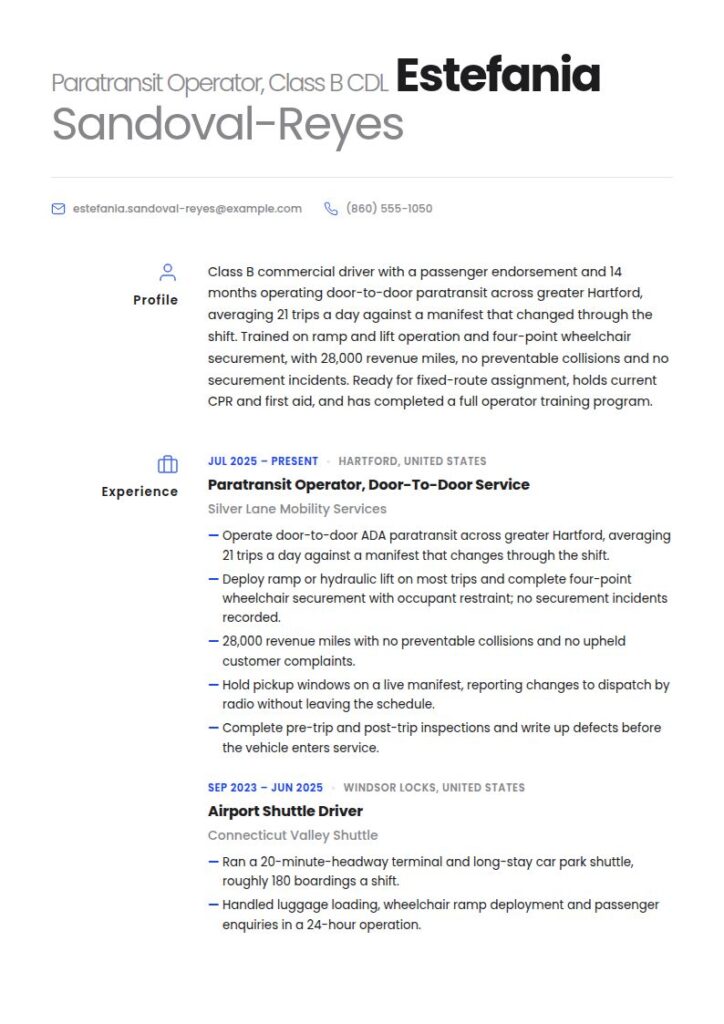
Class B commercial driver with a passenger endorsement and 14 months operating door-to-door paratransit across greater Hartford, averaging 21 trips a day against a manifest that changed through the shift. Trained on ramp and lift operation and four-point wheelchair securement, with 28,000 revenue miles, no preventable collisions and no securement incidents. Ready for fixed-route assignment, holds current CPR and first aid, and has completed a full operator training program.
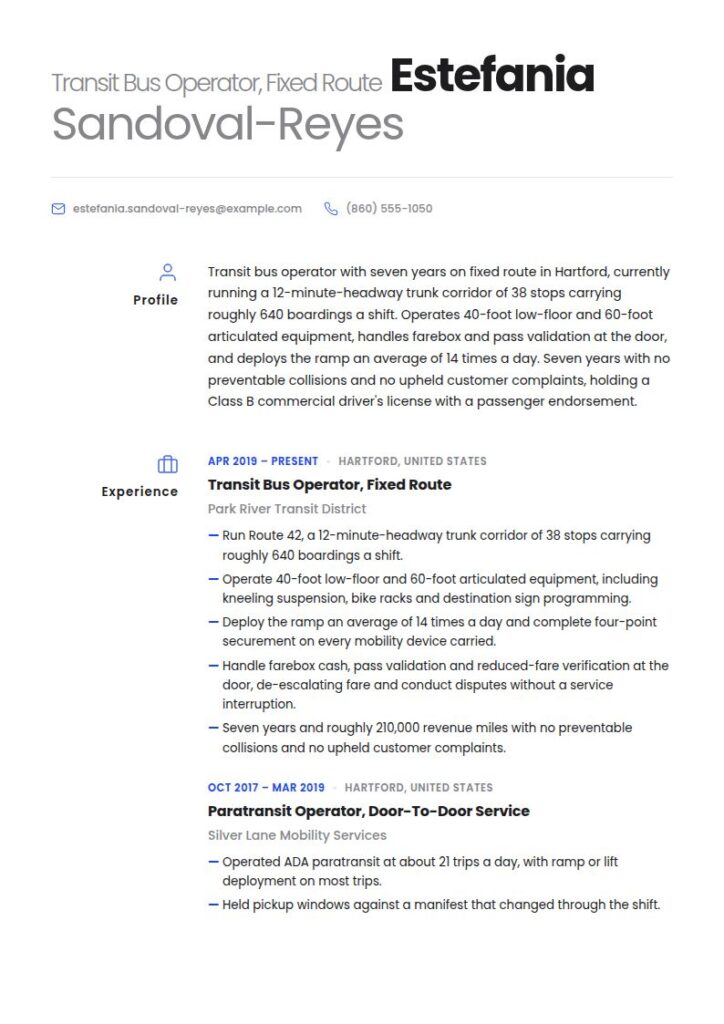
Transit bus operator with seven years on fixed route in Hartford, currently running a 12-minute-headway trunk corridor of 38 stops carrying roughly 640 boardings a shift. Operates 40-foot low-floor and 60-foot articulated equipment, handles farebox and pass validation at the door, and deploys the ramp an average of 14 times a day. Seven years with no preventable collisions and no upheld customer complaints, holding a Class B commercial driver's license with a passenger endorsement.
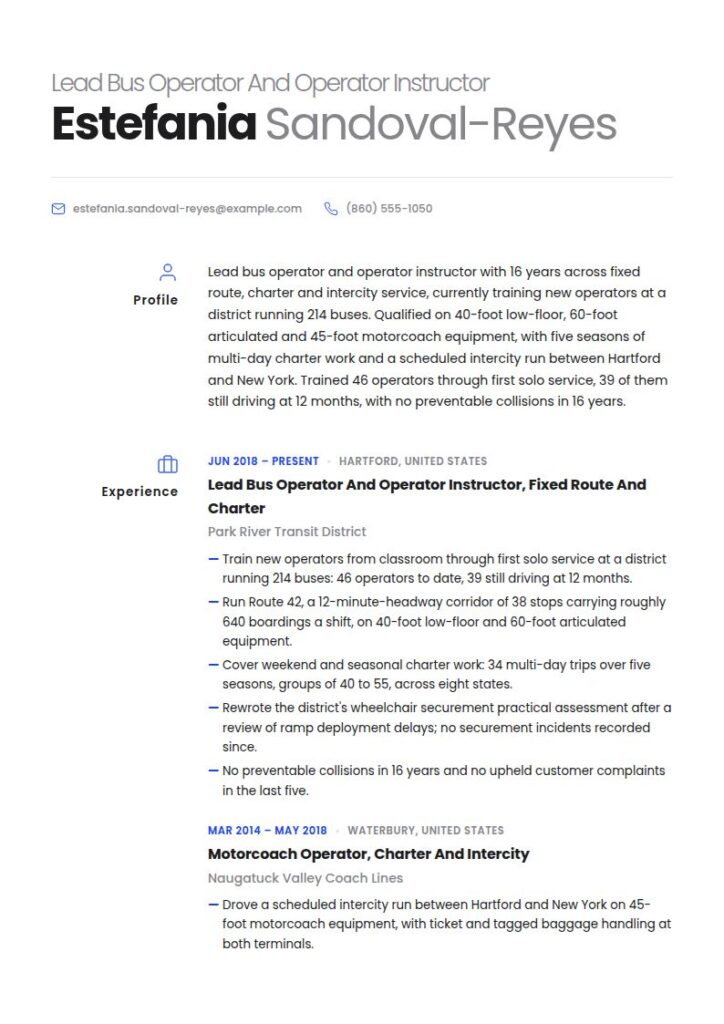
Lead bus operator and operator instructor with 16 years across fixed route, charter and intercity service, currently training new operators at a district running 214 buses. Qualified on 40-foot low-floor, 60-foot articulated and 45-foot motorcoach equipment, with five seasons of multi-day charter work and a scheduled intercity run between Hartford and New York. Trained 46 operators through first solo service, 39 of them still driving at 12 months, with no preventable collisions in 16 years.
Right vs wrong: the same bus driver summary, twice
| ✅ Right | ❌ Wrong |
|---|---|
| Transit bus operator with seven years on fixed route, running a 12-minute-headway corridor of 38 stops. | Experienced bus driver with a strong work ethic and excellent customer service skills. |
| Operates 40-foot low-floor and 60-foot articulated equipment and deploys the ramp about 14 times a day. | Comfortable driving a variety of vehicles and assisting passengers as needed. |
| Seven years with no preventable collisions and no upheld customer complaints. | Committed to safety and to a positive experience for every rider. |
In other words, the left column can be assigned to a run on Monday morning. By contrast, the right column has to be interviewed first to find out what it means.
Outline your driving experience
Employer, city, service, equipment and dates in the header line, then three to five bullets, each carrying a number: trips, boardings, stops, miles, groups, securements. Put the service in the header rather than the bullets, because a reader scanning five files in two minutes sees headers first.
| Instead of | Use |
|---|---|
| Drove a bus on an assigned route | Ran Route 42 on a 12-minute headway, 38 stops, roughly 640 boardings a shift |
| Assisted passengers with disabilities | Deployed the ramp about 14 times a day and completed four-point securement on every mobility device carried |
| Collected fares | Handled farebox cash, pass validation and reduced-fare verification at the door on a route with roughly 640 boardings a shift |
| Maintained a safe driving record | Seven years and roughly 210,000 revenue miles with no preventable collisions |
Lead Bus Operator and Operator Instructor, Fixed Route and Charter, Park River Transit District, Hartford, CT, June 2018 to Present
Run Route 42, a 12-minute-headway trunk corridor of 38 stops carrying roughly 640 boardings a shift, on 40-foot low-floor and 60-foot articulated equipment.
Train new operators from classroom through first solo service: 46 operators to date, 39 still driving at 12 months.
Deploy the ramp an average of 14 times a day and complete four-point securement on every mobility device carried, with no securement incidents recorded.
Cover weekend charter work in season: 34 multi-day trips over five seasons, groups of 40 to 55, across eight states.
Name the service you drove: fixed route, charter, intercity or paratransit
In fact, this is the block almost nobody writes, and it is the one that turns an application into an interview.
Even so, the four services share a license and share almost nothing else. Specifically, they differ in who your passengers are, how long you are with them, and what goes wrong on a bad day. An employer hiring for one of them is trying to work out from your file whether you have done that one.
| Service | What the day actually is | What the resume has to prove |
|---|---|---|
| Fixed route | The same corridor on a published timetable, fares taken at the door, ramp deployed on demand, running time to be recovered when traffic takes it, radio contact with control | Headway or trip count, stops, boardings, equipment length, on-time performance, ramp and securement volume |
| Charter | One group, one itinerary, often several days and several states, luggage bays, hotels away from base, a customer who chose you rather than a timetable | Motorcoach hours, trip lengths, group sizes, states driven, luggage and manifest handling, overnight trips |
| Intercity | Scheduled service between cities on a ticketed timetable, terminal and station procedures, tagged baggage, long driving legs between stops | Route miles, station stops, ticket and baggage handling, layover and overnight patterns, night driving |
| Paratransit | Door-to-door trips booked in advance, a manifest that changes through the shift, a lift or ramp on most trips, pickup windows to hold, one passenger at a time | Trips per day, on-time window performance, securement volume, mobility device types, door-to-door assistance |
Securement and fares for bus drivers
Two duties cut across all four and both belong on the page in numbers.
The first is securement. Every service carries mobility devices, and the operator deploys the ramp or lift, positions the device, applies four-point tie-downs and fits the occupant restraint. Even so, it is skilled work that resumes reduce to "assisted passengers". Write the volume: deployments in a typical shift, the device types you have secured, and whether your record is clear.
The second is fare and ticket handling. On fixed route it is a farebox, passes and reduced-fare verification, done while the bus sits in traffic and the next passenger waits. For intercity work, it is tickets, baggage tags and a terminal. On charter it is a manifest and a head count before every departure. On paratransit it is a no-show policy applied to someone standing in their own doorway. All four involve telling a passenger no, in public, without the day getting worse.
The license itself is the short part. The Federal Motor Carrier Safety Administration lists the passenger (P) endorsement among the commercial driver's license endorsements in 49 CFR 383.93, and the passenger endorsement requires both a knowledge test and a skills test, unlike the tank, hazardous materials and doubles endorsements, which are knowledge tests only. Write the endorsement letter, the state, the license number and the expiry, then move on. It gets you considered. Instead, the service block is what gets you called.
Services operated: Fixed route (7 years, 40-foot low-floor and 60-foot articulated); Charter (5 seasons, 45-foot motorcoach, 34 multi-day trips across 8 states); Intercity (2 years, scheduled Hartford to New York run); Paratransit (14 months, door-to-door, averaging 21 trips a day)
Commercial Driver's License: Class B, Connecticut, #CT-8840217, passenger (P) endorsement added 2010, valid through March 2029
Passenger service: Ramp and lift operation, four-point wheelchair securement and occupant restraint, farebox and pass validation, stop announcements, fare and conduct de-escalation
Record: No preventable collisions in 16 years, no securement incidents, no upheld customer complaints in the last 5 years
Build a snapshot of your key skills
For skills, list twelve to sixteen entries in four groups: equipment, passenger service, compliance and inspection, and the systems your employer runs.
Equipment: 40-foot low-floor transit bus, 60-foot articulated bus, 45-foot motorcoach, wheelchair ramp and hydraulic lift, kneeling suspension, bike rack loading
Passenger service: Four-point wheelchair securement and occupant restraint, door-to-door passenger assistance, stop announcements, farebox and pass validation, fare and conduct de-escalation
Compliance and inspection: Pre-trip and post-trip inspection, defect reporting, blind spot discipline in urban traffic, incident reporting
Systems: Automatic vehicle location and radio dispatch, electronic farebox, destination sign programming, paratransit scheduling manifests
List your education and certifications
Here, formal education matters little and training records matter a great deal. The Bureau of Labor Statistics records a high school diploma or equivalent as the typical entry-level education for bus drivers, and no related work experience before hire (BLS Occupational Outlook Handbook, Bus Drivers, published 27 August 2026). For this reason, name the operator training program and its length; it is the credential an employer recognizes.
Commercial Driver's License: Class B, Connecticut, #CT-8840217, passenger (P) endorsement, valid through March 2029
Operator Training Program, Park River Transit District, Hartford, CT, 2010. Eight weeks classroom and behind-the-wheel, including wheelchair securement, farebox procedure and defensive driving.
Motorcoach Qualification, Naugatuck Valley Coach Lines, Waterbury, CT, 2016. 45-foot motorcoach, luggage bay handling and multi-day trip procedure.
High School Diploma, East Hartford, CT, 2006
Certifications: CPR and first aid, American Red Cross, renewed 2026
Choose the right layout and design
For layout, use one column, 11 or 12 point type, clear headings, no photograph and no graphics. Transit districts and municipal employers read applications into a structured record before anyone opens the file, and two-column layouts, text boxes and icons are where that reading breaks.
Keep service names in plain words rather than internal shorthand. A district that brands its paratransit service will still search for the word paratransit, and the next employer has never heard the brand.
Name the service in every experience header: fixed route, charter, intercity or paratransit. Give the equipment by length and type. Put a number on the run: headway, stops, boardings, trips, route miles or group sizes. State securement volume and device types. Write the safety record as facts with a period attached. Explain any gap in one line.
Do not write "bus driver" alone as a job title when the service is what is being hired for. Do not describe passenger assistance without saying how often you do it. Do not call yourself safety conscious in place of giving the record. Do not leave the license expiry or the endorsement letter off the page. Do not use a two-column template for a municipal application portal. Do not pad to two pages before you have run more than one service.
Bus driver job market and outlook
A large occupation with slow growth and heavy replacement demand, which means the openings are there and the competition is about fit rather than scarcity.
| Measure | Value |
|---|---|
| Bus driver jobs, 2025 | 563,200 |
| Projected change, 2025-35 | 2% (slower than average), +9,800 |
| Projected annual openings | ~77,600 |
| Typical entry-level education | High school diploma or equivalent |
| Work experience in a related occupation | None |
| Median annual wage, May 2025 | $49,390 ($23.75 per hour) |
| Median, transit and intercity bus drivers, May 2025 | $59,050 |
| Median, school bus drivers, May 2025 | $47,920 |
Source: U.S. Bureau of Labor Statistics, Occupational Outlook Handbook, Bus Drivers, May 2025 wage data and 2025 to 2035 projections, published 27 August 2026.
The occupation is two occupations, and the pay gap proves it
The Bureau of Labor Statistics counts 396,800 school bus driver jobs against 166,400 transit and intercity bus driver jobs, with median annual wages of $47,920 and $59,050 respectively as of May 2025 (BLS Occupational Outlook Handbook, Bus Drivers, published 27 August 2026).
The occupation as a whole shows a median of $49,390 and about 77,600 openings a year on 2 percent projected growth through 2035, which is slower than the average for all occupations (BLS, published 27 August 2026).
Two things follow. The headline median is dominated by school bus work, so do not use it to judge what a transit post is worth. And an occupation with high openings and low growth hires on replacement, where the screening question is whether you have run this particular service before.
For reference, here is where transit and intercity work sits, and what it pays there:
| Industry | Share of employment | Median annual wage (May 2025) |
|---|---|---|
| Local government, excluding education and hospitals | 54% | $64,590 |
| Urban transit systems | 17% | $57,820 |
| Charter bus industry | 8% | $48,420 |
| Interurban and rural bus transportation | 5% | $46,860 |
| Other transit and ground passenger transportation | 3% | $48,330 |
Source: U.S. Bureau of Labor Statistics, Occupational Outlook Handbook, Bus Drivers, May 2025.
In short, that table is the clearest argument for naming your service. More than half of transit and intercity driving sits inside local government, the best paid of the five settings, while charter and interurban work pays close to school bus rates. If your experience is on the public side, say so in the first header line; if it is on the charter side, bridge the gap with the fixed-route duties you have done anyway.
What salary you can expect as a bus driver
Overall, the median annual wage for bus drivers was $49,390 as of May 2025, or $23.75 an hour (BLS Occupational Outlook Handbook, published 27 August 2026). Within that, meanwhile, transit and intercity bus drivers had a median of $59,050 and school bus drivers $47,920.
However, the spread inside transit and intercity driving is wide: $64,590 in local government down to $46,860 in interurban and rural bus transportation, a gap of $17,730 (BLS, May 2025). That is far larger than the gap between industries in most driving occupations, and it is mostly a gap between public transit employers and private coach operators rather than between individual drivers.
That is why what a resume can move is which of those doors opens. Public transit districts hire on demonstrated fixed-route or paratransit experience and a long clean record; coach operators hire on motorcoach hours, trip range and customer handling. Premiums in this occupation attach to documented qualifications rather than to negotiation: a motorcoach qualification, an instructor role, a lead operator assignment. Each is something the resume either states with a date or omits.
Key takeaways for a bus driver resume
- Name the service in every experience header: fixed route, charter, intercity or paratransit.
- Put the license class, the endorsement letter and the expiry in four short lines, then move on.
- First, give the run its numbers: headway, stops, boardings, trips, route miles or group sizes.
- Then write securement as skilled work, with volume and device types, not as "assisted passengers".
- Say how you handle fares, tickets or manifests, because it is the part of the job that involves saying no.
- Finally, state the safety record as facts with a period attached, never as an adjective.
- Keep it single column, because a district portal reads it before a person does.
Build your bus driver resume in 15 minutes with our AI resume builder.
Related transportation resume examples
- School bus driver resume
- Transportation resume
- Driver resume
- Train operator resume
- Flight attendant resume
- Uber driver resume
- Seaman resume
- Truck driver resume
- Delivery driver resume
- Dispatcher resume
- Transport and logistics resume
- Tractor driver resume
Pair it with a matching bus driver cover letter.
Bus driver resume questions, answered
How long should a bus driver resume be?
One page for your first few years. Two once you have run more than one service, trained operators, or held a lead role long enough that the detail is the point. Never three, and never a page of generic duties that any licensed driver could have written.
What do I put on a bus driver resume with no experience?
Write the training as a job: the operator training program, its length, the equipment you trained on, the behind-the-wheel hours and the evaluation you passed. Then anything adjacent, such as shuttle driving, non-emergency medical transport, delivery work or dispatch. The Handbook lists no related work experience as typical for bus drivers, with a high school diploma or equivalent as the usual entry-level education (BLS Occupational Outlook Handbook, published 27 August 2026), so a new operator is not applying from behind.
Should I list both school bus and transit experience?
Yes, and separately, with the service named in each header. They are different jobs with different pay: school bus drivers had a median of $47,920 and transit and intercity drivers $59,050 as of May 2025 (BLS, published 27 August 2026). A transit district reading a file that only says "bus driver" will assume the cheaper one.
Do I need to explain my endorsement on the resume?
One line is enough. The Federal Motor Carrier Safety Administration lists the passenger (P) endorsement in 49 CFR 383.93, and it requires a knowledge test and a skills test. Write the class, the state, the license number, the endorsement letter and the expiry date, and spend the space you save on the service block.
What if I have only driven paratransit and want fixed route?
Lead with what transfers, because most of it does. Securement volume, passenger assistance, holding a schedule, farebox or fare handling, urban traffic and pre-trip inspection are all fixed-route duties you have already been doing, often at higher intensity. Then say plainly that you are seeking fixed-route assignment, so the reader is not left to work out whether you want it.