Operations Assistant Renata Villalobos
Operations Assistant
[email protected] | (303) 555-2250 | Boulder, United States
Profile
Operations assistant with 14 months supporting a 22-person distribution team, handling 60 to 80 inbound orders a day and the daily carrier reconciliation. Cut mis-shipped order credits from 41 a month to 17 over two quarters by rebuilding the pick-list check into a two-step confirmation. Fluent in Spanish and English, and the shift's first point of contact for account escalations.
Work Experience
07/2025 - Present, Operations Assistant, Bright Harbor Outfitters, Boulder, United States
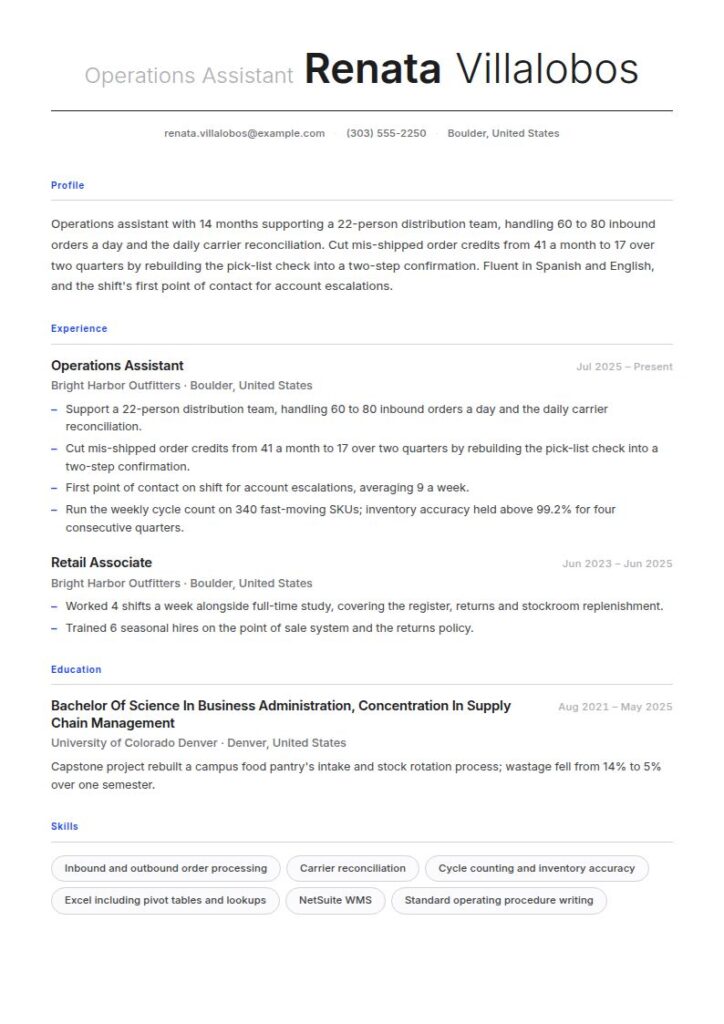
- Support a 22-person distribution team, handling 60 to 80 inbound orders a day and the daily carrier reconciliation.
- Cut mis-shipped order credits from 41 a month to 17 over two quarters by rebuilding the pick-list check into a two-step confirmation.
- First point of contact on shift for account escalations, averaging 9 a week.
- Run the weekly cycle count on 340 fast-moving SKUs; inventory accuracy held above 99.2% for four consecutive quarters.
06/2023 - 06/2025, Retail Associate, Bright Harbor Outfitters, Boulder, United States
- Worked 4 shifts a week alongside full-time study, covering the register, returns and stockroom replenishment.
- Trained 6 seasonal hires on the point of sale system and the returns policy.
Education
08/2021 - 05/2025, Bachelor of Science, Business Administration, concentration in Supply Chain Management, University of Colorado Denver, Denver, United States
Capstone project rebuilt a campus food pantry's intake and stock rotation process; wastage fell from 14% to 5% over one semester.
Skills
Inbound and outbound order processing, 75
Carrier reconciliation, 70
Cycle counting and inventory accuracy, 75
Excel including pivot tables and lookups, 80
NetSuite WMS, 60
Standard operating procedure writing, 60
Languages
Spanish, native
English, native
Certificates
08/2025, OSHA 10-Hour General Industry, Occupational Safety and Health Administration
Completed through an OSHA Outreach Training Program provider.
09/2025, Forklift Operator Certification, Bright Harbor Outfitters
Summary
A general resume is a one page document you cut from a longer master record rather than a file you write once and send everywhere. This guide gives you three adaptable versions, a worked before and after showing the same three years cut two ways for two different postings, and current Bureau of Labor Statistics figures on earnings and job movement across the workforce.
General resume examples by experience level
A general resume is the one page document you send when a posting does not name a narrow specialty. It is almost always a cut-down version of a much longer file that you never send at all.
That distinction is what this page is about. Most people keep one resume, edit it in place for every application, and quietly lose the material they deleted three postings ago. The better habit is two documents: a master record that only ever grows, and a targeted version cut from it in about fifteen minutes for each posting.
Resume guide for a general resume
This guide and the corresponding general resume example will cover:
- How to write a general resume, section by section
- How to keep one master record and cut a targeted version from it
- Three adaptable summaries: first job, established and lead
- A worked before and after: the same three years, cut two ways
- What population-level data says about earnings and job movement
How to write a general resume
Five sections: contact header, summary, experience, education and skills. One page for anything under about ten years, two pages after that, and never three.
The general resume has one structural problem that a specialist resume does not. A nurse's resume knows who is reading it. Yours does not, so every section has to survive a reader who does not already know what your job title means.
| Section | What it is answering | Where it goes |
|---|---|---|
| Header and title line | What role is this person applying for right now? | Top, with the posting's own title |
| Summary | What do they do, for how long, and what changed because of it? | Under the header, three or four lines |
| Experience | Where have they worked, and what did they own there? | Reverse chronological, with numbers |
| Education and certifications | Do they clear any stated requirement? | Below experience after the first year |
| Skills | Which named tools could they be tested on tomorrow? | Short block, no ratings bars |
Write the long file first, then cut the short one
Open a document called master-resume.md and put everything in it: every job, every contract, every certificate with its number, every system you have administered, every number you can still defend. Eight bullets a job rather than three. No length limit, because nobody will ever read it.
Then, for each posting, copy the whole file, save it under the employer's name, and delete until one page is left. Deleting is a faster and more honest decision than writing, and the master file is still intact for the next application.
The gain is that material cut for a January posting is still there in June when a different employer wants exactly that. People who edit one file in place lose it permanently.
Run the finished one-page version through the ATS resume checker before you send it. A general resume passes through more automated screens than a specialist one, because the postings it answers attract more applicants.
Choosing the best resume format for a general resume
Reverse chronological, almost without exception. One page while your history fits, two once it genuinely does not.
Functional and skills-based formats are marketed hardest to exactly the people reading this page, and they are the wrong answer. A recruiter reads a general resume for shape: what you have done, in what order, for how long, and whether the story holds together. A format that removes the order reads as an order worth removing.
A combination format is defensible in one case: you are changing fields and the relevant work is old. Even then keep the dated list underneath, unbroken. Our career change resume example is built for that case.
Include your contact information
| ✅ Right | ❌ Wrong |
|---|---|
| Renata Villalobos | Renata Villalobos |
| Operations Coordinator | Hardworking professional seeking new opportunities |
| Denver, CO | 1442 Eastwood Terrace, Apt 4B, Denver, CO 80206 |
| (303) 555-2250, [email protected] | (303) 555-2250, [email protected] |
| linkedin.com/in/renatavillalobos | facebook.com/renatavillalobos |
Four things only: name, the title of the role you are applying for, city and state, and two ways to reach you. The street address stopped being useful when applications stopped arriving by post, and it is the one field that can be used to screen you on commute before anyone reads a bullet.
The title line is the highest-return edit in the document and the one most people never make. It should read as the posting's own job title, not as a description of yourself.
Make use of a summary
Three or four lines: what you do, how long, the scale you operate at, and one result with a number and a time frame attached.
Operations assistant with 14 months supporting a 22-person distribution team, handling 60 to 80 inbound orders a day and the daily carrier reconciliation. Cut mis-shipped order credits from 41 a month to 17 over two quarters by rebuilding the pick-list check into a two-step confirmation. Fluent in Spanish and English, and the shift's first point of contact for account escalations.
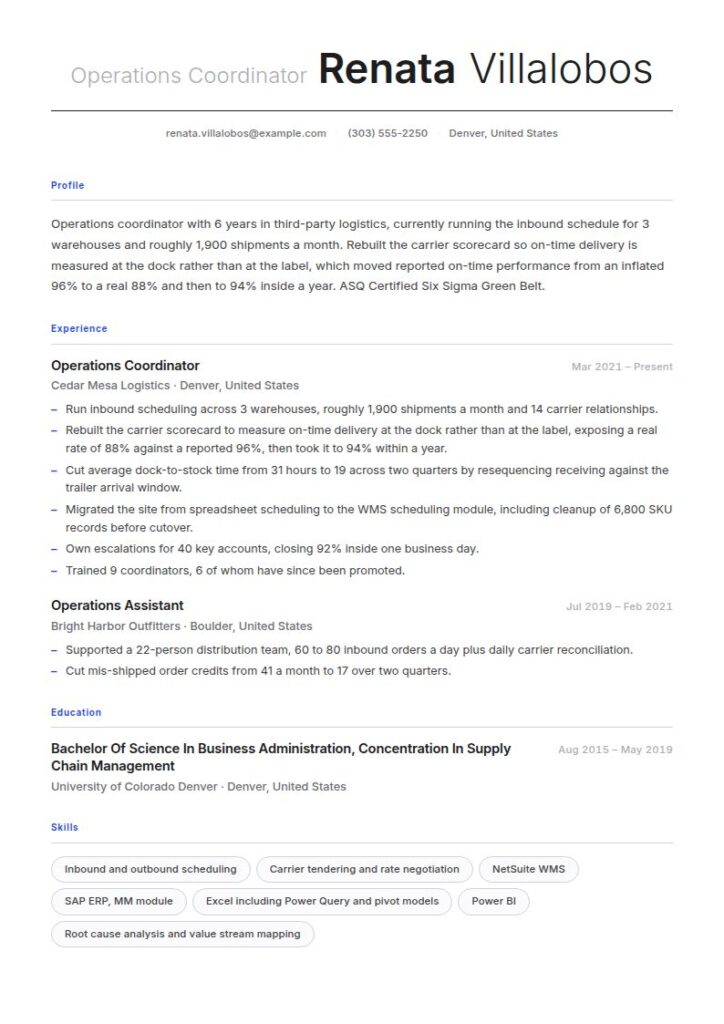
Operations coordinator with 6 years in third-party logistics, currently running the inbound schedule for 3 warehouses and roughly 1,900 shipments a month. Rebuilt the carrier scorecard so on-time delivery is measured at the dock rather than at the label, which moved reported on-time performance from an inflated 96% to a real 88% and then to 94% inside a year. ASQ Certified Six Sigma Green Belt.
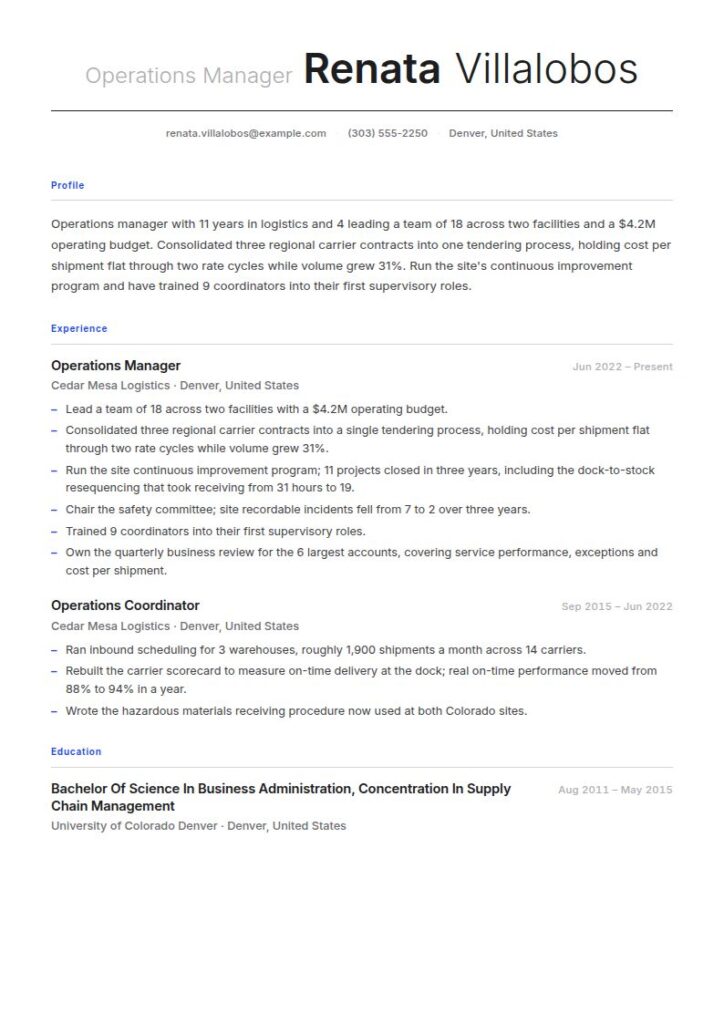
Operations manager with 11 years in logistics and 4 leading a team of 18 across two facilities and a $4.2M operating budget. Consolidated three regional carrier contracts into one tendering process, holding cost per shipment flat through two rate cycles while volume grew 31%. Run the site's continuous improvement program and have trained 9 coordinators into their first supervisory roles.
Each of those is portable. Change the numbers and the nouns and the shape still works for a coordinator, an analyst, an assistant manager or a specialist, which is exactly what a general resume needs.
Right vs wrong: the same general summary, twice
| ✅ Right | ❌ Wrong |
|---|---|
| Operations coordinator with 6 years in third-party logistics. | Results-driven professional with a passion for excellence. |
| Currently running the inbound schedule for 3 warehouses and roughly 1,900 shipments a month. | Experienced in a wide variety of operational functions. |
| Moved real on-time delivery from 88% to 94% inside a year by measuring it at the dock. | Proven track record of improving efficiency and driving results. |
| ASQ Certified Six Sigma Green Belt. | Excellent communication and problem-solving skills. |
The right column contains four things a reader can check. The left column contains none, and every other applicant has already written it.
Outline your experience
Employer, city and state, your title, and dates by month and year. Then three to five bullets, each naming a thing you owned and carrying a number.
| Instead of | Use |
|---|---|
| Responsible for daily operations | Ran the inbound schedule for 3 warehouses, roughly 1,900 shipments a month |
| Improved team efficiency | Cut average dock-to-stock time from 31 hours to 19 over two quarters |
| Assisted with reporting | Built the weekly carrier scorecard now used by 4 site managers |
| Worked with vendors | Renegotiated 3 regional carrier contracts into one tender, holding cost per shipment flat across two rate cycles |
| Trained new staff | Trained 9 coordinators, 6 of whom were promoted within 2 years |
| Handled customer issues | Owned account escalations for 40 accounts, closing 92% within one business day |
Operations Coordinator, Cedar Mesa Logistics, Denver, CO, March 2021 to Present
Run the inbound schedule across 3 warehouses, roughly 1,900 shipments a month and 14 carrier relationships.
Rebuilt the carrier scorecard to measure on-time delivery at the dock rather than at the label, which exposed a real rate of 88% against a reported 96%, then took it to 94% within a year.
Cut average dock-to-stock time from 31 hours to 19 across two quarters by resequencing receiving against the trailer arrival window.
Own escalations for 40 key accounts, closing 92% of them inside one business day.
Trained 9 coordinators, 6 of whom have since been promoted.
Keep one master resume and cut the version you send from it
This is the section that separates a general resume that works from one that does not, and it is a filing habit rather than a writing skill.
The master file holds everything, in full, with no length discipline at all. The sent file is one page, cut for one posting, and thrown away afterwards. Keeping the two separate is what lets you tailor quickly without losing material.
Here is the same three years, written once at master length and then cut two ways.
Operations Coordinator, Cedar Mesa Logistics, Denver, CO, March 2021 to Present
Run inbound scheduling for 3 warehouses, roughly 1,900 shipments a month, 14 carriers.
Rebuilt the carrier scorecard to measure on-time delivery at the dock; real rate 88% against a reported 96%, then 94% within a year.
Cut dock-to-stock from 31 hours to 19 across two quarters.
Own escalations for 40 key accounts, 92% closed inside one business day.
Run the Monday operations review for 4 site managers and the regional director.
Migrated the site from spreadsheet scheduling to the WMS scheduling module, including data cleanup of 6,800 SKU records.
Built the quarterly business review deck for the 6 largest accounts.
Trained 9 coordinators; 6 promoted.
Sit on the safety committee; site recordable incidents fell from 7 to 2 over three years.
Wrote the standard operating procedure for hazardous materials receiving, adopted at both Colorado sites.
Two postings, two cuts. Neither one invents anything; both delete.
Operations Coordinator, Cedar Mesa Logistics, Denver, CO, March 2021 to Present
Run inbound scheduling for 3 warehouses, roughly 1,900 shipments a month across 14 carriers.
Cut dock-to-stock time from 31 hours to 19 across two quarters by resequencing receiving against trailer arrival.
Rebuilt the carrier scorecard to measure on-time delivery at the dock rather than the label; real on-time performance moved from 88% to 94% in a year.
Migrated the site from spreadsheet scheduling to the WMS scheduling module, including cleanup of 6,800 SKU records.
Wrote the hazardous materials receiving procedure now used at both Colorado sites.
Operations Coordinator, Cedar Mesa Logistics, Denver, CO, March 2021 to Present
Own the operational relationship for 40 key accounts, closing 92% of escalations inside one business day.
Build and present the quarterly business review for the 6 largest accounts, covering service performance, exceptions and cost per shipment.
Run the Monday operations review for 4 site managers and the regional director.
Rebuilt service reporting so clients see on-time delivery measured at the dock; the honest number was 88% and is now 94%.
Trained 9 coordinators on account handling; 6 have since been promoted.
Same job, same three years, same facts. The first cut is about throughput and systems, the second about clients and reporting, and the safety committee line moves in and out depending on which the posting asks for.
Three rules make this work. Keep the master file ordered the way the sent file will be, so cutting never means rewriting. Never let a number exist only in a sent file, because that copy is temporary. And decide what to cut by reading the posting's first three requirements and nothing else, since those are almost always the ones the screener was given.
Most people will do this many times
Individuals born between 1957 and 1964 held an average of 12.9 jobs from ages 18 to 58, and more than 40 percent of those jobs were held before age 25 (U.S. Bureau of Labor Statistics, Number of Jobs, Labor Market Experience, Marital Status, and Health for Those Born 1957 to 1964, released 26 August 2025 and reissued 21 July 2026).
The current market moves at a similar pace. In July 2026 there were 7.3 million job openings, 5.1 million hires and 3.1 million quits, a quits rate of 1.9 percent (BLS Job Openings and Labor Turnover Survey, released 1 September 2026).
Read those two together and the master file stops looking like a chore. Nearly thirteen jobs across a working life is a great deal of cutting, and the people who do it fast are cutting from something rather than rewriting one file from scratch every time.
Build a snapshot of your key skills
Ten to fourteen named entries in three groups. Named, meaning something a reader could ask you to demonstrate.
Systems: NetSuite WMS, SAP ERP (MM module), Excel including Power Query and pivot models, Power BI, Smartsheet
Operational: Inbound and outbound scheduling, Carrier tendering and rate negotiation, Cycle counting and inventory accuracy, Root cause analysis, Standard operating procedure writing
Process and quality: Lean Six Sigma Green Belt methods, Value stream mapping, Kaizen facilitation, Hazardous materials receiving compliance
Languages: Spanish (native), English (native)
Leave out the traits. Communication, teamwork, attention to detail and problem-solving appear on almost every resume in the stack and prove nothing. If teamwork is genuinely your case, it belongs in an experience bullet with a number on it.
List your education and certifications
Degree, field, institution, city and state, and the year it was awarded. Certifications below with the issuing body, the identifier if there is one, and the date.
Bachelor of Science, Business Administration, concentration in Supply Chain Management, University of Colorado Denver, Denver, CO, 2018
Certifications: Certified Six Sigma Green Belt, American Society for Quality, #SSGB-118402, 2022. Certified Associate in Project Management, Project Management Institute, 2021. OSHA 30-Hour General Industry, 2023. Hazardous Materials Employee Training, current through 2028.
Once you are more than a year past graduation, education sits below experience, and the GPA comes off unless you finished within the last two years and it was strong. Put certification identifiers on the page: a reader who can verify a credential in ten seconds treats it as a fact rather than a claim.
Choose the right layout and design
Single column, one typeface at 10.5 to 12 point, clear headings, consistent date formatting, no photograph and no rating bars. Save as PDF unless the portal asks for something else, and name the file for yourself and the role.
Keep a master file that only grows, and cut each sent version from it. Put the posting's own job title in your header line. Give every bullet an object and a number. Use month and year for every date, including the gaps. Name the systems you could be tested on. Keep it to one column so a parser can read it. Save it as renata-villalobos-operations-coordinator.pdf rather than resume-final-v3.pdf.
Do not send the master file; it is for you. Do not use a two-column template with the dates in a sidebar, because that is where parsing most often breaks. Do not open with an objective statement telling the employer what you are looking for. Do not list soft skills as skills. Do not leave an unexplained date gap when one dated line would close it. Do not put your street address on the page.
General resume job market and outlook
There is no Bureau of Labor Statistics employment level, growth rate or median wage for a general resume, because it describes a document rather than an occupation. The Standard Occupational Classification system that all federal employment data is built on sorts every worker into one of 867 detailed occupations across 23 major groups (BLS Standard Occupational Classification, 2018 SOC structure, page last modified 5 February 2026), and "general" is not one of them.
So the figures below describe the workforce you are competing inside, not a job you can apply for. When you find the posting you actually want, look up its own occupational profile before you talk about money.
| Measure | Value |
|---|---|
| Detailed occupations in the 2018 SOC system | 867 across 23 major groups |
| Job openings, July 2026 | 7.3 million |
| Hires, July 2026 | 5.1 million |
| Quits, July 2026 | 3.1 million, a rate of 1.9 percent |
| Median usual weekly earnings, all full-time workers 25 and over, 2025 | $1,268 |
| Unemployment rate, all workers 25 and over, 2025 | 3.4 percent |
| Median annual wage, all occupations, May 2025 | $50,980 |
Sources: U.S. Bureau of Labor Statistics, Job Openings and Labor Turnover Survey, released 1 September 2026; BLS unemployment rates and earnings by educational attainment, 2025 data, table last modified 1 September 2026; BLS Occupational Outlook Handbook, May 2025 wage data published 27 August 2026.
Two things follow for the document. The first is that 5.1 million hires a month is a market where a general, undifferentiated file gets read quickly and forgotten quickly, so the fifteen minutes of cutting is the whole margin. The second is that whatever you are applying for has a real occupational median behind it, and the general figures on this page are not it.
What salary you can expect
There is no salary for a general resume, and any page that gives you one is guessing. What exists is a population figure: full-time wage and salary workers aged 25 and over had median usual weekly earnings of $1,268 in 2025, with an unemployment rate of 3.4 percent (BLS, unemployment rates and earnings by educational attainment, 2025 data, table last modified 1 September 2026). BLS notes that the 2025 estimates are 11-month averages that exclude October because of a federal government shutdown.
Across all occupations, the median annual wage was $50,980 in May 2025 (BLS Occupational Outlook Handbook, May 2025 wage data published 27 August 2026).
Both are medians across the entire American workforce, including people thirty years into a career and people in occupations nothing like yours. They are not a starting salary and not a target. Read them the way you would read a national average house price: useful for orientation, useless for an offer.
What to do at offer time is specific. Find the occupational title of the role, not the employer's internal title, look up its current median and its 10th and 90th percentiles from the Bureau of Labor Statistics rather than a crowdsourced site, and then price the individual things your master file proves you already do. An employer pays for what they will not have to train, and the master file is where the evidence of that lives.
Key takeaways for a general resume
- Keep two documents: a master record that only grows, and a one-page cut you send.
- Put the posting's own job title in your header line, every time.
- Cut against the posting's first three requirements and ignore the rest.
- Give every bullet an object and a number with a time frame.
- Use reverse chronological order and month-and-year dates, including across gaps.
- Name systems, not traits; leave communication and teamwork off the skills block.
- Look up the real occupational data for the job you are applying to, because there is none for "general".
Build your general resume in 15 minutes with our AI resume builder.
Related resume examples
- Career change resume
- Entry level resume
- One year experience resume
- Part time job resume
- Work from home resume
- Self employed resume
- Freelancer resume
- Volunteer resume
- Buyer resume
- Translator resume
- Tour guide resume
- Canadian resume format
Pair it with a matching general cover letter.
General resume questions, answered
How long should a general resume be?
One page until you have roughly ten years of work, two after that, never three. The master file behind it has no limit, because you never send it. If the one-page version is running long, cut the oldest job to a single line, cut the second example from any bullet that has two, and delete the skills you listed as traits.
Is a general resume worse than a tailored one?
Only if you send it untailored. The document is fine; what fails is sending one file to twelve employers. Fifteen minutes of cutting against the posting's first three requirements is the difference.
What do I put on a general resume with no work experience?
Anything with a scope and a date: campus or community roles, volunteering, a contract or freelance job, a certificate with a completion date, a project with a named client or brief. Write each one the way you would write a job, with the organization, your role, dates and two bullets. Our [entry level resume example](/resume/entry-level/) covers that case in full.
Should I include an objective statement?
No. An objective tells the employer what you want; a summary tells them what they get. The one legitimate use is a genuine field change where your recent history does not explain itself, and even then a single line in the summary does the work better than a labeled objective block.
How many versions of my resume should I keep?
One master file, plus whatever sent versions you have not yet deleted. Do not maintain three or four parallel "versions" for different industries, because they drift apart and only one of them ever gets the new job you just started. Update the master, then cut.
How often should I update the master file?
Once a quarter, and on the day anything countable happens. The number you can quote exactly today becomes "about fifty, I think" in eight months, and a number you cannot defend does not belong on a resume.