Brand and Web Designer Nadia Petrossian
Owner and Designer
[email protected] | (818) 555-2252 | Glendale, United States
Profile
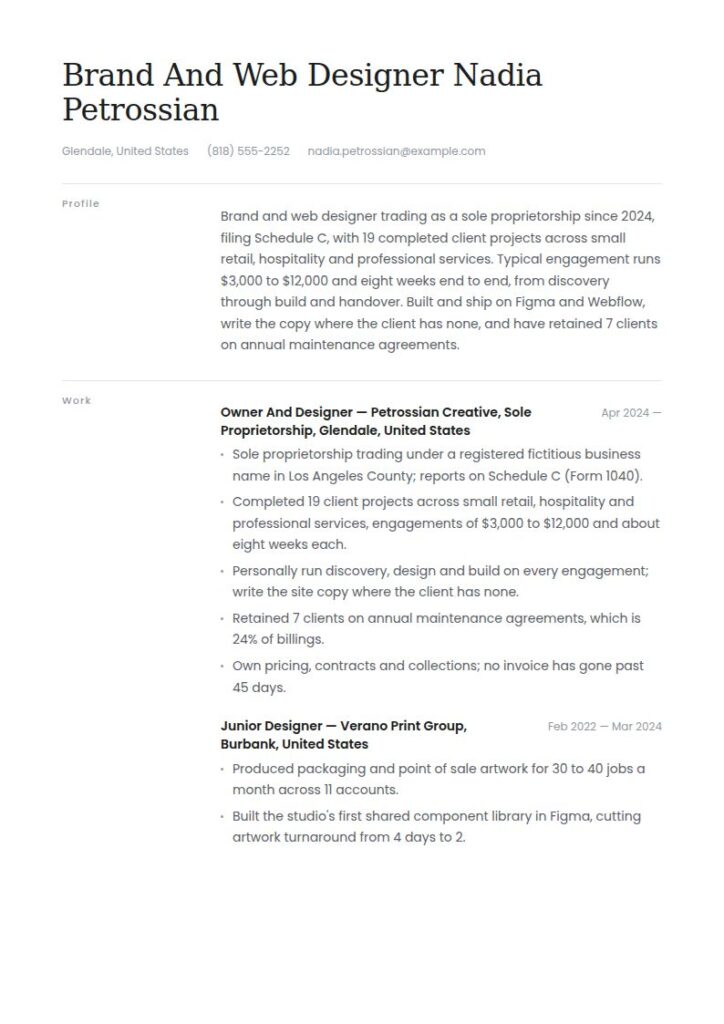
Brand and web designer trading as a sole proprietorship since 2024, filing Schedule C, with 19 completed client projects across small retail, hospitality and professional services. Typical engagement runs $3,000 to $12,000 and eight weeks end to end, from discovery through build and handover. Built and ship on Figma and Webflow, write the copy where the client has none, and have retained 7 clients on annual maintenance agreements.
Work Experience
04/2024 - Present, Owner and Designer, Petrossian Creative, sole proprietorship, Glendale, United States
- Sole proprietorship trading under a registered fictitious business name in Los Angeles County; reports on Schedule C (Form 1040).
- Completed 19 client projects across small retail, hospitality and professional services, engagements of $3,000 to $12,000 and about eight weeks each.
- Personally run discovery, design and build on every engagement; write the site copy where the client has none.
- Retained 7 clients on annual maintenance agreements, which is 24% of billings.
- Own pricing, contracts and collections; no invoice has gone past 45 days.
02/2022 - 03/2024, Junior Designer, Verano Print Group, Burbank, United States
- Produced packaging and point of sale artwork for 30 to 40 jobs a month across 11 accounts.
- Built the studio's first shared component library in Figma, cutting artwork turnaround from 4 days to 2.
Education
08/2017 - 05/2021, Bachelor of Fine Arts, Graphic Design, California State University, Long Beach, Long Beach, United States
Skills
Brand identity systems, 75
Figma, 85
Webflow, 80
Adobe Creative Cloud, 85
Scoping and pricing, 65
Client discovery interviews, 70
Quarterly estimated tax planning, 60
Languages
English, native
Armenian, native
Spanish, intermediate
Certificates
09/2024, Webflow Expert, Webflow
Summary
A self-employed resume writes your own business as an employer entry: the legal entity, its start date, what you personally did inside it, and the scale you operated at. This guide gives you three adaptable versions, the federal filings a hiring manager can verify you against, and current Bureau of Labor Statistics counts of self-employed workers.
Self-Employed resume examples by experience level
In short, a self-employed resume is a one to two page document that writes your own business the way it would write any other employer: legal name, dates, your title inside it, and what you owned.
The mistake that costs interviews is writing the business instead of the job. A reader who finishes your entry knowing what your company sold, but not what you personally did on a Tuesday, has nothing to hire. In particular, this page is about that separation, and about the paperwork that turns your claims into verifiable facts.
Resume guide for a self-employed resume
To start, this guide and the corresponding self-employed resume example will cover:
- First, how to write a self-employed resume, section by section
- Then, how to write your business as an employer entry with a legal name and dates
- Also, three adaptable summaries: sole proprietor, company owner and incorporated owner
- Next, the federal filings that verify what you have written
- Finally, what the data says about the size of the self-employed workforce
How to write a self-employed resume
Overall, six sections: contact header, summary, business or employer entries, a client and project scale block, education and certifications, and skills. One page under about six years of trading, two after that.
Your business entry sits exactly where a salaried job would sit, in the same reverse chronological list, formatted identically. After all, anything that visually separates self-employment from employment invites the reader to discount it.
| Section | What it is answering | Where it goes |
|---|---|---|
| Business entry | What is the legal entity, when did it start, and what was your role in it? | Top of experience, in the same list as salaried jobs |
| What you did | Which of the work did this person personally perform? | Bullets inside the entry, first person implied |
| Scale | How big was this, in clients, projects, revenue or headcount? | A scale line or block, given as ranges |
| Verification | Can any of this be checked? | Named filings and registrations, in education and certifications |
| Education and certifications | Do they clear any stated requirement? | Below experience |
Give the entity its legal name and its start date
Write "Petrossian Creative LLC, Glendale, CA, March 2019 to present", not "Freelance, 2019 to now". The first is an organization with a filing history behind it. The second reads as a period of unemployment that the writer has renamed.
If you have not formed an entity, that is fine and you should still write it as an entry: "Sole proprietorship, doing business as Petrossian Creative, Glendale, CA". The Internal Revenue Service treats a sole proprietorship as a business you report on Schedule C (Form 1040), which is used "to report income or loss from a business you operated or a profession you practiced as a sole proprietor" (IRS, About Schedule C (Form 1040), page last reviewed or updated 28 June 2026). A federal tax schedule exists for what you did, which is a stronger footing than most people give themselves.
The same is true of a single-member LLC. For federal income tax the IRS treats it as an entity disregarded as separate from its owner unless it files Form 8832 and elects corporate treatment, and the owner reports the business on Schedule C (IRS, Single Member Limited Liability Companies, page last reviewed or updated 27 July 2026). So the LLC name goes on the resume as an employer even though the tax return still routes through your personal 1040.
Run the finished file through the ATS resume checker before you send it, because a parser that cannot find an employer name in your longest entry will leave it out of the structured record entirely.
Choosing the best resume format for a self-employed resume
As a rule, reverse chronological, with your business in the same list as everything else. Yet this is the format most people running a business are tempted to abandon, and abandoning it is what makes the file look defensive.
By contrast, a functional resume groups your work by skill and hides the dates. For a self-employed candidate that reads as concealment, because the obvious question about a business is when it started, whether it is still trading, and how much of your working life it accounts for.
Include your contact information
| ✅ Right | ❌ Wrong |
|---|---|
| Nadia Petrossian | Nadia Petrossian |
| Brand and Web Design Lead | Entrepreneur, Founder, Visionary |
| Owner, Petrossian Creative LLC | Self-employed |
| Glendale, CA | 2207 Sycamore Court, Glendale, CA 91206 |
| (818) 555-2252, [email protected] | (818) 555-2252, [email protected] |
Instead, two lines under your name, not one. The first is the job you are applying for, and the second, in turn, is your current position with the entity named. As a result, a reader learns in two seconds that you run something and what you would be hired to do.
Use a personal email address rather than your business one, which signals that you are still selling.
Make use of a summary
For the summary, four lines: what you do, the entity and how long it has traded, the scale in clients or revenue, and one result with a number.
Brand and web designer trading as a sole proprietorship since 2024, filing Schedule C, with 19 completed client projects across small retail, hospitality and professional services. Typical engagement runs $3,000 to $12,000 and eight weeks end to end, from discovery through build and handover. Built and ship on Figma and Webflow, write the copy where the client has none, and have retained 7 clients on annual maintenance agreements.
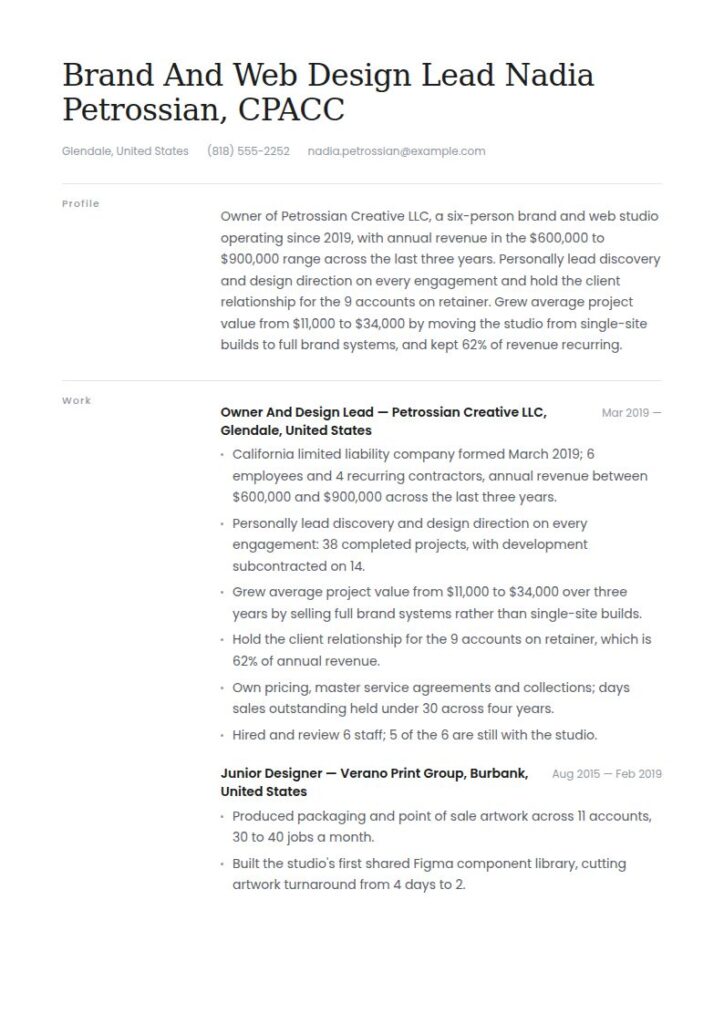
Owner of Petrossian Creative LLC, a six-person brand and web studio operating since 2019, with annual revenue in the $600,000 to $900,000 range across the last three years. Personally lead discovery and design direction on every engagement and hold the client relationship for the 9 accounts on retainer. Grew average project value from $11,000 to $34,000 by moving the studio from single-site builds to full brand systems, and kept 62% of revenue recurring.
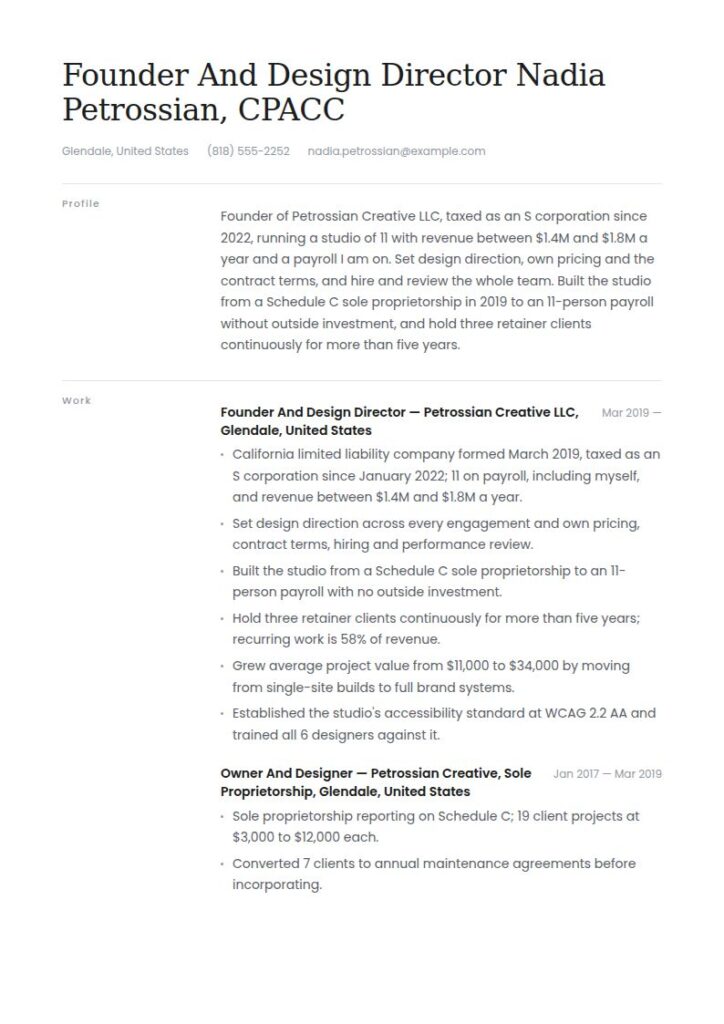
Founder of Petrossian Creative LLC, taxed as an S corporation since 2022, running a studio of 11 with revenue between $1.4M and $1.8M a year and a payroll I am on. Set design direction, own pricing and the contract terms, and hire and review the whole team. Built the studio from a Schedule C sole proprietorship in 2019 to an 11-person payroll without outside investment, and hold three retainer clients continuously for more than five years.
Right vs wrong: the same self-employed summary, twice
| ✅ Right | ❌ Wrong |
|---|---|
| Owner of Petrossian Creative LLC, a six-person brand and web studio operating since 2019. | Entrepreneur and creative visionary with a passion for building brands. |
| Annual revenue in the $600,000 to $900,000 range across the last three years. | Successfully grew a thriving business from the ground up. |
| Personally lead discovery and design direction on every engagement. | Wore many hats and handled all aspects of the business. |
| Grew average project value from $11,000 to $34,000 and kept 62% of revenue recurring. | Delivered outstanding results for a wide range of happy clients. |
In fact, "wore many hats" is the most common sentence on a self-employed resume and the one that loses the interview. After all, it tells a reader the writer cannot say which hat was theirs.
Outline your experience
For each entry, give entity name, city and state, your title inside it, and dates by month and year. Then bullets that describe your work, not the company's offering.
| Instead of | Use |
|---|---|
| Ran my own design business | Owner and design lead, Petrossian Creative LLC, 6 staff, revenue $600,000 to $900,000 a year |
| Worked with a variety of clients | Held the client relationship for 9 retainer accounts across hospitality, clinics and professional services |
| Handled all aspects of the business | Personally led discovery and design direction on all 38 engagements; subcontracted development on 14 of them |
| Grew the business significantly | Moved average project value from $11,000 to $34,000 over three years by selling brand systems rather than single-site builds |
| Managed finances | Own pricing, contract terms and collections; days sales outstanding held under 30 across four years |
| Built a team | Hired and reviewed 6 staff and 4 recurring contractors; 5 of the 6 are still with the studio |
Owner and Design Lead, Petrossian Creative LLC, Glendale, CA, March 2019 to Present
California limited liability company, formed March 2019, 6 employees and 4 recurring contractors. Annual revenue between $600,000 and $900,000 across the last three years.
Personally lead discovery and design direction on every engagement; 38 completed projects, with development subcontracted on 14.
Grew average project value from $11,000 to $34,000 over three years by selling full brand systems rather than single-site builds.
Hold the client relationship for the 9 accounts on retainer, which is 62% of annual revenue.
Own pricing, master service agreements and collections; days sales outstanding held under 30 across four years.
Hired and review 6 staff; 5 of the 6 are still with the studio.
Write the business as an employer entry, and name what proves it
A self-employed entry is the one entry on a resume with no third party behind it; that is why a hiring manager reads it differently. Four things make it verifiable.
The entity and its start date. Name the legal form and the state: a California limited liability company formed in March 2019, a sole proprietorship doing business as a registered trade name, an S corporation election effective January 2022. Business registrations are public records in every state, so a named entity with a formation date is something a reader can look up in a minute.
What you did, separated from what the business sold. Split these physically. One line describes the company: what it makes, for whom, at what scale. The bullets underneath describe your own hands: what you performed, what you decided, what you subcontracted. A reader hiring a designer needs to know you still design.
Scale written as ranges. Most engagements are covered by confidentiality, and ranges solve that without naming anyone: revenue between $600,000 and $900,000 a year, engagements between $3,000 and $12,000, clients in hospitality, outpatient clinics and professional services. That is more informative than three logos and breaks no agreement. Name a client only where the work is public or you have permission.
Tax filings that verify self-employment
The documents behind it. You do not attach these, but knowing they exist changes how you write.
| Document | What it evidences | Who issues it |
|---|---|---|
| Schedule C (Form 1040) | That you operated a business as a sole proprietor, and its income or loss | Filed by you with the IRS |
| Schedule SE (Form 1040) | Net earnings from self-employment and the tax due on them | Filed by you with the IRS |
| Form 1099-NEC | Nonemployee compensation a client paid you in a year | Issued to you by the client |
| State entity registration | The legal existence and formation date of your LLC or corporation | Secretary of State |
| Local business license | That the business was permitted to operate at an address | City or county |
Schedule SE is used "to figure the tax due on net earnings from self-employment" (IRS, About Schedule SE (Form 1040), page last reviewed or updated 3 April 2026), and you must file it if your net earnings from self-employment, excluding church employee income, were $400 or more (IRS, Self-Employment Tax, page last reviewed or updated 27 June 2026). In practice, that $400 line means almost any real trading year produced a federal filing with your business on it.
The 1099 threshold changed, and your older records look different
For tax years beginning after 2025 the minimum reporting threshold for nonemployee compensation on Form 1099-NEC rose to $2,000, up from the long-standing $600 (IRS, Instructions for Forms 1099-MISC and 1099-NEC, December 2026 revision).
That matters for how you count your own history. Small engagements from 2026 onward may generate no 1099 at all, so a client list reconstructed from forms in a drawer will look thinner in recent years for a reason unrelated to your business.
Your own invoices and bank deposits are the record that did not change. Keep the invoice numbering continuous: a continuously numbered ledger is the cleanest private evidence of trading volume you can hold, and it is what you will want when a reference check gets specific.
Name the legal entity and its formation month. Put the business in the same reverse chronological list as any salaried job. Write revenue and project values as ranges. Say which work you performed and which you subcontracted. Give headcount including contractors, and say which is which. State plainly whether the business is still trading, winding down, or closed, with the date.
Do not write "self-employed" alone as an employer name. Do not claim your company's outputs as your personal work without saying who did what. Do not list clients who are covered by a confidentiality agreement. Do not use "we" throughout and leave the reader guessing how many people that was. Do not hide the business behind a functional format.
Build a snapshot of your key skills
For skills, list twelve to fourteen named entries in three groups. Self-employment produces an unusual mix, and the commercial skills, in particular, are the ones an employer cannot easily buy.
Craft: Brand identity systems, Figma, Webflow, Adobe Creative Cloud, Design systems and component libraries, Accessibility to WCAG 2.2 AA
Commercial: Scoping and pricing, Master service agreements and statements of work, Client discovery and stakeholder interviews, Retainer design, Collections and days sales outstanding
Operating: Hiring and performance review, Subcontractor management, Project scheduling across 6 to 9 concurrent engagements, Bookkeeping handover to a CPA, Quarterly estimated tax planning
List your education and certifications
Degree, institution, city and state, year. Then certifications with their issuing body and date. Then, in its own short line, the business registrations, because they belong with credentials rather than inside a bullet.
Bachelor of Fine Arts, Graphic Design, California State University, Long Beach, Long Beach, CA, 2015
Certifications: Webflow Expert, Webflow (2021). IAAP Certified Professional in Accessibility Core Competencies, International Association of Accessibility Professionals, #CPACC-24-7715 (2024).
Business credentials: Petrossian Creative LLC, California limited liability company, formed March 2019. City of Glendale business license, current. S corporation election effective January 2022.
That last block is short, checkable, and answers the question the reader has not asked out loud: whether the business is a business.
Choose the right layout and design
As for layout, single column, one typeface at 10.5 to 12 point, month and year dates, no photograph and no logo. Your own logo on your own resume reads as marketing, and this is an application rather than a proposal.
Of course, two pages is fine and often correct. Still, keep the business entry on page one in full and let older salaried roles compress onto page two at a line or two each. Finally, save as PDF named for yourself and the role.
Self-employed job market and outlook
Notably, there is no Bureau of Labor Statistics employment level, projected growth rate or median wage for "self-employed", because it is a work arrangement rather than an occupation. Instead, federal employment data is organized by what you do, not by who signs your pay. Even so, the figures below describe the size of the group you are in.
| Measure | Value |
|---|---|
| Self-employed workers, unincorporated, August 2026, seasonally adjusted | 9,548,000 |
| Self-employed workers, incorporated, August 2026, not seasonally adjusted | 6,856,000 |
| Threshold of net self-employment earnings requiring a Schedule SE filing | $400 |
| Form 1099-NEC reporting threshold, tax years beginning after 2025 | $2,000 |
| Median annual wage, all occupations, May 2025 | $50,980 |
Sources: U.S. Bureau of Labor Statistics, Employment Situation, Table A-9 Selected employment indicators, August 2026; IRS, Self-Employment Tax, page last reviewed or updated 27 June 2026; IRS, Instructions for Forms 1099-MISC and 1099-NEC, December 2026 revision; BLS Occupational Outlook Handbook, May 2025 wage data published 27 August 2026.
Incorporated and unincorporated are counted separately
The Bureau of Labor Statistics counts self-employment twice, and the two counts mean different things. In August 2026 there were 9,548,000 unincorporated self-employed workers on a seasonally adjusted basis, and 6,856,000 incorporated self-employed workers on a basis that is not seasonally adjusted (BLS, Employment Situation, Table A-9 Selected employment indicators, August 2026).
The split matters for your resume. Incorporated self-employed people are, in the statistical sense, employees of their own corporations: there is a payroll, a W-2 and a legal employer with a name. Unincorporated self-employed people are the Schedule C population.
If you are in the incorporated group, say so, because it moves you from "worked for myself" to "was employed by a company I own", and those read differently to a reader who has never run anything. If you are in the unincorporated group, the Schedule C filing is your equivalent proof and the entity line is where you say it.
What salary you can expect as a self-employed candidate
In other words, there is no salary figure for self-employment, and anyone who gives you one is describing something else. Two things are true instead.
The first is that your own number is net earnings, not revenue, and the gap is larger than most employed readers assume. The self-employment tax rate is 15.3 percent, made up of 12.4 percent for Social Security and 2.9 percent for Medicare, and it applies to net earnings from self-employment; the employer-equivalent half is deductible in figuring adjusted gross income (IRS, Self-Employment Tax, page last reviewed or updated 27 June 2026). For example, an employee splits that contribution with an employer. You do not, however, which is why a $95,000 contract year and a $95,000 salary are not the same offer.
The second is that the role has its own occupational median, and that is the number to negotiate against. Across all occupations the median annual wage was $50,980 in May 2025 (BLS Occupational Outlook Handbook, May 2025 wage data published 27 August 2026), but that population figure is a target for nobody. Therefore, find the occupational title of the role, take its current median and its 10th and 90th percentiles from BLS, and price from there.
When you are asked what you were earning, answer with a structure rather than a number: the revenue range of the business, what you drew from it, and what privately bought benefits cost you. Similarly, a candidate who can separate those three has shown the commercial literacy the role is testing for.
Key takeaways for a self-employed resume
- Write the entity's legal name, its state and its formation month, not "self-employed".
- Keep the business in the same reverse chronological list as every salaried job.
- Separate what the company sold from what you personally did.
- Give scale as ranges: revenue, project value, clients, headcount including contractors.
- Name the filings behind the claim: Schedule C, Schedule SE, 1099-NEC, state registration.
- Say whether the business is trading, winding down or closed, with the date.
- Talk about net earnings rather than revenue, because the 15.3 percent is yours alone.
Build your self-employed resume in 15 minutes with our AI resume builder.
Related resume examples
- Freelancer resume
- Freelance writer resume
- Work from home resume
- Career change resume
- General resume
- Copywriter resume
- Technical writer resume
- Grant writer resume
- Audio engineer resume
- Dog trainer resume
- Tour guide resume
- Writer resume
Pair it with a matching self-employed cover letter.
Self-employed resume questions, answered
How do I list self-employment on a resume?
As an employer entry in the same list as everything else. Legal entity name, city and state, your title inside the business, and dates by month and year. Then a one-line description of the company and three to six bullets describing your own work. The formatting should be indistinguishable from a salaried entry, because the reader's eye is looking for a reason to treat it differently.
Will employers take my business seriously?
More readily than most self-employed applicants expect, and what decides it is specificity rather than size. A named entity with a formation date, revenue as a range, a headcount, and a clear line between what you did and what you subcontracted reads as a real company. The same business described as "ran my own thing for a few years" does not.
What if I cannot name my clients?
Use ranges and categories. Sector, engagement size, count and duration tell a reader everything they need: eleven clients across outpatient clinics and hospitality, engagements between $3,000 and $12,000, nine of them repeat. Name a client only where the work is public or you have written permission, and never list one covered by a confidentiality agreement.
Should I include my business revenue?
Yes, as a range, if it is meaningful and you are comfortable with it. Revenue is the clearest single indicator of scale available to you, and without it a reader is left guessing whether the business was a full-time company or occasional weekend work. If you would rather not, substitute another scale measure: project count, headcount, retainer share, or the average value of an engagement.
How do I explain closing my business?
In one sentence, with a date, inside the entry: "Wound down and dissolved December 2025 following the loss of the two largest retainers." That is a business decision, not a failure, and stating it plainly closes the question. An entry that simply stops in 2025 with no end date invites the reader to invent a worse reason.
Does self-employment count as work experience?
Yes. It is a business you operated and it generated federal filings in your name. What does not count is an entry a reader cannot pin down: no entity, no dates, no scale and no description of your own labor. Fix those four and the years count for what they were.