Nadia Petrossian Owner, Petrossian Creative LLC Glendale, 91206, United States [email protected] · (818) 555-2252
17 September 2026
Ms. Alina Renteria Marketing Corvid Health Pasadena, United States
Application for Senior Brand Designer, Corvid Health
Dear Ms. Renteria,
I am applying for the Senior Brand Designer post at Corvid Health, which you listed on 4 September. I run Petrossian Creative LLC, a six-person brand and web studio in Glendale that I formed in March 2019, and I still lead discovery and design direction on every engagement we take.
The work closest to yours has been in outpatient care. Over three years the studio has delivered brand systems for four clinic groups, engagements between $28,000 and $46,000, each covering identity, patient-facing print and a Webflow build to WCAG 2.2 AA. On the largest, appointment bookings through the site rose 31% in the six months after launch, which the client put down mainly to the rewritten service pages and the new intake flow.
I am moving to a salaried role deliberately rather than because the studio is struggling. Revenue has sat between $600,000 and $900,000 for three years, and to grow past that I would have to sell more and design less. I would rather design. Corvid Health has one product line and a five-year roadmap, which is the opposite of my current week.
I will finish two active engagements through November and can start on 1 December. Thank you for reading this.
Sincerely, Nadia Petrossian
Summary
A self-employed cover letter names the business you run, gives its scale without breaching client confidentiality, and answers plainly why you are applying for a salaried role. This guide gives you a full adaptable letter, the paragraph that handles the question about leaving self-employment, and the federal filings that stand behind what you have written.
Self-Employed cover letter examples by experience level
A self-employed cover letter is a one page, four paragraph letter naming the business you run, what you personally do inside it, and why you are applying for a job.
That last part decides the reading. Every hiring manager who opens a letter from a business owner has the same private question: if the business works, why do you want this, and will you go back to it. Answering that in one unembarrassed sentence is worth more than anything else in the letter.
Guide to a self-employed cover letter
This guide and the corresponding self-employed cover letter example will cover:
- How to structure the letter, paragraph by paragraph
- How to name the entity so it reads as a company rather than a gap
- Answering why you are moving from your own business to a payroll
- Giving scale when clients are covered by confidentiality
- What the federal filings behind your business let you claim
How to write a self-employed cover letter
| Paragraph | Its job | Length |
|---|---|---|
| Opening | The post, the entity you run, what you do in it | 2 to 3 sentences |
| Evidence | One engagement, with a number and a period | 4 to 5 sentences |
| The move | Why you are applying for a salaried role, stated plainly | 3 to 4 sentences |
| Close | Availability, notice on commitments, thank you | 2 sentences |
Name the entity in the first sentence
"I run Petrossian Creative LLC, a six-person brand studio in Glendale" is a company. "I have been freelancing since 2019" is a period of time the reader will interpret for themselves, usually unkindly.
The legal form carries information for free. A limited liability company has a formation date on file with a Secretary of State. A sole proprietorship reports on Schedule C (Form 1040), used "to report income or loss from a business you operated or a profession you practiced as a sole proprietor" (IRS, About Schedule C (Form 1040), page last reviewed or updated 28 June 2026).
Either way there is a public or federal record with your business on it, and naming the entity points at it. Match the entity line on your self-employed resume exactly.
A self-employed cover letter example you can adapt
Dear Ms. Renteria,
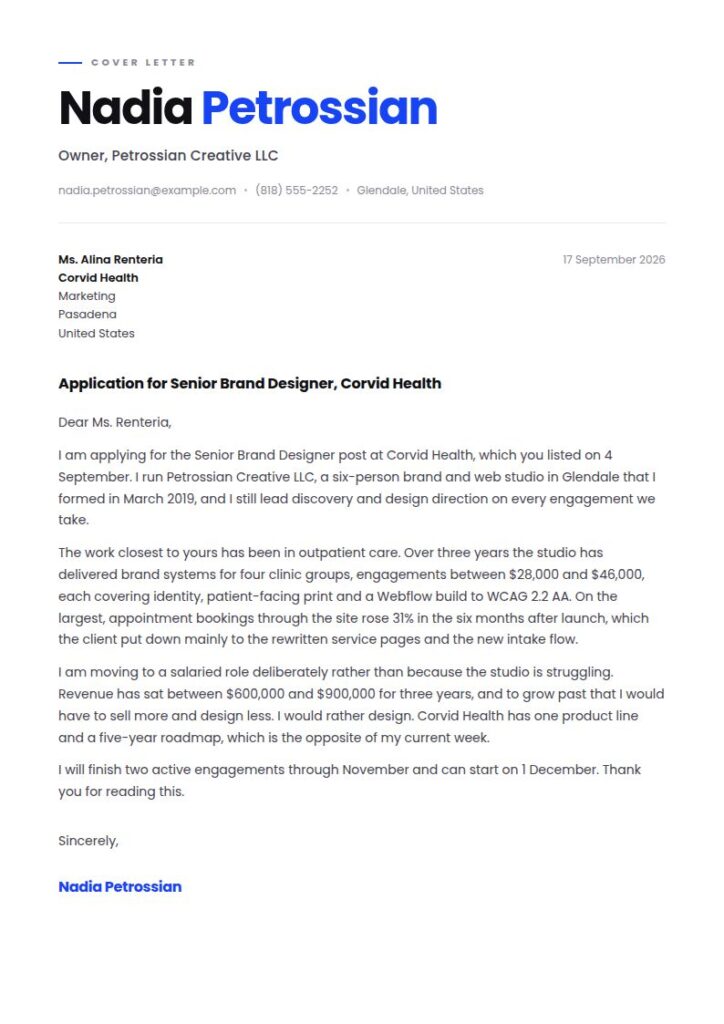
I am applying for the Senior Brand Designer post at Corvid Health, which you listed on 4 September. I run Petrossian Creative LLC, a six-person brand and web studio in Glendale that I formed in March 2019, and I still lead discovery and design direction on every engagement we take.
The work closest to yours has been in outpatient care. Over three years the studio has delivered brand systems for four clinic groups, engagements between $28,000 and $46,000, each covering identity, patient-facing print and a Webflow build to WCAG 2.2 AA. On the largest, appointment bookings through the site rose 31% in the six months after launch, which the client put down mainly to the rewritten service pages and the new intake flow.
I am moving to a salaried role deliberately rather than because the studio is struggling. Revenue has sat between $600,000 and $900,000 for three years, and to grow past that I would have to sell more and design less. I would rather design. Corvid Health has one product line and a five-year roadmap, which is the opposite of my current week.
I will finish two active engagements through November and can start on 1 December. Thank you for reading this.
Sincerely, Nadia Petrossian
Answer the question they will not ask
Nobody writes "why are you leaving self-employment" into a posting, and almost every reader wonders it. An unanswered question becomes an assumption: that the business failed, or that you will treat the job as a bridge.
| Reason | How to write it |
|---|---|
| You want depth instead of breadth | "To grow past this revenue I would have to sell more and design less. I would rather design." |
| You want to stop carrying the commercial load | "I have owned pricing, contracts and collections for seven years and would like to hand that back." |
| The market moved | "Two of my three retainers were consolidated in 2025, and I am winding the studio down rather than chasing replacements." |
| You want a team around you | "I am the only senior designer in a six-person studio, and I want to be the third most experienced person in a room again." |
| Stability, and you can say so | "I would like a predictable income and health coverage that is not on my own card." |
Any of those reads better than silence. The version that hurts you implies the business is thriving and says nothing about why you are leaving it.
Give scale without naming clients
Two populations, counted differently
In August 2026 the Bureau of Labor Statistics counted 9,548,000 unincorporated self-employed workers on a seasonally adjusted basis, and 6,856,000 incorporated self-employed workers on a basis that is not seasonally adjusted (BLS, Employment Situation, Table A-9 Selected employment indicators, August 2026).
If you are in the incorporated group you are, statistically, an employee of a company you own, with a payroll and a legal employer. Saying so changes how a reader hears the application.
One more number matters before you write about money. The self-employment tax rate is 15.3 percent, 12.4 percent for Social Security and 2.9 percent for Medicare, with the employer-equivalent half deductible in figuring adjusted gross income (IRS, Self-Employment Tax, page last reviewed or updated 27 June 2026). That is part of the gap between revenue and income, and why a salary offer and a contract year are not comparable.
Ranges and categories carry scale without breaching anything: "four clinic groups, engagements between $28,000 and $46,000" tells a reader more than three logos would. Name a client only where the work is public or you hold written permission.
Openings that work
| Instead of | Use |
|---|---|
| I have been self-employed for the past seven years | I run Petrossian Creative LLC, a six-person brand studio I formed in March 2019 |
| I am looking to transition back into a full-time role | I am applying for the Senior Brand Designer post you listed on 4 September |
| I have worked with clients of all shapes and sizes | The work closest to yours has been four clinic groups over three years |
| I am excited about this opportunity | Corvid Health has one product line and a five-year roadmap, which is the opposite of my current week |
Name the legal entity and its formation month in the first sentence. Say what you personally do inside the business, in the present tense, if it is still trading. Give scale as ranges. Answer why you want a job, in one sentence, without apology. State your real availability, including engagements you must finish. Keep every figure identical to the resume.
Do not call yourself an entrepreneur or a visionary. Do not pitch: this is an application, not a proposal, and a letter that sounds like a sales email is read as one. Do not list clients covered by a confidentiality agreement. Do not imply you will keep taking side work unless you have agreed it. Do not use your business email or put your logo on the letter.
Length, format and sending it
One page, four paragraphs, 250 to 400 words. PDF unless the portal says otherwise, named for yourself and the post: nadia-petrossian-brand-designer-cover-letter.pdf.
Use a personal email address. A letter from your studio's domain, under your studio's signature block, reads as business development whatever the words say.
One note on your own records. For tax years beginning after 2025 the reporting threshold for nonemployee compensation on Form 1099-NEC rose to $2,000 from $600 (IRS, Instructions for Forms 1099-MISC and 1099-NEC, December 2026 revision), so smaller recent engagements may leave no form behind. Your invoice ledger did not change, and it is what you reach for if a reference check gets specific.
Key takeaways
- Name the legal entity and its formation month in the first sentence.
- Say what you personally do inside the business, not what the business sells.
- Give one engagement with a number and a period as your evidence.
- Answer why you are leaving self-employment, in one plain sentence.
- Use ranges and sectors instead of client names.
- State your real availability and what you must finish first.
- Send from a personal address, no logo and no pitch.
Write your self-employed cover letter in 10 minutes with our AI cover letter builder.
Self-employed cover letter questions, answered
How do I explain self-employment in a cover letter?
Name the entity, its legal form and its start month in the opening sentence, then describe your own work inside it in the present tense. The paragraph about the journey of entrepreneurship is the thing to leave out. A company with a name and a formation date needs no defense.
Should I say why I am leaving my business?
Yes, in one sentence, in the third paragraph. Readers assume the worst when a letter is silent. Whether the reason is depth over breadth, a lost retainer, wanting a team around you or wanting predictable income, stating it plainly closes the question.
Will they think I am going to go back to freelancing?
Some will, which is why availability matters. Say what you are finishing and when, and what happens to the entity: dormant, dissolved, or registered with no active clients. Someone who has thought about the wind-down reads as someone who has decided.
Can I mention my revenue in the letter?
A range, once, if it supports your point. "Revenue has sat between $600,000 and $900,000 for three years" makes the case that you are not leaving a failure. A precise figure invites a conversation about your business, not the job.
What if my business is very small?
Write it accurately; small businesses read fine. One person, eleven clients, engagements between $3,000 and $12,000, four years, is a clear and creditable picture. Vagueness fails, not size, and a small business described exactly beats a larger one described in adjectives.