Beatrix Lindgren Gallery Manager, Primary Market Santa Fe, 87501, United States [email protected] · (505) 555-0168
11 September 2026
Ms. Odalys Marrero Owner Blue Mesa Projects Denver, United States
Application for Gallery Director, Blue Mesa Projects
Dear Ms. Marrero,
I am applying for the Gallery Director position at Blue Mesa Projects. I currently manage Acequia Contemporary in Santa Fe, a primary market gallery with an eighteen artist roster, an eight exhibition calendar and two fairs a year, and I administer every consignment agreement, insurance schedule and artist settlement on that roster.
The work I would most want to bring to Blue Mesa is the collector list. When I arrived, the gallery had a single undifferentiated mailing list of about 310 contacts and sent every preview to all of them. I rebuilt it around medium and price band, wrote separate preview offers against each segment, and tracked which segment each placement came from. The active list is now 690 contacts, and the segmentation is what made our first museum placement possible, because I could see who was already collecting at that level and in that medium.
I have followed your program since the Ortiz show and I think the two year sequence you have built with your painters is unusually coherent for a gallery of your size. The gap I would want to work on is fairs. I have run the Expo Chicago booth end to end across three editions, from selection and crating through customs paperwork, install, staffing and follow up, and fairs now account for around a third of dealer sales across the trade, which is hard to reach from a single location.
I can start with a month's notice and I am glad to come to Denver at my own cost to talk it through. Thank you for reading.
Sincerely, Beatrix Lindgren, M.A.
Summary
An art gallery manager cover letter tells a gallery owner which market you work in, what you have run, and what you can be trusted with when nobody is watching the storeroom. This guide gives you a full adaptable letter, the openings that work on a gallery application, and the line between useful evidence and a breach of a collector's confidence.
Art Gallery Manager cover letter examples by experience level
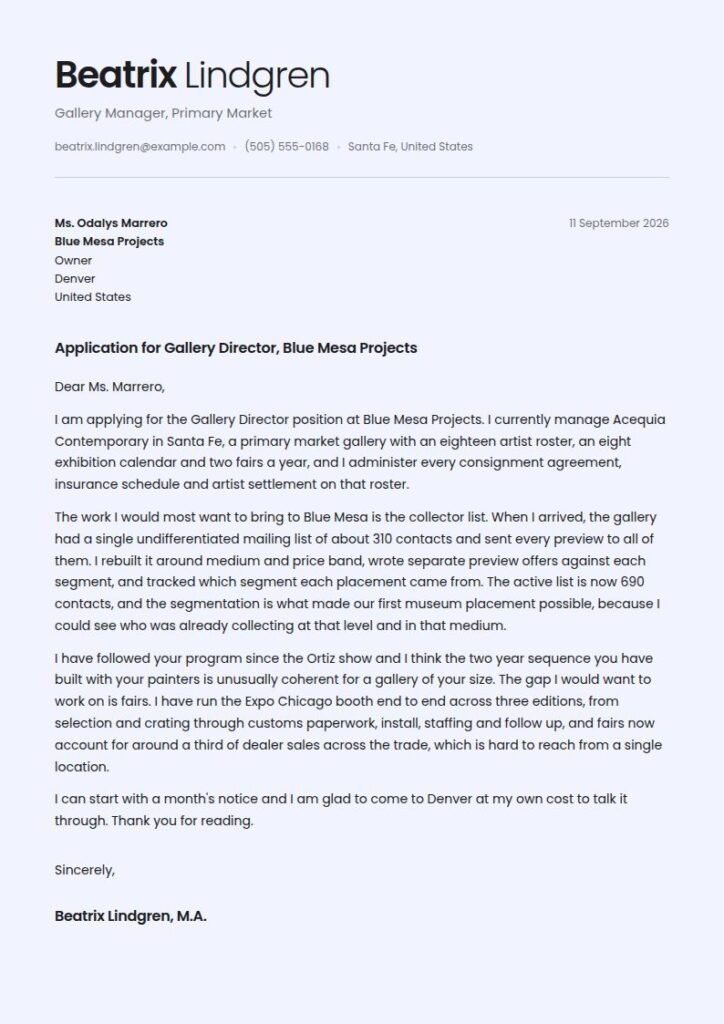
An art gallery manager cover letter is a one page letter telling a gallery owner which market you work in, what you have actually run, and why the consigned work in their storeroom would be safe with you.
Galleries are small. The letter is often read by the owner, sometimes on a phone, between a studio visit and a shipper's call. It has to be concrete in the first three lines.
Guide to an art gallery manager cover letter
This guide and the corresponding art gallery manager cover letter example will cover:
- How to structure the letter, paragraph by paragraph
- Why the first line must say primary or secondary market
- What counts as evidence in a gallery, and what is a confidence you cannot spend
- How art fair experience changes the reading of a letter
- The close that gets a gallery to call rather than file
How to write an art gallery manager cover letter
| Paragraph | Its job | Length |
|---|---|---|
| Opening | The role, your market, the roster and program you run now | 2 to 3 sentences |
| Evidence | One result: list growth, a fair, a placement, a settlement record | 4 to 5 sentences |
| Fit | Something true about their program, and what you would take on | 3 to 4 sentences |
| Close | Availability, and a plain offer to talk | 2 sentences |
Open with the market and the roster, not with the art
Every letter a gallery receives opens with an appreciation of art. The owner has read it hundreds of times and it tells them nothing about whether you can run their business.
Open with the shape of what you have held instead: "I manage a primary market contemporary gallery with an eighteen artist roster, an eight exhibition calendar and two fairs a year." That is four facts in one sentence, and it lets the owner compare you to their own operation immediately.
Then say what you administer. A gallery manager who mentions consignment agreements, insurance schedules and artist settlements in the first paragraph is announcing that they understand the legal shape of the job.
An art gallery manager cover letter example you can adapt
Dear Ms. Marrero,
I am applying for the Gallery Director position at Blue Mesa Projects. I currently manage Acequia Contemporary in Santa Fe, a primary market gallery with an eighteen artist roster, an eight exhibition calendar and two fairs a year, and I administer every consignment agreement, insurance schedule and artist settlement on that roster.
The work I would most want to bring to Blue Mesa is the collector list. When I arrived, the gallery had a single undifferentiated mailing list of about 310 contacts and sent every preview to all of them. I rebuilt it around medium and price band, wrote separate preview offers against each segment, and tracked which segment each placement came from. The active list is now 690 contacts, and the segmentation is what made our first museum placement possible, because I could see who was already collecting at that level and in that medium.
I have followed your program since the Ortiz show and I think the two year sequence you have built with your painters is unusually coherent for a gallery of your size. The gap I would want to work on is fairs. I have run the Expo Chicago booth end to end across three editions, from selection and crating through customs paperwork, install, staffing and follow up, and fairs now account for around a third of dealer sales across the trade, which is hard to reach from a single location.
I can start with a month's notice and I am glad to come to Denver at my own cost to talk it through. Thank you for reading.
Sincerely, Beatrix Lindgren, M.A.
Openings that work
| Instead of | Use |
|---|---|
| I have always had a passion for contemporary art | I manage a primary market gallery with an eighteen artist roster and an eight exhibition calendar |
| I am writing to apply for the gallery director position | I am applying for the Gallery Director position at Blue Mesa Projects |
| I have strong relationships with collectors | I grew the active collector list from 310 to 690 contacts and placed two works with a regional museum |
| I have experience with art fairs | I have run the Expo Chicago booth end to end across three editions, selection through post-fair follow up |
| I am highly organized | I administer every consignment agreement, insurance schedule and artist settlement on a roster of eighteen |
What counts as evidence in a gallery
| Kind of evidence | What it looks like in a sentence |
|---|---|
| Collector list | Grew the active list from 310 to 690 contacts by segmenting on medium and price band |
| Placement | Closed the gallery's first museum placement, a two work acquisition by a regional institution |
| Program | Ran eight exhibitions a year from checklist and price list through deinstall |
| Fairs | Ran the Expo Chicago booth end to end across three editions |
| Objects | Cataloged and condition reported 480 works across six exhibitions |
| Consignment | Administered eighteen artist settlements with no disputed payment in five years |
The settlement line is the quietest and often the most persuasive. Late or contested artist payments are how small galleries lose rosters, and an owner reading that sentence knows exactly what it costs them not to have.
Writing about collectors and consignment without breaching a confidence
Say whether you work the primary or the secondary market in the first line. Give roster size, exhibition count and fair count. Describe the collector list by size, segmentation and growth. Name an institution you placed with if the acquisition is public. Say you administer consignment agreements, insurance schedules and settlements, in those words. Name one real thing about their program that you could only know by following it.
Do not name a collector or what they bought. Do not mention an unannounced private sale, an artist's studio finances, or a gallery's turnover. Do not claim you curated a show you installed. Do not open with your love of art. Do not send a designed letter with columns or a photograph; galleries read that as a lack of judgment.
A third of dealer sales now happen at fairs
Global art sales reached $59.6 billion in 2025, up 4 percent, with the dealer and gallery sector at $34.8 billion and the United States holding a 44 percent share, around $26.0 billion (Art Basel and UBS Global Art Market Report 2026, by Arts Economics, published March 2026).
Within the dealer sector, art fairs accounted for 35 percent of sales in 2025, up from 31 percent in 2024 (Art Basel and UBS Global Art Market Report 2026). That is the fastest way to change how a gallery owner reads your letter: a candidate who has run a booth end to end can reach a third of the revenue that a candidate who has only worked a gallery floor cannot.
The same report, based on a survey of more than 1,650 dealers across seventy markets, found the average gallery has been operating for twenty-six years. These are long-lived businesses that hire on trust, which is why the consignment and settlement sentences carry so much weight in a short letter.
Length, format and sending it
One page, four paragraphs, 250 to 400 words. PDF, named for yourself and the role: beatrix-lindgren-gallery-director-cover-letter.pdf. Plain layout, no photograph, one typeface.
Address the owner or director by name. Gallery staff pages are public, and a letter to "Dear Hiring Manager" in a field this small reads as a letter sent to twelve galleries at once.
Keep the figures identical to your resume so the two documents agree. Our art gallery manager resume example uses the same numbers, and the free Rezoom ATS resume checker is worth running if you are applying to a gallery group or an auction house.
Key takeaways
- Say primary or secondary market in the opening sentence.
- Give roster size, exhibitions a year and fairs a year as one compact fact.
- Pick one result and follow it through: what you found, what you changed, what happened.
- Name the fairs and what you owned at them.
- Say you administer consignment agreements and settlements, in those words.
- Never name a collector, a price, or an unannounced sale.
- Address the owner by name and keep the design plain.
Write your art gallery manager cover letter in 10 minutes.
Related retail resume examples
- Antique dealer resume
- Auction house manager resume
- Store manager resume
- Retail manager resume
- Sales associate resume
- Shop assistant resume
- Cashier resume
- Retail cashier resume
- Clothing store resume
- Fragrance sales associate resume
- Coffee shop manager resume
- Retail resume
Build the matching document with the Rezoom AI resume builder.
Art gallery manager cover letter questions, answered
How long should an art gallery manager cover letter be?
One page, four paragraphs, 250 to 400 words. Gallery owners read everything but they read it fast, usually between other obligations. A letter that takes two screens on a phone is a letter that gets left.
Should I mention specific artists I have worked with?
Represented artists are public, so naming them is fine and often useful, particularly if their work overlaps with the gallery's program. What is not fine is anything private about them: sales figures, studio finances, a dispute, or a move between galleries that has not been announced.
What if I am moving from a museum or an auction house?
Say which part transfers and be honest about which part does not. Registrar work, condition reporting, provenance and cataloging transfer directly. Selling on a commercial floor and holding artist relationships may not, so name the thing you have not done rather than letting the owner discover it in the interview.
How do I write to a gallery with no advertised opening?
Short, specific and about them. One paragraph on what you run now, one on a show or an artist of theirs you have followed closely enough to say something real about, and one line saying you would be glad to talk if anything opens. Galleries hire this way more often than they advertise.
Does art fair experience really matter that much?
Yes. Art fairs accounted for 35 percent of dealer sales in 2025, up from 31 percent the year before (Art Basel and UBS Global Art Market Report 2026). Running a booth is a distinct operational skill covering selection, crating, shipping, customs, install, staffing and follow up, and a gallery that cannot staff one is cut off from a third of the trade's revenue.