Niamh Fitzgerald Shop Assistant, Homeware and Kitchen Portland, 97214, United States [email protected] · (503) 555-0142
11 September 2026
Ms. Dana Whitcomb Store Manager Alder & Post Portland, United States
Application for Shop Assistant, Homeware, Alder & Post
Dear Ms. Whitcomb,
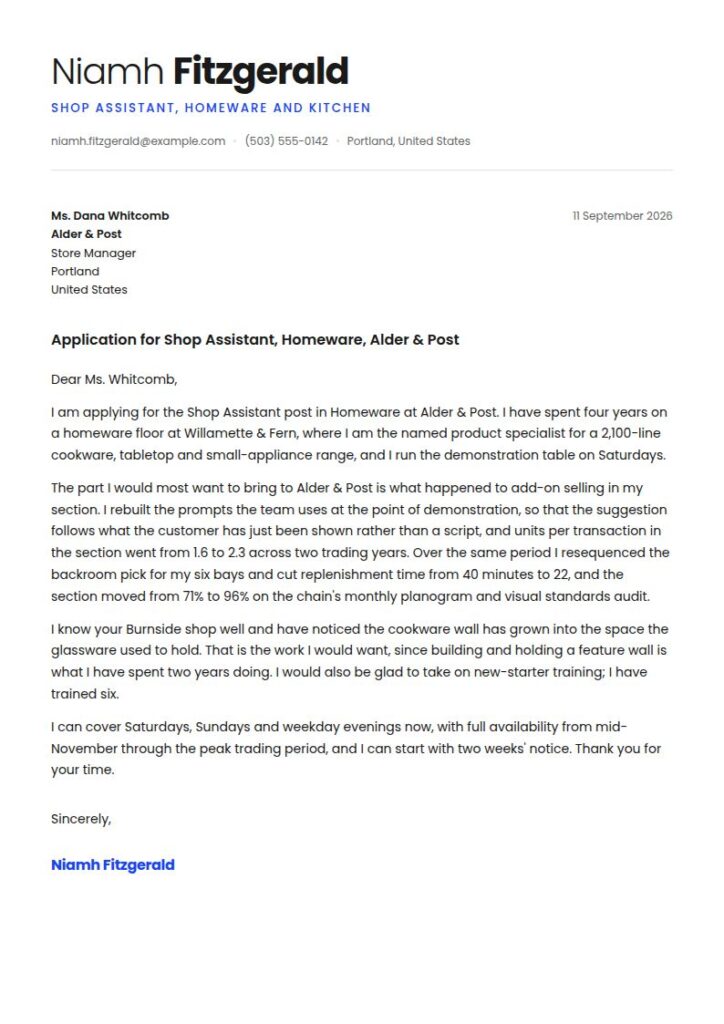
I am applying for the Shop Assistant post in Homeware at Alder & Post. I have spent four years on a homeware floor at Willamette & Fern, where I am the named product specialist for a 2,100-line cookware, tabletop and small-appliance range, and I run the demonstration table on Saturdays.
The part I would most want to bring to Alder & Post is what happened to add-on selling in my section. I rebuilt the prompts the team uses at the point of demonstration, so that the suggestion follows what the customer has just been shown rather than a script, and units per transaction in the section went from 1.6 to 2.3 across two trading years. Over the same period I resequenced the backroom pick for my six bays and cut replenishment time from 40 minutes to 22, and the section moved from 71% to 96% on the chain's monthly planogram and visual standards audit.
I know your Burnside shop well and have noticed the cookware wall has grown into the space the glassware used to hold. That is the work I would want, since building and holding a feature wall is what I have spent two years doing. I would also be glad to take on new-starter training; I have trained six.
I can cover Saturdays, Sundays and weekday evenings now, with full availability from mid-November through the peak trading period, and I can start with two weeks' notice. Thank you for your time.
Sincerely, Niamh Fitzgerald
Summary
A shop assistant cover letter names the product category you know, one measured result from your own section of the floor, and the shifts you can cover. This guide gives you a full adaptable letter, what to write when the numbers belong to the store rather than to you, and how the letter changes for a British, Irish or Australian employer.
Shop Assistant cover letter examples by experience level
A shop assistant cover letter is a one-page letter that tells a store manager which part of their floor you could take over, what you have made better on a floor before, and when you can work.
Store managers hire fast, usually under a rota gap and often before a trading peak. Most letters they receive are three paragraphs of goodwill. One carrying a category, a number and an availability line is unusual enough to get the interview on its own.
Guide to a shop assistant cover letter
This guide and the corresponding shop assistant cover letter example will cover:
- How to structure the letter, paragraph by paragraph
- Why the product category belongs in the first sentence
- What counts as evidence when the till is not yours
- How to write availability without sounding as though you are negotiating
- What changes for a UK, Irish, Australian or New Zealand employer
How to write a shop assistant cover letter
| Paragraph | Its job | Length |
|---|---|---|
| Opening | The role, the store, and the category you know | 2 to 3 sentences |
| Evidence | One section, one measure, one before and after | 4 to 5 sentences |
| Fit | Something specific about their shop, and what you would take on | 3 to 4 sentences |
| Close | Availability, start date, thank you | 2 sentences |
Open with a category, not a character trait
A manager filling a homeware vacancy is not looking for an enthusiastic person. They want someone who can stand at a demonstration table on a Saturday and answer a question about induction compatibility without fetching anyone.
So the first sentence names the category and the depth: "I have spent four years on a homeware floor and I am the named product specialist for a 2,100-line cookware and small-appliance range." That tells the manager which department you fit and implies the training they will not have to pay for.
A shop assistant cover letter example you can adapt
Dear Ms. Whitcomb,
I am applying for the Shop Assistant post in Homeware at Alder & Post. I have spent four years on a homeware floor at Willamette & Fern, where I am the named product specialist for a 2,100-line cookware, tabletop and small-appliance range, and I run the demonstration table on Saturdays.
The part I would most want to bring to Alder & Post is what happened to add-on selling in my section. I rebuilt the prompts the team uses at the point of demonstration, so that the suggestion follows what the customer has just been shown rather than a script, and units per transaction in the section went from 1.6 to 2.3 across two trading years. Over the same period I resequenced the backroom pick for my six bays and cut replenishment time from 40 minutes to 22, and the section moved from 71% to 96% on the chain's monthly planogram and visual standards audit.
I know your Burnside shop well and have noticed the cookware wall has grown into the space the glassware used to hold. That is the work I would want, since building and holding a feature wall is what I have spent two years doing. I would also be glad to take on new-starter training; I have trained six.
I can cover Saturdays, Sundays and weekday evenings now, with full availability from mid-November through the peak trading period, and I can start with two weeks' notice. Thank you for your time.
Openings that work
Three shapes, each putting something checkable in the first two lines.
The category opening. "I have spent four years on a homeware floor and I am the named product specialist for a 2,100-line cookware range." Best when your depth is the strongest thing you have.
The result opening. "I took my section from 71% to 96% on the chain's visual standards audit across four quarters." Best when you have one genuinely good number.
The availability opening. "I can cover every Saturday and Sunday from now through January." Best for a first retail job, or when the advert is built around a rota gap.
Never open with why you want to work in retail. The manager has no doubt about the supply of people who want the job.
What counts as evidence on a sales floor
The objection to every shop assistant letter is that the numbers belong to the store. Answer it with measures reported at section level, or graded against you personally.
| Instead of | Use |
|---|---|
| I helped increase sales in my department | Units per transaction in my section went from 1.6 to 2.3 across two trading years |
| I kept the store looking good | The section moved from 71% to 96% on the chain's monthly visual standards audit |
| I was quick at restocking | I resequenced the backroom pick for six bays and cut replenishment from 40 minutes to 22 |
| I know a lot about the products | I am brand-trained on 14 cookware ranges, including induction compatibility and warranty terms |
| I trained new team members | I trained six new starters on product knowledge and planogram compliance |
If your store reported none of this, count something for a month before you write: consultations a shift, bays replenished, features built.
Write availability as a fact, not a request
The last paragraph is where most of these letters go soft. Managers read "flexible availability" as "will turn out to have a conflict".
Write the actual shifts: "Saturdays, Sundays and weekday evenings now, full availability from mid-November." If your availability is narrow, say plainly what it is. A manager who learns it at interview has lost an hour and will remember who cost them it.
Name the department in the first sentence. Give one before-and-after number with a period of time. Mention something real about their shop, ideally something you have seen on the floor. State the exact shifts you can cover and your notice period. Keep it to one page.
Do not open with how much you love the brand. Do not write "excellent customer service", "hardworking" or "team player". Do not repeat the resume bullet for bullet; pick one thing and tell the story behind it. Do not claim store-level revenue you did not own. Do not leave availability vague.
Writing for a UK, Irish or Australian employer
The content holds; the conventions differ. In the United Kingdom and Ireland it is a covering letter attached to a CV, two pages of CV is normal, and right to work is often addressed directly. In Australia and New Zealand named referees are expected at the end of the CV, and the letter is often replaced by written responses to selection criteria, answered one by one rather than in prose. In all four markets, no photograph and no date of birth.
The market you are applying into is a flat one, so evidence decides it
Employment of retail sales workers is projected to show little or no change from 2025 to 2035, yet about 550,600 openings a year are projected over the decade, most of them from workers transferring out of the occupation or leaving the labor force (U.S. Bureau of Labor Statistics, Occupational Outlook Handbook, last modified 27 August 2026).
Retail remains the largest private-sector employer in the country, supporting 55 million jobs and directly providing 32.2 million of them in 2022 (National Retail Federation, November 2024).
Read together, those figures explain what the letter is for: no shortage of vacancies and no shortage of applicants, at a median hourly wage of $17.03 for retail salespersons in May 2025 (BLS, same handbook). Nothing about the market will shortlist you. A specific category and one honest number will.
Length, format and sending it
One page, four paragraphs, roughly 250 to 320 words. Plain type, no photograph, no graphics. Send a PDF unless the portal asks otherwise, named with your name and the role. If the portal has no upload field for a letter, paste the four paragraphs into the "anything else you would like us to know" box. That box is read and is almost always empty.
Key takeaways
- Name the department and the size of the range in the first two lines.
- Use one section-level measure with a before, an after and a time frame.
- Say something about their actual shop, not about the brand's values.
- Write availability as specific shifts, and include your notice period.
- Do not repeat the resume; tell the story behind one line of it.
Pair it with a matching shop assistant resume example, check the finished file with the Rezoom ATS resume checker, and build both in 15 minutes.
Shop assistant cover letter questions, answered
How long should a shop assistant cover letter be?
One page and four paragraphs, around 250 to 320 words. Store managers read these between tasks on the floor, and a letter that repeats the resume gets skimmed to the availability line anyway.
Do I need a cover letter if the chain uses an online application?
Write one even with no upload field. Most chain portals have a free-text box near the end and it is usually empty. Four tight paragraphs there do the same job, attached to the application rather than sent in a separate email.
What do I write with no retail experience at all?
Lead with availability and with any setting where you held a standard for other people: a charity shop, a market stall, a school enterprise, a family business. Then name one product area you know well as a customer and say you want to sell in it. Managers hire first-job applicants on reliability and interest in the category, in that order.
Should I mention the pay or the hours in the letter?
Mention hours, not pay. The shifts you can cover are information the manager needs in order to shortlist you. Pay is an offer-stage conversation, and raising it early reads as a condition rather than a question.
How do I write about a shop I have only visited once?
Notice something physical rather than something from the website: a range that has expanded, a feature wall, a department that has moved. One accurate sentence about the floor proves you have stood on it, which is more than most letters manage.