Alistair Pemberton Dealer, Southern Furniture and Anglo-American Silver Charleston, 29401, United States [email protected] · (843) 555-0167
11 September 2026
Ms. Eleanor Harrow Principal Ashmore & Finch Charleston, United States
Gallery Director, Ashmore & Finch
Dear Ms. Harrow,
I am writing about the gallery director post at Ashmore & Finch. I deal in Southern furniture and Anglo-American silver of 1720 to 1860, and I have run my own Charleston gallery and a four-fair-a-year calendar since 2017.
The part of my practice I would want to bring is the estate side. Over five years I bought and placed 14 estates, two of them into museum collections and one as a 340-object private collection kept intact. That work turns on being trusted by the executor before the appraisers arrive, which comes from doing the unglamorous things consistently: a written condition report, a provenance file and a database search result with every object above $2,500, and a restricted materials procedure covering ivory, tortoiseshell and protected timbers so nothing crosses a state line without a documented exemption.
I noticed Ashmore & Finch has been building a Southern decorative arts strand and took a stand at two fairs last year where I was also exhibiting. My contact list in that field is fifteen years deep on both the buying and the selling side, and a consignment program is where I think it would earn most for you.
I can provide trade references from two salerooms and an estate attorney, and I am able to start after the spring fair. Thank you for your time.
Sincerely, Alistair Pemberton
Summary
An antique dealer cover letter names the categories and periods you can authenticate, the channels you can source from, and the provenance and restricted materials discipline you work to. This guide gives you a full adaptable letter, what changes between a gallery, an auction house and a private client, and the claims that cost you the trade's trust.
Antique Dealer cover letter examples by experience level
An antique dealer cover letter is a one-page letter naming the categories and periods you can authenticate, the channels you can buy through, and the paperwork discipline that stands behind both.
This is a small trade with a long memory. The letter is being read by someone who will know, or can find out in one phone call, whether your claims hold. That makes overreach far more expensive here than in most fields, and specificity far more valuable.
Guide to an antique dealer cover letter
This guide and the corresponding antique dealer cover letter example will cover:
- How to structure the letter, paragraph by paragraph
- Why the categories you can authenticate belong in the first sentence
- Sourcing channels, and why a gallery is really buying yours
- What changes between a gallery, an auction house and a private client
- The claims that cost you the trade's trust
How to write an antique dealer cover letter
| Paragraph | Its job | Length |
|---|---|---|
| Opening | The role, your categories and periods, and your base | 2 to 3 sentences |
| Evidence | One object, one estate or one placement, written completely | 4 to 5 sentences |
| Fit | What you would bring to their program, named | 3 sentences |
| Close | Compliance and references, availability, thank you | 2 sentences |
Name the category and the period, not the word antiques
"Antiques" is not a specialism. Every dealer worth hiring works in a defined lane, and the lane is how a gallery decides whether you fill a gap or duplicate what they already have.
Write it the way a catalog would: "Southern furniture and Anglo-American silver of the period 1720 to 1860." Then, if it is true, add the second strand: "with a working knowledge of Lowcountry works on paper."
Two things follow from a sentence like that. The reader knows which sales you can be sent to, and they know which attributions you can be trusted to make unsupervised, which is the thing that actually costs money when it goes wrong.
An antique dealer cover letter example you can adapt
Dear Ms. Harrow,
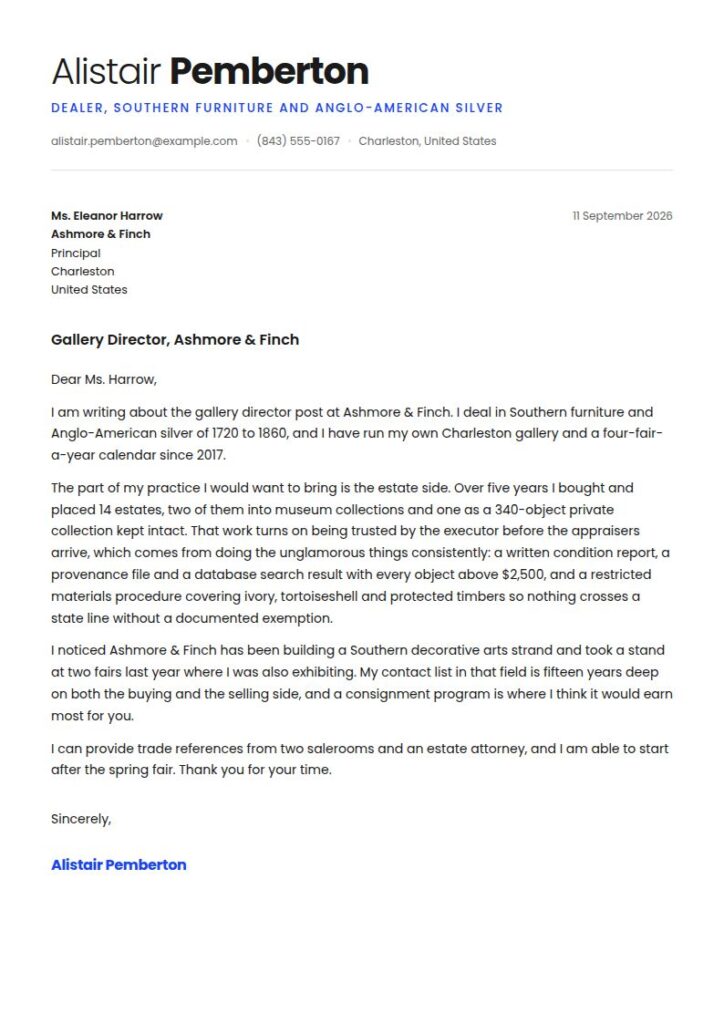
I am writing about the gallery director post at Ashmore & Finch. I deal in Southern furniture and Anglo-American silver of 1720 to 1860, and I have run my own Charleston gallery and a four-fair-a-year calendar since 2017.
The part of my practice I would want to bring is the estate side. Over five years I bought and placed 14 estates, two of them into museum collections and one as a 340-object private collection kept intact. That work turns on being trusted by the executor before the appraisers arrive, which comes from doing the unglamorous things consistently: a written condition report, a provenance file and a database search result with every object above $2,500, and a restricted materials procedure covering ivory, tortoiseshell and protected timbers so nothing crosses a state line without a documented exemption.
I noticed Ashmore & Finch has been building a Southern decorative arts strand and took a stand at two fairs last year where I was also exhibiting. My contact list in that field is fifteen years deep on both the buying and the selling side, and a consignment program is where I think it would earn most for you.
I can provide trade references from two salerooms and an estate attorney, and I am able to start after the spring fair. Thank you for your time.
Sincerely, Alistair Pemberton
Openings that work
| Instead of | Use |
|---|---|
| I have a lifelong love of antiques and beautiful objects | I deal in Southern furniture and Anglo-American silver of 1720 to 1860 |
| I have extensive experience in the antiques trade | I have run my own Charleston gallery and a four-fair calendar since 2017 |
| I have a good eye and strong attention to detail | Over five years I bought and placed 14 estates, two into museum collections |
| I am knowledgeable about many periods and styles | A condition report, a provenance file and a database search with every object above $2,500 |
What a gallery is really buying
Stock can be replaced. The two things that cannot are the eye and the address book.
| What you are offering | How to write it |
|---|---|
| Attribution you can make unsupervised | The categories and period range, stated as a catalog would |
| Sourcing channels | Estates, salerooms, the trade, fairs, private clients, and which of those you actually hold |
| A client list | Depth in years and field, never names |
| Compliance you can evidence | Provenance files, database searches, restricted materials procedure |
| Commercial discipline | Stock turn, margin, or what you placed and where |
| Standing in the trade | Fairs vetted for, associations, references from salerooms |
Never list a client by name in a letter. The trade runs on discretion, and a dealer who names collectors in an application is telling the reader exactly what they would do with theirs.
Gallery, auction house or private client
For a gallery, lead with category, sourcing and the client relationships you would bring, and be concrete about stock turn or placements. For an auction house, lead with cataloging volume and accuracy, condition reporting, consignor relationships and estate intake, because that is the work. For a private client or a family office, lead with discretion, collection management, condition and conservation oversight, and documented valuations. Offer trade references, since this is a trade that checks them.
Do not name a collector, an estate family or a private buyer. Do not claim an attribution you could not defend to a specialist in that category. Do not describe an object as an antique without the period. Do not imply an association membership, a vetting record or a certification you do not hold, because both are published and easily checked.
Compliance is a selling point, not a footnote
Two things now sit on every serious transaction: whether the object can lawfully move, and whether title is clean.
The first covers restricted materials. Ivory, tortoiseshell, some protected timbers and several species of shell carry federal and state restrictions that vary and change, and the burden of documenting an exemption sits with the seller. A dealer with a written procedure is a dealer who has not created a problem for the gallery's next shipment.
The second covers provenance and stolen property registers. Running a search before consignment, and keeping the result on file, is what stops an object being the gallery's problem two years after it sold.
Neither of these is glamorous. Both are worth a clause in the letter, because they are exactly what an owner worries about when handing their inventory to someone new.
Length, format and sending it
One page, four paragraphs, 250 to 400 words. PDF, named for yourself and the post: alistair-pemberton-gallery-director-cover-letter.pdf.
Much of this trade hires by conversation rather than by advert, so the same letter often goes to someone who was not advertising. That version needs one extra sentence saying plainly why you are writing to them specifically.
Pair it with a document that agrees. Our antique dealer resume example carries the figures used here, and the auction house manager resume covers the saleroom side.
Key takeaways
- Name the categories and the period range in the first sentence.
- Say which sourcing channels you actually hold, not which exist.
- Write one estate, object or placement completely rather than listing five.
- Give a commercial number: stock turn, margin, turnover or what you placed.
- Put the provenance and restricted materials discipline in writing.
- Describe your client list by depth and field, never by name.
- Offer trade references, because they will be taken up.
Write your antique dealer cover letter in 10 minutes.
Antique dealer cover letter questions, answered
How long should an antique dealer cover letter be?
One page, four paragraphs, 250 to 400 words. In a trade this small the letter is usually read alongside a conversation someone has already had about you, so its job is to be precise rather than complete.
What if most of my trading has been self-employed?
Write it as the business it is. Years trading, the categories, the fairs you exhibit at, stock holding and turn, margin, and what you placed and where. A dealer who can describe their own numbers is demonstrating exactly the judgement a gallery is hiring, and self-employment is the normal shape of this career rather than a gap to explain.
Should I mention specific objects I have handled?
Yes, one, written completely: what it was, the period, how it came to you, what you established about it and where it went. That single paragraph shows your eye, your sourcing and your paperwork at once. Give the object, not the buyer.
How do I write about authentication without overclaiming?
Say what you can attribute unsupervised, and say where you refer out. "I attribute Southern furniture and Anglo-American silver in period; for continental silver I work with a specialist" is a stronger sentence than a broad claim, because it tells the reader your judgement includes knowing its own edges.
Do I need qualifications to work in the antiques trade?
There is no license to deal. What exists is appraisal certification through the professional appraisal bodies, auction-house training, and the vetting records of the fairs you exhibit at. Certification matters most when you write valuations, since those carry liability. Everything else is evidenced by what you have handled and who will vouch for you.