Auction Cataloger, Silver and Decorative Arts Philippa Ashworth
Cataloger, Silver and Decorative Arts
[email protected] | (401) 555-0168 | Providence, United States
Profile
Auction cataloger with two years in a regional saleroom, responsible for roughly 2,340 lots across 11 sales a year in silver, ceramics and decorative arts. Write lot descriptions, measurements, condition reports and estimates, and hit catalog close on 11 of 11 sales. Photograph and upload to three online bidding platforms, and handle viewing enquiries and condition report requests, which ran to about 400 a season.
Work Experience
07/2024 - Present, Cataloger, Silver and Decorative Arts, Benefit Street Auction Galleries, Providence, United States
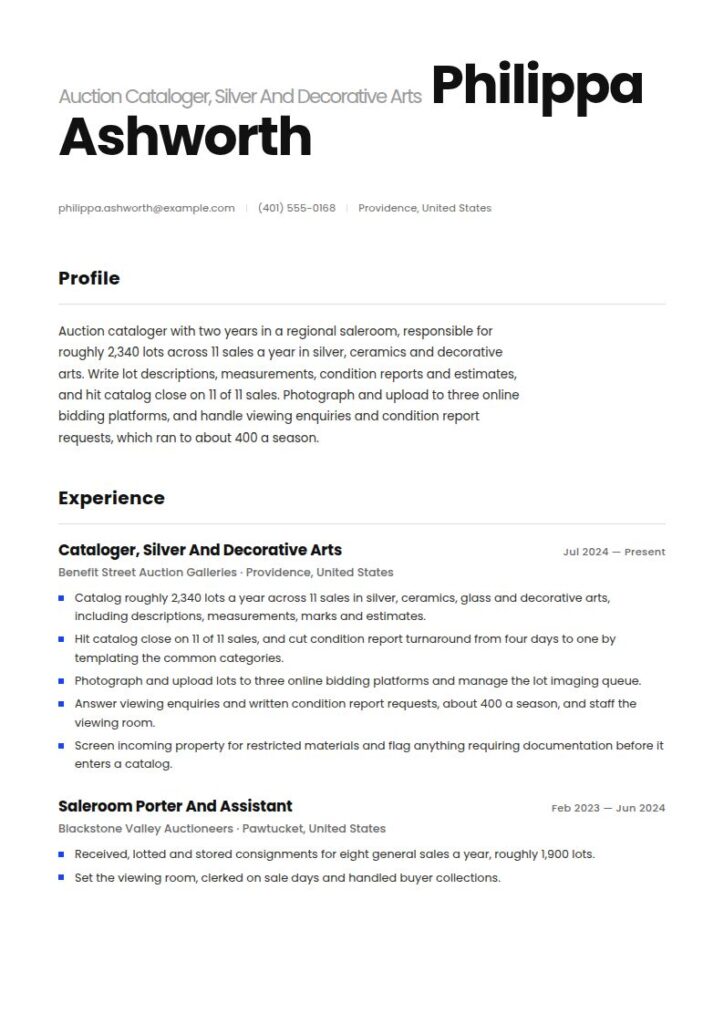
- Catalog roughly 2,340 lots a year across 11 sales in silver, ceramics, glass and decorative arts, including descriptions, measurements, marks and estimates.
- Hit catalog close on 11 of 11 sales, and cut condition report turnaround from four days to one by templating the common categories.
- Photograph and upload lots to three online bidding platforms and manage the lot imaging queue.
- Answer viewing enquiries and written condition report requests, about 400 a season, and staff the viewing room.
- Screen incoming property for restricted materials and flag anything requiring documentation before it enters a catalog.
02/2023 - 06/2024, Saleroom Porter and Assistant, Blackstone Valley Auctioneers, Pawtucket, United States
- Received, lotted and stored consignments for eight general sales a year, roughly 1,900 lots.
- Set the viewing room, clerked on sale days and handled buyer collections.
Education
09/2019 - 05/2023, Bachelor of Arts, History of Art and Architecture, Brown University, Providence, United States
Coursework in decorative arts, material culture and museum practice.
Skills
Cataloging and lot description, 80
Condition reporting, 80
Silver and metalware, 75
Ceramics and glass, 70
Lot photography and imaging, 85
Online bidding platform uploads, 85
Restricted materials screening, 65
Languages
English, native
French, intermediate
Certificates
03/2025, Uniform Standards of Professional Appraisal Practice, 15-hour course, The Appraisal Foundation approved instructor
Prerequisite for International Society of Appraisers credentialing.
Summary
An auction house manager resume is a one to two page document measured in sales held, lots cataloged, sell-through rate and hammer total. This guide gives you three adaptable versions, the consignment and compliance detail that separates a saleroom resume from a retail one, and current art market and Bureau of Labor Statistics figures.
Auction House Manager resume examples by experience level
An auction house manager resume is a one to two page document measured in sales held, lots cataloged, sell-through rate and hammer total.
An auction business is not a shop. A shop opens in the morning and sells what is on the shelf. A saleroom runs a calendar: a consignment deadline, a cataloging deadline, a photography deadline, a viewing, a sale day, then settlement to the consignor, and the whole cycle again three weeks later for the next sale. The manager who can be trusted with that calendar is the one who gets hired, and the resume has to show the calendar, not the salesmanship.
Resume guide for an auction house manager resume
This guide and the corresponding auction house manager resume example will cover:
- How to write an auction house manager resume, section by section
- The four figures a saleroom is actually judged on, and how to present them
- Three adaptable summaries: cataloger, sale coordinator and house manager
- The compliance lines that belong on the page and the authorities behind them
- What the auction market looks like and what the job pays
How to write an auction house manager resume
Six sections: contact header, summary, sale record, experience, specialisms and compliance, and education and credentials. One page as a cataloger or coordinator, two once you have owned a calendar and a profit and loss account.
The order is built around the one question the principal of a saleroom has. They are not asking whether you love objects. They are asking whether next month's sale will close on time with enough lots in it.
| Section | What it is answering | Where it goes |
|---|---|---|
| Sale record | How many sales, how many lots, what sold, for how much? | Its own block, directly under the summary |
| Experience | What did you own in the cycle, from intake to settlement? | Reverse chronological, a number per bullet |
| Specialisms | Which categories can you catalog and estimate without help? | Named categories, not "fine art and antiques" |
| Compliance | Title, restricted materials, cash reporting, consignor money | Short, factual, with the authority named |
Write the calendar, not the passion
Almost every auction resume opens with a sentence about a lifelong love of antiques. Every one of them does, so it carries no information.
What carries information is the shape of your year. "Ran 18 sales a year across four departments, roughly 5,400 lots cataloged, with catalog close hit on 17 of 18" tells a principal your throughput, your department breadth and your reliability in a single line.
Then add the consequence: "sell-through rose from 71% to 84% over three years, and hammer total from $6.1M to $9.3M." A saleroom lives on the buyer's premium and the seller's commission that sit on top of hammer, so hammer total with sell-through beside it is the closest thing this trade has to a revenue figure.
Run the finished file through the free Rezoom ATS resume checker before you send it. Larger houses and auction groups run applications through a tracking system even when the interview will be a conversation in a viewing room.
Choosing the best resume format for an auction house manager resume
Reverse chronological, with a sale record block sitting above the history. Auction careers are built inside a small number of houses over long periods, and the timeline is the proof of trust. Two pages is normal at manager level here, earlier than in most retail roles, because specialisms have to be named and a one-line skills list cannot carry them.
Include your contact information
| ✅ Right | ❌ Wrong |
|---|---|
| Philippa Ashworth | Philippa Ashworth |
| Auction House Manager, Fine Art and Decorative Arts | Lifelong antiques enthusiast and auction professional |
| ISA Accredited Member, GPPA, National Auction Association | Certified appraiser |
| (401) 555-0168, [email protected], Providence, RI | (401) 555-0168, [email protected] |
Name the credentialing body rather than the word certified. The International Society of Appraisers awards Member, Accredited Member and Certified Member of Personal Property, the last of which requires 900 documented hours of appraisal reporting and a passed examination (International Society of Appraisers, credentialing requirements). The National Auction Association awards the Certified Auctioneers Institute designation and the Graduate Personal Property Appraiser designation. Those are checkable; "certified appraiser" is not.
Make use of a summary
Four lines: what you run, the size of the calendar, one sell-through or hammer figure, and your catalog specialisms.
Auction cataloger with two years in a regional saleroom, responsible for roughly 2,340 lots across 11 sales a year in silver, ceramics and decorative arts. Write lot descriptions, measurements, condition reports and estimates, and hit catalog close on 11 of 11 sales. Photograph and upload to three online bidding platforms, and handle viewing enquiries and condition report requests, which ran to about 400 a season.
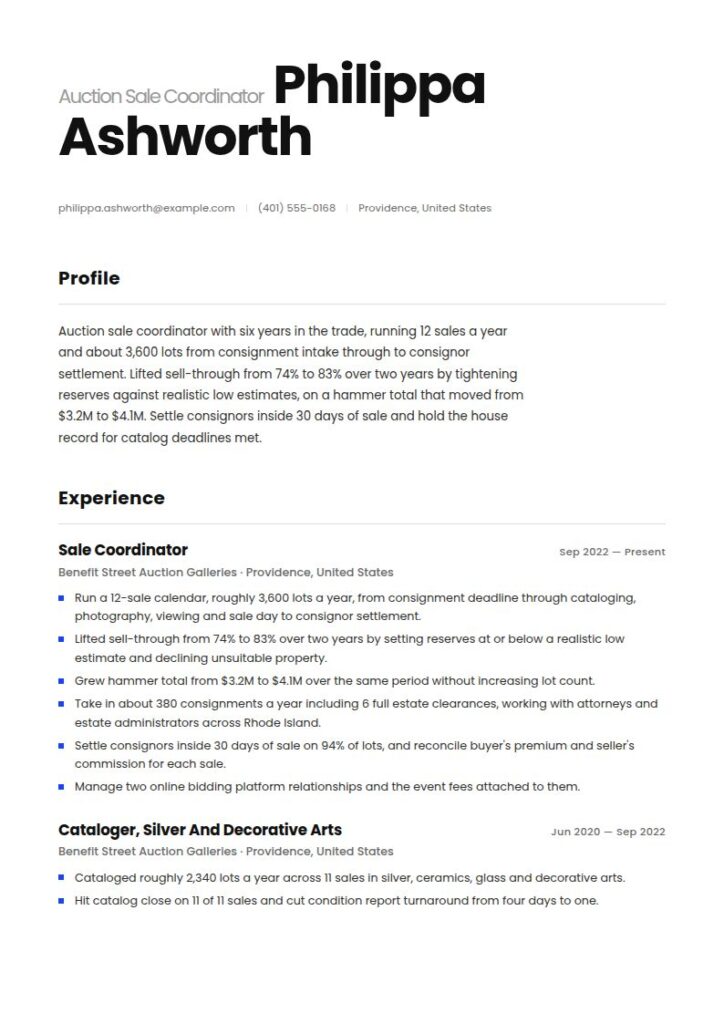
Auction sale coordinator with six years in the trade, running 12 sales a year and about 3,600 lots from consignment intake through to consignor settlement. Lifted sell-through from 74% to 83% over two years by tightening reserves against realistic low estimates, on a hammer total that moved from $3.2M to $4.1M. Settle consignors inside 30 days of sale and hold the house record for catalog deadlines met.
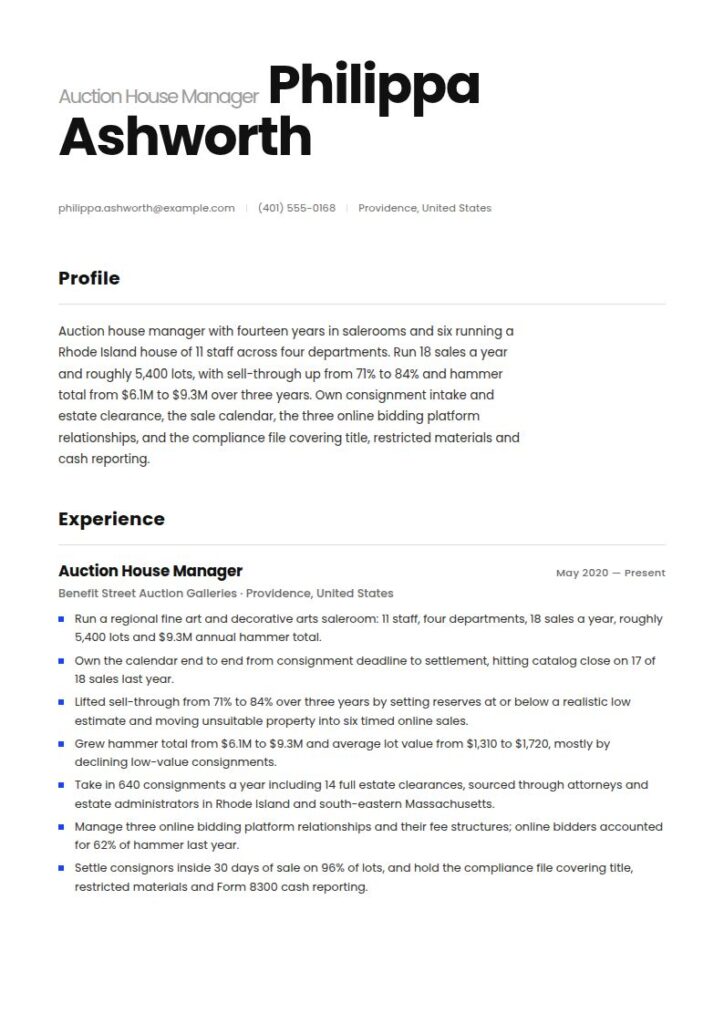
Auction house manager with fourteen years in salerooms and six running a Rhode Island house of 11 staff across four departments. Run 18 sales a year and roughly 5,400 lots, with sell-through up from 71% to 84% and hammer total from $6.1M to $9.3M over three years. Own consignment intake and estate clearance, the sale calendar, the three online bidding platform relationships, and the compliance file covering title, restricted materials and cash reporting.
Right vs wrong: the same auction house manager summary, twice
| ✅ Right | ❌ Wrong |
|---|---|
| Run 18 sales a year and roughly 5,400 lots across four departments. | Responsible for the day to day running of a busy auction house. |
| Sell-through up from 71% to 84% and hammer total from $6.1M to $9.3M over three years. | Consistently achieved strong results at auction. |
| Settle consignors inside 30 days of sale. | Maintained excellent relationships with clients and vendors. |
| Own the compliance file covering title, restricted materials and cash reporting. | Ensured all regulatory requirements were met. |
The right column can be verified by anyone who has worked in a saleroom. The left column is what a principal reads when they are deciding whether you will still be standing after the December sale.
Outline your experience
House, city, dates, then the house profile, then three to five bullets. Every bullet names a stage of the cycle and carries a number.
| Instead of | Use |
|---|---|
| Managed the auction house day to day | Ran 18 sales a year across four departments, 5,400 lots, with 11 staff |
| Responsible for consignments | Took in 640 consignments a year, including 14 full estate clearances, at an average lot value of $1,720 |
| Cataloged items for sale | Cataloged 2,340 lots a year in silver, ceramics and decorative arts, hitting catalog close on 11 of 11 sales |
| Improved auction results | Lifted sell-through from 71% to 84% by setting reserves at or below realistic low estimates |
| Worked with online bidding | Ran three online bidding platforms; online bidders accounted for 62% of hammer in the last full year |
| Handled payments to sellers | Settled consignors inside 30 days of sale on 96% of lots across 18 sales |
Auction House Manager, Benefit Street Auction Galleries, Providence, RI, May 2020 to Present
Regional fine art and decorative arts saleroom, 11 staff, four departments, 18 sales a year, roughly $9.3M annual hammer total.
Own the sale calendar end to end: consignment deadline, cataloging and photography close, viewing, sale day and settlement, with catalog close hit on 17 of 18 sales last year.
Lifted sell-through from 71% to 84% over three years by setting reserves at or below a realistic low estimate and moving unsuitable property to the timed online sales.
Grew hammer total from $6.1M to $9.3M while lifting average lot value from $1,310 to $1,720, mostly by refusing low-value consignments rather than by chasing volume.
Manage three online bidding platform relationships and the fees attached to them; online bidders accounted for 62% of hammer in the last full year.
Settle consignors inside 30 days of sale on 96% of lots, and hold the house compliance file covering title, restricted materials and cash reporting.
Write the sale calendar: sales held, lots cataloged, sell-through and hammer total
This is the block that separates an auction resume from a retail one, and almost nobody includes it.
An auction business is a pipeline with a fixed release date. Property comes in by consignment, estate intake or a house call. It gets cataloged, measured, condition reported, photographed and estimated. A reserve is agreed with the consignor, which in normal practice sits at or below the low estimate, because a reserve above it guarantees the lot is bought in. The lot goes into a catalog with a hard close date, then a viewing, then the sale. Then the consignor is paid.
Four figures describe that whole machine, and they belong in their own block:
| Figure | What it means | Why a principal cares |
|---|---|---|
| Sales held | Sale days a year, by department or sale type | Throughput, and whether you can run a calendar |
| Lots cataloged | Lots entered, described and photographed | The real workload, and your cataloging capacity |
| Sell-through rate | Lots sold as a share of lots offered | Estimating and reserve discipline in one number |
| Hammer total | Total of winning bids before premium | The closest thing to revenue this trade has |
Sales held: 18 a year, four departments, 12 cataloged live sales and 6 timed online sales
Lots cataloged: roughly 5,400 a year, average lot value $1,720
Sell-through: 84% in the last full year, up from 71% in 2023
Hammer total: $9.3M in the last full year, up from $6.1M in 2023
Consignment intake: 640 consignments a year including 14 full estate clearances
Settlement: consignors paid inside 30 days on 96% of lots
Add the premium structure you have worked with if you have set one, because it is a commercial decision and it moves. Sotheby's moved to a buyer's premium of 28 percent on hammer prices up to $2m in New York, 22 percent from $2m to $8m and 15 percent above that, effective 13 February 2026, while Christie's has charged 27 percent up to $1.5m, 22 percent to $8m and 15 percent above since September 2025 (The Art Newspaper, 17 February 2026). Regional houses set their own, and a manager who has modeled the effect of a premium change on hammer and on consignor recruitment should say so.
The online platform fees are the other commercial line worth naming. LiveAuctioneers charges partner houses 5 percent commission on sold lots across arts and antiques and most other categories, plus a live sale event fee running from $525 to $895 a sale day depending on partner tier, and 3.99 percent plus $0.25 per credit card transaction through its payments product (LiveAuctioneers master rate card, last modified 22 April 2026). If you have negotiated a tier, moved a sale between platforms, or measured what share of hammer each one produced, that is management, and it is rare enough on a resume to be worth two lines.
The compliance line an auction resume has to carry
Auction houses handle other people's property and other people's money, and the trust that rests on that is the product. A resume that shows you know where the legal edges are is doing something no amount of connoisseurship does.
Four areas are worth a line each.
Title and provenance. A saleroom that sells something the consignor did not own has a serious problem. Say what your intake process actually is: signed consignment agreement, identification checked, proof of ownership or authority to sell for estates, and a check against the stolen art databases you use.
Restricted materials. Ivory, tortoiseshell, certain rosewoods, marine mammal products and some taxidermy are restricted under the Endangered Species Act and the Convention on International Trade in Endangered Species, with additional state-level bans. If you have withdrawn lots, sought documentation, or built a screening step into cataloging, write it down.
Cash reporting. Any trade or business receiving more than $10,000 in cash in one transaction or in related transactions must report it on Form 8300 within 15 days, and the Internal Revenue Service names works of art, antiques, rugs, gems, stamps, metals and coins as collectibles within designated reporting transactions (Internal Revenue Service, Form 8300 reference guide). A saleroom takes cash. Somebody has to own that filing, and saying you did is a differentiator.
Anti-money laundering. The Anti-Money Laundering Act of 2020 extended Bank Secrecy Act obligations to dealers in antiquities and directed the Treasury to study money laundering through the wider art trade, while art dealers and auction houses generally were not brought directly within the regime at that point (Norton Rose Fulbright, January 2021). Many houses run voluntary customer due diligence on high-value lots anyway, particularly where a European counterparty is involved. If you wrote or ran that program, it belongs on the page.
Licensing is a state question, and the answer is often no
There is no national auctioneer license in the United States, and requirements vary sharply by state. Rhode Island is a clear example: the General Assembly repealed the requirement that auctioneers be licensed by the Department of State, and the licensing regulation has been inactive since 3 December 2015 (Rhode Island Department of State, Commercial Licensing Regulation 2, Auctioneers).
That cuts both ways on a resume. In a state with no license, the credential gap gets filled by the trade designations instead, so the International Society of Appraisers and National Auction Association letters after your name do more work than they would elsewhere.
In a licensing state, put the license number and expiry in the header the way a licensed trade does. And if you are applying across state lines, check the destination state's rule before you write the application, because it is the first thing a principal will ask.
Build a snapshot of your key skills
Twelve to fourteen entries in three groups: the cycle, the categories, and the systems. Categories matter most, because they decide which sales you can be given.
The cycle: Consignment intake and estate clearance, Cataloging and lot description, Condition reporting, Estimates and reserve setting, Catalog production and deadlines, Viewing management, Rostrum and clerking, Post-sale invoicing and consignor settlement
Categories: English and American furniture, Silver and metalware, Ceramics and glass, Fine art on paper, Jewellery and watches, Asian works of art, Books and manuscripts
Systems and commercial: Auction management software, Online bidding platforms and their fee structures, Photography and lot imaging, Shipping and packing coordination, Buyer's premium and commission modeling, Title and restricted materials screening, Form 8300 cash reporting
List your education and certifications
Degree if you have one, then the appraisal and auction credentials with the awarding body, then the courses. The credentials do more work here than the degree.
Bachelor of Arts, History of Art and Architecture, Brown University, Providence, RI, 2011
Accredited Member, International Society of Appraisers (ISA AM), declared specialty in decorative arts, 2019. Requires core appraisal training, the 15-hour USPAP course and 700 documented hours of appraisal experience.
Graduate Personal Property Appraiser (GPPA), National Auction Association, 2021
Uniform Standards of Professional Appraisal Practice, 15-hour course, most recent update 2025
Continuing professional development: restricted materials and endangered species compliance for salerooms, 2024
Choose the right layout and design
Single column, 11 point body type, clear headings, no photograph. Keep the sale record block as plain text rather than a graphic, because the figures in it are the point and a chart will not survive parsing.
Put sales held, lots cataloged, sell-through and hammer total in their own block near the top. Name the categories you can catalog and estimate unaided. Give the consignment intake number and the settlement timescale. Name the online platforms you have run and what share of hammer they produced. Write the credential with its awarding body. Say which compliance areas you personally owned.
Do not open with a sentence about a lifelong passion for antiques. Do not write "fine art and antiques" where the specific categories would do. Do not quote a record price for a single lot without the sell-through beside it, since one good lot is luck and a rate is management. Do not claim a category you cannot estimate. Do not use the word certified without naming who certified you.
Auction house manager job market and outlook
There is no Bureau of Labor Statistics occupation called auction house manager, which tells you something about the job: it is hired by people rather than by systems, in a small trade where reputation travels. Three occupations bracket it.
| Measure | General and operations managers | Archivists, curators and museum workers | Retail sales workers |
|---|---|---|---|
| Employment, 2025 | 3,599,000 | 38,500 | 4,271,400 |
| Projected change, 2025-35 | +5%, +181,300 | +4%, +1,600 | 0%, -5,700 |
| Projected annual openings | ~304,100 across top executives | ~4,300 | ~550,600 |
| Typical entry-level education | Bachelor's degree | Master's degree for curators and archivists | No formal educational credential |
| Median annual wage, May 2025 | $105,770 | $60,330, curators $63,420 | $35,560 |
Source: U.S. Bureau of Labor Statistics, Occupational Outlook Handbook, 2025-35 projections and May 2025 wage data.
The trade's own numbers describe the market better than the occupational ones do.
Auction is the part of the art market that grew
Public auction sales reached $20.7 billion globally in 2025, up 9 percent year on year, while private sales through auction houses fell 5 percent to $4.2 billion and the dealer and gallery sector rose 2 percent to $34.8 billion, on a total art market of $59.6 billion, up 4 percent (Art Basel and UBS Global Art Market Report 2026, by Arts Economics).
Online sales across the whole market were $9.2 billion, or 15 percent of sales by value, the lowest level since 2019 (Art Basel and UBS Global Art Market Report 2026). That number is often misread. Online bidding into a live saleroom sale is not counted as an online sale, which is exactly why your own platform share is worth stating: a regional house can easily take the majority of its hammer from bidders who never enter the room.
The practical reading for a resume is that the rostrum side of the business is where the growth has been, and that volume, sell-through and settlement discipline are what a growing house needs to buy. Write those, not the one record lot.
What salary you can expect as an auction house manager
There is no published national wage for the title, so treat the bracketing occupations as the honest range. General and operations managers had a median annual wage of $105,770 in May 2025, curators $63,420, the broader archivists, curators and museum workers group $60,330, and retail sales workers $35,560 (U.S. Bureau of Labor Statistics, Occupational Outlook Handbook, May 2025). A manager running a regional saleroom generally sits between the curatorial and the general management figures, with the principals of large houses well above both.
Three things move the number. House size is the first, measured in annual hammer total rather than staff count, because commission income scales with hammer. The second is whether your package includes a share of premium or commission, which is common in this trade and is where the upside sits; ask for the structure in writing rather than relying on what anyone calls standard. The third is specialism: a manager who can also catalog and estimate a high-margin department is doing two jobs, and should be paid for both.
Neighboring trades price differently again. Our antique dealer resume example covers buying for your own stock and margin, and our art gallery manager resume example covers primary market sales and fairs; both are useful if you are deciding which side of the trade to aim at.
Key takeaways for an auction house manager resume
- Lead with the calendar: sales held, lots cataloged, sell-through and hammer total.
- Give sell-through as a change over a period, not as a single year.
- Name the consignment intake number and how fast you settle consignors.
- List the categories you can catalog and estimate unaided, by name.
- Say what share of hammer came from each online bidding platform.
- Put the compliance areas you owned on the page: title, restricted materials, cash reporting.
- Write credentials with their awarding body, and licensing with its state.
Build your auction house manager resume in 15 minutes.
Related retail resume examples
- Antique dealer resume
- Art gallery manager resume
- Store manager resume
- Retail manager resume
- Retail resume
- Shop assistant resume
- Cashier resume
- Retail cashier resume
- Coffee shop manager resume
- Clothing store resume
- Fragrance sales associate resume
- Ikea resume
Pair it with a matching auction house manager cover letter.
Auction house manager resume questions, answered
How long should an auction house manager resume be?
Two pages is normal at manager level, one as a cataloger or coordinator. The second page is earned by the sale record block and the category list, both of which are specific enough that a principal will read them. It is not earned by adding adjectives to your intake description.
What if my house will not let me publish hammer totals?
Use a band or a relative measure. "A house in the $8M to $10M annual hammer range" or "the largest of three salerooms in the state by lots offered" carries the scale without publishing a figure. Sell-through as a percentage is rarely confidential, and a rate with a period attached is often more persuasive than the absolute number anyway.
Do I need an auctioneer's license?
It depends entirely on the state, and there is no national license. Rhode Island, for example, repealed its auctioneer licensing requirement and the regulation has been inactive since 3 December 2015 (Rhode Island Department of State, Commercial Licensing Regulation 2, Auctioneers). Where a license is required, put the number and expiry in your header. Where it is not, the trade designations do that work instead.
Which certifications actually count in a saleroom?
The appraisal credentials, because estimating is the skill the whole calendar rests on. The International Society of Appraisers awards Member, Accredited Member and Certified Member of Personal Property, the last requiring 900 documented hours of appraisal reporting and a passed examination (International Society of Appraisers, credentialing requirements), and the National Auction Association awards the Certified Auctioneers Institute and Graduate Personal Property Appraiser designations. Name the body, the designation and the year.
How do I move from cataloger to running a sale?
Take a stage of the cycle nobody wants and measure it. Catalog close, condition report turnaround, photography throughput, post-sale invoicing, or the timed online sales that the live departments ignore. A cataloger who can write "hit catalog close on 11 of 11 sales and cut condition report turnaround from four days to one" is applying for a coordinator job with evidence, which is the only thing that gets a first calendar handed over.