Apparel Sales Associate and Stylist Renata Moreno-Vance
Sales Associate and Stylist
[email protected] | (480) 555-0139 | Scottsdale, United States
Profile
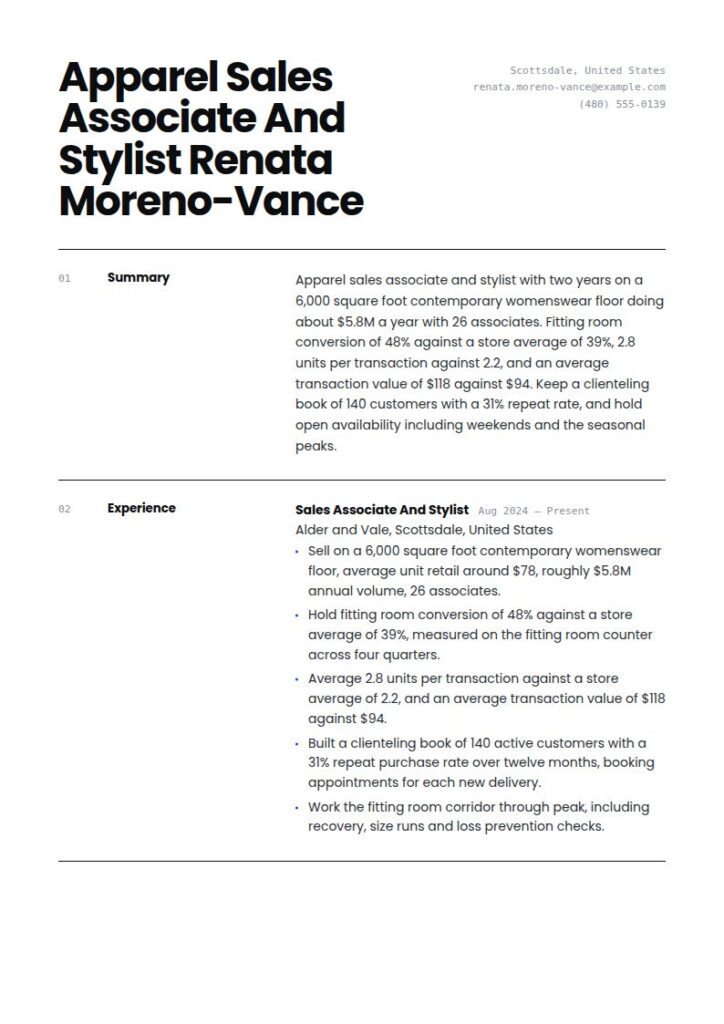
Apparel sales associate and stylist with two years on a 6,000 square foot contemporary womenswear floor doing about $5.8M a year with 26 associates. Fitting room conversion of 48% against a store average of 39%, 2.8 units per transaction against 2.2, and an average transaction value of $118 against $94. Keep a clienteling book of 140 customers with a 31% repeat rate, and hold open availability including weekends and the seasonal peaks.
Work Experience
08/2024 - Present, Sales Associate and Stylist, Alder and Vale, Scottsdale, United States
- Sell on a 6,000 square foot contemporary womenswear floor, average unit retail around $78, roughly $5.8M annual volume, 26 associates.
- Hold fitting room conversion of 48% against a store average of 39%, measured on the fitting room counter across four quarters.
- Average 2.8 units per transaction against a store average of 2.2, and an average transaction value of $118 against $94.
- Built a clienteling book of 140 active customers with a 31% repeat purchase rate over twelve months, booking appointments for each new delivery.
- Work the fitting room corridor through peak, including recovery, size runs and loss prevention checks.
10/2023 - 01/2024, Seasonal Sales Associate, Camelback Outfitters, Phoenix, United States
- Worked the full October to January peak on a value-price apparel floor, averaging 34 hours a week.
- Handled queue management, returns and fitting room recovery through the two busiest trading weeks of the year.
- Offered a permanent part-time post at the end of the season.
Education
08/2020 - 05/2022, Associate of Applied Science, Fashion Merchandising, Scottsdale Community College, Scottsdale, United States
Coursework in merchandising, visual presentation, textiles and retail buying.
Skills
Fitting room service and conversion, 85
Wardrobing and outfit building, 80
Styling for body shape and occasion, 80
Clienteling and appointment booking, 75
Accessory attachment selling, 80
Point of sale and mobile checkout, 85
Loyalty and credit enrollment, 75
Languages
English, native
Spanish, native
Certificates
01/2026, First Aid and CPR, American Red Cross
Summary
A clothing store resume is a one to two page document written in the language apparel retail uses: sell-through at full price, markdown cadence, size and color curve, fitting room conversion and floor sets. This guide gives you three adaptable versions, separate guidance for five different jobs on the same floor, and current Bureau of Labor Statistics pay for apparel retail.
Clothing Store resume examples by experience level
A clothing store resume is a one to two page document for anyone applying to work in an apparel or fashion store, at any level, written in the measures that apparel retail actually uses.
That first sentence needs saying plainly, because "clothing store" is a place, not a job title. The same store hires a weekend sales associate, a key holder, a visual merchandiser, an assistant manager and a store manager, and those are five different resumes. This guide covers the shape that all five share, and then splits into what each one has to prove.
What makes apparel different from the rest of retail is that the merchandise expires. A hardware store can sell the same drill in March that it stocked in January. A clothing store is holding a season that has a full-price window of a few weeks, a size curve that breaks unevenly, and a markdown clock that starts the day the floor set goes up. Everything worth putting on an apparel resume comes from that fact.
Resume guide for a clothing store resume
This guide and the corresponding clothing store resume example will cover:
- How to write a clothing store resume, section by section
- The numbers apparel measures that the rest of retail does not
- Three adaptable summaries: sales associate, key holder and store manager
- Separate guidance for five different jobs on the same shop floor
- What apparel retail pays and when it hires
How to write a clothing store resume
Six sections: contact header, summary, store profile and experience, apparel numbers, availability, education and certifications, and skills. One page up to key holder, two once you are running a store.
The store profile matters more in apparel than anywhere else in retail, because format changes the job completely. A 1,400 square foot boutique carrying 40 styles, a 6,000 square foot mall specialty unit and a 25,000 square foot department store concession are three different trades sharing a job title.
| Section | What it is answering | Where it goes |
|---|---|---|
| Store profile | Format, square footage, volume, headcount, price point | Above the bullets for each role |
| Apparel numbers | Sell-through, markdowns, UPT, fitting room conversion | Its own short block near the top |
| Experience | What did you own on the floor or in the stockroom? | Reverse chronological, a number per bullet |
| Availability | Weekends, evenings, and the seasonal peaks | Four lines, near the end |
Name the price point, not just the store
Apparel hiring managers screen hard on price point, because selling a $39 t-shirt and selling a $390 coat are different skills. One is about speed, size availability and queue management. The other is about fit, wardrobing, appointments and a client book.
Write it in the store profile line: "6,000 square foot mall specialty store, contemporary price point, average unit retail around $78, roughly $5.8M annual volume, 26 associates."
If you are moving up a price point, say what transfers and what you would have to learn. A candidate who says "I have not done appointment-based selling and would want training on it" is more credible than one who implies they have.
Run the finished file through the free Rezoom ATS resume checker before you apply. Apparel chains parse applications into a tracking system, and most are started on a phone.
Choosing the best resume format for a clothing store resume
Reverse chronological. Apparel is seasonal by design, so part-time, seasonal and concurrent jobs are normal and should be labeled rather than hidden: "seasonal, October to January", "part-time, 16 to 22 hours alongside study".
Include your contact information
| ✅ Right | ❌ Wrong |
|---|---|
| Renata Moreno-Vance | Renata Moreno-Vance |
| Apparel Sales Associate and Stylist, Contemporary | Fashion lover seeking a role in retail |
| (480) 555-0139, [email protected], Scottsdale, AZ | (480) 555-0139, [email protected] |
| Open availability, including weekends and seasonal peaks | Full address, photograph, height and dress size |
Never put a photograph, your measurements or your dress size on an apparel resume, including for a store that also uses associates as fit models. If a store needs that, it will ask separately and lawfully.
Make use of a summary
Four lines: what you are, the store format and price point, one apparel number with the store average beside it, and your availability.
Apparel sales associate and stylist with two years on a 6,000 square foot contemporary womenswear floor doing about $5.8M a year with 26 associates. Fitting room conversion of 48% against a store average of 39%, 2.8 units per transaction against 2.2, and an average transaction value of $118 against $94. Keep a clienteling book of 140 customers with a 31% repeat rate, and hold open availability including weekends and the seasonal peaks.
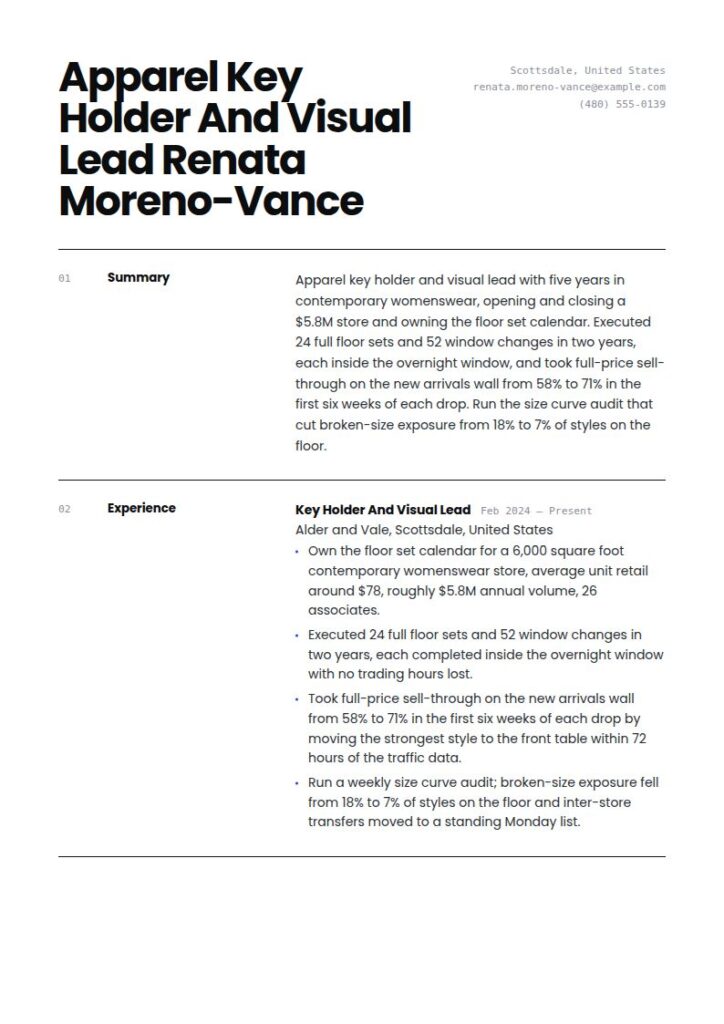
Apparel key holder and visual lead with five years in contemporary womenswear, opening and closing a $5.8M store and owning the floor set calendar. Executed 24 full floor sets and 52 window changes in two years, each inside the overnight window, and took full-price sell-through on the new arrivals wall from 58% to 71% in the first six weeks of each drop. Run the size curve audit that cut broken-size exposure from 18% to 7% of styles on the floor.
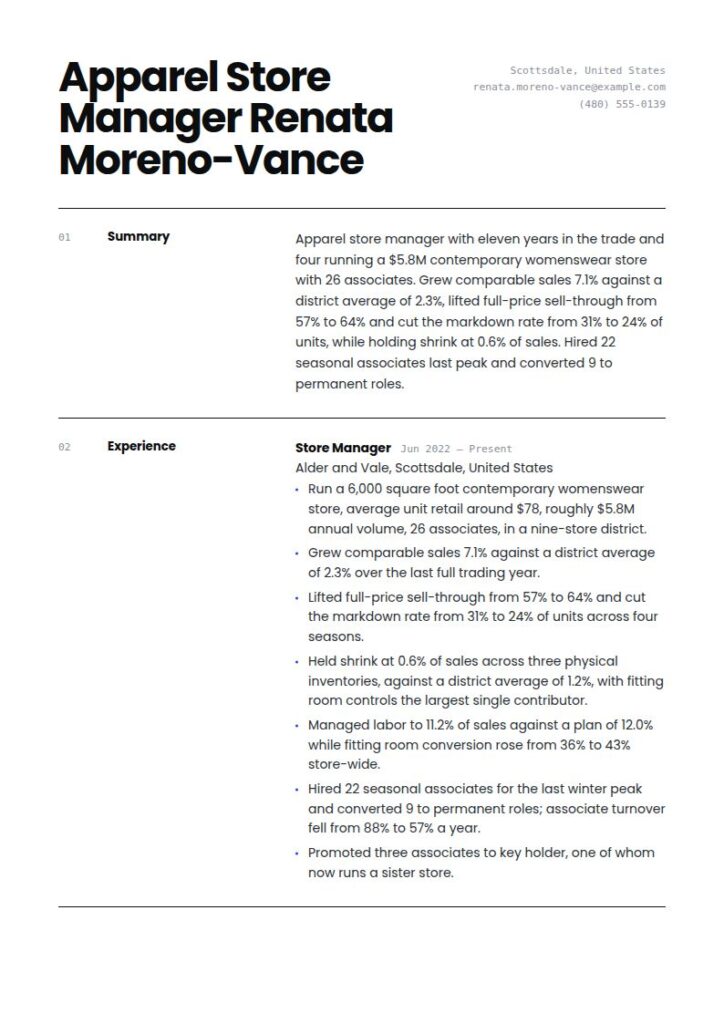
Apparel store manager with eleven years in the trade and four running a $5.8M contemporary womenswear store with 26 associates. Grew comparable sales 7.1% against a district average of 2.3%, lifted full-price sell-through from 57% to 64% and cut the markdown rate from 31% to 24% of units, while holding shrink at 0.6% of sales. Hired 22 seasonal associates last peak and converted 9 to permanent roles.
Right vs wrong: the same clothing store summary, twice
| ✅ Right | ❌ Wrong |
|---|---|
| Apparel key holder and visual lead in contemporary womenswear, opening and closing a $5.8M store. | Fashion-forward retail professional with a passion for style. |
| Executed 24 full floor sets and 52 window changes in two years, each inside the overnight window. | Responsible for maintaining visual standards and store appearance. |
| Took full-price sell-through on the new arrivals wall from 58% to 71% in the first six weeks. | Helped drive sales and achieve store targets. |
| Cut broken-size exposure from 18% to 7% of styles on the floor. | Assisted with inventory and stock replenishment. |
The right column is written in the language a district manager uses in their own weekly call. The left column is written in the language of a resume template.
Outline your experience
Store, brand, city, dates, then the profile line, then three to five bullets. Every bullet carries a number and a period.
| Instead of | Use |
|---|---|
| Helped customers find clothing | Fitting room conversion of 48% against a 39% store average across four quarters |
| Worked on visual displays | Executed 24 full floor sets and 52 window changes in two years, each inside the overnight window |
| Assisted with markdowns | Ran the weekly markdown cadence for 340 styles; markdown rate fell from 31% to 24% of units |
| Maintained stock levels | Ran a weekly size curve audit; broken-size exposure fell from 18% to 7% of styles on the floor |
| Built customer relationships | Built a clienteling book of 140 customers with a 31% repeat purchase rate over twelve months |
| Worked busy periods | Worked four seasonal peaks, moving to full-time hours each October through January |
Key Holder and Visual Lead, Alder and Vale, Scottsdale, AZ, February 2024 to Present
6,000 square foot contemporary womenswear store in a regional mall, average unit retail around $78, roughly $5.8M annual volume, 26 associates.
Own the floor set calendar: 24 full sets and 52 window changes in two years, each completed inside the overnight window with no trading hours lost.
Took full-price sell-through on the new arrivals wall from 58% to 71% in the first six weeks of each drop, by moving the strongest style to the front table within 72 hours of the traffic data rather than at the end of the week.
Run the weekly size curve audit; broken-size exposure fell from 18% to 7% of styles on the floor, and transfer requests to sister stores went from ad hoc to a standing Monday list.
Open or close four shifts a week and own the nightly cash office reconciliation for a $5.8M store.
Trained 11 seasonal associates across two peaks on fitting room service and the floor set standards; 5 were kept on permanently.
The numbers apparel retail measures that other retail does not
Apparel has its own scorecard, and a resume that uses it reads as written by somebody from the trade. These are the measures that do not appear in general retail guidance.
| Measure | What it means | Who owns it |
|---|---|---|
| Full-price sell-through | Share of units in a style or delivery sold before any markdown, usually measured over the first six or eight weeks | Everyone from the floor up; owned by managers |
| Markdown rate | Units or dollars taken down as a share of the total, and how fast | Assistant and store managers |
| Size curve and broken sizes | Whether a style still has a sellable spread of sizes on the floor | Key holders, stock leads, managers |
| Fitting room conversion | Share of customers entering a fitting room who buy | Sales associates and stylists |
| Units per transaction | Average items on a receipt, the clearest measure of wardrobing | Sales associates and stylists |
| Average unit retail | Average price of a unit sold, which shows whether you sell at full price | Associates and managers together |
Two of these deserve more explanation, because they are where apparel resumes win.
Full-price sell-through is the whole game. A clothing store buys a season months in advance and then has a short window to sell it before the markdown clock forces the price down. An associate who can say "the styles on my table sold through at 71% at full price in six weeks against a store average of 58%" is describing margin, not enthusiasm. If your store does not publish the number, use what it does: first-markdown timing, units sold in week one of a delivery, or the percentage of your sales rung at full price.
Broken sizes are invisible on most resumes and obvious to every manager. A style with only extra small and extra large left is dead stock that still takes up a fixture. Anyone who has run a size curve audit, built a transfer list between stores, or pulled a broken style off the floor into a consolidated rail has done real inventory work, and should write it as such.
Full-price sell-through: 71% on the new arrivals wall in the first six weeks, against a 58% store average
Markdown rate: 31% to 24% of units over four seasons
Fitting room conversion: 48% personal, against a 39% store average
Units per transaction: 2.8 personal, against 2.2 store average
Average transaction value: $118 personal, against $94 store average
Size curve: broken-size exposure cut from 18% to 7% of styles on the floor
Clienteling: 140 active customers, 31% repeat purchase rate over twelve months
Five jobs in a clothing store, and what each resume has to prove
Because the slug is a store rather than a title, it is worth being explicit about which resume you are writing. Each of these is hired against a different question.
Sales associate or stylist. The question is whether you sell more than the person standing next to you. Lead with fitting room conversion, units per transaction and average transaction value, each with the store average beside it. Add your clienteling book if the store runs one, with the size and the repeat rate. Availability goes high on the page, because a first-line manager is filling a rota. One page, always.
Key holder or shift supervisor. The question is whether the building is safe with you alone in it. Lead with shifts opened and closed a week, cash office variance, and the hours you run the floor without a manager. Then add one operational result: a cycle count accuracy figure, a size curve audit, or a training number. Selling figures go second here, not first.
Visual merchandiser. The question is throughput and standard, not taste. Count your work: full floor sets a year, window changes, mannequin changes, whether they were completed inside the overnight or before-open window, and whether trading hours were lost. Then give one commercial result tied to a visual decision, such as sell-through on a feature table or traffic to a moved fixture. Keep the portfolio link in the header and off the page itself; the resume still has to parse. Merchandise displayers and window trimmers had a median hourly wage of $18.94 and mean annual earnings of $42,830 across employment of 165,220 as of May 2025 (BLS Occupational Employment and Wage Statistics, May 2025), so this is a distinct occupation, not a duty.
Assistant manager. The question is whether you own a piece of the store end to end. Pick your function and write it as a job: stock and receiving, the markdown cadence, scheduling, or the fitting room and front end. Give the function's numbers, the headcount you scheduled and the hours you controlled. The common mistake is writing the store manager's resume with smaller figures instead of your own function with real ones.
Store manager. The question is profit and loss. Comparable sales against the district, full-price sell-through, markdown rate, shrink as a percent of sales, labor as a percent of sales, and turnover. Two pages is fine here. Our store manager resume example goes deeper on single-store profit and loss, and is the better page to work from once you have the title.
The seasonal calendar a clothing store hires against
Apparel hiring is not evenly spread through the year, and applying against the calendar is worth more than any wording change.
Four moments matter. Seasonal peak hiring runs from late September through November for the winter holidays. Back to school hiring runs July into August. Spring floor set and post-holiday clearance hiring happens in January, when stores lose the seasonal cohort and need permanent replacements. And a store opening or remodel hires in a block, usually six to eight weeks before the doors open.
January is the underrated one. A store that has just converted a handful of seasonal associates still has holes where the rest left, and the applicant pool has emptied out.
Peak hiring is getting smaller, which changes the seasonal application
The National Retail Federation expected retailers to hire between 265,000 and 365,000 seasonal workers for the 2025 winter holiday season, down from 442,000 seasonal hires in 2024, against a forecast of $1.01 trillion to $1.02 trillion in November and December sales (National Retail Federation, 6 November 2025).
Hours in apparel are short and part-time by design. Production and nonsupervisory employees in clothing and clothing accessories stores worked an average of 22.3 hours a week in July 2026, with average hourly earnings of $21.86 (U.S. Bureau of Labor Statistics, Current Employment Statistics, preliminary). The sector employed 1,152,000 people as of August 2026 (BLS Current Employment Statistics, preliminary).
Two consequences for the resume. A seasonal application should state plainly that you want to stay past January, because a shrinking seasonal cohort means managers are choosing conversions from a smaller group and they start with the people who said so. And because the average contract is around twenty-two hours, an applicant who can offer more hours, or who can offer the specific hours that are empty, is offering something scarce.
Build a snapshot of your key skills
Twelve to fourteen entries in three groups: selling, merchandising, and operations. Apparel-specific terms belong here; generic retail terms do not.
Selling: Fitting room service and conversion, Wardrobing and outfit building, Styling for body shape and occasion, Clienteling and appointment booking, Add-on and accessory attachment, Loyalty and credit enrollment
Merchandising: Floor sets and window changes, Mannequin styling, Planogram and directive execution, Feature table and fixture planning, Size curve audits and consolidation, Markdown and clearance execution
Operations: Opening and closing, Cash office reconciliation, Receiving and processing deliveries, Inter-store transfers, Cycle counting and physical inventory, Buy online pick up in store fulfillment, Loss prevention in fitting rooms
List your education and certifications
Apparel retail is entered without formal qualifications and promoted on results, so keep this section short and put the specific training first.
Retail sales workers typically need no formal educational credential to enter the occupation (BLS Occupational Outlook Handbook, May 2025). A fashion or merchandising qualification helps for visual and buying roles and matters much less on the selling floor.
Associate of Applied Science, Fashion Merchandising, Scottsdale Community College, Scottsdale, AZ, 2022
Training: Brand visual merchandising certification, in-house, 2025. Fitting and alteration basics, in-house tailoring program, 2024. Loss prevention awareness, in-house, 2024.
Certifications: First aid and CPR, American Red Cross (2026)
Portfolio: floor sets and window work available on request
Choose the right layout and design
Single column, 10 or 11 point body type, clear headings, no photograph. This applies to visual merchandising applications too: put the portfolio behind a link in the header and keep the resume itself plain, because the tracking system reads it before the creative director does.
Say which of the five jobs you are applying for in your header line. Give the store format, square footage, volume and price point above your bullets. Use apparel measures: sell-through at full price, markdown rate, size curve, fitting room conversion. Put the store average next to every personal number. State availability including the seasonal peaks. Link a portfolio for visual roles rather than embedding images.
Do not put a photograph, your measurements or your dress size on the page. Do not write "fashion-forward" or "passion for style" anywhere. Do not give a conversion figure without the store average. Do not use a designed two-column template for an apparel chain portal, even for a visual role. Do not describe a brand's aesthetic back to it in place of a result.
Clothing store job market and outlook
Apparel retail employment is large, flat and unusually part-time, which shapes both the hiring and the resume.
| Measure | Value |
|---|---|
| Clothing and clothing accessories stores employment, August 2026 | 1,152,000 |
| Average weekly hours, production and nonsupervisory, July 2026 | 22.3 |
| Average hourly earnings, production and nonsupervisory, July 2026 | $21.86 |
| Retail sales workers, employment 2025 | 4,271,400 |
| Retail sales workers, projected change 2025-35 | 0%, -5,700 |
| Retail sales workers, projected annual openings | ~550,600 |
| Share of retail salespersons in clothing, accessories, shoe and jewelry retailers | 17% |
| Typical entry-level education | No formal educational credential |
Sources: U.S. Bureau of Labor Statistics, Current Employment Statistics, preliminary data for July and August 2026; Occupational Outlook Handbook, 2025-35 projections and May 2025 wage data.
The wider fashion market is flat too. The State of Fashion 2026 projects low single-digit growth for the global fashion industry in 2026, with 46 percent of surveyed executives expecting conditions to worsen and 25 percent expecting improvement, and resale forecast to grow two to three times faster than the firsthand market through 2027 (McKinsey and The Business of Fashion, The State of Fashion 2026, published 17 November 2025).
What salary you can expect in a clothing store
Retail salespersons had a median hourly wage of $17.03 in May 2025, but the apparel figure sits below it: clothing, accessories, shoe and jewelry retailers paid a median of $16.43 an hour, against $17.82 in building material and garden equipment suppliers and $16.58 in general merchandise retailers (BLS Occupational Outlook Handbook, May 2025). Across all retail salespersons, the lowest 10 percent earned less than $13.08 an hour and the highest 10 percent more than $23.02 (BLS Occupational Outlook Handbook, May 2025).
Above the floor, first-line supervisors of retail sales workers had a median hourly wage of $23.33 and mean annual earnings of $53,380 across employment of 1,121,800 (BLS Occupational Employment and Wage Statistics, May 2025), and merchandise displayers and window trimmers a median of $18.94 an hour and mean annual earnings of $42,830 (BLS Occupational Employment and Wage Statistics, May 2025).
Three things move apparel pay beyond the base rate. Commission or a selling bonus, which exists at higher price points and almost never at value ones, so moving up a price point is the largest single lever available. Hours, because at an average of 22.3 hours a week (BLS Current Employment Statistics, July 2026, preliminary) the difference between a twenty-hour and a thirty-five-hour contract dwarfs a fifty-cent rate increase. And the step to key holder, which is where scheduled hours become reliable.
Key takeaways for a clothing store resume
- Say which of the five jobs you are applying for, because the store hires all of them.
- Give format, square footage, volume and price point above every set of bullets.
- Use apparel measures: full-price sell-through, markdown rate, size curve, fitting room conversion.
- Put the store average next to every personal figure, with the period.
- Count visual work: floor sets, window changes, and whether they landed inside the window.
- State availability including the seasonal peaks, because hours are short and scarce.
- Keep it plain and single column, portfolio behind a link.
Build your clothing store resume in 15 minutes.
Related retail resume examples
- Store manager resume
- Retail manager resume
- Retail resume
- Shop assistant resume
- Cashier resume
- Retail cashier resume
- Fragrance sales associate resume
- Coffee shop manager resume
- Art gallery manager resume
- Antique dealer resume
- Auction house manager resume
- Target resume
Pair it with a matching clothing store cover letter.
Clothing store resume questions, answered
Is a clothing store resume different from a general retail resume?
Yes, in vocabulary and in what it measures. A general retail resume uses conversion, units per transaction and shrink. An apparel resume adds full-price sell-through, markdown rate, size curve and fitting room conversion, all of which exist because the merchandise has a short full-price life. Using the apparel terms signals that you have worked the floor rather than read about it.
What do I put on a clothing store resume with no experience?
Availability first, then anything measured from another setting: money handled, customers served, a shift you ran, a team you were part of. Retail sales work requires no formal educational credential to enter (BLS Occupational Outlook Handbook, May 2025), and apparel stores hire first-time associates every season. Apply in late September for the winter peak or in July for back to school, which is when the pool is being taken.
How do I write a visual merchandiser resume for a clothing store?
Count the work and time it. Full floor sets a year, window changes, mannequin changes, and whether each landed inside the overnight window without losing trading hours. Then one commercial result tied to a visual decision. Merchandise displayers and window trimmers are a distinct occupation with a median hourly wage of $18.94 as of May 2025 (BLS Occupational Employment and Wage Statistics, May 2025), so write it as a job rather than as a duty attached to selling.
How do I move from sales associate to key holder in a clothing store?
Take the operational work before you have the title. Ask to run a size curve audit, join the overnight floor set team, learn the cash office close, or own the transfer list to sister stores. Each of those produces a number, and a number from the next rung up is what turns an internal application into a promotion rather than a request.
What if my store does not publish sell-through figures?
Use the proxies the store does produce. First-markdown timing on the styles you were responsible for, units sold in the first week of a delivery, the share of your own sales rung at full price, or the traffic and conversion data from the fitting room counter. Any measured figure with a store average and a period beside it does the job.