Store Manager, $2.1M Volume, 11 Associates Deandra Whitlock
Store Manager
[email protected] | (918) 555-0157 | Tulsa, United States
Profile
Store manager for a 4,200 square foot specialty retail store doing $2.1 million in annual volume with 11 associates across 3 departments, promoted from department supervisor after four years with the company. Took comparable store sales from minus 2.1 percent to plus 6.4 percent across two fiscal years while holding labor at 11.8 percent of sales. Cut shrink from 1.9 to 0.9 percent of sales over three inventory cycles by rebuilding receiving and cycle count routines.
Work Experience
03/2018 - 01/2021, Store Manager, Ridgeline Outfitters, Broken Arrow, Broken Arrow, United States
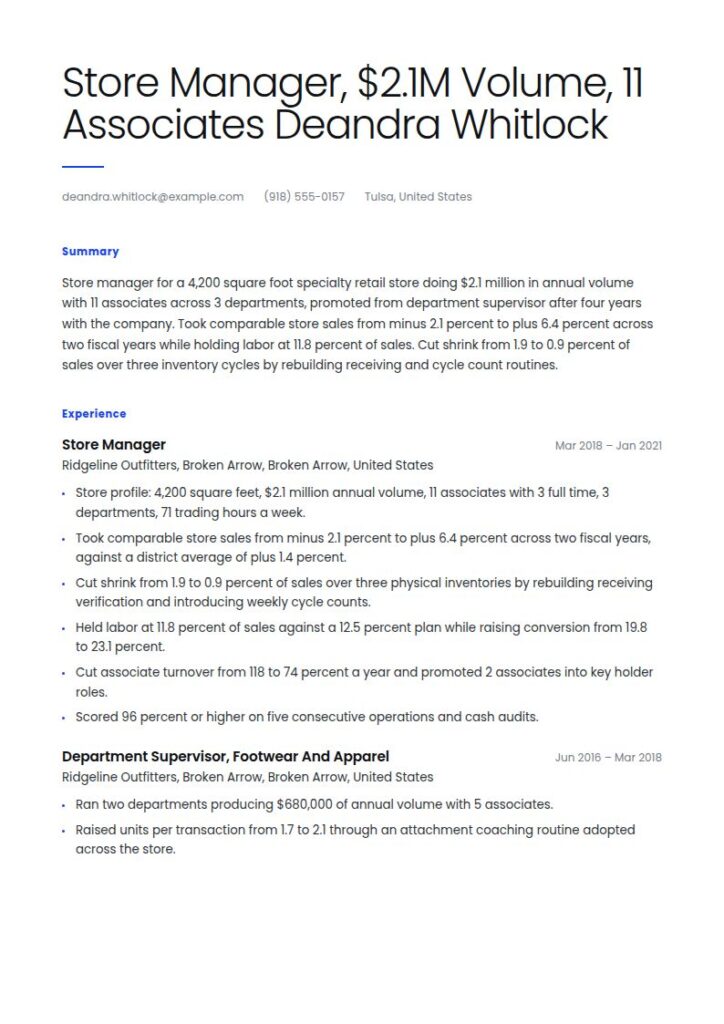
- Store profile: 4,200 square feet, $2.1 million annual volume, 11 associates with 3 full time, 3 departments, 71 trading hours a week.
- Took comparable store sales from minus 2.1 percent to plus 6.4 percent across two fiscal years, against a district average of plus 1.4 percent.
- Cut shrink from 1.9 to 0.9 percent of sales over three physical inventories by rebuilding receiving verification and introducing weekly cycle counts.
- Held labor at 11.8 percent of sales against a 12.5 percent plan while raising conversion from 19.8 to 23.1 percent.
- Cut associate turnover from 118 to 74 percent a year and promoted 2 associates into key holder roles.
- Scored 96 percent or higher on five consecutive operations and cash audits.
06/2016 - 03/2018, Department Supervisor, Footwear and Apparel, Ridgeline Outfitters, Broken Arrow, Broken Arrow, United States
- Ran two departments producing $680,000 of annual volume with 5 associates.
- Raised units per transaction from 1.7 to 2.1 through an attachment coaching routine adopted across the store.
08/2014 - 06/2016, Sales Associate, Ridgeline Outfitters, Broken Arrow, Broken Arrow, United States
- Opened and closed the store as a key holder, and ran the cash office reconciliation on weekend shifts.
Education
08/2010 - 05/2012, Associate of Applied Science, Business Management, Tulsa Community College, Tulsa, United States
Coursework in accounting, business law and management.
Skills
P&L ownership at store level, 70
Shrink reduction and cycle counts, 80
Scheduling to traffic, 70
Hourly recruiting and onboarding, 75
Visual merchandising to planogram, 75
Cash office and deposit controls, 85
Point of sale and back office reporting, 80
Languages
English, native
Spanish, intermediate
Certificates
05/2018, Interviewing and Selection Certification, Ridgeline Outfitters
04/2019, First Aid, CPR and AED, American Red Cross
Summary
A store manager resume is a profit and loss document. The store is a small business and you own its numbers. This guide gives you three adaptable versions, the store profile block that tells a district manager your scale in four seconds, the metrics retail actually measures, and current Bureau of Labor Statistics pay and outlook for the occupation.
Store Manager resume examples by experience level
A store manager resume is a one to two page profit and loss document, and that is the single idea the whole page turns on.
A store is a small business. It has revenue, a gross margin, a payroll line, an inventory position, a lease and a headcount, and the store manager owns all of it. The district manager reading your resume is not asking whether you are good with people. They are asking whether you can hold a number under pressure across a full year, including the four weeks that produce a quarter of the volume.
Resume guide for a store manager resume
This guide and the corresponding store manager resume example will cover:
- How to write a store manager resume, section by section
- The store profile block, and why it goes above everything else
- Three adaptable summaries: first store, established store and flagship
- The retail metrics a district manager actually reads, and how to write them
- What the job market looks like and what you can expect to earn
How to write a store manager resume
Six sections: contact header, summary, store profile, experience with numbers, education and certifications, and skills. One page until you have run two or three stores, two once you have volume and headcount worth listing.
The store profile block goes third, above experience, because scale is the first filter. A manager who has run an $8 million store and a manager who has run a $1 million store are doing different jobs with the same title, and no amount of good writing about leadership substitutes for the number.
| Section | What it is answering | Where it goes |
|---|---|---|
| Store profile | What size of business has this person actually run? | Its own block, directly under the summary |
| Experience | Which numbers did they move, by how much, over what period? | Reverse chronological, one metric per bullet |
| People | How many, how deep, and did they stay? | Inside experience, with headcount and turnover |
| Compliance | Do they pass an audit without a rescue? | With certifications, near the end |
Every bullet gets a number, and the number gets a period of time
Retail is the most heavily measured work in the economy. Your point-of-sale system already knows your conversion rate, your units per transaction, your average transaction value and your sales per labor hour, and your district manager already reviews them weekly.
That means a store manager resume without numbers is not modest. It reads as a manager who does not look at the reports.
Write the metric, the before, the after and the period: "Took comparable store sales from minus 2.1 percent to plus 6.4 percent across two fiscal years." "Cut shrink from 1.9 percent of sales to 0.8 percent over three inventory cycles." "Held labor at 11.2 percent of sales against a 12 percent plan while keeping conversion above 24 percent."
Run the finished file through the free Rezoom ATS resume checker before you apply. Retail chains parse applications into a system before a district manager sees them.
Choosing the best resume format for a store manager resume
Reverse chronological. One page early, two once you have multiple stores, a volume step up or a district training role.
Functional formats fail because retail promotion is a visible ladder: associate, key holder, department supervisor, assistant manager, store manager, then bigger store. A reader is measuring how fast you climbed it and whether you have ever taken a store that was in trouble.
Include your contact information
| ✅ Right | ❌ Wrong |
|---|---|
| Deandra Whitlock | Deandra Whitlock |
| Store Manager, $9.4M volume, 62 associates | Retail management professional |
| Open to relocation within Oklahoma, Arkansas and North Texas | Willing to relocate |
| (918) 555-0157, [email protected], Tulsa, OK | (918) 555-0157, [email protected] |
Put your volume and headcount in the title line. It is the fastest scale signal available and it costs you eight words.
Name the geography you will actually move to. Retail promotion is frequently a relocation, and a district manager with an open store two hours away reads a specific relocation line as a real answer.
Make use of a summary
Four lines: the format and scale you run, your years, the two or three numbers you own, and one result.
Store manager for a 4,200 square foot specialty retail store doing $2.1 million in annual volume with 11 associates across 3 departments, promoted from department supervisor after four years with the company. Took comparable store sales from minus 2.1 percent to plus 6.4 percent across two fiscal years while holding labor at 11.8 percent of sales. Cut shrink from 1.9 to 0.9 percent of sales over three inventory cycles by rebuilding receiving and cycle count routines.
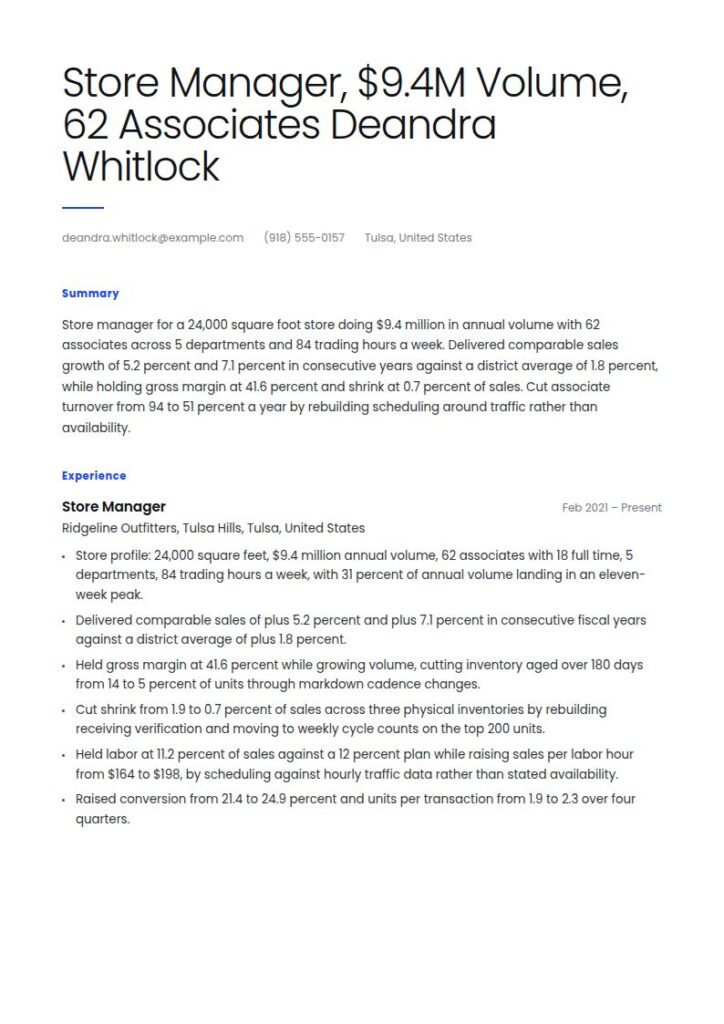
Store manager for a 24,000 square foot store doing $9.4 million in annual volume with 62 associates across 5 departments and 84 trading hours a week. Delivered comparable sales growth of 5.2 percent and 7.1 percent in consecutive years against a district average of 1.8 percent, while holding gross margin at 41.6 percent and shrink at 0.7 percent of sales. Cut associate turnover from 94 to 51 percent a year by rebuilding scheduling around traffic rather than availability.
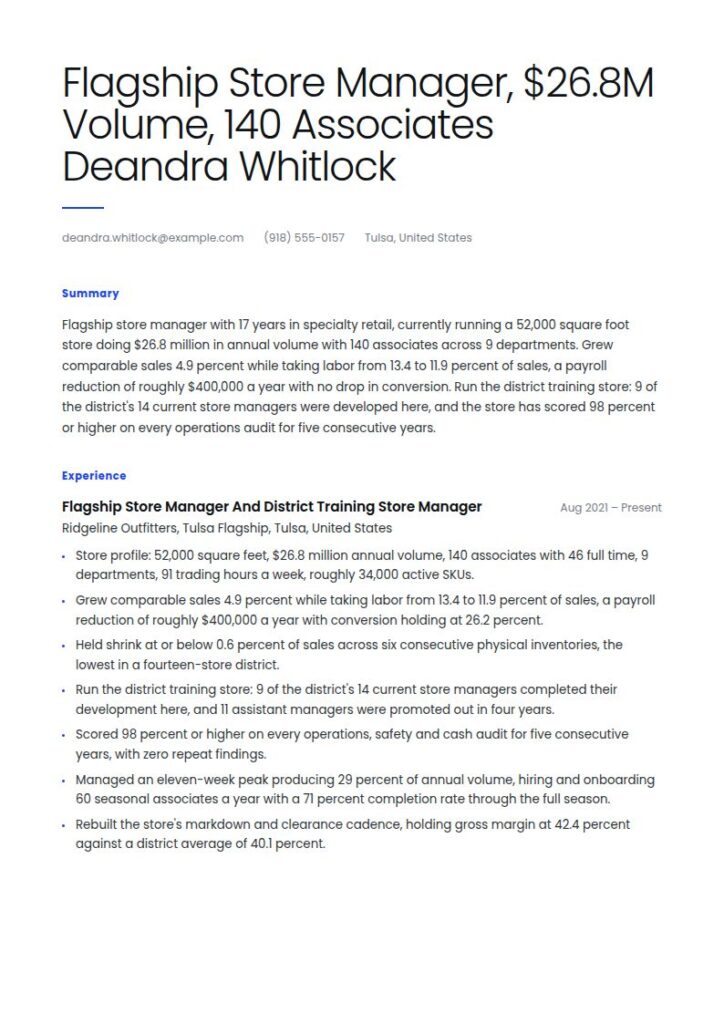
Flagship store manager with 17 years in specialty retail, currently running a 52,000 square foot store doing $26.8 million in annual volume with 140 associates across 9 departments. Grew comparable sales 4.9 percent while taking labor from 13.4 to 11.9 percent of sales, a payroll reduction of roughly $400,000 a year with no drop in conversion. Run the district training store: 9 of the district's 14 current store managers were developed here, and the store has scored 98 percent or higher on every operations audit for five consecutive years.
Right vs wrong: the same store manager summary, twice
| ✅ Right | ❌ Wrong |
|---|---|
| Store manager for a 24,000 square foot store doing $9.4 million in annual volume with 62 associates. | Experienced retail manager with a strong background in store operations. |
| Comparable sales growth of 5.2 and 7.1 percent in consecutive years against a district average of 1.8 percent. | Consistently exceeded sales targets and drove business results. |
| Cut associate turnover from 94 to 51 percent a year by rebuilding scheduling around traffic. | Built a positive team culture and developed high-performing associates. |
The right column belongs to a person who has been accountable for a P&L. The left column could be written by anyone who has ever worked in a shop, and the district manager knows it.
Outline your experience
Store, city, format, dates and title first. Then bullets, one metric each, with the before, the after and the period.
| Instead of | Use |
|---|---|
| Responsible for driving store sales and meeting targets | Delivered comparable sales of plus 5.2 and plus 7.1 percent in consecutive years against a district average of plus 1.8 percent |
| Managed inventory and reduced losses | Cut shrink from 1.9 to 0.7 percent of sales across three physical inventories through receiving controls and weekly cycle counts |
| Controlled labor costs | Held labor at 11.2 percent of sales against a 12 percent plan while raising sales per labor hour from $164 to $198 |
| Scheduled staff and managed payroll | Rebuilt the schedule against hourly traffic data, moving 210 weekly payroll hours into the 11am to 7pm peak with no headcount increase |
| Improved the customer experience | Raised conversion from 21.4 to 24.9 percent and units per transaction from 1.9 to 2.3 over four quarters |
| Hired, trained and developed a team | Cut turnover from 94 to 51 percent a year, and developed 4 associates into assistant manager roles across two stores |
Store Manager, Ridgeline Outfitters, Tulsa Hills, Tulsa, OK, February 2021 to Present
Run a 24,000 square foot specialty store: $9.4 million annual volume, 62 associates with 18 full time, 5 departments, 84 trading hours a week, plus seasonal peaks that produce 31 percent of annual volume in eleven weeks.
Delivered comparable sales of plus 5.2 percent and plus 7.1 percent in consecutive fiscal years against a district average of plus 1.8 percent.
Held gross margin at 41.6 percent while growing volume, through markdown cadence changes and a clearance discipline that cut aged inventory over 180 days from 14 to 5 percent of units.
Cut shrink from 1.9 to 0.7 percent of sales across three physical inventories by rebuilding receiving verification and moving to weekly cycle counts on the top 200 units.
Held labor at 11.2 percent of sales against a 12 percent plan while raising sales per labor hour from $164 to $198, by scheduling against hourly traffic data rather than stated availability.
Cut associate turnover from 94 to 51 percent a year, and developed 4 associates into assistant manager roles across two stores.
Lead with a store profile block, then run the numbers
This is the section that separates two store manager resumes with identical job titles, and almost nobody writes it.
A district manager reading applications has one question before all others: how big was your store? Everything else in retail scales off that answer. A $2 million store and a $27 million store differ in headcount by a factor of ten, in scheduling complexity by more than that, and in the amount of money a single bad decision costs.
Give them a compact profile block for each store you have run. Six facts, one line each.
Store profile, Ridgeline Outfitters Tulsa Hills
Format and size: 24,000 square feet, freestanding, 5 departments
Annual sales volume: $9.4 million
Headcount: 62 associates, 18 full time, 3 assistant managers, 5 department supervisors
Trading hours: 84 a week, 7 days, plus extended holiday hours in November and December
Seasonality: 31 percent of annual volume in an eleven-week peak
Inventory: roughly 18,000 active SKUs, two annual physical inventories
Then the metrics. Retail measures itself with a fairly standard set, and a store manager who writes in that vocabulary is immediately recognizable as someone who has sat in the weekly business review.
| Metric | What it is | How to write it |
|---|---|---|
| Annual sales volume | The store's revenue, the single scale number | Give the figure, and say if it grew under you |
| Comparable sales | Growth against the same store in the prior period, the number the industry lives by | Give your percentage and the district or chain average beside it |
| Gross margin | Sales less cost of goods, as a percentage | Give the percentage and what you did to markdown or clearance |
| Shrink | Inventory loss as a percentage of sales | Give before and after across a stated number of inventories |
| Labor as a percentage of sales | Payroll cost against revenue, the lever you control most directly | Give your percentage against plan, and protect it with a conversion number |
| Sales per labor hour | Revenue produced per hour scheduled | Give before and after; it proves you cut hours without cutting sales |
| Conversion rate | Share of visitors who buy, from door counters | Give the percentage; it separates traffic problems from selling problems |
| Units per transaction | Average basket size in units | Give before and after; it is the attachment and training number |
| Turnover | Annual associate turnover rate | Give the percentage and the direction, plus promotions out |
| Audit or compliance score | Operations, safety and cash audit results | Give the score, the number of consecutive audits and repeat findings |
Shrink is a percentage of sales, and it is worth more than the number looks
Shrink accounted for $112.1 billion in losses across the industry, or 1.6 percent of total retail sales, in 2022 (National Retail Federation, 2023 National Retail Security Survey). More recently, NRF found a 12.4 percent decrease in shoplifting incidents and an 8.1 percent decline in retail merchandise theft in 2025 compared with 2024 (National Retail Federation, The Impact of Theft and Violence 2026, published 30 July 2026).
Write shrink as a percentage of sales, not as a dollar figure, because that is how it appears on the P&L and how your district compares stores of different sizes.
Then show the reader why the number moved. Shrink is rarely one cause: it is receiving accuracy, markdown discipline, cycle count cadence, price change execution, cash handling and external theft, in roughly that order of how much a store manager can influence. A bullet that says "cut shrink from 1.9 to 0.7 percent across three physical inventories through receiving verification and weekly cycle counts on the top 200 units" tells a district manager you understand the mechanism, not just the metric.
Open each role with a store profile: square footage, annual volume, headcount, departments and trading hours. Write comparable sales with the district or chain average beside it. Give shrink and labor as percentages of sales. Pair a cost reduction with a sales or conversion number so it does not read as cutting into the business. Name your seasonality if peak is a large share of volume. Say how many people you promoted out.
Do not write "responsible for all store operations" and leave it there. Do not give a dollar figure for shrink where a percentage belongs. Do not claim a comparable sales number without the period it covers. Do not list customer service as a skill; it is the job. Do not inflate headcount by counting seasonal hires as permanent without saying so, because a reference call will find it.
Build a snapshot of your key skills
Twelve to sixteen entries in four groups: commercial, people, operations, and the systems your chain runs.
Commercial: P&L ownership, Comparable sales growth, Gross margin and markdown management, Conversion and units per transaction, Visual merchandising to planogram, Promotional execution
People: Hourly recruiting and onboarding, Scheduling to traffic, Performance management and progressive discipline, Assistant manager development, Succession planning, Turnover reduction
Operations: Inventory accuracy and cycle counts, Shrink reduction programs, Receiving and vendor compliance, Cash office and deposit controls, Loss prevention partnership, Health and safety compliance
Systems: Point of sale and back office reporting, Workforce management and labor scheduling software, Inventory management and replenishment systems, Applicant tracking, Task management platforms
List your education and certifications
Retail promotes on performance, so put experience first and keep education compact. Name any certification your chain or state actually requires.
Associate of Applied Science, Business Management, Tulsa Community College, Tulsa, OK, 2012
Certifications and training: ServSafe Food Handler, National Restaurant Association (2024). Oklahoma ABLE Commission alcohol seller and server license (2023). First aid, CPR and AED, American Red Cross (2025). Internal certifications: District Training Store Manager (2023), Interviewing and Selection certification (2021).
Retail sales work requires no formal educational credential to enter, according to the Bureau of Labor Statistics (Occupational Outlook Handbook, May 2025), and most store managers are promoted from the floor. A degree helps at the district level and above; it rarely decides a store manager hire against a candidate with better numbers.
Choose the right layout and design
Single column, 10 or 11 point body type, clear headings, no photograph. National and regional chains run applicant tracking systems and most retail applications begin on a phone, so keep the file simple enough to survive both.
Store manager job market and outlook
A very large occupation whose hiring is driven almost entirely by turnover rather than growth.
| Measure | Value |
|---|---|
| First-line supervisors of retail sales workers, employment | 1,121,800 |
| Median hourly wage, first-line supervisors of retail sales workers | $23.33 |
| Mean annual wage, first-line supervisors of retail sales workers | $53,380 |
| Retail sales workers, employment 2025 | 4,271,400 |
| Retail sales workers, projected 2035 | 4,265,700 |
| Retail sales workers, projected annual openings | ~550,600 |
| Typical entry-level education, retail sales workers | No formal educational credential |
Sources: U.S. Bureau of Labor Statistics, Occupational Employment and Wage Statistics, May 2025, for first-line supervisors of retail sales workers; Occupational Outlook Handbook, May 2025 wage data and 2025-35 projections, for retail sales workers.
Two things follow from those numbers. The team you manage comes from an occupation of more than four million people that is projected to add none over the decade but still turns over roughly 550,600 positions a year (BLS Occupational Outlook Handbook, 2025-35 projections). And the supervisory layer above it is over a million people, which means the competition for a store manager job is real and largely internal.
Turnover is the store manager’s biggest controllable cost
The quits rate in retail trade was 3.1 percent in July 2026, meaning roughly one in thirty-two retail employees voluntarily left their job in a single month (U.S. Bureau of Labor Statistics, Job Openings and Labor Turnover Survey, data for July 2026, released 1 September 2026).
Compounded across a year, that is why turnover dominates the labor line in a store. Every departure costs recruiting time, onboarding hours, a period of lower productivity, and usually overtime somewhere else in the schedule to cover the gap.
It is also why a turnover number on a store manager resume reads as a commercial result rather than a soft one. "Cut associate turnover from 94 to 51 percent a year" tells a district manager you have taken cost out of the schedule, protected the customer experience during peak, and built a bench, all with one number. Put it next to your labor percentage so the two are read together.
What salary you can expect as a store manager
The Bureau of Labor Statistics reports a median hourly wage of $23.33 and a mean annual wage of $53,380 for first-line supervisors of retail sales workers, across employment of 1,121,800 people (BLS Occupational Employment and Wage Statistics, May 2025). That category spans a wide range of roles, from a shift supervisor in a small store to the manager of a large one, which is exactly why your store profile block matters at the offer stage.
The workers you manage sit well below that. Retail sales workers had a median annual wage of $35,560, or $17.10 an hour, in May 2025, with retail salespersons ranging from under $13.08 an hour at the tenth percentile to over $23.02 an hour at the ninetieth (BLS Occupational Outlook Handbook, May 2025).
Three things move a store manager offer. Volume is the first and largest: pay bands in most chains are tiered by store volume, so moving from a $4 million store to a $12 million store is a raise before any negotiation happens. Format is second, since big-box, specialty, grocery and automotive parts all pay differently for the same title. The third is the bonus structure, which is usually tied to comparable sales, gross margin, shrink and labor. That is the strongest practical argument for writing all four of those metrics onto your resume: they are the terms in which your next employer will pay you, so they should be the terms in which you describe yourself.
Key takeaways for a store manager resume
- Write the resume as a P&L document, because that is how it will be read.
- Open each role with a store profile: square footage, volume, headcount, departments, hours.
- Put annual volume and headcount in your title line so scale is visible in four seconds.
- Give comparable sales with the district or chain average beside it.
- Write shrink and labor as percentages of sales, never as dollars alone.
- Pair every cost reduction with a conversion or sales number.
- Include turnover and promotions out; a bench is a commercial result.
Build your store manager resume in 15 minutes.
Related retail resume examples
- Retail manager resume
- Retail resume
- Sales associate resume
- Shop assistant resume
- Cashier resume
- Retail cashier resume
- Coffee shop manager resume
- Clothing store resume
- Art gallery manager resume
- Antique dealer resume
- Auction house manager resume
- Fragrance sales associate resume
Pair it with a matching store manager cover letter.
Store manager resume questions, answered
How long should a store manager resume be?
One page for your first store. Two once you have run more than one, stepped up in volume, or taken a training store. The second page is earned by numbers, not by duties, and a district manager will read it if the first page has a volume figure on it.
What if my company will not let me disclose store sales figures?
Use a band or a relative measure. "A store in the $8 to $10 million volume band" or "the second highest volume store in a fourteen-store district" both communicate scale without publishing a confidential figure. The same applies to shrink: "cut shrink by more than half across three physical inventories" works when the absolute number is restricted.
Do I need a degree to be a store manager?
Usually not. Retail sales work requires no formal educational credential to enter (BLS Occupational Outlook Handbook, May 2025), and most store managers are promoted from the floor on performance. A degree matters more at district and regional level. If you have one, list it briefly; if you do not, spend the space on numbers instead.
How do I write a store manager resume when my store underperformed?
Write what you controlled and be specific about what you did not. A store in a declining center with a comparable sales number below plan is a common situation, and a manager who can say "held shrink at 0.6 percent and labor at 11.4 percent against a 12 percent plan while traffic fell 9 percent" is demonstrating exactly the discipline a district manager wants. Vague writing about a hard year looks like an excuse; a metric with context looks like management.
Should I list the brands I have worked for?
Yes, by name, because format and customer type are real information. A district manager can infer a great deal from whether you have run grocery, specialty apparel, big-box hardware or automotive parts. If the brand is small or regional, add one line of context: "a 14-store regional outdoor specialty chain".
What numbers should I use if I was an assistant manager rather than a store manager?
The same ones, scoped honestly to what you owned. Say which departments, which shifts, and which metrics were yours: "owned the receiving and inventory function for a $9.4 million store, and cut cycle count variance from 3.1 to 0.9 percent." An assistant manager who can name a metric they personally moved is a stronger candidate than a store manager who cannot.