Antiques Assistant and Cataloger Alistair Pemberton
Cataloger and Condition Reporter
[email protected] | (843) 555-0167 | Charleston, United States
Profile
Antiques assistant with three years split between a Charleston gallery and a regional saleroom, cataloging and condition-reporting American furniture, silver and works on paper. Wrote 640 catalog entries across 11 sales, including measurement, marks, condition and provenance notes, and handled consignor intake for estates valued between $8,000 and $190,000. Trained in hallmark identification and in Art Loss Register searching before consignment.
Work Experience
09/2007 - 08/2009, Cataloger and Condition Reporter, Lowcountry Auction Galleries, Charleston, United States
- Wrote 640 catalog entries across 11 sales covering American furniture, silver, ceramics and works on paper.
- Produced written condition reports with measurements, marks, restoration notes and photographs for every lot above $1,000.
- Handled consignor intake for estates valued between $8,000 and $190,000, including inventory, receipting and settlement paperwork.
- Ran Art Loss Register searches on consigned property and filed the results with the lot record.
07/2006 - 08/2007, Gallery Assistant, King Street Antiques Gallery, Charleston, United States
- Managed stock records and photography for a gallery holding roughly 400 objects.
- Assisted at three national antiques fairs a year, including packing, stand build and client follow-up.
Education
08/2002 - 05/2006, Bachelor of Arts, Art History, College of Charleston, Charleston, United States
Coursework in American decorative arts, material culture of the Lowcountry and museum practice.
Skills
Cataloging and lot description, 80
Condition reporting, 75
Hallmark and touchmark identification, 65
Art Loss Register searching, 70
Object photography, 75
Consignor intake and settlement paperwork, 70
Languages
English, native
French, intermediate
Certificates
06/2008, Certificate in Decorative Arts, Christie's Education
Short course in American and English decorative arts, with an emphasis on silver marks and furniture construction.
Summary
An antique dealer resume is an evidence document for a trade that runs on connoisseurship and access: what you can authenticate, where you can source, what you turn, and how you handle title and restricted materials. This guide gives you three adaptable versions, the compliance record buyers now expect, and current market data from the published art market report.
Antique Dealer resume examples by experience level
An antique dealer resume is an evidence document for a trade that runs on two things: what you can authenticate, and what you can get your hands on.
It is an unusual resume, because most people in this trade are not employees. A dealer resume is written for a partnership, a consignment relationship, a gallery or shop post, an auction house specialist role, or a collection manager's job. The reader might be an employer, but might equally be a prospective partner, a consignor deciding whether to trust you with their family's furniture, or a saleroom deciding whether to take your business.
A conventional resume proves you did the work. A dealer resume proves you have judgment, access and a clean record on title.
Resume guide for an antique dealer resume
This guide and the corresponding antique dealer resume example will cover:
- How to write a dealer resume when you are self-employed, section by section
- Naming your categories: what you can authenticate, and to what depth
- Your sourcing channels, and why they are the scarcest thing you own
- Three adaptable summaries: assistant, dealer and principal
- Title, provenance and restricted materials
How to write an antique dealer resume
Six sections: contact header, profile, categories and connoisseurship, trading history, sourcing and channels, and credentials with compliance. One to two pages; two is normal here.
The ordering is the point. A generalist reads as an amateur in this trade, and naming three categories you can defend beats claiming forty you cannot.
| Section | What it is answering | Where it goes |
|---|---|---|
| Categories | What can this person tell apart, and how deep does it go? | Immediately under the profile |
| Trading history | What have they bought, sold, turned, and at what level? | Reverse chronological, with values |
| Sourcing and channels | Where does their stock come from that mine does not? | Own block, before credentials |
| Credentials and compliance | Can I trust their title work and their appraisals? | Bottom, with named authorities |
Write the compliance record, because that is what has changed in this trade
Twenty years ago a dealer resume could be pure connoisseurship. Buyers, insurers and salerooms now expect a documented process on title and restricted materials, and a resume that shows one separates you immediately.
Three things to name. First, database checking: the Art Loss Register describes itself as the world's largest private database of lost, stolen and looted art, antiques and collectibles, listing more than 700,000 items and carrying out more than 400,000 market checks a year for auction houses, fairs, law enforcement, museums, dealers and collectors (Art Loss Register, accessed September 2026).
Second, cultural property: the United States restricts imports of designated archaeological and ethnological material from partner countries under the Convention on Cultural Property Implementation Act, with restricted categories listed by country in federal regulation (19 CFR 12.104g, current as of 10 September 2026).
Third, protected species material, covered below.
Run the file through the free Rezoom ATS resume checker if you are applying to an auction house or gallery group, since those hire through parsed portals.
Choosing the best resume format for an antique dealer resume
Reverse chronological, one to two pages, single column, no photograph.
Self-employment is where people reach for a functional format, and it is the wrong instinct. Write your own business as an employer: trading name, years, format, categories and numbers. "Pemberton Antiques, Charleston, SC, 2017 to present, sole proprietor" is a job. A skills-first layout with no dates reads like someone hiding a thin decade. Keep a separate, longer document for inventory and your fair record.
Include your contact information
| ✅ Right | ❌ Wrong |
|---|---|
| Alistair Pemberton | Alistair Pemberton |
| Dealer, Southern furniture and Anglo-American silver, 1720 to 1860 | Antiques expert and collector |
| Charleston, SC. Trading as Pemberton Antiques since 2017 | Charleston, SC |
| (843) 555-0167, [email protected] | (843) 555-0167, [email protected] |
The second line is doing real work. A period range and two categories tell a reader more in eight words than a paragraph about a lifelong love of old things. If you have a gallery, a booth in a multi-dealer center or a stand at a recognized fair, name it.
Make use of a summary
Four lines: categories and period, years in the trade, one number on what you sell or turn, and one line on credentials.
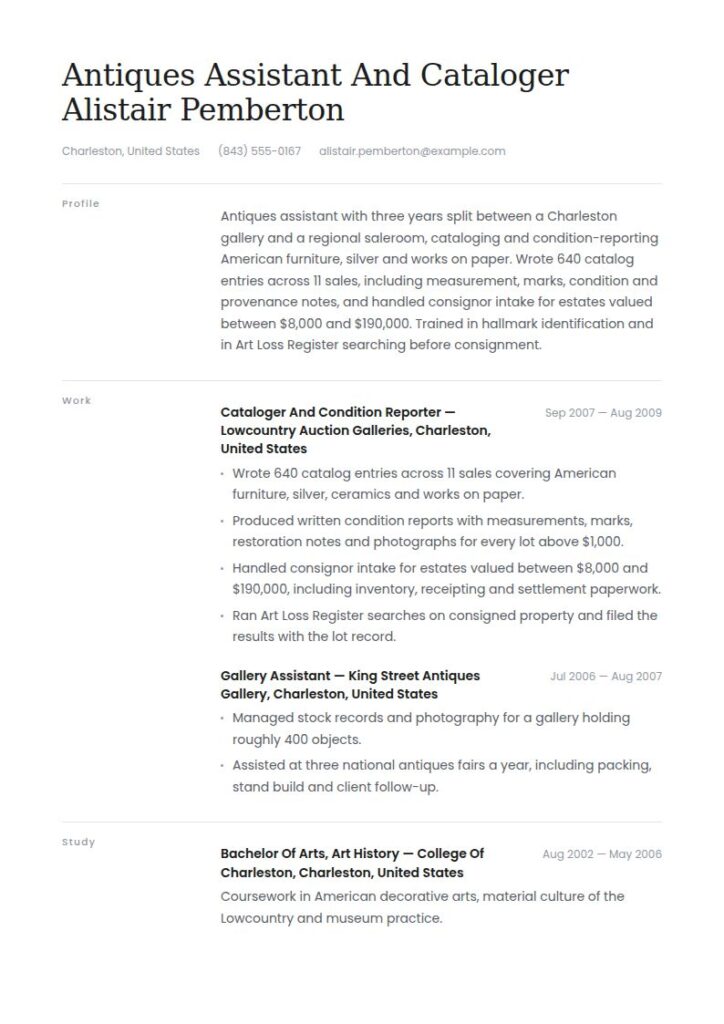
Antiques assistant with three years split between a Charleston gallery and a regional saleroom, cataloging and condition-reporting American furniture, silver and works on paper. Wrote 640 catalog entries across 11 sales, including measurement, marks, condition and provenance notes, and handled consignor intake for estates valued between $8,000 and $190,000. Trained in hallmark identification and in Art Loss Register searching before consignment.
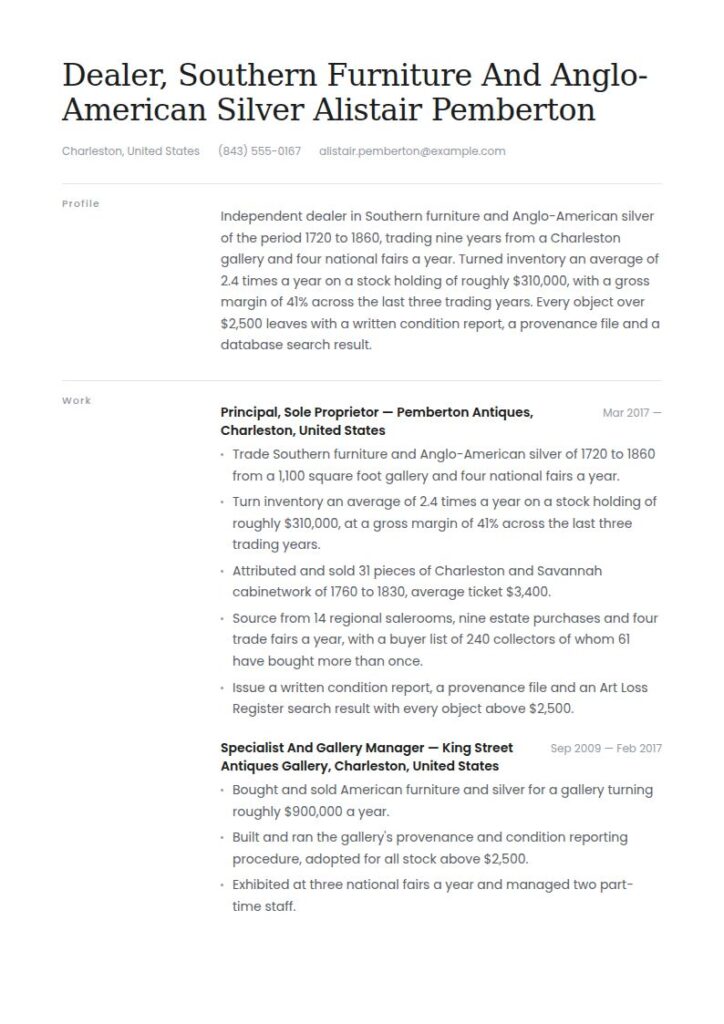
Independent dealer in Southern furniture and Anglo-American silver of the period 1720 to 1860, trading nine years from a Charleston gallery and four national fairs a year. Turned inventory an average of 2.4 times a year on a stock holding of roughly $310,000, with a gross margin of 41% across the last three trading years. Every object over $2,500 leaves with a written condition report, a provenance file and a database search result.
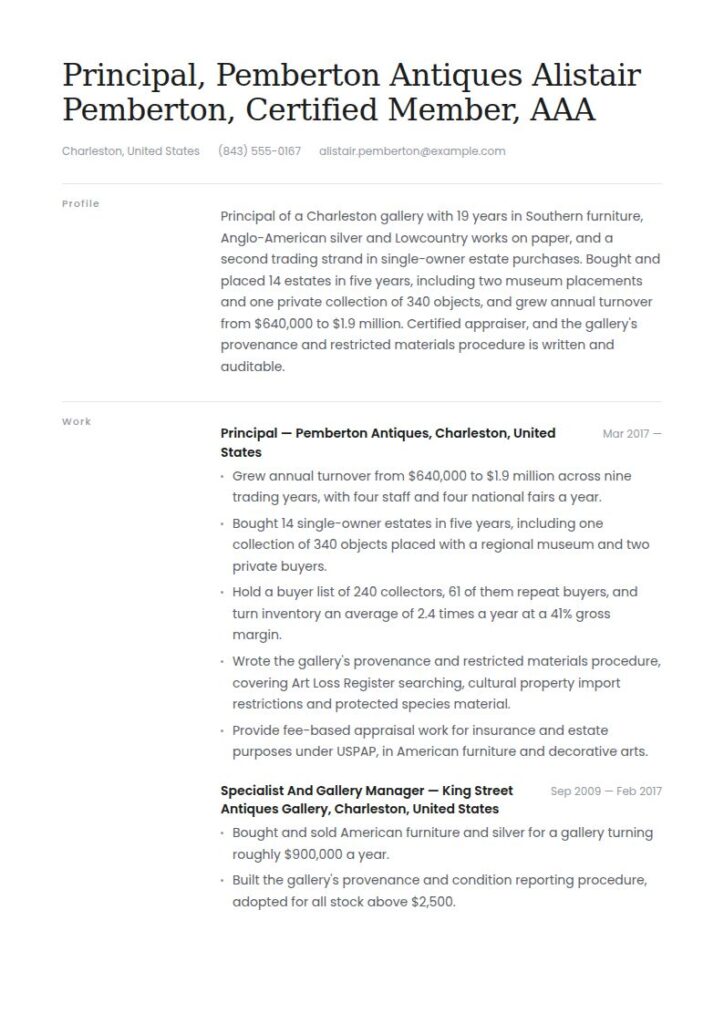
Principal of a Charleston gallery with 19 years in Southern furniture, Anglo-American silver and Lowcountry works on paper, and a second trading strand in single-owner estate purchases. Bought and placed 14 estates in five years, including two museum placements and one private collection of 340 objects, and grew annual turnover from $640,000 to $1.9 million. Certified appraiser, and the gallery's provenance and restricted materials procedure is written and auditable.
Right vs wrong: the same antique dealer summary, twice
| ✅ Right | ❌ Wrong |
|---|---|
| Independent dealer in Southern furniture and Anglo-American silver of the period 1720 to 1860. | Antiques dealer with a wide knowledge of period furniture and decorative arts. |
| Turned inventory an average of 2.4 times a year on a stock holding of roughly $310,000. | Bought and sold a large variety of high-quality antiques. |
| Every object over $2,500 leaves with a condition report, a provenance file and a database search result. | Committed to honesty and integrity in every transaction. |
The right column can be tested in about two questions. The wrong column is what every booth sign in America already says.
Outline your experience
Trading name or employer, city, format, dates, then three to five bullets. Values, volumes and margins belong here.
| Instead of | Use |
|---|---|
| Bought and sold antique furniture | Bought 210 objects and sold 186 across three trading years, average ticket $3,400 |
| Built good relationships with clients | Built a buyer list of 240 collectors, 61 of whom bought more than once |
| Attended auctions and estate sales | Sourced from 14 regional salerooms, 9 estate purchases and 4 trade fairs a year |
| Knowledgeable about period furniture | Attributed and sold 31 pieces of Charleston and Savannah cabinetwork, 1760 to 1830 |
Principal, Pemberton Antiques, Charleston, SC, March 2017 to Present
Trade Southern furniture and Anglo-American silver of 1720 to 1860 from a 1,100 square foot gallery and four national fairs a year.
Turn inventory an average of 2.4 times a year on a stock holding of roughly $310,000, at a gross margin of 41% across the last three trading years.
Issue a written condition report, a provenance file and an Art Loss Register search result with every object above $2,500.
Maintain a restricted materials procedure covering ivory, tortoiseshell and protected timbers, with no item sold across state lines outside a documented exemption.
Name the categories you can authenticate and the channels you can source from
This is the section that separates a dealer resume from a retail resume, and it is two lists rather than one.
Categories. Write them as material, region and period, and be honest about depth. Three tiers works well.
Attribute and authenticate: Charleston and Savannah cabinetwork 1760 to 1830, Anglo-American silver 1720 to 1860 including provincial hallmarks, Southern portrait miniatures
Buy and sell with confidence: English and American brass, period lighting, Lowcountry works on paper, early Southern ceramics
Buy with outside opinion: Continental furniture, Asian export porcelain, arms and militaria
Method: hallmark and touchmark identification, secondary wood analysis, tool mark evidence, ultraviolet examination, comparative auction records since 1998
Three tiers is credible in a way a single long list is not. Every experienced dealer has categories they call a friend about, and saying so is a mark of judgment.
Sourcing channels. Access is the scarcest asset in this trade and the hardest to copy, so it deserves its own block.
| Channel | What to state | Why the reader cares |
|---|---|---|
| Estates and probate | Estates bought direct, attorneys and executors you work with | The highest-margin, lowest-competition route |
| Auction and saleroom | Rooms you buy in, bidding volume, whether you buy for clients | Where your price knowledge comes from |
| Trade and runners | Fairs you exhibit at, standing arrangements | Whether stock will keep arriving |
| Private and collector | Repeat sellers, deaccession work, collection management | Trust, which is the whole business |
| Consignment | Consignors held, terms, settlement record | A saleroom or gallery reads this first |
Restricted materials and title. This belongs on the page, briefly, because it is where a dealer career ends when it goes wrong.
Elephant ivory is the clearest case. Under the Endangered Species Act an item qualifies for the antiques exemption only if it meets all four conditions: 100 years or older, composed in whole or in part of an ESA-listed species, not repaired or modified with any such species after December 27, 1973, and imported through an endangered species antique port. A separate de minimis exemption covers African elephant ivory where the ivory is a fixed or integral component that is not the primary source of the item's value, weighs less than 200 grams in total, and the item was made before July 6, 2016. Interstate sale is otherwise prohibited, and the burden of proof sits with the seller, met through CITES certificates, qualified appraisals, dated photographs and detailed provenance (U.S. Fish and Wildlife Service, elephant ivory guidance, accessed September 2026).
Stating that you operate a written procedure against those rules says something most dealers cannot.
Build a snapshot of your key skills
Twelve entries in three groups: connoisseurship, commercial and compliance.
Connoisseurship: Hallmark and touchmark identification, Construction and tool mark analysis, Secondary wood identification, Ultraviolet and raking light examination, Auction record research
Commercial: Estate purchase and valuation, Consignment terms and settlement, Fair exhibiting, Inventory turn and margin management, Cataloging and photography
Compliance: Provenance file assembly, Art Loss Register searching, Cultural property import restrictions, Restricted species materials, Condition reporting and restoration disclosure
List your education, credentials and compliance training
Appraisal credentials first, then conservation or academic training.
Certified Member, Appraisers Association of America, specialization in American furniture and decorative arts, 2021
Uniform Standards of Professional Appraisal Practice, Personal Property, 15 hours, most recent update 2026
Bachelor of Arts, Art History, College of Charleston, Charleston, SC, 2006
Continuing education: 40 hours a year in decorative arts and appraisal method
Be precise about what a credential is. There is no license to be an antique dealer, and none for appraising personal property either: the Appraisal Foundation states that "unlike real property appraisal, there is no law requiring personal property appraisers to obtain a credential or designation to practice" (Appraisal Foundation, accessed September 2026). What exists is membership qualification. Certified Membership of the Appraisers Association of America requires ten years of direct marketplace and appraisal writing experience, at least 120 hours of education including 15 hours of Personal Property USPAP, application in a single area of specialization, and a certification exam (Appraisers Association of America, accessed September 2026).
Restoration is the other place wording matters. The American Institute for Conservation's Code of Ethics holds that conservation professionals must maintain accurate, complete and permanent records of examination and treatment, and that compensation for loss should be detectable by common examination methods (AIC, Code of Ethics and Guidelines for Practice, adopted August 1994). If you restore or commission restoration, say that you disclose and document it.
Choose the right layout and design
One to two pages, single column, plain type, no photograph. Objects can be beautiful; the resume should not try to be. If you are applying to an auction house or gallery group the file is parsed before it is read, so avoid two columns, text boxes and graphics. For a prospective partner or consignor, attach a short portfolio as a separate PDF: six to ten objects with attribution, period, provenance line and price achieved.
Name three categories you can defend, with region and period. Split what you authenticate from what you buy on an outside opinion. Give turn, margin and average ticket. List sourcing channels with numbers. State your appraisal credential and its specialization. Say that you disclose restoration.
Do not claim a category you cannot date from construction evidence. Do not call yourself a certified or licensed dealer; no such license exists. Do not list a designation without its issuing body. Do not describe a sale in a way that identifies a private client. Do not imply an attribution is firmer than your evidence.
Antique and art dealing market and outlook
The trade sits inside a global art and antiques market measured annually, and the dealer share is the number that matters.
| Measure | Value, 2025 |
|---|---|
| Global art and antiques market sales | $59.6 billion, up 4% |
| Dealer sector sales | $34.8 billion, up 2% |
| Public auction sales | $20.7 billion, up 9% |
| United States share of the global market | 44%, at $26.0 billion |
| Transactions | 41.5 million, up 2% |
Source: The Art Basel and UBS Global Art Market Report 2026, by Arts Economics, covering 2025 sales.
The dealer sector is larger than the auction sector, and it is thin at the top
Dealers accounted for $34.8 billion of a $59.6 billion market in 2025, against $20.7 billion through public auction, but dealer sales grew 2% while auction sales grew 9% (The Art Basel and UBS Global Art Market Report 2026, by Arts Economics).
The report also found that 42% of dealers reported increased sales in 2025, and that dealers sold to an average of 57 unique buyers over the year. Fifty-seven is the single most useful figure on this page: a dealer business is a relationship business with a buyer list you could write on one sheet of paper.
That is why the sourcing and buyer-list lines carry more weight than anything about display or marketing. Whoever reads your resume is asking who will still buy from you next year.
At the employed end, US retail sales workers, the group covering shop-based antiques selling, numbered 4,271,400 in 2025 with a median annual wage of $35,560 as of May 2025, and employment is projected to change by 0% over 2025 to 2035 (U.S. Bureau of Labor Statistics, Occupational Outlook Handbook, May 2025 wages and 2025-35 projections). Salaried antiques work is a small, flat niche inside a large flat occupation, which is why most people in it trade for themselves or move to a saleroom. For the auction route, see the auction house manager resume, the closest salaried sibling.
What income you can expect as an antique dealer
There is no published wage for antique dealers, because most of them are not paid a wage. Anyone quoting a national average for this job has made it up.
The trade runs on margin and turn, and those are the numbers to put on your resume. A dealer holding $310,000 of stock and turning it 2.4 times a year at a 41% gross margin is describing the business precisely. State all three together: a high margin with no turn is a storage unit.
For the employed roles this resume also serves, gallery assistant, cataloger, saleroom specialist and collection manager, the benchmark is the retail and auction pay scale, and the BLS figure above is the floor to argue from. Appraisal work is the other strand worth naming: fee-based, and where a credential converts directly into billable work.
Key takeaways for an antique dealer resume
- Name three categories with region and period, not forty with none.
- Split what you authenticate from what you buy on an outside opinion.
- Give turn, margin and average ticket together; one alone says nothing.
- Treat sourcing channels as a section; access is the scarcest thing you own.
- Write your own business as an employer, with a trading name and dates.
- State your appraisal credential exactly, with issuing body and specialization.
- Show a written procedure on title, provenance and restricted materials.
Build your antique dealer resume in 15 minutes.
Related retail resume examples
- Store manager resume
- Retail manager resume
- Shop assistant resume
- Cashier resume
- Retail cashier resume
- Coffee shop manager resume
- Clothing store resume
- Fragrance sales associate resume
- Art gallery manager resume
- Auction house manager resume
- Retail resume
- Ikea resume
Pair it with a matching antique dealer cover letter.
Antique dealer resume questions, answered
Do I need a license or certification to be an antique dealer?
No. There is no license for dealing, and none for appraising personal property either: the Appraisal Foundation states that "unlike real property appraisal, there is no law requiring personal property appraisers to obtain a credential or designation to practice" (Appraisal Foundation, accessed September 2026). You may need a local resale or business license and, in some states, a secondhand dealer registration. Never write "certified antique dealer"; anyone in the trade reads it as a claim that cannot exist.
How do I write a resume when I am self-employed?
Write the business as the employer. Trading name, city, format, dates, then bullets with values: objects bought and sold, average ticket, inventory turn, gross margin, estates purchased, fairs exhibited, consignors held. Self-employment is not a gap to explain, but it needs the structure an employed role would get.
How much does provenance work matter now?
Enough to belong on the resume. The Art Loss Register lists more than 700,000 lost, stolen and looted items and carries out more than 400,000 market checks a year for auction houses, fairs, museums, dealers and collectors (Art Loss Register, accessed September 2026). A dealer who searches routinely and files the result is one a saleroom or insurer can work with.
What do I need to know about ivory and other protected materials?
That the exemptions are narrow and documented. The Endangered Species Act antiques exemption requires an item to be 100 years or older, with no repair or modification using a listed species after December 27, 1973, and import through a designated antique port, among other conditions; the de minimis exemption for African elephant ivory requires ivory under 200 grams that is not the primary source of value in an item made before July 6, 2016 (U.S. Fish and Wildlife Service, accessed September 2026). The burden of proof is on the seller.
Should I mention restoration work on the resume?
Yes, and specifically that you disclose it. The American Institute for Conservation's Code of Ethics holds that conservation professionals must keep accurate, complete and permanent treatment records and that compensation for loss should be detectable by common examination methods (AIC, Code of Ethics and Guidelines for Practice, adopted August 1994). A dealer who photographs and documents restoration is describing a business that does not generate disputes.