AI Resume Review vs Human Review: Which Feedback to Trust
AI resume review vs human review: what each one catches and misses, cost and speed compared, and a simple rule for when to use each on your resume.
On this pageWhat is the difference between an AI resume review and a human review?
- What is the difference between an AI resume review and a human review?
- How do AI and human resume reviews compare on speed, cost and depth?
- What does an AI resume review catch that humans miss?
- What does a human resume review catch that AI misses?
- When should you use AI resume review, and when a human?
- How do you combine AI and human feedback?
- FAQ
- Sources
An AI resume review is best for fast, repeatable fixes: spelling, grammar, formatting, parsing and keyword gaps against a posting. A human review from a career coach, resume writer, mentor or career center is best for strategy: which story to tell, what to cut and how your field reads a resume. Use AI first on every draft, then book a human for career changes, senior roles or when applications are not turning into interviews.
An AI resume review is faster and cheaper, and it reliably catches mechanical problems such as typos, weak formatting and missing keywords. A human review is slower and often costs more, but it catches what software cannot judge: whether your story fits the job and your field.
So the honest answer to "AI resume review vs human review" is not either-or. Use AI to clean every draft, and use a person when the stakes or the strategy questions are high.
This guide is about getting feedback on your own resume. If you want to know how software and recruiters screen applications on the employer side, read our comparison of an ATS resume checker vs a human recruiter instead.
What is the difference between an AI resume review and a human review?
An AI tool checks your file against rules and patterns, so it is fast and good at typos, format and keywords. A human review uses judgment and field knowledge, so it is better at strategy, story and what to cut.
The two are built for different jobs.
AI tools work from rules and patterns. Emory's career center describes its AI tool, VMock, as giving instant, personalized feedback3 on formatting, presentation and content, and comparing your resume against industry and peer benchmarks.
Human reviewers work from experience. A career coach knows what a hiring manager in your field expects. A mentor in your target company knows which projects matter there. A resume writer knows how to compress ten years into one page.
Most people already have free access to one human option. In NACE's 2024 student survey, close to 60% of graduating seniors5 used their career center, and 63.7% of those users cited resume help as a service they used. Check whether your school extends that access to alumni.
How does an AI resume review work?
You upload your resume and often paste a job post. The tool parses the file, checks spelling, format and length, and compares your words with the posting. Then it returns a score and a list of fixes. It cannot judge whether your story fits the job.
How do AI and human resume reviews compare on speed, cost and depth?
AI tools return feedback in seconds and are often free or cheap. Human reviews take longer and cost more, from free career center help to paid resume writers. So humans go deeper on strategy, and AI goes wider on errors.
Here is how the main options compare.
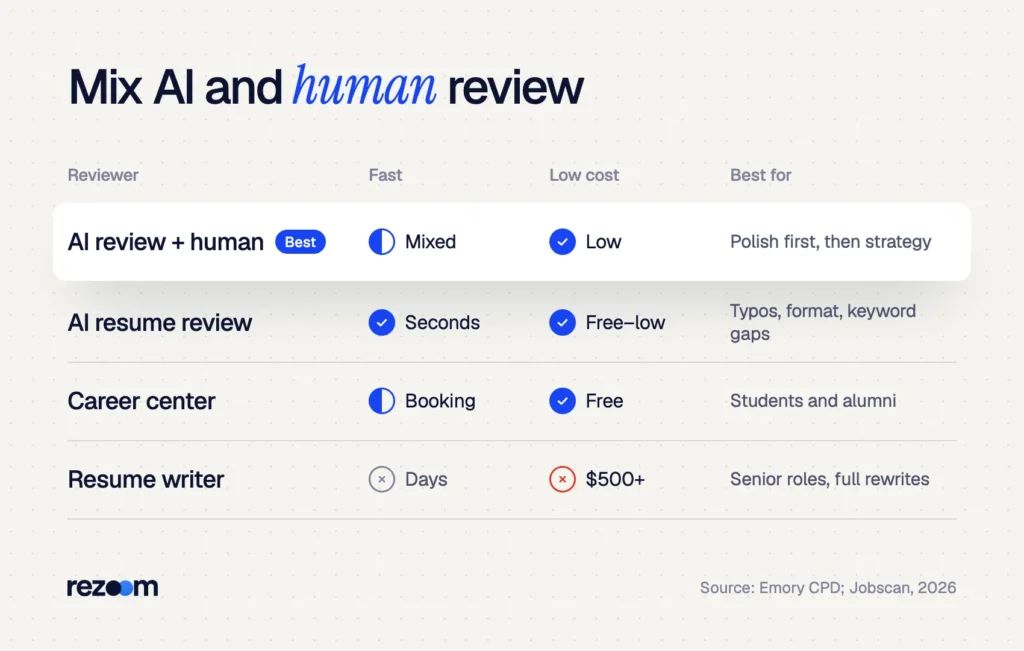
| Option | Speed | Typical cost | Catches best | Main blind spot |
|---|---|---|---|---|
| AI resume review tool | Seconds; unlimited reruns | Free to low monthly fee | Typos, format, parsing, keyword gaps | Strategy, context, honesty of claims |
| University career center | Appointment needed | Usually free for students | Structure, student norms, next steps | Less depth for senior or niche roles |
| Mentor in your field | Depends on their time | Free | Industry norms, what to cut | Small sample of one opinion |
| Career coach | Scheduled sessions | Paid per session or package | Positioning, career changes | Quality varies by coach |
| Professional resume writer | Days, not minutes | Often $500 to $600 for quality | Full rewrite and narrative | Cost; voice may stop sounding like you |
The cost numbers vary widely. A Jobscan roundup cites a Find My Profession survey where prices ran from $99 to $2,5976, with an average of $631. The same article estimates about $500 to $600 for a quality writer.
University tools have limits as well. Emory, for example, gives students 10 uploads or rescores3 of its AI tool per academic year.
Does your resume follow these 4 rules?
What does an AI resume review catch that humans miss?
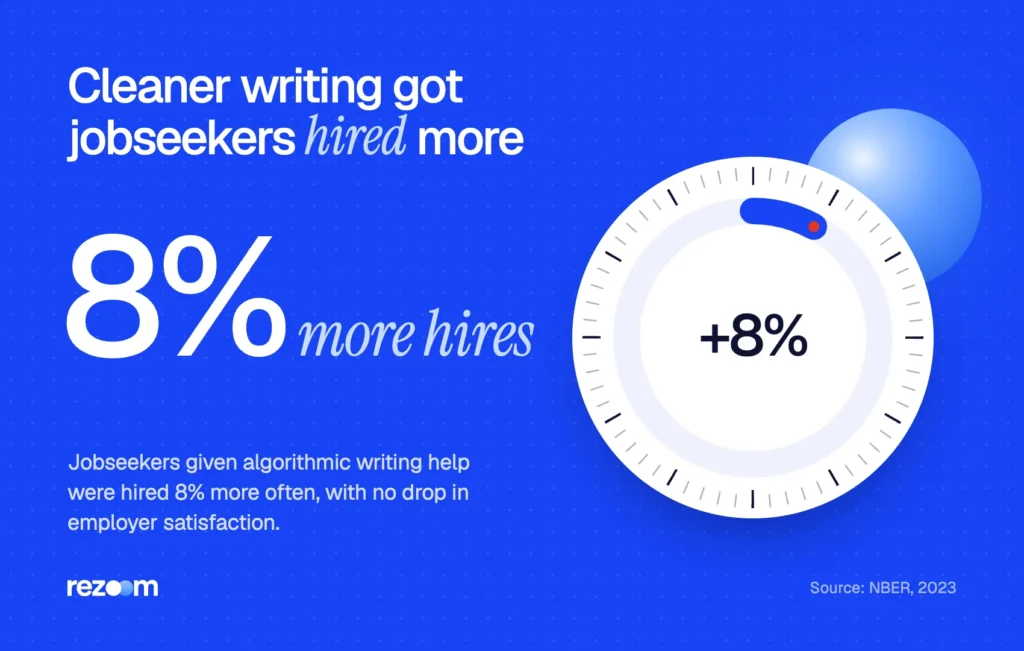
AI tools catch small, repeatable errors that tired human eyes skip: misspellings, commonly confused words, inconsistent dates, formatting that may not parse and missing keywords from a pasted job description. Evidence suggests this matters. In a field experiment with nearly half a million jobseekers, writing assistance raised hires by 8%.
The strongest evidence for an AI resume review comes from a large experiment. Researchers ran a field experiment in an online labor market, giving some jobseekers algorithmic writing help on their profiles. Treated jobseekers were hired 8% more often1, with no evidence that employers were less satisfied.
The tool flagged words that were spelled wrong or used incorrectly2 and suggested fixes for punctuation, word use and tone. The biggest error reductions came from commonly confused words. The authors concluded that clearer writing helps employers see a candidate's ability, rather than signaling it.
AI also has endless patience. It checks the fifteenth draft as carefully as the first. That makes it ideal for keyword matching against each posting, a task few humans want to repeat for dozens of applications.
Before: Responsible for insuring compliance with all data privacy rules and principals After: Ensured compliance with GDPR and CCPA data privacy rules across 12 client accounts
What does a human resume review catch that AI misses?
A human reviewer catches strategy problems: the wrong story for the role, a career change that is not explained, achievements buried under duties, seniority that reads too junior, or claims that sound inflated. People also know field norms, such as whether a portfolio or a two-page resume is expected, which generic AI tools often miss.
Ask a person the questions software cannot answer. Is this the right resume for this career move? Which job should lead? What should you leave out entirely?
Career centers say the same. Emory calls its AI tool a starting point3 that should be used alongside its coaching services, not instead of them. It also warns that the scoring is subjective, so students should focus on the feedback rather than the score.
UC Berkeley's career center points to further AI blind spots. It warns that generative AI "is not always accurate"4, tells students to verify anything AI generates and suggests removing your name, email and phone number before pasting a resume into an AI tool. For individual help, it points students to a career educator.
Before (summary): Retail store manager with 8 years of experience in sales and merchandising After (summary): Operations leader moving into supply chain; cut stockouts 18% and managed a $4M inventory across 3 stores
Career changers get the most from a human read. To see a finished operations resume, compare yours with our supply chain resume example or browse more logistics resume examples.
Supply chain resume example
A finished operations resume to compare with your draft after an AI review.
Free ATS score, the text the software extracts and your missing keywords. No sign-up.
When should you use AI resume review, and when a human?
Use an AI review on every draft and for every posting you apply to. Add a human when you are changing careers, applying for senior or niche roles, returning after a gap, or sending many tailored applications with few interviews. Then treat the human feedback as strategy and the AI feedback as polish.
Here is a simple decision rule.
- Always use AI first. Fix typos, formatting and keyword gaps before anyone else reads the file. You spend a human's time on strategy, not commas.
- Book a human when the story is hard. Career changes, gaps, layoffs, senior roles and highly regulated fields need judgment.
- Book a human when results stall. If your applications are not turning into interviews, the problem may be positioning, not wording. Our guide on why you are not getting a job lists other causes to rule out.
- Run AI again after the human edit. Rewrites can break formatting or drop keywords.
Before paying a resume writer, check whether your university career center serves alumni, and ask one person who already holds your target job to read your resume for a few minutes. Bring a cleaned-up draft and one specific question.
Do
- Run an AI resume review before every human review
- Give the human reviewer the job posting you are targeting
- Verify every number and claim an AI tool rewrites
- Remove contact details before pasting into an AI chat tool
Don’t
- Treat any AI score as a hiring prediction
- Accept AI phrasing that you could not explain in an interview
- Pay for a full rewrite before trying free feedback
- Let one reviewer's taste override clear field norms
How do you combine AI and human feedback?
Use a three-pass loop. First, an AI resume review against a real posting fixes errors and keyword gaps. Second, a human reviews strategy, story and what to cut. Third, a final AI pass checks that the rewrite still parses and still covers the posting's required skills. Then apply and track results.
The loop takes less time than it sounds.
- Pass 1, AI polish. Paste the posting into a checker and fix flagged items. The free Rezoom ATS resume checker shows missing keywords and formatting issues against the job description.
- Pass 2, human strategy. Ask your reviewer three questions: what would you cut, what is missing, and does the top third match the job?
- Pass 3, AI recheck. Confirm the new version still parses and covers the required skills.
If you use AI to draft new bullets, keep them honest. Our guides on whether it is bad to use AI for your resume and whether employers can detect an AI resume cover the line between help and fabrication. For a wider view of tools, see today's guide to AI job search tools. The same loop works for letters, so compare your draft with these logistics cover letter examples.
An ATS resume checker and a human recruiter grade different things — and disagree on four. Here's each checklist, where they conflict, and what to do.
Frequently asked questions
Is an AI resume review accurate?
It is accurate for mechanical checks such as spelling, formatting and keyword overlap. It is less reliable for judging your story or fit, and any score it gives is a rough signal, not a verdict.
Is a professional resume writer worth the money?
It can be for senior roles, complex career changes or when you lack time. Try free options first, since one survey of services found an average price of $631.
Can ChatGPT review my resume?
Yes, it can flag errors and suggest phrasing. Remove your contact details first, check every rewritten claim, and pair it with a posting so the feedback is specific.
Do university career centers review resumes for alumni?
Many do, though rules vary by school. Check your career center's website or call before paying for a private review.
How often should I get a human resume review?
Once per major change: a new target role, a new industry or a long job search without interviews. AI checks can run on every application.
Should I trust an AI resume score?
Use it to compare versions of the same resume, not as a prediction. Emory's career center tells students to focus on the feedback rather than the score.
How long does an AI resume review take?
Most AI resume reviews return results in seconds. A human review takes longer, because a person has to read and comment on each section, so plan for days, not minutes.
Sources
We opened and read each page below. The small numbers in the text point here. Pages that carry no publication date show n.d.
- NBER (Wiles, Munyikwa and Horton)2023
Field experiment with nearly half a million jobseekers; treated jobseekers hired 8%…
- arXiv (Wiles, Munyikwa and Horton)2023
Tool underlined misspelled or misused words and advised on punctuation, word use…
- Emory University Career and Professional Developmentn.d.
VMock gives instant feedback on formatting, presentation and content; a starting point…
- UC Berkeley Career Engagement2026
Generative AI is not always accurate; verify AI output; remove name, email…
- NACE2024
Close to 60% of graduating seniors used the career center; 63.7% of…
- Jobscan2026
Find My Profession survey: resume writing prices from $99 to $2,597, average…
Mohammad has spent more than ten years designing consumer products and leads product at Rezoom, deciding what gets built and what gets left out. His guides cover the whole job search, from resume sections and cover letters to interview answers and career moves.
Goodi, M. (2026, October 30). AI Resume Review vs Human Review: Which Feedback to Trust. Rezoom. https://rezoom.io/ai-resume-review-vs-human-review/