How to Make Your Resume Stand Out in 2027: 11 Moves That Work
Make your resume stand out in 2027 with 11 moves built for AI screening, skills-based hiring and fast recruiter scans, plus before-and-after bullet rewrites.
On this pageHow do you make your resume stand out in 2027?
- How do you make your resume stand out in 2027?
- What changed in hiring for 2026 and 2027?
- Which resume moves actually get you noticed?
- How do you rewrite bullets so they stand out?
- What should you NOT do to make your resume stand out?
- How do your cover letter and LinkedIn help you stand out?
- How do you build a standout resume step by step?
- What should you check before you hit apply?
- FAQ
- Sources
To make your resume stand out in 2027, match your job title to the posting, lead each bullet with a measurable result, list skills you can prove, and keep a plain one-column layout. Employers now see floods of AI-written applications, so specific, verifiable detail is what separates a real candidate from the pile.
To make your resume stand out in 2027, prove you are real and right for this exact job. Match the posting's title, show numbers, list skills you can back up, and keep the layout simple.
That sounds basic, but the bar moved. Employers now sort through floods of AI-written applications, and many use AI to screen them first. So the resume that wins is the one that reads like a specific person with specific results.
Quick answers by situation
| Your situation | What it means / what to do | Example line |
|---|---|---|
| You apply to many jobs a week | Tailor the title and top third for each role | "Senior Project Manager, Agile Delivery" |
| Your bullets list duties | Rewrite each one as action + result + number | "Cut vendor costs 18% in 6 months" |
| You have no degree for the role | Lead with a skills section you can prove | "Jira, MS Project, budget ownership to $2M" |
| You used AI to draft your resume | Strip generic phrases and add your own facts | "Led 14 launches" beats "results-driven leader" |
| You use a two-column template | Switch to one column with standard headings | "Experience", "Skills", "Education" |
| Your LinkedIn is out of date | Sync titles, dates and skills with your resume | Same title and dates on both |
How do you make your resume stand out in 2027?
Make your resume stand out in 2027 by tailoring it to each posting, opening with a sharp summary, writing results-first bullets with numbers, proving your skills, and using a clean one-column format. Then back it up with a matching LinkedIn profile and a short cover letter, because employers now want proof that you are a real, qualified person.
Your resume gets two reads. First, software or a recruiter checks fit in seconds. Then a hiring manager looks for proof.
The 11 moves at a glance
| # | Move | Why it works now |
|---|---|---|
| 1 | Match the posting's job title | Biggest interview lift in Jobscan's data |
| 2 | Write a two-line summary for this role | Recruiters read the top first |
| 3 | Mirror the top five keywords | Helps both AI screens and humans |
| 4 | Start bullets with a verb, end with a result | Shows impact, not duties |
| 5 | Put a number in most bullets | Specifics read as real, not AI filler |
| 6 | List skills you can prove | Skills-based hiring checks for proof |
| 7 | Add scope: team, budget or users | Signals your level fast |
| 8 | Use one column and standard headings | Parses cleanly and scans fast |
| 9 | Link LinkedIn and a portfolio | Confirms you are a real person |
| 10 | Cut AI filler and claims you can't defend | Employers now flag generic text |
| 11 | Send a short, tailored cover letter | Few applicants do it |
If you only have time for three, do moves 1, 4 and 5. They change the most in the least time.
What changed in hiring for 2026 and 2027?
Three things changed. AI-written applications now flood recruiters, so employers distrust generic resumes. More employers hire on skills and drop degree rules. And AI screening plus human interviews now sit side by side, so your resume must read well to software and still sound like a real person.
AI-written applications flood the pile
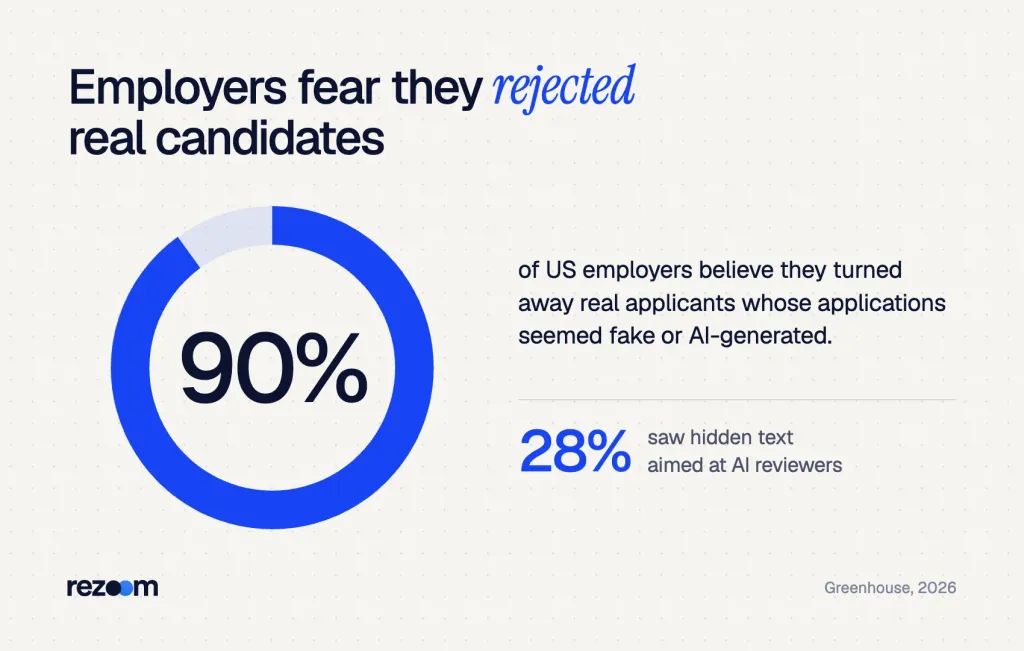
The biggest shift is trust. In a November 2026 survey, 90% of US employers1 said they believe they rejected real candidates because the applications seemed fake or AI-generated. The same Greenhouse report found 49% saw applicants claim skills they do not have.
Hiring managers also see the volume firsthand. A 2026 Resume Genius report found 58% of hiring managers2 have received AI-generated resumes or cover letters. And 58% use AI to screen resumes and applications.
That means generic wording now reads as a warning sign. If you want to know how employers spot it, see our guide on whether employers can detect an AI resume.
Today, only three in 100 applications ever reach an interview, and adding more human interviews can't close that gap.
Greenhouse, 2026
Skills now beat credentials
Employers are also hiring for skills over degrees. TestGorilla's 2025 report found 85% of employers use skills-based hiring3, up from 81% a year earlier. More than half, 53%, have dropped degree requirements, and the US figure is 57%.
So your skills section matters more than it did. But a skills list only helps when your bullets show those skills in use.
Recruiters still scan fast
The best-known data on scan time is older. Ladders' 2018 eye-tracking study found recruiters skim a resume for an average of 7.4 seconds5. It also found that simple layouts with clear headings held attention, while multiple columns and long sentences did not.
We have a full breakdown of how long recruiters look at a resume and what they check first.
Which resume moves actually get you noticed?
The moves with the clearest data are matching the job title, tailoring keywords, quantifying results, and adding a cover letter and an optimized LinkedIn profile. Jobscan's 2025 data tied a matching job title to a 10.6 times higher interview rate, the largest effect it measured.
Match the title and tailor the top third
Jobscan's 2025 analysis of more than 2.5 million applications found that a resume title that matched the posting had a 10.6 times higher interview rate4. That is the cheapest edit you can make. If the posting says "Project Manager, Construction," don't lead with "Operations Professional."
Next, pull the top five skills from the posting and use them in your summary and bullets. Our guide to tailoring your resume to a job description walks through it line by line. For the words themselves, see our list of resume keywords by field.
JORDAN LEE
Senior Project Manager, Agile Delivery | Denver, CO | jordan.lee@email.com | linkedin.com/in/jordanlee
Summary: PMP-certified project manager with 7 years leading Agile software launches for teams of 10 to 25.
Summary: Delivered 30+ releases on budget; known for clear stakeholder reporting in Jira and Smartsheet.
Lead with results, not duties
A duty tells the reader what your job was. A result tells them what changed because you were there. So start each bullet with a verb, name the work, then end with the outcome.
Numbers make the result easy to trust. If you are not sure what to count, our guide on how to quantify your resume lists 30 metrics by role.
Read each bullet and ask "so what?" If the answer is not in the bullet, add it. Most weak bullets stop one clause too early.
Prove your skills and show your scope
Skills-based hiring rewards proof. List the tools and methods you use, then make sure at least one bullet shows each top skill in action.
Also add scope. A line like "managed a $2M budget across 3 sites" tells a reader your level faster than any title.
How do you rewrite bullets so they stand out?
Rewrite each bullet as action, task, and measurable result. Swap vague verbs like "responsible for" for strong ones like "led" or "cut," add a number, and name the tool or method. Keep each bullet to one or two lines so a fast reader can take it in at a glance.
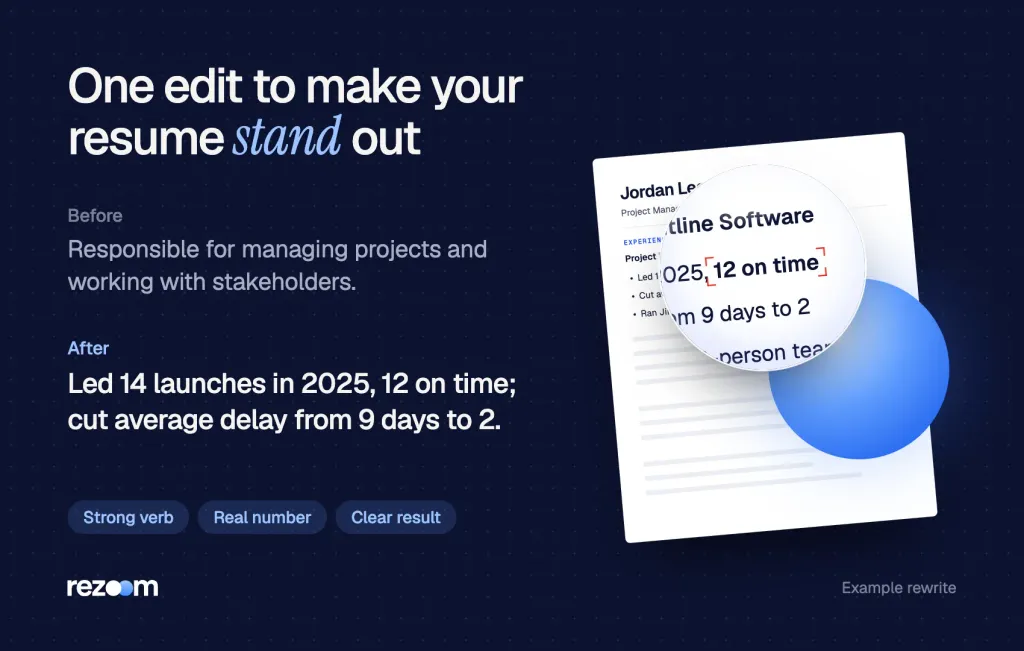
The numbers below are examples; use your own.
JORDAN LEE
Project Manager | Denver, CO | jordan.lee@email.com
Before: Responsible for managing projects and working with stakeholders.
After: Led 14 software launches in 2025, 12 on time, and cut average delay from 9 days to 2.
JORDAN LEE
Project Manager | Denver, CO | jordan.lee@email.com
Before: Results-driven, dynamic leader passionate about driving synergy and innovation.
After: Project manager who rebuilt intake for a 20-person team and cut project setup time 40%.
A fill-in-the-blank bullet template
When you get stuck, fill in this pattern. Then cut any word that does not add meaning.
YOUR NAME
Target Job Title | City, ST | email | linkedin.com/in/yourname
[Action verb] [what you did] for [who or what], [result] by [number] in [time frame].
[Action verb] [process or tool] to [goal], saving [hours or dollars] per [week or year].
See a full resume built this way
It helps to see these moves on a whole page. Browse our business and management resume examples to compare formats across roles. If you lead projects, start with this project manager resume example, which uses a tailored title and results-first bullets.
Project manager resume example
See results-first bullets, a proof-based skills list and a clean one-column layout.
How to tailor your resume to a job description in 8 steps: sort required vs preferred skills, map your proof, rewrite the top third and handle gaps honestly.
Free ATS score, the text the software extracts and your missing keywords. No sign-up.
What should you NOT do to make your resume stand out?
Skip tricks. Hidden white text, photos, heavy graphics, multi-column templates and AI filler can hurt more than help. Employers now watch for manipulation and fake applications, so anything that looks like gaming the system can get a real candidate rejected.
Some "stand out" advice now backfires. The Greenhouse 2026 report found 28% of US employers1 have seen applicants hide text in resumes aimed at AI reviewers. So recruiters are looking for it.
Tricks that backfire
- White text and hidden prompts. Copied keywords in white font show up when a system strips formatting. Read why white text on a resume is a risk, not a hack.
- Photos. Most US employers don't expect one, and some avoid them to reduce bias risk.
- Graphics and skill bars. A "4 out of 5 stars" bar tells a reader nothing and may not parse.
- Multi-column layouts. Ladders found multiple columns hurt readability, and parsers can scramble them.
- AI fluff. Words like "dynamic," "synergy" and "passionate" read as machine filler.
- Claims you cannot defend. If a recruiter asks about a skill, you need a story ready.
Do
- Use one column with headings like Experience, Skills and Education.
- Put real numbers in most bullets, even estimates you can explain.
- Match your job title and top keywords to the posting.
- Keep dates and titles the same on your resume and LinkedIn.
Don’t
- Hide white text or prompts for AI screeners.
- Add a photo, skill bars or icons in place of words.
- Paste an AI draft without adding your own facts.
- List skills that no bullet proves.
If a sentence sounds like it could describe anyone, it will read that way to a recruiter too. Replace it with a fact only you could write.
Resume mistakes that cost interviews: 15 common pitfalls, from generic summaries to typos, each with a quick fix. Check your resume against the list.
How do your cover letter and LinkedIn help you stand out?
They act as proof that you are real and engaged. Jobscan's 2025 data found a cover letter tied to a 3.4 times higher interview rate and an optimized LinkedIn profile tied to a 2.2 times higher rate. Keep both consistent with your resume.
Send a short cover letter
Many people skip the cover letter, so it helps you stand apart. Jobscan found that including a cover letter4 raised interview rates by 3.4 times in its 2025 data.
Keep it to three short paragraphs: why this role, one proof story, and a clear close. If you need a model, use this project manager cover letter as a starting point.
Project manager cover letter example
A short, tailored letter that opens with one project result and ties it to the role.
Keep LinkedIn in sync
The same Jobscan data tied an optimized LinkedIn profile to a 2.2 times higher interview rate4. So match your headline, titles and dates to your resume. When employers worry about fake applicants, a consistent profile works like a second ID.
If your field shows work, add a portfolio link too.
How do you build a standout resume step by step?
Start with the posting, not your old resume. Pull the title and top keywords, write a targeted summary, rewrite bullets as results with numbers, check the format, then sync LinkedIn. A tool can speed up the draft, but the facts must be yours.
- Mark up the postingHighlight the job title, top five skills and any tools named. These become your targets.
- Rewrite the top thirdMatch the title and write a two-line summary for this role only.
- Upgrade every bulletUse action, task and result, and add a number to most lines.
- Check the formatUse one column, standard headings and a plain font, then save as PDF or Word per the posting.
- Sync and sendUpdate LinkedIn to match, then add a short cover letter if the form allows.
Use AI as a drafting tool, not a ghostwriter
AI can save time on structure and phrasing. But employers now flag generic text, so treat any draft as a first pass. Our AI resume builder tailors your resume to a posting, and then you add the facts only you know.
What should you check before you hit apply?
Before you apply, confirm the title matches the posting, most bullets carry a number, every listed skill appears in a bullet, the layout is one column with no hidden text, and your LinkedIn matches. This takes five minutes and catches the issues that sink most applications.
Before you hit apply
If you can check all six, you have done what most applicants skip. That alone can make your resume stand out.
Tailored to the job post, checked against ATS.
Frequently asked questions
What makes a resume stand out to recruiters in 2027?
A matching job title, results with numbers, and skills you can prove. Specific detail beats polished but generic wording.
Should I use AI to write my resume in 2027?
Yes, for drafts, but edit every line. Add your own numbers and project names, and cut stock phrases.
Is a one-page resume still best?
One page works for most people with under 10 years of experience. If you have more, two pages is fine when page one holds your best results.
Do recruiters really spend only seconds on a resume?
Ladders' 2018 eye-tracking study measured an average first scan of 7.4 seconds. That first pass decides whether a recruiter reads further, so put your best proof at the top.
Should I put a photo on my US resume?
No. Most US employers don't expect one, so use the space for results.
How do I make my resume stand out with no experience?
Lead with a skills section and projects, coursework, volunteer work or internships. Then write those entries as results with numbers, just like work bullets.
Sources
We opened and read each page below. The small numbers in the text point here. Pages that carry no publication date show n.d.
- Greenhouse2026
90% of US employers believe they rejected real candidates whose applications seemed fake or AI-generated, 49% saw false skill claims, and 28% saw hidden text.
- Resume Genius2026
58% of hiring managers have received AI-generated resumes or cover letters, and 58% use AI to screen applications.
- TestGorilla2025
85% of employers use skills-based hiring, and 53% have dropped degree requirements (57% in the US).
- Jobscan2025
A matching resume title tied to a 10.6x higher interview rate, a cover letter to 3.4x, and an optimized LinkedIn profile to 2.2x.
- HR Dive (Ladders eye-tracking study)2018
Recruiters skim a resume for an average of 7.4 seconds, and simple layouts with clear headings held attention best.
Mohammad has spent more than ten years designing consumer products and leads product at Rezoom, deciding what gets built and what gets left out. His guides cover the whole job search, from resume sections and cover letters to interview answers and career moves.
Goodi, M. (2026, November 28). How to Make Your Resume Stand Out in 2027: 11 Moves That Work. Rezoom. https://rezoom.io/how-to-make-your-resume-stand-out/