
Summary
A two column resume can pass an ATS, but it is a gamble you cannot see. Greenhouse lists columned layouts among the causes of unsuccessful resume parses, while Textkernel says at least 15% of CVs use columns and has improved its column handling. Independent tests show the deciding factor is the order in which the PDF stores text, not the column count. Test your file before applying online, and use a single column whenever you apply through a portal.
A two column resume can be read by an applicant tracking system, but not reliably. Some parsers read each column in order, others read straight across the page and mix your sidebar into your job history.
The honest answer to "is a two column resume ATS friendly?" is: it depends on the parser and on how your file was built, and you cannot see either one when you click Apply. That is why this guide gives you a test you can run in five minutes and a clear rule for when to switch to one column.
Below you will find what ATS vendors themselves say about columns, what recent parsing tests found, and how to keep a sidebar design without losing data.
Can ATS read a two column resume?
Often, but not always. Greenhouse lists "resumes that have a columned layout" as a cause of unsuccessful parses. Textkernel, a parsing engine used inside several ATS products, reports that at least 15% of CVs use columns and has invested in reading them. Results vary by parser and by how the PDF stores text.
Start with the vendors, because they know their own software. Greenhouse's support center lists the formats that cause unsuccessful resume parses. "Resumes that have a columned layout" is on that list, next to tables, headers, footers, text boxes and graphics. A failed parse can be complete, or partial and in need of manual correction.
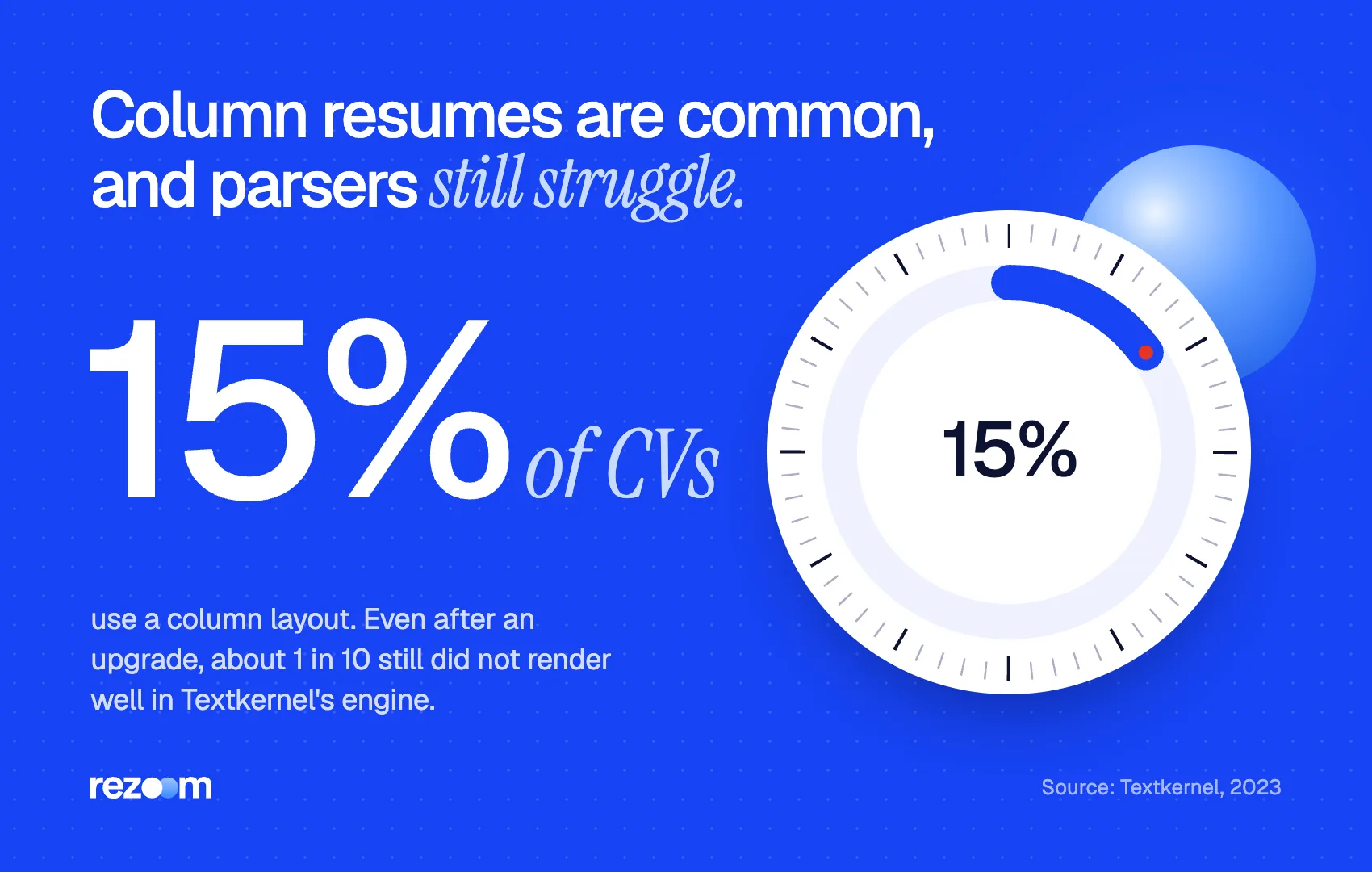
Textkernel, which builds the parsing engine behind several ATS platforms, describes the same problem from the other side. In its post on improving extraction from column resumes, it says at least 15% of CV documents use a column layout. Read left to right and top to bottom, those resumes mix content from different sections.
Textkernel's fix raised the share of well-rendered column CVs from 62% to 90%. That is real progress. It also means about 1 in 10 column CVs still did not render well in that engine after the upgrade, and not every ATS uses that engine.
Market share shows why vendor differences matter. Jobscan found Workday is used by over 40% of Fortune 500 companies in 2026. In a wider sample of 13,130 companies, Greenhouse led at 19.0%, followed by Workday, Lever and iCIMS. You rarely know which one sits behind an Apply button.
Why do columns confuse resume parsers?
A PDF stores text as a stream of characters with positions, not as columns. If the parser reads across the page row by row, your left sidebar and right column merge into mixed lines. Skills land inside job descriptions, dates detach from titles, and contact details can go missing.
A resume looks like two columns to you. To a parser, it is a set of text fragments with x and y coordinates. The parser has to guess the reading order.
When it guesses wrong, this happens:
Original left sidebar: SKILLS / SQL / Tableau / Python Original right column: Data Analyst | Brightway Health | 2023 – Present / Built weekly KPI dashboard used by 40 managers
Scrambled extraction: SKILLS Data Analyst | Brightway Health | 2023 – Present SQL Built weekly KPI dashboard used by 40 managers Tableau Python
Now the ATS sees "SKILLS Data Analyst" as one line. Your job title may be filed under skills, and your employer may not be detected at all. For the basics of how fields get mapped, see how does ATS work.
A 2026 study published on DEV Community ran one resume through four real parsers in 36 layouts: Zoho Recruit, Workable, Textkernel and Manatal. Several two-column templates parsed perfectly, while some single-column ones underperformed. Its conclusion: "the failure mode isn't columns. It's text-stream order."
That finding matters. A two column resume built so the PDF stores the full left column before the right column can parse cleanly. One built with floating text boxes often will not.
What did recent two column resume tests find?
Tests disagree on the size of the risk but agree on the cause. One vendor test found two-column resumes kept their section structure 35% of the time under worst-case extraction versus 60% for single column. Another study found perfect parses for some two-column templates. Reading order decides the outcome.
The most detailed public test comes from resume builder Enhancv, which ran 357 extraction runs across its templates using seven extraction tools. Under worst-case extraction, two-column resumes retained section structure 35% of the time, against 60% for single-column resumes. With other extraction methods, the gap largely disappeared.
The same test found that when AI models processed the extracted text, structure recovery rose to about 97%. Yet employer-name accuracy stayed at 83% for two-column layouts versus 100% for single column. It also noted that no ATS company has publicly confirmed using the AI option as its default.
Note the conflict of interest: Enhancv reports that its most popular template is a two-column design. Even so, its own worst case shows a clear drop.
| Evidence | What it found | What it means for you |
|---|---|---|
| Greenhouse support docs | Columned layouts listed as a cause of failed parses | At least one major ATS warns against columns |
| Textkernel engineering post | 15%+ of CVs use columns; well-rendered rate rose from 62% to 90% | Better, but not solved |
| Enhancv extraction test | Structure kept 35% (two column) vs 60% (single) in worst case | Risk depends on the extraction method |
| DEV Community parser study | Some two-column templates parsed perfectly | Text order, not layout, decides |
The shared lesson: you cannot judge your file by looking at it. You have to test it.
How do you test if your two column resume passes ATS?
Run three checks. Copy all text from your PDF and paste it into a plain text editor to see the reading order. Upload the file to a job site that autofills a profile and check every field. Then run it through an ATS resume checker. If any check scrambles sections, switch to one column.
This test takes about five minutes and needs no special software.
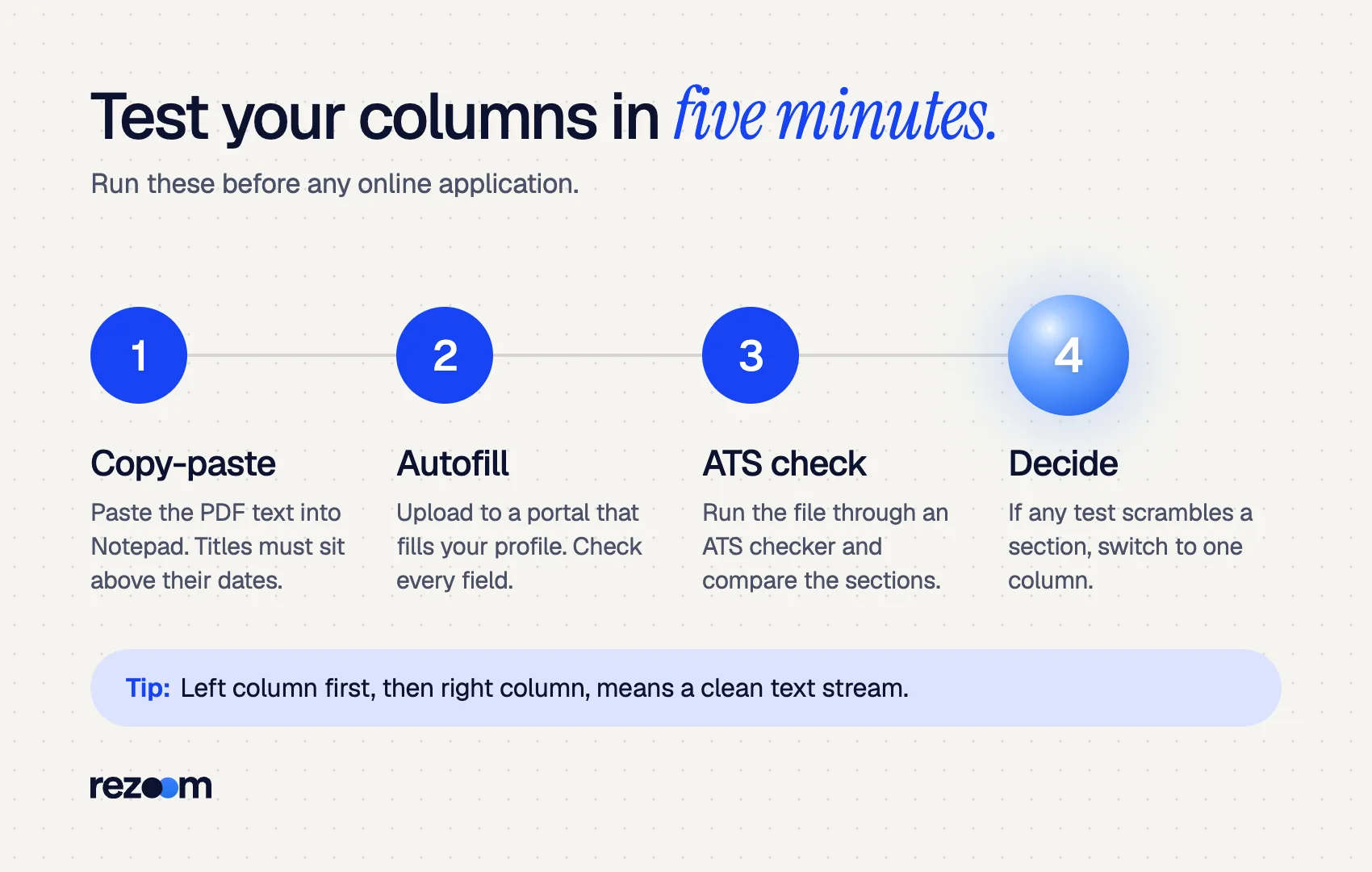
- The copy-paste test. Open your PDF, select all, copy, and paste into Notepad or TextEdit. Read it top to bottom. Each job title should sit directly above its employer, dates and bullets. If sidebar words appear between job lines, parsers that read in stream order will see the same mess.
- The autofill test. Upload your resume on a job site or employer portal that fills in your profile from the file. Check the name, email, phone, job titles, employers and dates. Missing or swapped fields are a red flag.
- The ATS check. Upload the PDF to the Rezoom ATS resume checker and compare the parsed sections with your original.
- The contact check. Make sure your name, email and phone appear in the main body text, not in a header, footer or text box. Greenhouse lists contact details in those places as a cause of failed parses. Our resume header guide shows a safe setup.
- The file check. Export a text-based PDF, not a scan or image. If you cannot highlight the words, no parser can read them. See should I send my resume as a PDF or Word.
Check the text order, not the look
If the copy-paste test shows the whole left column first and then the whole right column, your file has a clean text stream. That is the best sign you can get without access to the employer's ATS. If the lines interleave, rebuild the layout in one column instead of trying to fix spacing.
When should you use a single column instead?
Use a single column whenever you apply through an online portal, an ATS-driven job board or a large employer. Keep a two column resume for direct handoffs: email to a person, networking events, interviews and portfolio sites. If the copy-paste test scrambles anything, use one column everywhere.
A simple decision rule covers most cases:
| Situation | Best layout | Why |
|---|---|---|
| Online application or company career portal | Single column | Parser unknown, risk invisible to you |
| Large employer or Fortune 500 company | Single column | ATS use is close to universal |
| Email straight to a hiring manager | Either | A person reads the PDF |
| Career fair or interview printout | Either | Paper, no parser |
| Design, UX or creative role with portfolio | Two column is fine for handoffs | Visual skill is part of the pitch |
| Copy-paste test scrambles sections | Single column | Your file has a bad text stream |
Many job seekers keep two versions: a single-column file for portals and a designed file for people. That costs one extra export and removes the guesswork. Our ATS friendly resume template is a good single-column base.
Use a single column for every online application do: Run the copy-paste test on any two column resume before sending it do: Keep contact details in the main body, not a header or text box do: Keep a designed two column version for email and in-person handoffs
Put job titles, employers or dates in the sidebar dont: Build columns with floating text boxes dont: Put skills in charts, icons or rating bars dont: Assume a template is safe because it says ATS friendly
How do you keep a sidebar look in a single column?
Move sidebar content into full-width sections in a fixed order: header, summary, skills, experience, education. Use a bold heading and a thin rule for each section, and list skills as comma-separated text. This keeps the scannable look of a sidebar while giving every parser one clean reading order.
You can keep most of what makes a sidebar useful. The sidebar usually holds contact details, skills, tools and languages. Each one can become a short full-width section.
ALEX RIVERA Data Analyst | Chicago, IL | [email protected] | (312) 555-0148 | linkedin.com/in/alexrivera
SKILLS SQL, Python, Tableau, Power BI, Excel (pivot tables, Power Query), A/B testing, stakeholder reporting
EXPERIENCE Data Analyst | Brightway Health | Chicago, IL | Mar 2023 – Present - Built a weekly KPI dashboard used by 40 managers, cutting ad hoc report requests by a third
A one-column skills line fits more keywords in less space than a sidebar of single words. If you need more room, see our guide to resume margins and spacing or decide whether a two page resume is justified.
Design tools are the most common source of column layouts. If you built yours in a design app, read our sibling guides on Canva resumes and ATS and infographic resumes. And if you want to see what really triggers rejections, read the ATS rejection myth.
Frequently asked questions
Is a two column resume ATS friendly?
Sometimes. It depends on the employer's parser and on whether your PDF stores text column by column. Greenhouse lists columned layouts as a cause of failed parses, so test your file before applying online.
Does Workday read two column resumes?
Workday has not published column-specific parsing guidance that we could find. Because you cannot verify how it handles your file, use a single column for Workday portals and check the autofilled fields carefully.
Are two column resumes bad for recruiters?
Not for human readers. Recruiters often find a clean sidebar easy to scan. The risk is in the software step before a person sees the file.
Can I use a table to make two columns?
It is not safer. Greenhouse lists complex resumes with tables among the causes of failed parses, and career centers such as Santa Clara University advise avoiding tables.
Should I use a two column resume for a creative job?
For email and portfolio handoffs, yes. For an online portal, upload a single-column version and let your portfolio show your design skill.
How do I know which ATS a company uses?
Look at the application page URL or the careers site footer, which often names the vendor. Even then, settings vary by employer, so test the file anyway.



Comments