Devendra Iyer Business Intelligence Developer Raleigh, 27601, United States [email protected] · (919) 555-0671
14 September 2026
Ms. Corinne Haverford Director of Data and Analytics Oakhampton Home Charlotte, United States
Application for Senior Business Intelligence Developer, Oakhampton Home
Dear Ms. Haverford,
I am applying for the Senior Business Intelligence Developer post at Oakhampton Home. I currently own 118 dbt models over Snowflake for a specialty retail group, drawing from 9 source systems, and I own the certified metric layer they publish into: 34 definitions, each with a written formula, a stated grain and a named business owner outside the data team.
The piece of work I would most want to bring is the net sales definition. Two versions of the number were in circulation, roughly 3 percent apart, because one of them excluded loyalty redemption. I wrote a single definition at store, day and product grain, got the finance controller to own it, and then did the slow half: mapping and retiring 61 competing report-level measures over 18 months, each with a 30-day notice and a stated replacement. Self-serve went from answering 31 percent of reporting requests to 68 percent, and the weekly merchandising meeting stopped opening with an argument about which figure was right.
Your careers page describes a move from a legacy reporting server onto a cloud warehouse this year. The part that usually goes wrong in that move is not the migration but the definitions: reports get lifted across unchanged and the old disagreements arrive with them. I would want to spend the first quarter building the certified layer alongside the migration rather than after it, starting with the ten measures that appear in board reporting.
I hold the dbt Analytics Engineering Certification, SnowPro Core and the Microsoft Power BI Data Analyst Associate certification, and I can start on four weeks' notice. Thank you for your time.
Sincerely, Devendra Iyer
Summary
A business intelligence cover letter names the layer of the stack you own, one metric definition you settled with a business owner, and what happened to adoption or cost afterwards. This guide gives you a full adaptable letter, the rule about screenshots and company data, and the openings that get a strong file read rather than filtered on tool names alone.
Business Intelligence cover letter examples by experience level
A business intelligence cover letter is a one-page letter that says which layer of the stack you own, one metric definition you settled with the person whose targets depend on it, and what changed afterwards in adoption or in cost.
In practice, filters screen the resume on tool names. The letter, however, is where you say something a tool list cannot: that you have had the argument about what a number means, and won it in a way the business kept to.
Guide to a business intelligence cover letter
Specifically, this guide and the corresponding business intelligence cover letter example will cover:
- First, how to structure the letter, paragraph by paragraph
- Then, why the layer you own belongs in the first sentence
- Also, one certified definition as the evidence paragraph
- In addition, what you may and may not show from a current employer's platform
- Finally, the openings that work and the ones that waste your first line
How to write a business intelligence cover letter
| Paragraph | Its job | Length |
|---|---|---|
| Opening | The post, the stack, and which layer you were accountable for | 2 to 3 sentences |
| Evidence | One definition or one rebuild: what it replaced, who signed it, what moved | 4 to 5 sentences |
| Fit | Something specific about their data problem, and what you would do first | 3 to 4 sentences |
| Close | Certifications, availability, thank you | 2 sentences |
Say which layer you owned, not which tools you have touched
Most business intelligence letters open with a list: Snowflake, dbt, Power BI, Tableau, Airflow, Python. The reader already has that from your resume, and a list does not say whether you built the model or consumed it.
Open with ownership instead. "I own 118 dbt models over Snowflake and the certified metric layer they publish into, and I publish 23 Power BI datasets to about 640 weekly users" places you in one sentence.
Then add the scale, because it is the difference between two jobs with the same title. Source system count, row count and refresh cadence take one clause each and cost you nothing.
A business intelligence cover letter example you can adapt
Dear Ms. Haverford,
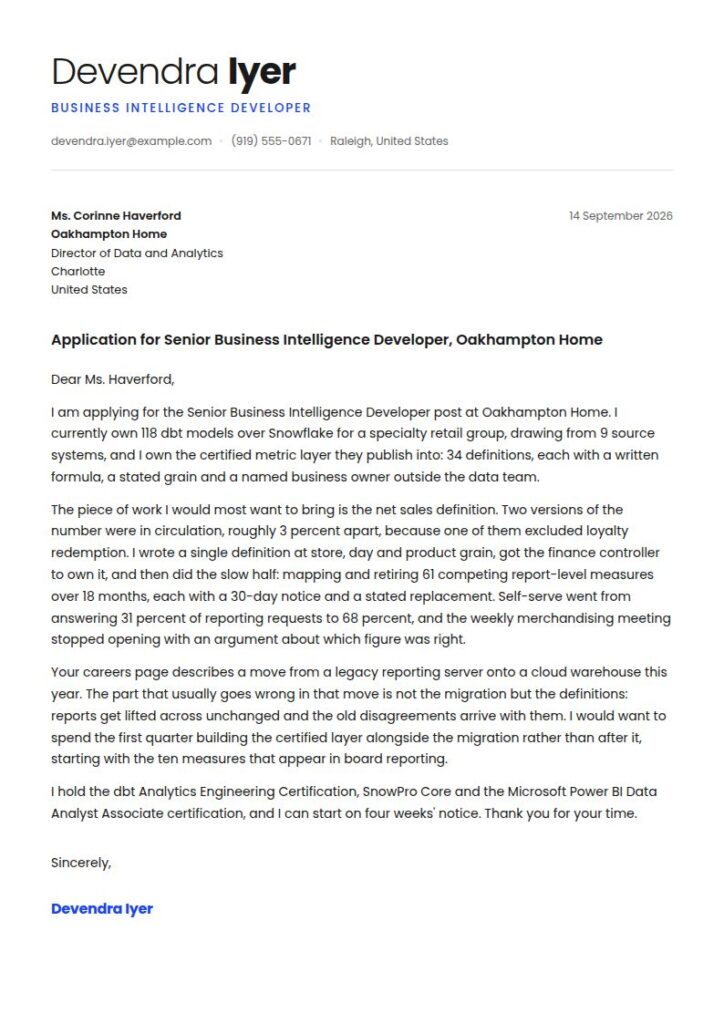
I am applying for the Senior Business Intelligence Developer post at Oakhampton Home. I currently own 118 dbt models over Snowflake for a specialty retail group, drawing from 9 source systems, and I own the certified metric layer they publish into: 34 definitions, each with a written formula, a stated grain and a named business owner outside the data team.
The piece of work I would most want to bring is the net sales definition. Two versions of the number were in circulation, roughly 3 percent apart, because one of them excluded loyalty redemption. I wrote a single definition at store, day and product grain, got the finance controller to own it, and then did the slow half: mapping and retiring 61 competing report-level measures over 18 months, each with a 30-day notice and a stated replacement. Self-serve went from answering 31 percent of reporting requests to 68 percent, and the weekly merchandising meeting stopped opening with an argument about which figure was right.
Your careers page describes a move from a legacy reporting server onto a cloud warehouse this year. The part that usually goes wrong in that move is not the migration but the definitions: reports get lifted across unchanged and the old disagreements arrive with them. I would want to spend the first quarter building the certified layer alongside the migration rather than after it, starting with the ten measures that appear in board reporting.
I hold the dbt Analytics Engineering Certification, SnowPro Core and the Microsoft Power BI Data Analyst Associate certification, and I can start on four weeks' notice. Thank you for your time.
Sincerely, Devendra Iyer
Openings that work
| Instead of | Use |
|---|---|
| I am a data-driven professional with a passion for analytics | I own 118 dbt models over Snowflake and the certified metric layer they publish into |
| I have experience with Snowflake, dbt, Power BI and SQL | I own the model and the semantic layer; the visualization tool is the last step, not the job |
| I built dashboards that helped stakeholders make better decisions | Self-serve went from answering 31 percent of reporting requests to 68 percent |
| I am excited about the opportunity to join your data team | Your careers page describes a warehouse migration this year, and definitions are what usually break in one |
In other words, every line on the right is checkable in an interview. Meanwhile, the lines on the left are what a filter has already read four hundred times this quarter.
What you can show, and what stays behind
This is the paragraph that quietly loses people offers, because the temptation is to attach a screenshot.
Describe the model by counts, sources, grain and row scale. Write a definition out in plain English, since a definition is a rule rather than a disclosure. Give adoption and cost as before and after percentages. Name the tools and say which you owned. Rebuild any portfolio example on a public dataset and say on the page that you did.
Do not attach a dashboard screenshot with real figures in it. Do not quote your employer's revenue, margin, headcount, customer counts or supplier terms. Do not name a customer or a supplier anywhere. Do not paste production SQL or model code into a public portfolio. Do not describe a data incident in enough detail to identify the system or the vendor.
For example, a percentage change is almost always safe and almost always more persuasive than the absolute. "Warehouse spend per weekly active user fell 38 percent while query volume roughly doubled" tells a hiring manager what they need and tells a competitor nothing.
The obstacle is ownership, not integration
In its 2026 State of Analytics Engineering report, published 14 April 2026 and based on 363 data practitioners and leaders surveyed in late 2025 and early 2026, dbt Labs found ambiguous data ownership named as a persistent obstacle by 41 percent of respondents, while technical integration problems fell from 35 percent to 27 percent year over year. Trust in data and data teams as an organizational priority rose from 66 percent to 83 percent, and 71 percent named incorrect or hallucinated outputs reaching stakeholders as a top concern (dbt Labs, April 2026).
That is the letter's argument in one paragraph. The connector problem is solved often enough that it is no longer the scarce skill. The unsolved problem is that nobody outside the data team owns the meaning of anything, so numbers disagree and trust falls.
Write your letter as the answer to that. One definition, one named business owner, one thing that got retired, one adoption number. It is a smaller claim than a tool list and a much harder one to fake.
Length, format and sending it
One page, four paragraphs, 250 to 400 words. PDF unless the portal insists otherwise, named for you and the post: devendra-iyer-bi-developer-cover-letter.pdf.
Address a person. A careers page or an engineering blog usually names the head of data, analytics engineering lead or director of business intelligence; as a result, a letter that names them reads as one written for a single employer.
Keep every figure identical to the one on your resume. Our business intelligence resume example is built on the numbers used here, and a reader who finds two versions of your adoption rate has found the one kind of inconsistency this profession cannot forgive.
Key takeaways
- First, open with the layer you owned, not with a list of tools.
- Then give the scale: source systems, model count, row volume, refresh cadence.
- Finally, make one certified definition the evidence paragraph.
- Name the business owner who signed it, because that sign-off is what proves someone governs it.
- Say what you retired, not only what you built.
- Close the evidence with an adoption or cost number, as a before and after.
- Never attach a screenshot carrying real company data, and say so if you rebuilt one.
Write your business intelligence cover letter in 10 minutes with our AI cover letter builder.
Business intelligence cover letter questions, answered
How long should a business intelligence cover letter be?
One page, four paragraphs, 250 to 400 words. These are read quickly by someone who already has your tool list from the resume, so the letter's whole job is to add the one thing the list cannot carry.
Should the letter repeat my tool stack?
Only once, and only to say which layer you owned. Listing the same eight tools the resume lists wastes the paragraph where you could describe a definition you settled or a migration you survived.
What do I write with no business intelligence job title yet?
Write the platform evidence from the job you had. A finance analyst has extracts retired and close reporting automated; an operations analyst has manual steps removed and hours returned; a support analyst has a data quality problem traced to its source. Then name the stack you have actually worked in and be exact about which layer you touched.
Can I mention a data incident or an outage?
Only in general terms, and only if it ends well. "A source feed changed without notice and reporting was wrong for a day, so I added freshness checks on all nine sources and failed builds fell from 11 a month to 2" is a strong paragraph. Naming the vendor, the system or the business impact in dollars is not.
How do I write to a company whose data platform I know nothing about?
Read what is public: the engineering blog, the job posting's tool list, the careers page, and any conference talk their team has given. A posting that names a warehouse migration, a semantic layer project or a first data hire is telling you what the first quarter looks like. One accurate sentence about that, and what you would do first, is worth more than a paragraph about your enthusiasm for data.