Hugo Palomares Tax Senior, CPA (Texas) San Antonio, 78209, United States [email protected] · (210) 555-0175
11 September 2026
Ms. Annelise Dorsett Tax Lundgate Farrow LLP San Antonio, United States
Application for Tax Manager, Lundgate Farrow LLP
Dear Ms. Dorsett,
I am applying for the Tax Manager post at Lundgate Farrow LLP. I am currently a tax senior at a regional firm, preparing and reviewing about 240 returns a season across Forms 1040, 1065, 1120-S and 1120 for closely held businesses and their owners, with filings in 14 states, and I hold a CPA license issued by the Texas State Board of Public Accountancy.
The work I would bring is the part of the book most firms are short of. I own multistate apportionment and the partner basis schedules for eight partnerships, and I maintain the fixed asset rollforward across 60 entities. Last season I wrote the research memo supporting our treatment of a state nexus question for clients with remote employees; the engagement partner reviewed it and it is now applied across the client base. I also resolved 31 agency notices in the last year, 22 of them automated underreporter matches, assembling the response files without escalation, which is work that arrives in June and July when the rest of the department is recovering.
Your posting describes a client base weighted toward manufacturing and professional services partnerships across several states, which is close to the mix I work in now. If I joined, the first thing I would want to do is read the extension list from last season, because the returns that go on extension for missing information are usually the same ones every year and that is where a season calendar is won or lost.
I hold a CPA license and a current PTIN, and I can start on 3 November, before the planning cycle begins. Thank you for your time.
Sincerely, Hugo Palomares, CPA
Summary
A tax accountant cover letter says what you can be handed in February: the returns you prepare or review by form, the states you file in, the complexity you carry and the notices you clear. This guide gives you a full adaptable letter, the openings that work, the timing that matters in tax hiring, and the confidentiality rule that decides whether the letter survives.
Tax Accountant cover letter examples by experience level
A tax accountant cover letter is a one-page letter answering a staffing question: what can this person be handed in February, at what volume, and how much review will it need.
Tax hiring runs on a calendar. Firms staff for the season months before it starts, and a letter that arrives with a start date and a return inventory in it is doing the reader's arithmetic for them. A letter that opens with enthusiasm for numbers is not.
This page is a guide to writing the letter. It is not tax advice.
Guide to a tax accountant cover letter
This guide and the corresponding tax accountant cover letter example will cover:
- How to structure the letter, paragraph by paragraph
- Why your returns by form belong in the first paragraph
- The notice and examination sentence almost nobody writes
- When to send it, because tax hiring is seasonal
- The confidentiality rule that keeps client information off the page
How to write a tax accountant cover letter
| Paragraph | Its job | Length |
|---|---|---|
| Opening | The post, your returns by form and volume, your license | 2 to 3 sentences |
| Evidence | One complexity you own, one position you documented, one outcome | 4 to 6 sentences |
| Fit | Something specific about their client base, and what you would take first | 3 to 4 sentences |
| Close | Credential, PTIN, availability against the season, thank you | 2 sentences |
Put a start date against the calendar in the last line
Tax is one of the few accounting fields where the timing of your availability is itself a qualification.
A candidate who can start in November is available for planning work, onboarding and the software migration before the season begins. A candidate available in February is arriving mid-wave and will cost review time when review time is scarcest. Say which you are, plainly, in the closing line.
Anchor it to the dates the reader already has in their head. The 2026 filing season opened on 26 January 2026 with a 15 April deadline for calendar-year individuals (IRS, IR-2026-12, 26 January 2026), and partnerships and S corporations are due a month earlier, on the 15th day of the third month after the end of the tax year (IRS Publication 509, 2026). "I can start on 3 November, before planning season" is a sentence a tax partner reads twice.
A tax accountant cover letter example you can adapt
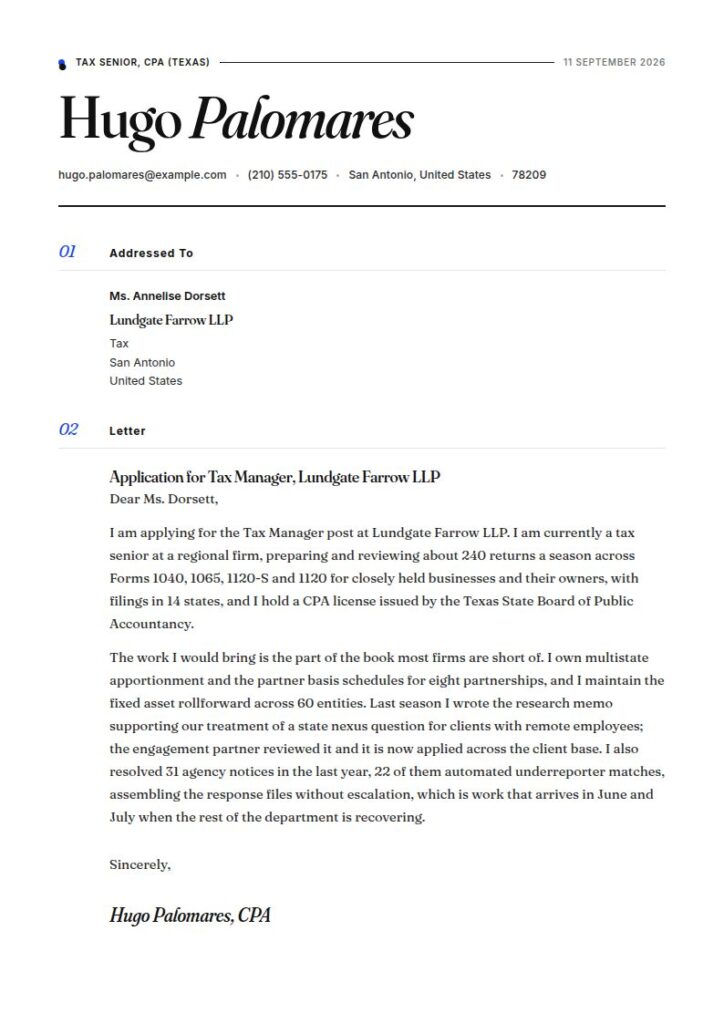
Dear Ms. Dorsett,
I am applying for the Tax Manager post at Lundgate Farrow LLP. I am currently a tax senior at a regional firm, preparing and reviewing about 240 returns a season across Forms 1040, 1065, 1120-S and 1120 for closely held businesses and their owners, with filings in 14 states, and I hold a CPA license issued by the Texas State Board of Public Accountancy.
The work I would bring is the part of the book most firms are short of. I own multistate apportionment and the partner basis schedules for eight partnerships, and I maintain the fixed asset rollforward across 60 entities. Last season I wrote the research memo supporting our treatment of a state nexus question for clients with remote employees; the engagement partner reviewed it and it is now applied across the client base. I also resolved 31 agency notices in the last year, 22 of them automated underreporter matches, assembling the response files without escalation, which is work that arrives in June and July when the rest of the department is recovering.
Your posting describes a client base weighted toward manufacturing and professional services partnerships across several states, which is close to the mix I work in now. If I joined, the first thing I would want to do is read the extension list from last season, because the returns that go on extension for missing information are usually the same ones every year and that is where a season calendar is won or lost.
I hold a CPA license and a current PTIN, and I can start on 3 November, before the planning cycle begins. Thank you for your time.
Sincerely, Hugo Palomares, CPA
Openings that work
| Instead of | Use |
|---|---|
| I am writing to express my interest in the tax accountant position | I am applying for the Tax Manager post, and I prepare and review about 240 returns a season |
| I have prepared a high volume of individual and business returns | 150 on Form 1040, 52 on Form 1065, 28 on Form 1120-S and 10 on Form 1120, in 14 states |
| I have strong technical tax knowledge | I own multistate apportionment and the partner basis schedules for eight partnerships |
| I am comfortable working under pressure during busy season | I can start on 3 November, before the planning cycle begins |
The sentence about notices, and why it works
Most tax cover letters stop at the return. The work that follows the return is where firms are thinnest, and a single quantified sentence about it separates a letter immediately.
In fiscal year 2025 the IRS closed 497,621 tax return audits and its Automated Underreporter program closed 987,460 cases, against roughly 164 million individual returns expected for tax year 2025 (IRS Compliance Presence, page last reviewed 5 June 2026, and IRS IR-2026-12, 26 January 2026). Automated matching reaches far more taxpayers than examination does, and every one of those cases is a letter with a deadline that somebody at a firm has to answer.
If you have done that work, write it with a number: how many notices, of which kind, resolved over what period, and whether you handled them without escalation. If you hold a CPA license or an enrolled agent credential, add the fact that gives it weight. The IRS states that "enrolled agents, certified public accountants, and attorneys have unlimited representation rights before the IRS", while other preparers have limited rights confined to returns they prepared and signed and to limited categories of IRS staff (IRS, page last reviewed 29 January 2026).
What has to stay out of the letter
Tax work is somebody else's confidential information almost from end to end, and the rule is easy to break by accident.
Give your returns by form with a count. Say how many states. Name the complexity you own: basis schedules, K-1 counts, fixed asset entities, consolidations. Quantify the notices you cleared and say whether they escalated. Name the preparation software and the research platform. State the license, the board that issued it and a current PTIN. Give a start date against the season.
Do not name a client or describe one in identifiable terms. Do not give a client's income, tax, refund, balance due or transaction value. Do not describe a position with enough facts that the taxpayer could be worked out from industry, size and state together. Do not write "over 300 returns" with no breakdown. Do not claim representation rights your credential does not carry. Do not publish your PTIN digits.
"Handled a research question for a San Antonio restaurant group with 40 locations" is a named client with the name taken off. "Wrote the memo supporting our treatment of a state nexus question for clients with remote employees" is the same competence with nobody identified, and it is the version that survives review.
When to send a tax accountant cover letter
| Window | What firms are doing | What the letter should emphasize |
|---|---|---|
| September to November | Staffing the coming season and running planning work | Start date, forms you can take unsupervised, software you already know |
| December to January | Filling late gaps before the season opens | Immediate availability, throughput, prior season volume |
| February to April | Rarely hiring permanent staff; seasonal and contract only | Seasonal availability and a clean, short letter |
| May to August | Hiring for the year, clearing notices and extensions | Controversy work, extended filings, review experience, planning |
The two strong windows are early autumn and late spring. A letter sent in March is read by someone who has no time to read it, and that is not a reflection of the letter.
Length, format and sending it
One page, four paragraphs, 250 to 400 words. PDF unless the portal says otherwise, named for yourself and the post: hugo-palomares-tax-manager-cover-letter.pdf.
Address a named person. Tax leadership is public on almost every firm's site, and "Dear Hiring Manager" on an otherwise precise letter reads like a file sent to a dozen firms in one afternoon.
Keep the numbers identical to your resume, including the license line and the return counts. Our tax accountant resume example is written with the figures used here.
Key takeaways
- Open with your returns by form and your volume, not with an expression of interest.
- Say how many states you file in; it is the fastest complexity signal available.
- Write one quantified sentence about notices or examinations.
- Name the license, the board that issued it, and a current PTIN.
- Give a start date anchored to the season calendar.
- Name one real thing about their client base, taken from their own pages.
- Keep every client name, figure and identifiable position out of the letter.
Write your tax accountant cover letter in 10 minutes with our AI cover letter builder.
Tax accountant cover letter questions, answered
How long should a tax accountant cover letter be?
One page, four paragraphs, 250 to 400 words. A tax partner is reading it between reviews. Length does not read as diligence in an occupation that measures diligence in filed returns.
Should I write a different letter for a corporate tax department?
Yes. In a corporate tax department the unit of work is the entity and the calendar, not the client. Rewrite the opening around the number of entities and jurisdictions you have filed for, your role in the quarterly and annual provision, and the compliance calendar you maintained. Keep the notice and examination sentence exactly as it is, because it is valuable on both sides.
Can I say which firm I worked at?
Your own employer, yes: that is your work history. Their clients, no, and not by description either. Naming the firm and describing the book by client type, forms and states is the standard, and it is what a reader expects.
What do I write after a single filing season?
Write the season as a job. Returns by form, the states, the software you prepared in, the complexity you touched, and one quality measure such as the share of your returns accepted by the reviewer without a preparer-caused correction. Then your credential position: PTIN held, credit hours completed, and which sections of the Uniform CPA Examination you have passed with the next one scheduled.
Should I mention that I am not yet licensed?
Yes, as a fact with a date attached rather than as an apology. "Two sections of the Uniform CPA Examination passed, the next scheduled for January 2027, 150 semester hours completed, current PTIN held" is a real position and firms hire against it every year. What you must not do is imply a license you do not hold, because the title is restricted by the state boards that issue it.