What Is a Protected Veteran? The 4 VEVRAA Categories Explained
A protected veteran fits one of four VEVRAA groups. See who qualifies, the 3-year rule, how it differs from VA disability and what to ask HR in 2026.

On this pageWhat is a protected veteran?
- What is a protected veteran?
- What are the four protected veteran categories?
- How is a protected veteran different from a veteran or VA disability?
- Which employers follow the protected veteran rules in 2026?
- What does protected veteran status mean for your job search?
- How do you check or explain your protected veteran eligibility?
- What should you do before you answer the veteran question?
- FAQ
- Sources
A protected veteran is a veteran covered by VEVRAA, a federal law for companies with federal contracts. You qualify if you are a disabled veteran, were discharged in the last three years, served on active duty in a war or badged campaign, or earned an Armed Forces Service Medal. Not every veteran qualifies. The status bars bias and makes contractors recruit veterans, but it is not a hiring preference.
A protected veteran is a US veteran who fits one of four groups in VEVRAA, a federal law for companies with federal contracts. If you are disabled, recently discharged, a wartime or campaign badge veteran, or a service medal holder, you count.
Our example is Sam, an Army veteran who left the service last year and wants a job with a defense contractor.
Quick answers by situation
| Your situation | What to say/do | Example line |
|---|---|---|
| You left active duty less than 3 years ago | You likely qualify as recently separated | "I separated in 2025, so I'm a recently separated veteran." |
| The VA pays you disability compensation | You qualify as a disabled veteran | "I'm a disabled veteran under VEVRAA." |
| You hold a campaign badge or the Armed Forces Service Medal | You qualify under that category | "I earned the Armed Forces Service Medal." |
| You served in peacetime, long ago, with no rating | You may not qualify; ask HR how they read the form | "Which war periods does your form use?" |
| You're applying to a federal agency | That's veterans' preference, a separate system | "Do I need an SF-15 for this posting?" |
| You're not sure and don't want to guess | Pick the "I don't wish to answer" option | "I'll confirm my category after the offer." |
What is a protected veteran?
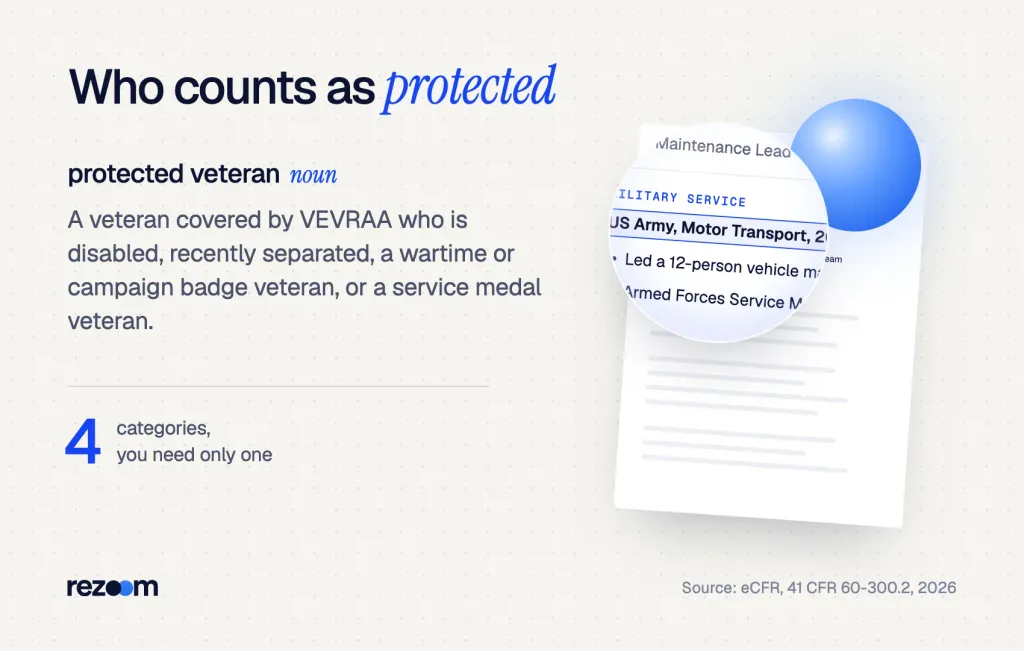
A protected veteran is a veteran covered by the Vietnam Era Veterans' Readjustment Assistance Act of 1974 (VEVRAA). The law covers four groups: disabled veterans, recently separated veterans, active duty wartime or campaign badge veterans, and Armed Forces service medal veterans. Companies with federal contracts can't discriminate against them and must make an effort to recruit them.
The label comes from federal contracting law, not from the VA. VEVRAA tells contractors to take affirmative action to employ and advance7 qualified covered veterans. The Labor Department's rules call these people "protected veterans" and define four groups1.
You must be a veteran first. Under the rule, that means you served in the active military, naval or air service and left under conditions other than dishonorable. So a dishonorable discharge rules you out of every group.
Why the job form asks about it
Federal contractors must invite you to self-identify, so the question shows up on many applications. For help with the form itself, read our guide on how to answer the protected veteran status question, which has scripts for each checkbox.
What is a protected veteran? Protected veteran status covers 4 VEVRAA groups. See who counts, which box to check on an application and what each answer means.
What are the four protected veteran categories?
The four groups are disabled veteran, recently separated veteran, active duty wartime or campaign badge veteran, and Armed Forces service medal veteran. You only need to fit one. Some last for life, such as a service-connected disability or a medal. The recently separated group ends three years after your discharge or release from active duty.
Here's a side-by-side view, using the wording in 41 CFR 60-300.21.
| Category | Who fits | How long it lasts | Proof you might hold |
|---|---|---|---|
| Disabled veteran | Entitled to VA disability pay, or discharged for a service-connected disability | For life | VA award letter, DD-214 |
| Recently separated veteran | Discharged or released from active duty recently | 3 years from discharge | DD-214 with separation date |
| Active duty wartime or campaign badge veteran | Served on active duty during a war or in a badged campaign | For life | DD-214 listing badges |
| Armed Forces service medal veteran | Took part in an operation that earned the Armed Forces Service Medal | For life | DD-214 listing the medal |
Disabled veteran
You fit this group if you are entitled to compensation under laws the VA runs. You also fit if you would be entitled but for your military retired pay. Then there's a second path: you were discharged or released from active duty because of a service-connected disability.
Recently separated veteran
This one has a clock. It covers you for the three-year period1 that starts on the date of your discharge or release from active duty. So if Sam left the Army in June 2025, he counts as recently separated until June 2028.
Active duty wartime or campaign badge veteran
You fit if you served on active duty during a war, or in a campaign or expedition with an authorized campaign badge. But some employers, such as the University of Notre Dame, point to the war periods in 38 USC 10113.
That law dates the Persian Gulf War from August 2, 19908, with no end date set yet. So ask HR how their form reads it.
Armed Forces service medal veteran
You fit if, on active duty, you took part in a US operation that earned the Armed Forces Service Medal. If your DD-214 lists the medal, you have your answer.
Pull out your DD-214 before you fill in any form. It shows your separation date, your discharge type and your badges and medals. Those four facts decide almost every protected veteran group.
How is a protected veteran different from a veteran or VA disability?
Every protected veteran is a veteran, but not every veteran is protected. You need to fit one of the four groups. A VA disability rating that pays compensation puts you in one group, but you can qualify without one. And veterans' preference for federal agency jobs is a separate system with its own rules.
People mix up three labels. Here's how they split.
- Veteran: You served on active duty and left under conditions other than dishonorable. That's the base for everything else.
- Protected veteran: You're a veteran who also fits one of the four VEVRAA groups. This label matters when you apply to a federal contractor.
- VA disability: The VA rates a service-connected condition. If it pays you compensation, you're a disabled veteran under VEVRAA, but the rating is only one path in.
Protected veteran vs. veterans' preference
Veterans' preference applies when you apply to a federal agency on USAJOBS. OPM says a 5-point or 10-point preference12 depends on your service dates, discharge and any service-connected disability. For a 10-point claim, you also submit an SF-15.
Protected veteran status gives you no points and no place at the front of the line. Instead, it bars bias and makes contractors recruit and track veterans. So if you want federal agency jobs, study our USAJOBS keywords guide too.
Do
- Check your separation date before you claim the recently separated category.
- Use the VEVRAA category names when you talk to HR at a contractor.
- Treat veterans' preference and protected status as two different things.
Don’t
- Assume every veteran is a protected veteran.
- Assume you need a VA rating to qualify.
- Expect a contractor to give you extra points for your status.
Which employers follow the protected veteran rules in 2026?
VEVRAA covers companies with a federal contract or subcontract of $200,000 or more. Those with 50 or more employees must also keep a written plan for veterans. In 2026, the Labor Department cut many contractor rules, but the VEVRAA self-identification invite and the hiring benchmark stayed in place.
Defense firms, banks, tech companies and schools often hold federal contracts. Basic VEVRAA coverage starts at a contract of $200,000 or more6. A written affirmative action plan applies when the employer also has 50 or more employees.
Covered contractors must also list most job openings with the state job service, and veterans get priority in referrals to those openings. That's written into the statute at 38 U.S.C. 42127.
What changed in 2026
On August 21, 20269, the Labor Department published three final rules. The disability self-ID form CC-305 went away, and the disability rule changes took effect September 21, 2026. The EO 11246 rules for race and sex ended October 26, 202610.
But the veterans rule mostly stayed. The VEVRAA final rule took effect September 21, 20264, and it mainly removed EO 11246 references and updated the contract threshold. It did not change the self-ID section or the benchmark section.
Section 503 and VEVRAA, along with their implementing regulations, remain in effect.
US Department of Labor, OFCCP
That line sits on the OFCCP home page5 as of November 2026. So contractors must still ask the veteran question.
How the self-ID invitation works
The current rule, 41 CFR 60-300.422, sets two steps. Before any offer, the employer asks if you believe you're a protected veteran. After the offer, it may ask which group you fit.
Both invites must say your answer is voluntary and private. They must also say a refusal won't lead to any adverse treatment.
The hiring benchmark
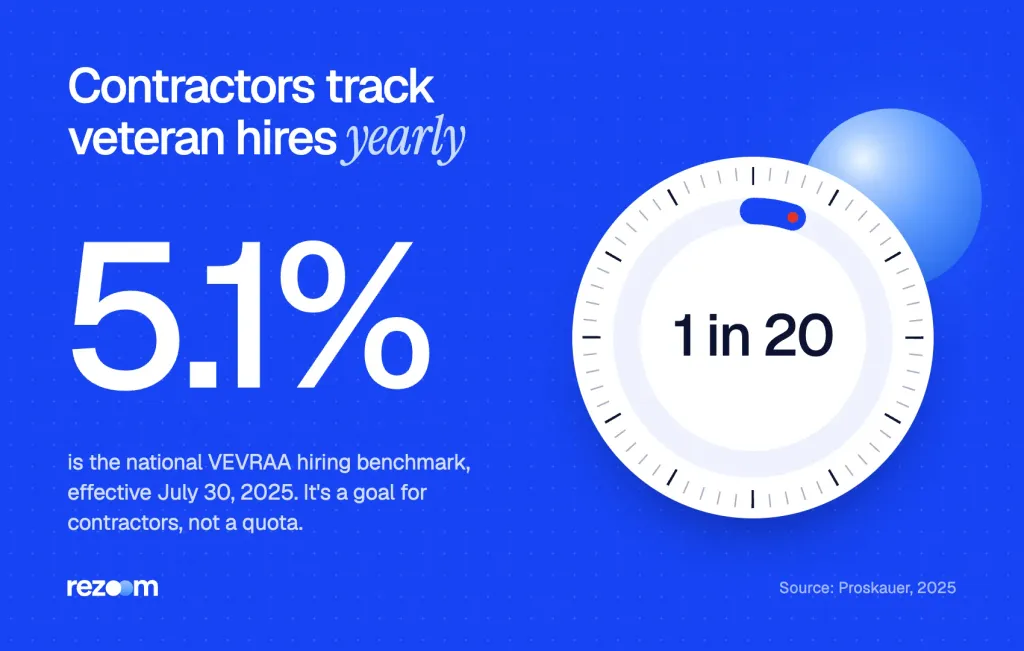
Contractors set a yearly goal for veteran hires. The rule says the benchmark is not a quota3, and it says quotas are forbidden. Many contractors use the national figure the OFCCP publishes.
The latest national figure we could confirm is 5.1%, effective July 30, 202511, down from 5.2% in 2024. We found no newer OFCCP figure as of November 2026. Contractors also file a yearly VETS-4212 report, and the 2026 report was due September 30, 202610.
Free ATS score, the text the software extracts and your missing keywords. No sign-up.
What does protected veteran status mean for your job search?
It means federal contractors want to find you, track how you fare, and treat you fairly. They post jobs where veterans look, and they measure veteran hires against a benchmark. But the status won't win you the job. Your resume still has to show civilian-ready skills, results and job titles a recruiter understands.
So treat the status as a door, not a pass. After outreach, a recruiter reads your resume like any other.
That's where most veterans lose ground. Our guide on writing a military-to-civilian resume shows how to swap ranks and codes for plain job language.
A military to civilian resume fails on translation, not qualification. Replace the verb, keep the number, add the scope — and leave one thing alone.
Show your service on the resume
Sam's first draft said "NCOIC, 88M section." He rewrote it as "Led a 12-person vehicle maintenance team." For models, browse these military resume examples to see how others translate their roles.
Military resume example
See how to turn ranks, duties and awards into civilian job language.
For roles with agencies or contractors, these government resume examples show how to list clearances and programs. If you'll apply on USAJOBS, the longer federal format in this USAJOBS resume example is a better fit.
Mention it in your cover letter
Name your service in one line of your cover letter, but skip your group. This military cover letter example shows the tone.
Military cover letter example
See how to link your service to the job in one or two lines.
How do you check or explain your protected veteran eligibility?
Start with your DD-214 and any VA award letter. Match your facts to the four groups. If you still aren't sure, ask HR how their form reads the wartime group, or wait for the post-offer form. You never have to share your group with a recruiter, and you can decline the question.
Here's the order Sam used.
- Get your papersPull your DD-214 and any VA disability award letter.
- Check the clockCount three years from your separation date for the recently separated group.
- Check your awardsLook for campaign badges or the Armed Forces Service Medal on your DD-214.
- Ask if unsureEmail HR with one clear question, or choose "I don't wish to answer."
Asking HR how they define the categories
If the wartime group confuses you, ask before you apply.
"Hi, I'm applying for the logistics analyst role." "Your veteran self-ID form lists 'active duty wartime or campaign badge veteran.'" "Which war periods do you use for that category, so I answer it correctly?"
Telling a recruiter about your status
If a recruiter asks if you're a veteran, keep it short and turn it toward the job.
"Yes, I served six years in the Army and separated last year." "I'm a recently separated veteran, so I'll be on your outreach list." "Most of my work was fleet maintenance, which is why this role caught my eye."
A fill-in-the-blank note for the post-offer form
After an offer, some employers send a second form. To confirm your group in writing, use this template.
"Thank you for the offer for the [job title] role."
"I've completed the veteran self-identification form."
"I fit the [category name] category, based on my [DD-214 / VA award letter]."
"Please let me know if HR needs anything else from me before [start date]."
What to say if they push back
- "Can you prove it?" Stay calm: "Yes. My DD-214 shows my dates and awards, and I can share it with HR."
- "Are you a disabled veteran?" You don't have to answer a recruiter: "I've completed the HR form. Is there something about the job duties I can speak to?"
Recruiter: "You checked protected veteran. Which category is that?"
"I'll list my category on the post-offer form, as the rules allow."
Recruiter: "Sure, I just wondered if you need any accommodation."
"Thanks. If I need one, I'll ask HR. For now, can we talk about the shift schedule?"
A disabled veteran group on the veteran form does not answer the disability form. Read up on the disability question on a job application, since the 2026 rules changed that form for contractors.
What should you do before you answer the veteran question?
Confirm your group with your papers, decide if you want to share it, and fix your resume before you apply. If you're unsure, decline the question rather than guess. Then focus on the parts that win the job: a clear resume, a short cover letter and a recruiter answer that points back to your skills.
Sam checked his DD-214, confirmed he was recently separated and answered yes. Then he put his real effort into his resume.
If you'd rather not answer at all, that's fine. Our guide to the "I do not wish to self-identify" option covers what that choice does. For the wider picture, read about voluntary self-identification on job applications.
Before you answer the protected veteran question
If your resume still reads like an review report, our AI resume builder can turn your duties and awards into clear civilian bullet points.
Tailored to the job post, checked against ATS.
Frequently asked questions
Is every veteran a protected veteran?
No. You must fit one of the four VEVRAA categories: disabled, recently separated, active duty wartime or campaign badge, or Armed Forces service medal veteran.
How long does recently separated veteran status last?
It lasts three years from the date of your discharge or release from active duty. After that, you may still fit another category.
Do I need a VA disability rating to be a protected veteran?
No. A rating that pays compensation is one way in, but a recent separation, a campaign badge or the Armed Forces Service Medal also counts.
Is protected veteran status the same as veterans' preference?
No. Veterans' preference gives points for federal agency jobs. Protected status applies to federal contractors and bars bias, but it gives no points.
Do employers still ask the protected veteran question in 2026?
Yes, if they are federal contractors. The 2026 rules ended the disability form CC-305, but the VEVRAA self-ID invitation stayed in place.
Can an employer reject me for declining to answer?
The rule says a refusal will not lead to any adverse treatment. Your answer is voluntary and must be kept confidential.
Does a dishonorable discharge count?
No. VEVRAA covers veterans who left under conditions other than dishonorable, so a dishonorable discharge rules you out.
Sources
We opened and read each page below. The small numbers in the text point here. Pages that carry no publication date show n.d.
- eCFR, US Government Publishing Office2026
Definitions of veteran, protected veteran and the four categories, including the three-year recently separated period (up to date as of October 22, 2026).
- eCFR, US Government Publishing Office2026
Pre-offer and post-offer self-ID invitations must say answers are voluntary, confidential and carry no adverse treatment.
- eCFR, US Government Publishing Office2026
The hiring benchmark is not a quota, and quotas are forbidden.
- Federal Register, US Department of Labor2026
The VEVRAA final rule took effect September 21, 2026, removed EO 11246 references and updated thresholds; it did not amend the self-ID or benchmark sections.
- US Department of Labor, OFCCP2026
Section 503 and VEVRAA and their regulations remain in effect.
- US Department of Labor, OFCCP2025
VEVRAA coverage starts at a $200,000 contract; a written plan applies with 50 or more employees.
- Legal Information Institute, Cornell Law Schooln.d.
38 U.S.C. 4212 requires contractors to take affirmative action for covered veterans and list openings with the state job service.
- Legal Information Institute, Cornell Law Schooln.d.
The Persian Gulf War period began August 2, 1990, and has no end date set.
- Duane Morris2026
DOL published three final rules on August 21, 2026; CC-305 was eliminated and VEVRAA benchmarks and reporting remain.
- Berkshire Associates2026
EO 11246 rules rescinded effective October 26, 2026; the 2026 VETS-4212 report was due September 30, 2026.
- Proskauer2025
The national VEVRAA hiring benchmark is 5.1%, effective July 30, 2025, down from 5.2% in 2024.
- US Office of Personnel Management, FedsHireVetsn.d.
Federal veterans' preference is 5-point or 10-point; 10-point claims need an SF-15.
- University of Notre Dame, Office of Institutional Equityn.d.
Example employer that refers to the war periods in 38 U.S.C. 101 for the wartime category.
Mohammad has spent more than ten years designing consumer products and leads product at Rezoom, deciding what gets built and what gets left out. His guides cover the whole job search, from resume sections and cover letters to interview answers and career moves.
Goodi, M. (2026, November 21). What Is a Protected Veteran? The 4 VEVRAA Categories Explained. Rezoom. https://rezoom.io/what-is-a-protected-veteran/