Title on Job Application: Mr., Ms., Mx., Dr. or Leave It Blank?
Title on job application forms, explained: what Mr., Ms., Mrs., Miss, Mx. and Dr. mean, if you must pick one, and why it never affects your screening.

On this pageWhat does title mean on a job application?
- What does title mean on a job application?
- Do you have to fill in the title on job application forms?
- Which title should you pick: Mr., Ms., Mrs., Miss or Mx.?
- When should you use Dr. as your title?
- Does the title on job application forms affect screening?
- How do you fill in the name section correctly?
- FAQ
- Sources
The title on a job application is the courtesy title that goes before your name, such as Mr., Ms., Mrs., Miss, Mx. or Dr. It's usually optional, so you can leave it blank. If you must pick one, choose the title you want on emails and offer letters. Ms. works for any adult woman, Mx. is gender-neutral, and the choice plays no part in screening.
The title on job application forms is the courtesy title before your name: Mr., Ms., Mrs., Miss, Mx. or Dr. It's usually optional, so pick the one you want recruiters to use, or leave it blank.
This guide covers what each option means, when you have to pick one, and how the field differs from "job title" and "suffix." Our example is Dana Price, who is applying for an administrative assistant job through Workday.
Quick answers by situation
| Your situation | What to say/do | Example line |
|---|---|---|
| The field is optional | Leave it blank, or pick the title you like | Title: [blank] |
| You're a woman and unsure | Pick Ms., because it doesn't show marital status | Title: Ms. |
| You don't want a gendered title | Pick Mx. if listed, or leave it blank | Title: Mx. |
| You hold an MD, DO or similar degree | Pick Dr. if the job is clinical | Title: Dr. |
| You hold a PhD | Pick Dr. for research or academic jobs, or skip it | Title: Dr. |
| The form asks for Jr. or III | That's the suffix box, not the title | Suffix: Jr. |
What does title mean on a job application?
In the name section, "Title," "Prefix" or "Salutation" means a courtesy title such as Mr., Ms., Mrs., Miss, Mx. or Dr. It sits before your first name. Employers use it to address you in letters and emails. It is not your job title, your degree or your name suffix.
The field usually sits at the top of the name section, above your first name.
Workday keeps a list of these values, and a Workday connector guide lists salutations such as Mr., Ms. and Dr.1 for formal letters and emails. So each employer's dropdown can look a little different.
Different systems use different labels for the same box. You may see Title, Prefix, Salutation, Courtesy Title or Honorific. They all mean the same thing in the US.
Lists available salutations, such as 'Mr.,' 'Ms.,' and 'Dr.,' for use in formal communications.
CData, Workday connector documentation
Title vs job title vs suffix
People mix up three fields that sit close together. This table shows which one is which.
| Field | What it asks | Example answer |
|---|---|---|
| Title or prefix | A courtesy title before your name | Ms. |
| Job title or position | The role you want or held | Administrative Assistant |
| Suffix | A generational or rank ending after your name | Jr., III |
| Professional title | A degree or credential, on some forms | PhD, RN |
If the form asks for the role you want, that's a different question. Our guide on the position applied for on a job application covers that field.
And if you're a Jr. or a III, put it in the suffix box, never in the title box.
What is a suffix on a job application form? It is the Jr., Sr., II or III after your last name. See what to enter, what to skip and examples for each case.
When "Prefix" means something else
In a few global systems, "prefix" can mean a last-name particle, not a courtesy title. Oracle's HR name formats, for example, list both a Title and a Prefix4 as separate parts of a name.
If you see both boxes, put Mr. or Ms. under Title and leave Prefix blank unless your last name starts with a particle like "van" or "de."
Do you have to fill in the title on job application forms?
Usually not. Most US forms treat the title as optional, and each employer decides whether to hide it, show it or make it mandatory. If the box has no red asterisk, you can leave it blank. If it's mandatory and none of the options fit you, pick the closest one or ask the recruiter. Most people can leave the title on job application forms blank.
Employers set this field up themselves. Workday lets each company hide or require name parts2 such as prefixes or middle names, or make them optional. Oracle's guide also says, "For example, title may be optional in some countries," on its person names page3.
Some systems lean the other way. Recruitee, a smaller ATS, hides its candidate title fields by default, but once an employer turns them on, they're mandatory by default5. So you'll see more variety than you might expect.
Government and federal forms
Federal applications often skip the title. The USA Staffing record lists first, middle and last name plus a suffix6, with no courtesy title. State and city forms vary, so follow the form in front of you.
- No title box: Don't add Mr. or Ms. to your first name field.
- Optional title box: Leave it blank or pick your title.
- Mandatory title box: Pick the title that matches how you want mail addressed.
- No option fits: Pick the closest choice, then tell the recruiter what you prefer.
If the field is optional, leaving it blank is not a mistake. The recruiter will still see your full name. Then their emails will just say "Dear Dana" or "Dear Dana Price" instead.
Which title should you pick: Mr., Ms., Mrs., Miss or Mx.?
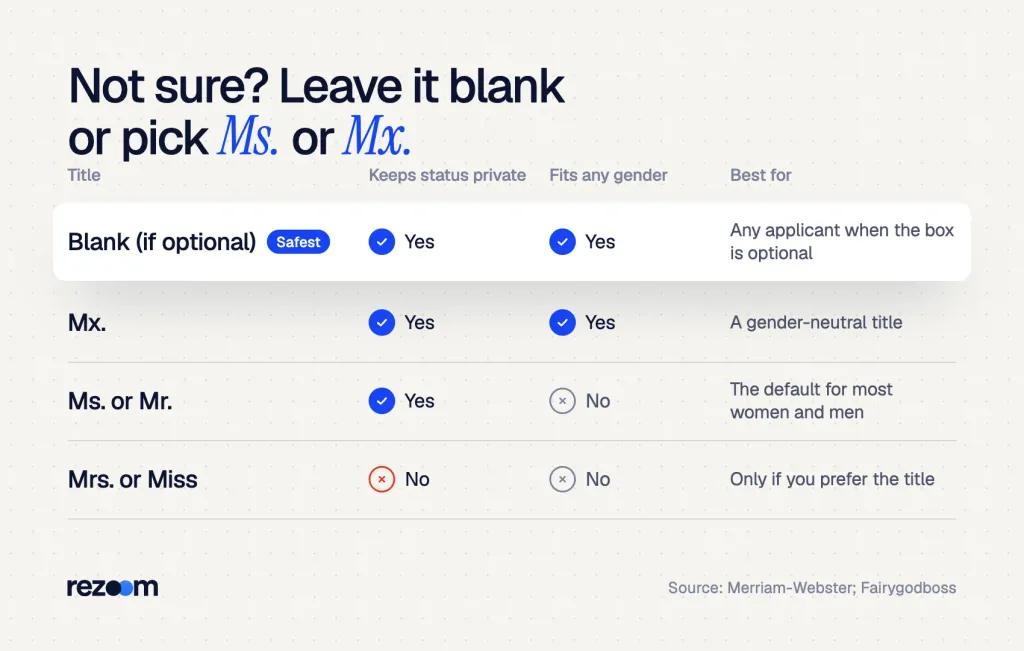
Pick the title you'd like people to use when they write to you. Ms. fits any adult woman and doesn't signal marital status, so it's the safe default for women. Mr. fits men. Mx. is a gender-neutral title for people who don't want a gendered one. Mrs. and Miss are fine if you prefer them.
There's no wrong answer here, as long as it's the title you want. But each option sends a slightly different signal, so it helps to know what they mean.
| Title | Who uses it | What it signals |
|---|---|---|
| Mr. | Men | Nothing beyond gender |
| Ms. | Any adult woman | Nothing about marital status |
| Mrs. | Married women, often with a spouse's last name | Marital status |
| Miss | Unmarried women, often younger | Marital status |
| Mx. | Anyone who wants a gender-neutral title | No gender or marital status |
| Dr. | People with a doctoral degree | An earned degree |
Ms. vs Mrs.
Ms. works for every adult woman.
Fairygodboss puts the rule simply: if you aren't sure, "always go with Ms.10" That's also why Ms. is the norm in business letters.
Pick Mrs. only if you like it and want people to use it. Your marital status has nothing to do with the job, so you don't have to share it.
What Mx. means
Merriam-Webster calls Mx. "a gender-neutral honorific8 for those who don't wish to be identified by gender." It's said like "mix." The dictionary notes that the title sees less official use in the US than in the UK, so not every dropdown lists it.
If your form has no Mx. option, leave the field blank when you can.
The Canadian government's writing guide makes the same point for letters: a gendered title should be left out9 when the person's preference isn't known. And if you'd like to share pronouns too, see how to display pronouns to the hiring team.
Title: Mx.
First name: Riley
Middle name: [blank]
Last name: Moore
Suffix: [blank]
When should you use Dr. as your title?
Use Dr. if you hold an earned doctorate and the job values it, such as an MD or DO for a clinical role or a PhD for a research or faculty job. For most business roles, Dr. is optional. Never use it for an honorary degree, and don't use it while your degree is still in progress. So the title on job application screens is a courtesy field, not a test.
Style guides split on this.
Some newsroom and university guides, such as the UMass style book11, use Dr. only for medical doctors. But an application isn't a news story, so the question is simpler: do you want recruiters to call you Dr.?
- Physicians, dentists and vets: Pick Dr. for clinical jobs. Patients and staff expect it.
- PhD in research or teaching: Pick Dr. if your field uses it, or skip it.
- PhD in a business role: It's your call. Your degree still shows in the education section.
- Doctorate in progress: Leave the title blank or pick Mr., Ms. or Mx. until you finish.
Recruiters screen your degree from the education section, not the title box. So list "PhD, Chemistry, 2024" there. Then the title field only decides how emails greet you.
Free ATS score, the text the software extracts and your missing keywords. No sign-up.
Does the title on job application forms affect screening?
No. The title is a name component, not a screening question. Systems use it to fill in greetings like "Dear Ms. Price" in emails. Some systems hide titles when they anonymize candidates. And the EEOC warns employers against using non-job-related marital-status questions, which is what Mrs. and Miss can signal.
ATS tools store the title so they can personalize messages. Recruitee, for example, has email placeholders that turn a title and last name into a line like "Dear Professor Vasquez5." The same help page says candidate titles stay hidden when a candidate is anonymous.
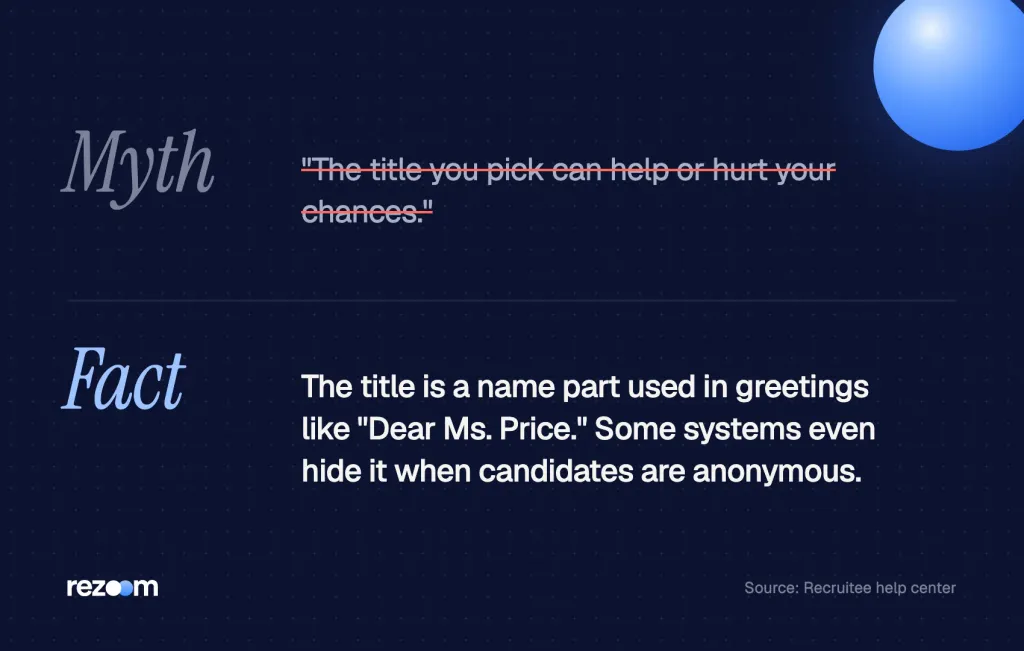
Your title also has nothing to do with the job.
The EEOC says employers should not use non-job-related questions7 about marital status. It adds that such questions often lead to bias against women.
That means picking Ms. over Mrs. is a safe way to keep that detail private.
How the title shows up after you apply
Once you submit, the title can appear in automated emails, interview invites and offer letters. So pick the one you'd be happy to see at the top of an offer.
Title: Ms. → "Dear Ms. Price,"
Title: Dr. → "Dear Dr. Price,"
Title: Mx. → "Dear Mx. Moore,"
Title: [blank] → "Dear Dana Price," or "Hi Dana,"
What to say if they push back
Sometimes a recruiter or form gets your title wrong. Here's how to handle the common cases without fuss.
- "Is it Miss or Mrs.?" Keep it simple: "Ms. is perfect, thanks."
- The email says Mr. but you use Ms. or Mx. Correct it once: "Quick note, I go by Mx. Moore."
- "Should we call you Dr.?" Be clear: "Dana is fine in person. Dr. Price works on formal letters."
- The form has no option that fits. Ask: "Your form didn't list Mx. Could you note it in my file?"
Recruiter: "Hi, is this Mrs. Price?"
"Yes, this is Dana Price. Ms. Price is fine, or just Dana."
Recruiter: "Got it. I'll update your profile."
"Thanks. I'm excited to talk about the administrative assistant role."
How do you fill in the name section correctly?
Start with the title, or leave it blank if it's optional. Then enter your legal first, middle and last names, add a suffix only if you have one, and set a preferred name if you go by something else. Keep every field the same as your resume, so the ATS and the recruiter see one consistent name. In short, pick the title on job application forms that you use in email.
The title is only the first box. The rest of the name section matters more, because background checks and offer letters use it. Start with your legal name on a job application, then add the extras.
- Pick or skip the titleChoose Mr., Ms., Mrs., Miss, Mx. or Dr., or leave it blank if optional.
- Enter your legal nameType your first and last name as they appear on your ID.
- Add a middle name or suffixFill in only the parts you have, such as a middle name or Jr.
- Set a preferred nameAdd the name you go by, so recruiters use it in calls and emails.
A fill-in template for the name section
Copy this layout and swap in your own details. Use the same spelling on your resume and your account profile.
Title: [Mr. / Ms. / Mrs. / Miss / Mx. / Dr. / blank]
First name: [legal first name]
Middle name: [legal middle name, or blank]
Last name: [legal last name]
Suffix: [Jr. / Sr. / III, or blank]
Preferred name: [the name you go by, or blank]
If you go by a nickname, the preferred name on a job application field is where it goes. And if your last name changed, the previous names on a job application question helps the background check find your old records.
Preferred name on job application forms means the first name you go by. See examples to type, how to show it on a CV and when to use your legal name.
Do
- Leave an optional title blank if none feels right.
- Pick Ms. if you're a woman who'd rather not share marital status.
- Put Jr. or III in the suffix box.
- Use Dr. only for a doctorate you've earned.
Don’t
- Type Mr. or Ms. into the first name field.
- Put your job title, such as Manager, in the title box.
- Add degrees like PhD or MBA to your last name.
Check before you submit
A two-minute check now saves an awkward fix later. Most of these fields carry over to every job you apply for with the same employer.
Before you submit the name section
Make your admin application stand out
Front-desk and office jobs often use these long Workday forms. Browse our administrative resume examples to see how strong applicants list scheduling, records and office tools.
Dana used this administrative assistant resume example to tighten her summary and list calendar and travel work as clear wins.
Administrative assistant resume example
See how to show calendar management, office software and fast, accurate support work on one page.
If the posting asks for a letter, our administrative cover letter examples show how to open with the right greeting and a strong first line. Then run your file through the ATS resume checker to confirm your name and contact details parse cleanly.
Free ATS score and your missing keywords. No sign-up.
Frequently asked questions
What does title mean on a job application?
It's the courtesy title before your name, such as Mr., Ms., Mrs., Miss, Mx. or Dr. Employers use it to greet you in emails and letters.
Is the title field on a job application required?
Usually not. Each employer decides, so leave it blank if there's no asterisk, or pick the title you prefer if the form forces a choice.
Should I put Ms. or Mrs. on a job application?
Pick Ms. if you want to keep your marital status private. Pick Mrs. only if you like that title and want people to use it.
What is the Mx. title?
Mx. is a gender-neutral courtesy title, said like "mix." Use it if you don't want a gendered title and the form lists it.
Can I put Dr. on a job application if I have a PhD?
Yes. It's most common for research and faculty roles. For other jobs it's optional, because your degree already shows in your education section.
Is title the same as job title on an application?
No. The title box asks for Mr., Ms. or a similar courtesy title. Your job title goes in the position or work history fields.
Does my title choice affect whether I get hired?
No. The title only shapes how the employer addresses you. Screening looks at your experience, skills and answers.
Sources
We opened and read each page below. The small numbers in the text point here. Pages that carry no publication date show n.d.
- CData (Workday connector documentation)n.d.
Workday lists salutations such as Mr., Ms. and Dr. for use in formal communications.
- Workdayn.d.
Workday lets employers hide or require name components such as prefixes and middle names, or make them optional.
- Oraclen.d.
Oracle name styles set which name components are required, and title may be optional in some countries.
- Oraclen.d.
Oracle name formats treat Title and Prefix as separate name components.
- Recruiteen.d.
Recruitee candidate title fields are hidden by default, required by default once added, used in greeting placeholders and hidden for anonymous candidates.
- OPM USA Staffingn.d.
USA Staffing biographic records list first, middle and last name plus a suffix such as Jr. or III.
- U.S. Equal Employment Opportunity Commissionn.d.
Employers generally should not use non-job-related questions about marital status, which are often used to discriminate against women.
- Merriam-Webstern.d.
Mx. is a gender-neutral honorific for people who do not wish to be identified by gender.
- Government of Canada, Language Portaln.d.
A gendered courtesy title should be left out when the person's gender or gender identity is unknown.
- Fairygodbossn.d.
Ms. does not depend on marital status and is the safe choice when you are unsure.
- UMass Amherst University Relationsn.d.
The UMass style book uses Dr. only for people with medical degrees.
Mohammad has spent more than ten years designing consumer products and leads product at Rezoom, deciding what gets built and what gets left out. His guides cover the whole job search, from resume sections and cover letters to interview answers and career moves.
Goodi, M. (2026, November 22). Title on Job Application: Mr., Ms., Mx., Dr. or Leave It Blank?. Rezoom. https://rezoom.io/title-on-job-application/