Associate Product Manager, Dispatch Ifeoma Nwachukwu
Associate Product Manager, Dispatch
[email protected] | (303) 555-0177 | Denver, United States
Profile
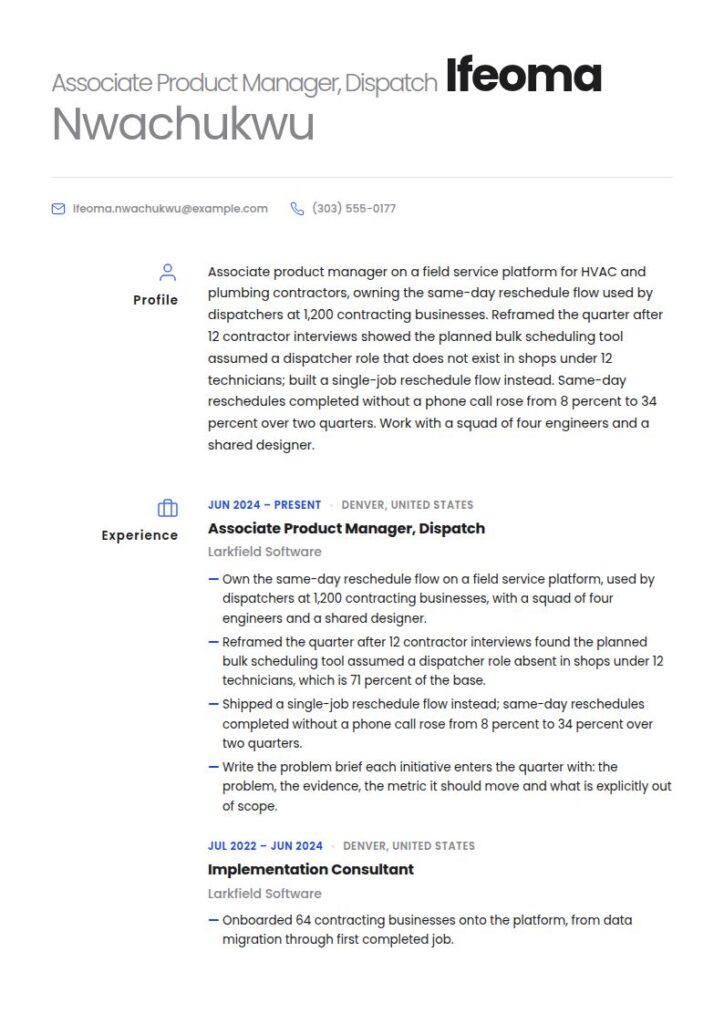
Associate product manager on a field service platform for HVAC and plumbing contractors, owning the same-day reschedule flow used by dispatchers at 1,200 contracting businesses. Reframed the quarter after 12 contractor interviews showed the planned bulk scheduling tool assumed a dispatcher role that does not exist in shops under 12 technicians; built a single-job reschedule flow instead. Same-day reschedules completed without a phone call rose from 8 percent to 34 percent over two quarters. Work with a squad of four engineers and a shared designer.
Work Experience
06/2024 - Present, Associate Product Manager, Dispatch, Larkfield Software, Denver, United States
- Own the same-day reschedule flow on a field service platform, used by dispatchers at 1,200 contracting businesses, with a squad of four engineers and a shared designer.
- Reframed the quarter after 12 contractor interviews found the planned bulk scheduling tool assumed a dispatcher role absent in shops under 12 technicians, which is 71 percent of the base.
- Shipped a single-job reschedule flow instead; same-day reschedules completed without a phone call rose from 8 percent to 34 percent over two quarters.
- Write the problem brief each initiative enters the quarter with: the problem, the evidence, the metric it should move and what is explicitly out of scope.
07/2022 - 06/2024, Implementation Consultant, Larkfield Software, Denver, United States
- Onboarded 64 contracting businesses onto the platform, from data migration through first completed job.
- Wrote the escalation criteria the support team still uses to decide which configuration issues reach product.
Education
08/2018 - 05/2022, Bachelor of Science, Industrial and Systems Engineering, University of Colorado Boulder, Boulder, United States
Coursework in operations research, human factors and systems design.
Skills
Problem framing and written problem briefs, 70
Customer and field interviews, 75
Slicing to a smallest testable version, 65
Funnel instrumentation and cohort reading, 65
Acceptance criteria and release sequencing, 70
Jira, Amplitude and SQL, 70
Languages
English, native
Igbo, native
Certificates
02/2025, Certified Scrum Product Owner (CSPO), Scrum Alliance
Course-based credential, renewed every two years on Scrum Education Units.
Summary
A product manager resume is a one to two page document showing the problem you chose to solve, the work you deliberately did not do, the metric that moved and over what period, and how you decided between competing roadmap items. This guide gives you three adaptable versions, a not-building block almost nobody writes, and current Bureau of Labor Statistics pay for the occupations product managers are counted under.
Product Manager resume examples by experience level
In short, a product manager resume is a one to two page document showing which problem you chose, what you deliberately did not build, which metric moved and over how long, and how you decided between the things competing for the same quarter.
By contrast, the standard version of this file is a list of launches: shipped a redesigned onboarding flow, launched a mobile app, delivered a new reporting module. However, every one of those sentences fits a product nobody adopted. Meanwhile, a hiring manager reading forty of them wants the candidate who can say what happened after the launch, and what they gave up to make it happen.
Resume guide for a product manager resume
To help, this guide and the corresponding product manager resume example will cover:
- How to write a product manager resume, section by section
- Why the things you chose not to build belong on the page
- Three adaptable summaries: associate, product manager and group lead
- How to write a metric so it survives an interview
- What the job market looks like and what you can expect to earn
How to write a product manager resume
Overall, use six sections: contact header, summary, experience, a decisions block, skills, and education with certifications. As a rule, one page for your first five years, two once you own an area with several teams in it.
That is why the order follows what a hiring manager is testing. They scan for the surface you owned and its scale, then for a metric with a time period attached, then for one trade-off they can push on. Recruiters read launch lists as filler.
| Section | What it is answering | Where it goes |
|---|---|---|
| Summary | What do you own, how big is it, and what moved? | Top, four lines |
| Experience | Did the outcome change, or only the feature set? | Reverse chronological, one metric per bullet |
| Decisions | What did you choose not to build, and on what evidence? | Its own block after experience |
| Skills | What can you run without help: discovery, pricing, technical trade-offs? | Grouped, honest about depth |
| Education and certifications | Anything that reads as credible, given there is no license | Last, brief |
Name the surface you own and the number attached to it
"Product manager at a software company" is unreadable. You might own a checkout flow used by two hundred people or a scheduling surface used by forty thousand, and the two jobs have nothing in common except the title.
Write the surface and the scale: "own the technician mobile experience on a field service platform, roughly 34,000 weekly active technicians across 2,900 contracting businesses, two engineers' worth of design and a squad of six." That is a sentence a hiring manager can size against their own organization.
Then add the one number that says you are accountable rather than adjacent: the metric you are measured on, its value before, its value after and the period. Not the launch date. The period.
Run the finished file through the ATS resume checker before you submit. Companies usually post product roles through the same requisition pipeline as engineering, and the parser reads your file before a person does.
Choosing the best resume format for a product manager resume
Reverse chronological, single column. One page for your first five years, two once you own an area with multiple teams.
On the other hand, the portfolio-style format, three case studies followed by a short employment list, works against you here. After all, a hiring manager needs to know which organization gave you which scope: owning a roadmap in a nine-person startup and owning one inside a product organization of three hundred are different jobs. Instead, keep the case studies for the interview.
Include your contact information
| ✅ Right | ❌ Wrong |
|---|---|
| Ifeoma Nwachukwu | Ifeoma Nwachukwu |
| Product Manager, Field Service Platform | Visionary product leader and customer champion |
| Technician mobile and dispatch, 34,000 weekly active users | Passionate about building products people love |
| (303) 555-0177, [email protected], Denver, CO | (303) 555-0177, [email protected] |
In particular, the third line is the one worth stealing. Two words of surface and one number does more than any headline adjective, and it tells a reader which of the many jobs called product manager you do.
Make use of a summary
Four lines: the surface you own and its scale, the metric you are measured on with before, after and period, one thing you decided not to build, and the shape of the team around you.
Associate product manager on a field service platform for HVAC and plumbing contractors, owning the same-day reschedule flow used by dispatchers at 1,200 contracting businesses. Reframed the quarter after 12 contractor interviews showed the planned bulk scheduling tool assumed a dispatcher role that does not exist in shops under 12 technicians; built a single-job reschedule flow instead. Same-day reschedules completed without a phone call rose from 8 percent to 34 percent over two quarters. Work with a squad of four engineers and a shared designer.
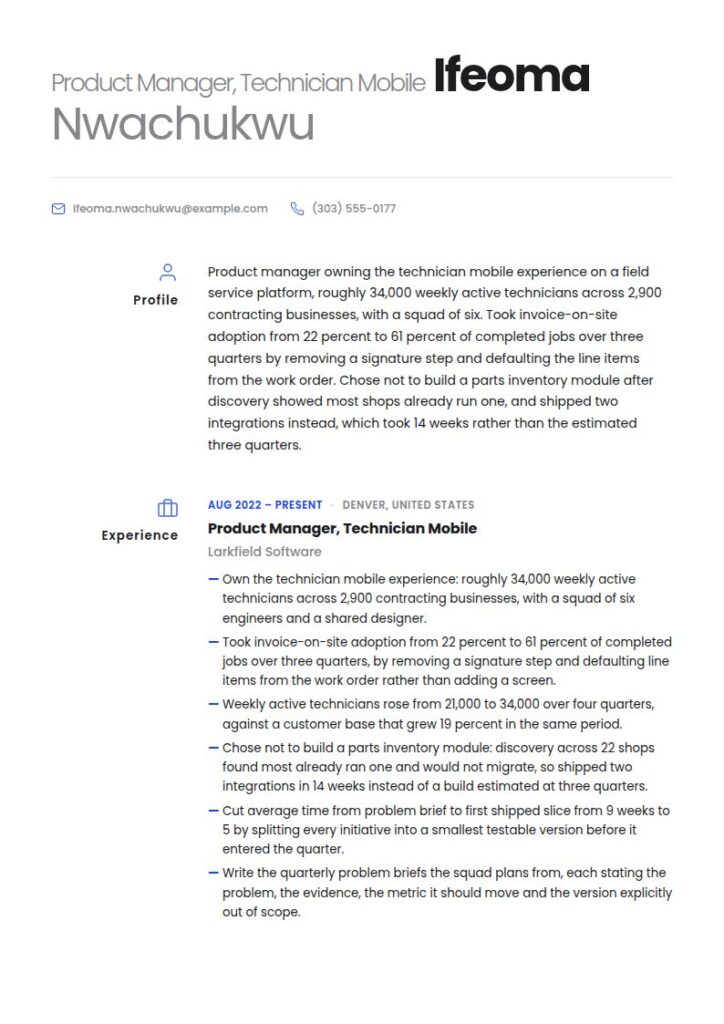
Product manager owning the technician mobile experience on a field service platform, roughly 34,000 weekly active technicians across 2,900 contracting businesses, with a squad of six. Took invoice-on-site adoption from 22 percent to 61 percent of completed jobs over three quarters by removing a signature step and defaulting the line items from the work order. Chose not to build a parts inventory module after discovery showed most shops already run one, and shipped two integrations instead, which took 14 weeks rather than the estimated three quarters.
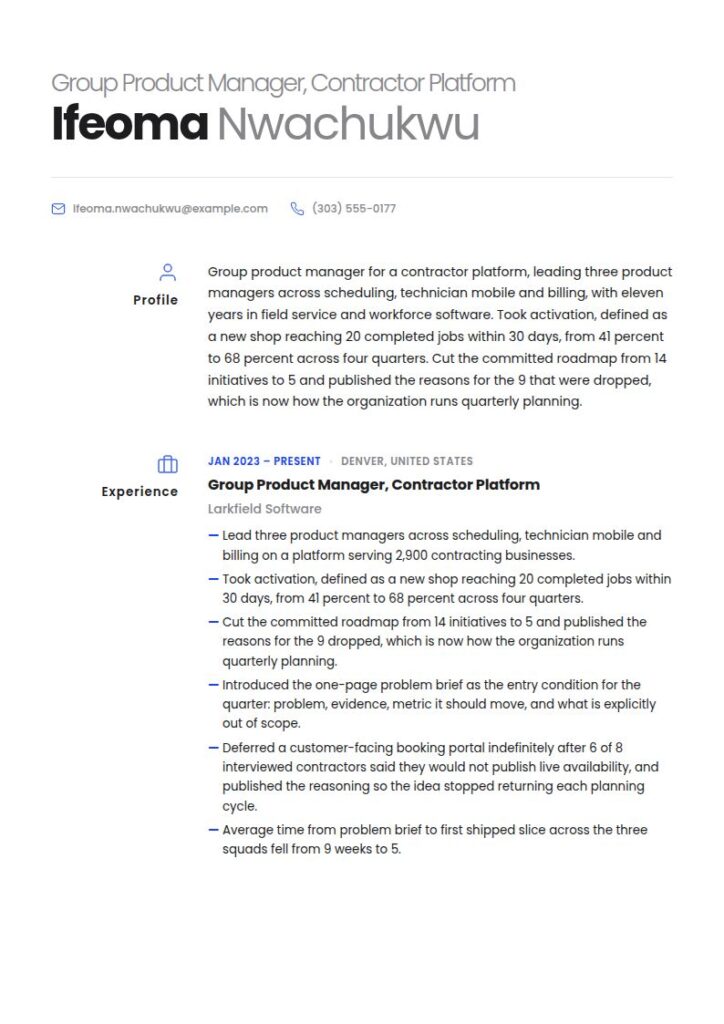
Group product manager for a contractor platform, leading three product managers across scheduling, technician mobile and billing, with eleven years in field service and workforce software. Took activation, defined as a new shop reaching 20 completed jobs within 30 days, from 41 percent to 68 percent across four quarters. Cut the committed roadmap from 14 initiatives to 5 and published the reasons for the 9 that were dropped, which is now how the organization runs quarterly planning.
Right vs wrong: the same product manager summary, twice
| ✅ Right | ❌ Wrong |
|---|---|
| Own the technician mobile experience, roughly 34,000 weekly active technicians across 2,900 contracting businesses. | Experienced product manager with a track record of delivering innovative products. |
| Invoice-on-site adoption moved from 22 percent to 61 percent of completed jobs over three quarters. | Launched a suite of new features that improved the customer experience. |
| Chose not to build a parts inventory module and shipped two integrations instead, in 14 weeks rather than three quarters. | Worked cross-functionally with engineering, design and stakeholders to drive impact. |
The right column, by contrast, is a set of claims with edges. The wrong column is the same paragraph in forty other files, and it survives being written by someone who was in the room rather than accountable for the outcome.
Outline your product manager experience
First, list employer, title, the surface you owned and its scale, the team shape, and dates. Then four to six bullets, each with one number and, wherever possible, the period over which it moved.
| Instead of | Use |
|---|---|
| Launched a redesigned mobile experience for technicians | Took invoice-on-site adoption from 22 percent to 61 percent of completed jobs over three quarters by removing a signature step and defaulting line items from the work order |
| Gathered customer feedback to inform the roadmap | Reframed the quarter after discovery showed the planned tool assumed a dispatcher role absent in shops under 12 technicians; shipped a single-job reschedule flow instead |
| Worked cross-functionally with engineering and design | Ran a squad of six with a shared designer; cut the average time from problem brief to first shipped slice from 9 weeks to 5 |
| Prioritized the product backlog | Cut the committed roadmap from 14 initiatives to 5 and published the reasons for the 9 that were dropped |
| Increased user engagement | Weekly active technicians rose from 21,000 to 34,000 over four quarters, against a customer base that grew 19 percent in the same period |
Product Manager, Technician Mobile, Larkfield Software, Denver, CO, August 2022 to Present
Own the technician mobile experience on a field service platform: roughly 34,000 weekly active technicians across 2,900 contracting businesses, with a squad of six engineers and a shared designer.
Took invoice-on-site adoption from 22 percent to 61 percent of completed jobs over three quarters, by removing a signature step and defaulting line items from the work order rather than by adding a new screen.
Weekly active technicians rose from 21,000 to 34,000 over four quarters, against a customer base that grew 19 percent in the same period.
Chose not to build a parts inventory module. Discovery across 22 shops found most already ran one and would not migrate; shipped two integrations in 14 weeks instead of a build estimated at three quarters.
Cut average time from problem brief to first shipped slice from 9 weeks to 5 by splitting every initiative into a smallest testable version before it entered the quarter.
Write what you decided not to build, and why
Above all, this is the block that separates a product manager from a delivery coordinator, and virtually nobody puts it on the page.
In other words, a roadmap is a set of refusals. For example, commit to five things in a quarter and you declined the other fourteen, and the quality of a product manager is more visible in the fourteen. Choosing what not to ship, on evidence, and explaining it to the people who wanted it, is the part that is hard to do and easy to prove.
Not built: parts inventory module. Requested by 31 accounts and estimated at three quarters of a squad. Discovery across 22 shops found most already ran inventory in a system they would not migrate, and that the real complaint was double entry rather than missing functionality. Shipped two integrations in 14 weeks instead. The request stopped appearing in churn interviews within two quarters.
Deferred: bulk scheduling tool. Built for a dispatcher role that does not exist in shops under 12 technicians, which is 71 percent of the base. Replaced in the quarter with a single-job reschedule flow; same-day reschedules completed without a phone call rose from 8 percent to 34 percent over two quarters.
How the calls were made: every initiative enters the quarter as a one-page problem brief stating the problem, the evidence, the metric it should move and what is explicitly out of scope. Briefs are ranked on size of the affected segment, confidence in the evidence and cost to reverse the decision. The committed list went from 14 initiatives to 5, with the reasoning for the 9 dropped ones published to the requesting teams.
Three things make this block persuasive rather than defensive.
Name the cost of what you declined. "Estimated at three quarters of a squad" is what turns a refusal into a decision, because it says what the alternative purchased.
Say what replaced it. Even so, a product manager who declines work and delivers nothing has made a gap, not a trade-off. The integration, the smaller flow, the workaround that held for two quarters: name it.
Then say how you told the people who wanted it. The hard part of declining a request is not the analysis, it is the account manager whose largest customer asked for it. "Published the reasoning to the requesting teams, and the idea stopped returning every planning cycle" is a sentence about organizational skill.
Write metrics so they survive the interview
Every number on a product resume gets one question: compared to what, and over what period. A metric that cannot answer both is decoration.
Write the definition into the claim when it is not obvious. "Activation, defined as a new shop reaching 20 completed jobs within 30 days, moved from 41 percent to 68 percent across four quarters" can be interrogated and defended. "Improved activation by 65 percent" cannot, and the relative figure invites the suspicion that the base was small.
Add the counterfactual where one exists. "Weekly active technicians rose from 21,000 to 34,000 against a customer base that grew 19 percent in the same period" is the sentence that shows you know the difference between your work and your company's growth.
Build a snapshot of your key skills
For skills, list twelve to fifteen entries in four groups: discovery and decision-making, delivery, commercial, and the tools. Group them, because the grouping is what a hiring manager matches against the gap on their team.
Discovery and decisions: Problem framing, opportunity sizing, customer and field interviews, concept evaluation, written problem briefs, prioritization against segment size, confidence and reversibility
Delivery: Roadmap and quarterly planning, slicing to a smallest testable version, acceptance criteria, release sequencing, launch and rollout planning, post-launch measurement
Commercial and analytical: Activation and retention metric definition, cohort analysis, funnel instrumentation, pricing and packaging input, integration and build-versus-buy assessment
Tools: Jira, Linear, Amplitude, Looker, SQL, Figma for review rather than production
Be honest about depth. Similarly, a three-year resume claiming pricing strategy, platform architecture, growth experimentation and go-to-market leadership reads as a list of things the candidate has been near, and the interviewer will open on the weakest.
List your education and certifications
Degree, institution and year, then anything credible, briefly. Also, this is the shortest section on a product manager resume and it should stay that way.
Bachelor of Science, Industrial and Systems Engineering, University of Colorado Boulder, Boulder, CO, 2015
Certified Scrum Product Owner (CSPO), Scrum Alliance, 2019, renewed 2025
Additional training: SQL for product analytics, 2022. Pricing and packaging for business-to-business software, 2024.
Product management has no license and no credential that gates entry, which is worth knowing before you spend money.
What exists is optional and mostly course-based. Scrum Alliance's Certified Scrum Product Owner must be renewed every two years using Scrum Education Units (Scrum Alliance, accessed September 2026). The International Institute of Business Analysis offers a Product Ownership Analysis certification alongside its business analysis tiers (IIBA, accessed September 2026), and the Project Management Institute's Professional in Business Analysis requires "36 months working as a practitioner of business analysis" in the last eight years with a bachelor's degree plus "35 contact hours earned in the topic of business analysis practices" (PMI, accessed September 2026).
Still, none of them will get you hired on their own. They read as reasonable when you are moving into product from engineering, delivery or support, and as padding on an experienced file. Spend the space on the decisions block instead.
Choose the right layout and design
For layout, use a single column, 10 or 11 point, clear headings, no photograph, no rating bars and no charts. A product resume containing a self-scored skills chart is an unsourced metric on a document that is otherwise arguing you are careful with metrics.
Name the surface you own and the number attached to it. Give every metric a before, an after and a period. Define any metric whose meaning is not obvious. Put two things you chose not to build on the page, with their estimated cost. Say what replaced them. Name the team shape you worked with.
Do not write a list of launches; a launch is an input. Do not use a relative percentage to hide a small base. Do not claim a company-level result as a personal one. Do not describe yourself as the chief executive of the product, a visionary or a customer champion. Do not name a customer, a colleague or an unreleased product; describe the segment and the work instead.
Product manager job market and outlook
To start, the Bureau of Labor Statistics publishes no Occupational Outlook Handbook profile for product manager. The Handbook measures broad occupations rather than titles, and employers file this one in at least three places.
Inside a technology company, for example, product managers usually sit in the same job family as computer and information systems managers. In a consumer or commercial organization, however, employers frequently file the role with marketing managers. Meanwhile, in many non-technology companies it lands with general and operations managers. As a result, those three brackets differ by roughly $70,000 at the median.
| Bracketing occupation | Employment, 2025 | Projected change, 2025 to 2035 | Annual openings | Median annual wage, May 2025 |
|---|---|---|---|---|
| Computer and information systems managers | 685,800 | 16 percent growth, 108,100 jobs | About 53,500 | $175,140 |
| Advertising, promotions and marketing managers | 454,800 | 6 percent growth, 27,900 jobs | About 36,300 | $165,780 |
| General and operations managers | 3,599,000 | Within a 5 percent growth occupation group | Within about 304,100 for top executives | $105,770 |
Source: U.S. Bureau of Labor Statistics, Occupational Outlook Handbook, May 2025 wage data and 2025 to 2035 projections.
Three job families, and a $69,370 gap at the median
Computer and information systems managers had a median annual wage of $175,140 in May 2025, with the lowest 10 percent above $107,550 and the highest 10 percent over $297,510. The occupation numbered 685,800 in 2025, is projected to grow 16 percent by 2035, which the Handbook calls much faster than average, and produces about 53,500 openings a year. Typical entry is a bachelor's degree plus five years or more of related work experience (BLS Occupational Outlook Handbook, May 2025 and 2025 to 2035 projections).
Marketing managers, the detailed occupation inside the advertising, promotions and marketing managers profile, had a median of $166,790 in May 2025; the combined profile stood at $165,780 with 454,800 jobs, 6 percent projected growth and about 36,300 openings a year (BLS Occupational Outlook Handbook, May 2025 and 2025 to 2035 projections).
General and operations managers, where the title lands in many non-technology employers, had a median of $105,770 in May 2025, with the lowest 10 percent under $50,090 and the highest 10 percent over $253,390 (BLS Occupational Outlook Handbook, May 2025).
The gap between the first and third of those medians is $69,370 for work that can carry the same job title. Read the job architecture in the posting, not the title, and if the surface you own is a software product, write the resume in the language of systems and technical trade-offs rather than campaigns.
The Product Focus 2026 profession survey, with 677 respondents across 40 countries and data collected between October 2025 and January 2026, found frequent AI tool use at 69 percent of respondents, up from 49 percent the previous year, and that 67 percent regard product management as a leadership role, rising to 80 percent among those reporting to a chief product officer (Product Focus, March 2026). In practice, reporting line does much of the work people usually credit to the title.
What salary you can expect as a product manager
Therefore, there is no published median for the job title. Instead, the BLS publishes the three occupations employers file the role under, and the spread between them is the point.
Computer and information systems managers had a median annual wage of $175,140 in May 2025, marketing managers $166,790, and general and operations managers $105,770 (BLS Occupational Outlook Handbook, May 2025). That means the same person, doing recognizably the same work, can land in any of the three bands depending on where the product organization reports.
What a resume can move, then, is the band. Scope of surface and its user or account count, a defined metric you are measured on, evidence that you decide rather than coordinate, and the shape of the team around you are the four signals that get a file read as senior product rather than as delivery. Ask about reporting line directly at offer stage, because the survey evidence above suggests it changes how the company treats the role as much as the title does.
Key takeaways for a product manager resume
- Finally, name the surface you own and the number attached to it, not the company size.
- Give every metric a before, an after and a period.
- Define any metric whose meaning is not self-evident.
- Put two things you chose not to build on the page, with their estimated cost.
- Say what you shipped instead, and how you told the people who wanted the other thing.
- Add the counterfactual when you have one; growth against baseline growth is the strongest line on the page.
- Keep education and certifications short, because nothing here gates entry.
Build your product manager resume in 15 minutes with our AI resume builder.
Related business and management resume examples
- Product owner resume
- Project manager resume
- Program manager resume
- Business analyst resume
- Senior business analyst resume
- Business intelligence resume
- Business development manager resume
- Business marketing manager resume
- Customer success resume
- Chief of staff resume
- Team lead resume
- CTO resume
Pair it with a matching product manager cover letter.
Product manager resume questions, answered
How long should a product manager resume be?
One page for your first five years. Two once you own an area with several teams in it, provided the second page carries decisions and outcomes rather than a longer list of launches.
What do I put on a product manager resume with no product manager title?
The decisions you already make. Support leads who choose which bugs get escalated, engineers who cut scope to hit a date, and account managers who decide which asks reach the roadmap are all doing parts of the job. Write one as a problem, an option set, a decision and an outcome. Then name the surface you know better than anyone applying from outside.
How do I show impact when the metric did not move?
Say what you learned and what it changed. "The concept was canceled after discovery showed the assumed workflow was absent in 71 percent of the base, and the quarter was reallocated to a reschedule flow that moved phone-free reschedules from 8 percent to 34 percent" is a stronger record than a shipped feature with a flat chart. Killing work is a result, and product hiring managers read it as one.
Should I put the roadmap or the strategy on my resume?
Neither as a document. Put the decisions the strategy produced: what you committed to, what you dropped, and the rule you used to choose. A strategy statement on a resume reads as an aspiration; a list of five commitments and nine refusals reads as authority.
Product manager or product owner: which title should I apply under?
Apply under whichever the posting uses, and read the responsibilities rather than the word. Many organizations use product owner for someone accountable to one team's backlog and product manager for someone accountable to an outcome across teams. If your work is the second, write the resume around outcomes and trade-offs whatever your badge says, and name the discrepancy in the cover letter.