Chizoba Balogun Grant Writer, Federal and Foundation Providence, 02906, United States [email protected] · (401) 555-1131
11 September 2026
Ms. Deborah Okwuosa Executive Director Quarry Street Collaborative Providence, United States
Application for Grants Manager, Quarry Street Collaborative
Dear Ms. Okwuosa,
I am applying for the Grants Manager post at Quarry Street Collaborative. I currently carry a portfolio of 41 submissions a year for a community health center, split across federal, state, private foundation and corporate funders, and I own the reporting calendar after the award as well as the writing before it.
Last fiscal year I submitted 38 proposals requesting $4.2 million and closed $1.6 million. The piece I would most want to bring to you is not the total but one file inside it. A federal application was declined in FY2024; I asked for the reviewer comments, rebuilt the evaluation plan and the budget narrative around what the panel had actually said, resubmitted in the next cycle, and it was funded at $900,000. That was our first federal award, and it came from treating a decline as a free critique rather than as a verdict.
Your most recent annual report shows institutional revenue concentrated in three foundation relationships, all of them long-standing and all of them renewing on a one-year cycle. That concentration is a strength as much as a risk, because a funder who has renewed for years is usually willing to be asked for a multi-year commitment. The first thing I would do is test that, and in parallel start a state pipeline in the two program areas where your outcomes data is already strong enough to carry an application.
I build budgets with finance rather than after them, file final reports inside the 120-day closeout window, and have prepared the schedule of expenditures of federal awards for two annual audits. I can start within four weeks and would be glad to talk through the FY2025 record in detail. Thank you for your time.
Sincerely, Chizoba Balogun, GPC
Summary
A grant writer cover letter gives the numbers behind a record rather than a win rate: submissions, awards, dollars requested and dollars closed, by funder type. This guide gives you a full adaptable letter, how to write about a decline, and what to say when your grants record belongs to a former employer's confidential file.
Grant Writer cover letter examples by experience level
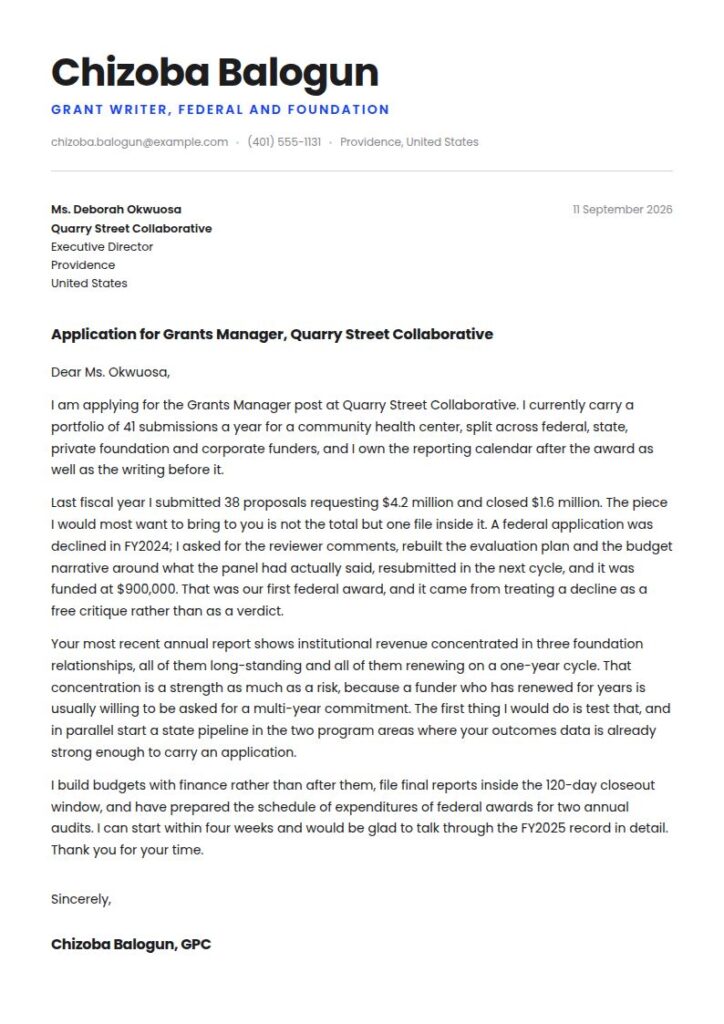
A grant writer cover letter is a one page letter that gives your submission and award numbers with their denominators, names the funder types behind them, and says one accurate thing about the reader's own funding.
It is also an audition for the proposal itself. A development director reading this letter is asking a quiet question: would I trust this person to write to a funder's rubric and stay inside a word limit? A letter that wanders answers it badly before the numbers get a chance.
Guide to a grant writer cover letter
This guide and the corresponding grant writer cover letter example will cover:
- How to structure the letter, paragraph by paragraph
- Why the denominators belong in the first number you give
- How to write about a decline so that it strengthens the application
- What to say when your record is confidential or belongs to a former employer
- The openings that get a strong application set aside
How to write a grant writer cover letter
| Paragraph | Its job | Length |
|---|---|---|
| Opening | The post, the volume you carry, the funder types | 2 to 3 sentences |
| Evidence | Submissions, awards, dollars, and one resubmission story | 4 to 5 sentences |
| Fit | One accurate reading of their funding mix, and what you would do first | 3 to 4 sentences |
| Close | What you own after the award, availability, thank you | 2 sentences |
Read their public filings before you write a word
Nonprofit funding is unusually public. Annual reports name funders. Audited financial statements show the split between contributed and earned revenue. An organization that expends federal money above the single audit threshold files a schedule of expenditures of federal awards, and that schedule tells you exactly which federal programs it is already inside.
Half an hour with those documents lets you write the sentence no other applicant will write: an accurate observation about where the institutional revenue is concentrated, and what that concentration risks.
Keep it neutral. "Your last annual report shows institutional revenue concentrated in three foundation relationships" is a fact. "Your funding is dangerously undiversified" is a lecture from someone who does not know why.
Then say what you would do first, in one sentence, and stop. The strategy conversation belongs in the interview; the letter only has to prove you would arrive with one.
A grant writer cover letter example you can adapt
Dear Ms. Okwuosa,
I am applying for the Grants Manager post at Quarry Street Collaborative. I currently carry a portfolio of 41 submissions a year for a community health center, split across federal, state, private foundation and corporate funders, and I own the reporting calendar after the award as well as the writing before it.
Last fiscal year I submitted 38 proposals requesting $4.2 million and closed $1.6 million. The piece I would most want to bring to you is not the total but one file inside it. A federal application was declined in FY2024; I asked for the reviewer comments, rebuilt the evaluation plan and the budget narrative around what the panel had actually said, resubmitted in the next cycle, and it was funded at $900,000. That was our first federal award, and it came from treating a decline as a free critique rather than as a verdict.
Your most recent annual report shows institutional revenue concentrated in three foundation relationships, all of them long-standing and all of them renewing on a one-year cycle. That concentration is a strength as much as a risk, because a funder who has renewed for years is usually willing to be asked for a multi-year commitment. The first thing I would do is test that, and in parallel start a state pipeline in the two program areas where your outcomes data is already strong enough to carry an application.
I build budgets with finance rather than after them, file final reports inside the 120-day closeout window, and have prepared the schedule of expenditures of federal awards for two annual audits. I can start within four weeks and would be glad to talk through the FY2025 record in detail. Thank you for your time.
Sincerely, Chizoba Balogun, GPC
Openings that work
| Instead of | Use |
|---|---|
| I am writing to apply for the Grants Manager position at your organization | I am applying for the Grants Manager post at Quarry Street Collaborative |
| I am passionate about mission-driven work and the nonprofit sector | I carry 41 submissions a year across federal, state, foundation and corporate funders |
| I have a 90% success rate on grant applications | Last fiscal year I submitted 38 proposals requesting $4.2 million and closed $1.6 million |
| I have raised significant funding for my current employer | Of that, $900,000 was a first federal award won on resubmission and $410,000 was foundation renewal |
| I believe my skills would be an asset to your team | Your annual report shows institutional revenue concentrated in three foundation relationships renewing annually |
How to write about a decline
Most letters hide losses. That is a mistake in a field where the majority of competitive applications are declined by design, and where the ability to use a rejection is the most transferable skill a grant writer has.
| The situation | What the letter says |
|---|---|
| Declined and resubmitted successfully | Names the award, the cycle, and what changed between the two versions |
| Declined with useful reviewer comments | Says what the panel flagged and what the organization changed as a result |
| Declined because the fit was wrong | Says how the go and no-go screen changed afterward, with the numbers |
| Still pending at year end | Counts it as pending, names the cycle length, does not fold it into either column |
| Withdrew before submission | Says why, which is often the most professional decision in the file |
The last row matters more than it looks. A writer who declined 99 opportunities out of 140 screened, with recorded reasons, is protecting program staff time and the organization's relationships. That is a grants professional. A writer who submits everything is generating work for other people.
What to say when your record is confidential
Give ranges and counts where exact figures belong to a former employer's confidential file. Name the funder types and cycles even when you cannot name the funders. Describe your own contribution precisely when you were one writer on a larger application. Say which systems and portals you have submitted through. Offer a writing sample that is yours to share, such as a redacted needs statement or a public program report.
Do not claim an award you contributed a section to. Do not name a funder in a way that implies a personal relationship with a program officer that you do not have. Do not attach a full proposal from a former employer, which is often their property and always a bad signal. Do not quote a career-long total as if it were one year's work.
Fundraisers are growing, the writing occupation is not
Fundraisers, the occupation most grant writers are employed within, are projected to grow 6 percent between 2025 and 2035, faster than the average for all occupations, adding about 7,800 jobs with roughly 10,000 openings a year, against a median annual wage of $72,550 in May 2025 (BLS Occupational Outlook Handbook, published 27 August 2026).
Writers and authors, where the writing itself is classified, is projected at 0 percent over the same decade, with a median of $76,910 (BLS, May 2025).
The gap between those two lines is the argument your letter should make without stating it. The demand is not for people who write well; it is for people who can bring institutional money in and keep it compliant afterward. Lead with the record and the compliance work, and let the writing prove itself by being good.
Length, format and sending it
One page, four paragraphs, 250 to 400 words. PDF unless the posting says otherwise, named for yourself and the post: chizoba-balogun-grants-manager-cover-letter.pdf.
Address a person. In a small development office the executive director is often the hiring manager, and in a larger one it is the chief development officer or director of institutional giving. Both are usually named on the organization's own site.
Keep to the word count if the posting gives one. Ignoring a stated limit in an application for a job that is entirely about respecting stated limits is a decision the reader will notice.
Use the same figures as your resume so the two documents agree. Our grant writer resume example is written with the numbers used here.
Key takeaways
- Open with the volume you carry and the funder types, not with enthusiasm.
- Give submissions, awards, dollars requested and dollars closed for a named period.
- Never quote a win rate without its denominator.
- Tell one resubmission story; a decline turned into an award is the strongest evidence you have.
- Read their annual report and say one accurate thing about their funding mix.
- Name what you own after the award: budget, reporting, closeout, audit preparation.
- One page, inside any stated word limit, addressed to a named person.
Write your grant writer cover letter in 10 minutes with our AI cover letter builder.
Grant writer cover letter questions, answered
How long should a grant writer cover letter be?
One page, four paragraphs, 250 to 400 words, and shorter if the posting sets a limit. This is the one field where going over a stated limit is read as a direct indicator of how you would treat a funder's guidelines.
Should I include my win rate in the letter?
Only with the numbers underneath it. "38 submitted, 14 awarded, $4.2 million requested, $1.6 million closed" is a record. "90% success rate" is a claim that invites a question about the denominator, and most development directors ask it immediately.
What if all my grant work was done as one of several writers?
Say exactly what you wrote. Needs statement, evaluation plan, budget narrative, logic model, attachments: these are separable pieces of work and naming yours is credible. A hiring manager who has run a large federal application knows perfectly well that one person rarely writes all of it.
How do I apply for a grant writing job with no grants record?
Write the letter around writing to somebody else's published criteria. Fellowship and scholarship applications, procurement bids, regulatory submissions, academic funding applications and board reports all qualify. Then name the program areas you know, because the needs statement is the part that most often fails, and subject knowledge is what fixes it.
Should I mention compliance in a cover letter?
Yes, in one sentence at the close. Final reports are due no later than 120 calendar days after the end of the period of performance, and a non-federal entity expending $1,000,000 or more in federal awards in a fiscal year must have a single audit (2 CFR 200.344 and 200.501, eCFR, retrieved 17 September 2026). A writer who knows what happens after the check clears is a lower risk hire, and very few applicants say so.