Emmett Bergstrom Senior Event Coordinator Minneapolis, 55408, United States [email protected] · (612) 555-0386
11 September 2026
Mr. Rudiger Hallowell Marketing Abernathy Surgical Instruments Saint Paul, United States
Application for Event Coordinator, Abernathy Surgical Instruments
Dear Mr. Hallowell,
I am applying for the Event Coordinator post at Abernathy Surgical Instruments. I deliver 22 events a year for a medical device manufacturer in Minneapolis: 14 trade shows, six user training summits, and a national sales meeting that ran 612 attendees over three days on a $740,000 budget this year.
That meeting is the work I would want to tell you about. I built and ran a 340-line run of show across three concurrent rooms with 24 on-site staff and nine vendors, contracted 1,240 room nights against an 80 percent attrition clause and closed at 94 percent pickup, and finished reconciliation 21 days after load out against a 30-day standard. Eight minutes before doors on day one the general session audio failed. We switched to the four backup handhelds we keep at the tech table, opened six minutes late, moved the housekeeping announcements to the end of the block, and the session closed on schedule. Every critical system on my events now has a written failure plan naming the backup and who fetches it.
Your posting describes a trade show program growing from six shows to fourteen next year. That is the change I have just been through, and the part that hurt was freight rather than booths: two late arrivals took us to a single freight partner and a fixed target of five days before show open, and we have not had a late arrival since.
I negotiate and hold audiovisual, staging, transport and catering agreements up to $50,000, and I hold current crowd manager and first aid certification. I can start with three weeks' notice and I am happy to travel for the show calendar. Thank you for your time.
Sincerely, Emmett Bergstrom
Summary
An event coordinator cover letter names the calendar you deliver, the size and budget of the largest event on it, the contracts you hold, and one thing that failed on site and what you did next. This guide gives you a full adaptable letter, the numbers that make an event claim comparable, and how to write a recovery without dramatizing it or naming anyone.
Event Coordinator cover letter examples by experience level
An event coordinator cover letter is a one-page letter telling a hiring manager how many events you deliver a year, how big the largest one is, what you are trusted to sign, and what you did the last time something failed while the doors were open.
The person reading it is holding a calendar of dates that will not move. They are not looking for enthusiasm, which every letter in the folder has. They are looking for someone who has already stood in a ballroom at eight in the morning with a broken system and forty minutes, and who can describe what happened next in plain words.
Guide to an event coordinator cover letter
This guide and the event coordinator cover letter example below will cover:
- How to structure the letter, paragraph by paragraph
- The four numbers that make an event claim comparable
- How to write a recovery in one sentence without dramatizing it
- Contracts, signing authority and why naming the limit helps you
- What changes when you are moving between venue, agency and in-house work
How to write an event coordinator cover letter
| Paragraph | Its job | Length |
|---|---|---|
| Opening | The post, how many events a year, and the largest one with its numbers | 2 to 3 sentences |
| Evidence | One event in detail: run of show, staffing, contracts, budget close | 4 to 5 sentences |
| Fit | Something specific about their calendar, and what you would take on | 3 to 4 sentences |
| Close | Certifications, signing authority, availability, thank you | 2 sentences |
Make the first sentence comparable to their calendar
The reader's first question is whether you have delivered something the size of what they have. Answer it before they ask.
Give the count and the ceiling together: how many events a year, and the largest one with attendees, days and budget. "I deliver 22 events a year for a medical device manufacturer, the largest a 612-attendee national sales meeting over three days on a $740,000 budget" does the whole job in one sentence.
If your events are smaller, say so precisely rather than reaching. A venue coordinator delivering 140 events a year has a stamina and a load-in fluency that a flagship-only candidate does not, and plenty of employers are hiring for exactly that.
An event coordinator cover letter example you can adapt
Dear Mr. Hallowell,
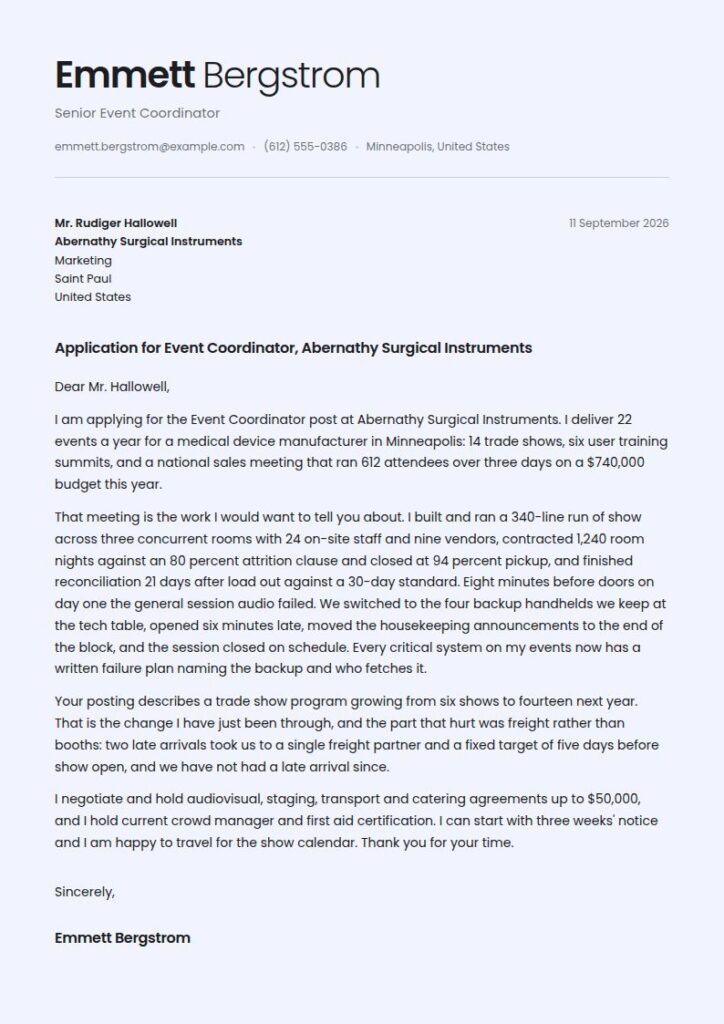
I am applying for the Event Coordinator post at Abernathy Surgical Instruments. I deliver 22 events a year for a medical device manufacturer in Minneapolis: 14 trade shows, six user training summits, and a national sales meeting that ran 612 attendees over three days on a $740,000 budget this year.
That meeting is the work I would want to tell you about. I built and ran a 340-line run of show across three concurrent rooms with 24 on-site staff and nine vendors, contracted 1,240 room nights against an 80 percent attrition clause and closed at 94 percent pickup, and finished reconciliation 21 days after load out against a 30-day standard. Eight minutes before doors on day one the general session audio failed. We switched to the four backup handhelds we keep at the tech table, opened six minutes late, moved the housekeeping announcements to the end of the block, and the session closed on schedule. Every critical system on my events now has a written failure plan naming the backup and who fetches it.
Your posting describes a trade show program growing from six shows to fourteen next year. That is the change I have just been through, and the part that hurt was freight rather than booths: two late arrivals took us to a single freight partner and a fixed target of five days before show open, and we have not had a late arrival since.
I negotiate and hold audiovisual, staging, transport and catering agreements up to $50,000, and I hold current crowd manager and first aid certification. I can start with three weeks' notice and I am happy to travel for the show calendar. Thank you for your time.
Sincerely, Emmett Bergstrom
Openings that work
| Instead of | Use |
|---|---|
| I live and breathe events and love creating memorable experiences | I deliver 22 events a year, the largest a 612-attendee national sales meeting over three days |
| I am writing to express my interest in the event coordinator position | I am applying for the Event Coordinator post, and I have just run a calendar the size of the one you describe |
| I thrive in fast-paced, deadline-driven environments | Eight minutes before doors the general session audio failed; we opened six minutes late and closed on schedule |
| I have excellent organizational and communication skills | I contracted 1,240 room nights against an 80 percent attrition clause and closed at 94 percent pickup |
The four numbers that make an event claim comparable
| Number | Why the reader needs it |
|---|---|
| Attendees | The single fastest way to compare your events with theirs |
| Days | A one-day event and a three-day event are different operations, not different sizes |
| Budget, with the close figure | Trust is measured in what you were accountable for closing, not what you tracked |
| Vendors or contracted room nights | The scale of the commitments behind the event, which is what goes wrong |
Add the format, because a trade show booth program, a hybrid user summit, an awards dinner and a multi-room conference are four different jobs. Then, if it is true, add the run of show size, since it is the clearest signal of how precisely you work.
Writing the recovery, and staying off the subject of people
Write one failure in four parts: what failed, how long before doors, what you did, what it cost in minutes or dollars. Attribute it to a system. Say what changed afterward, because the fix is the point. State your signing authority and where it stops. Name one real thing about their calendar. Say whether you can travel and how much.
Do not describe yourself as calm under pressure; a recovery sentence proves it and the phrase does not. Do not name or describe a vendor's staff, a speaker, a colleague or an attendee, and do not include a detail that identifies any of them. Do not write more than one disaster; a run of them reads as poor planning. Do not claim a budget you administered rather than closed. Do not send a letter that has no number in it.
The deadline is written into the federal job description
The Occupational Outlook Handbook says of meeting, convention and event planners: "Most meeting, convention, and event planners work full time, and many work more than 40 hours per week. They often work additional hours to finalize preparations as major events approach. During meetings or conventions, planners may work on weekends" (U.S. Bureau of Labor Statistics, Occupational Outlook Handbook, published 27 August 2026).
That is a description of a fixed date, and it is why interviews in this field spend so much time on what happened on site rather than on how you plan.
The occupation had a median annual wage of $61,160 in May 2025, with the lowest 10 percent under $36,830 and the highest 10 percent over $101,700, and employment is projected to grow 6 percent between 2025 and 2035, faster than the average for all occupations, with about 16,800 openings a year (BLS Occupational Outlook Handbook, May 2025 and 2025 to 2035 projections). No prior work experience is listed as typical for entry, which is why these postings are crowded and why numbers in a letter travel so far.
Length, format and sending it
One page, four paragraphs, 250 to 400 words. PDF unless the portal says otherwise, named for yourself and the post, for example emmett-bergstrom-event-coordinator-cover-letter.pdf.
Do not design the letter. The temptation to show your visual eye is strong in this field and it is the wrong instinct on an application document: link a portfolio in your header instead and keep the letter plain text in a single column.
Keep the figures identical to your resume. Our event coordinator resume example is built on the same numbers as this letter.
Key takeaways
- Open with the count and the ceiling: events a year, and the largest with attendees, days and budget.
- Give one event in detail rather than four in summary.
- Write one failure and the recovery in four parts, and say what changed afterward.
- Attribute failures to systems, never to people.
- State your signing authority and where it stops.
- Name one real thing about their calendar and what you would take on.
- Say whether you can travel, because the show calendar decides the job.
Write your event coordinator cover letter in 10 minutes with our AI cover letter builder.
Event coordinator cover letter questions, answered
How long should an event coordinator cover letter be?
One page, four paragraphs, 250 to 400 words. One event described properly is worth more than a summary of your whole calendar, which the resume already carries.
Should I write about an event that went wrong?
Yes, once, and as a recovery rather than a crisis. What failed, how long before doors, what you did, what it cost. It is the question you will be asked in the interview anyway, and answering it first reads as confidence. Keep it to one, keep it mechanical, and never suggest whose fault it was.
How do I write a letter with no professional event experience?
Write the events you have actually delivered, whatever the setting: a conference committee, campus programming, a fundraiser, a festival shift with a real role, a wedding you ran rather than attended. Give attendees, days, budget and the part you personally owned. No prior work experience is listed as typical for entry to this occupation (BLS Occupational Outlook Handbook, published 27 August 2026), so a specific small record beats a vague large claim.
Should I mention contracts and signing limits in a cover letter?
Yes, in the closing paragraph, because it tells a reader exactly what they could hand you on day one. "I negotiate and hold audiovisual, staging, transport and catering agreements up to $50,000" is more useful than any adjective, and naming the clauses you work with, such as attrition, cutoff dates and force majeure, signals that you have read a contract rather than forwarded one.
I am moving from a venue to an in-house corporate team. What changes in the letter?
Lead with what transfers, which is a great deal: load ins, room turns, banquet event orders, floor plans, vendor handling and day-of decision making are the same work everywhere, and venue volume is a genuine advantage. Then name the two things that are new, which are usually budget ownership and the annual calendar rather than a booking at a time, and say how you would learn them. A hiring manager moving someone across settings is really asking whether you know which parts you do not yet have.