Tarek Mansour Senior Payroll Specialist Louisville, 40204, United States [email protected] · (502) 555-0185
11 September 2026
Ms. Renata Bilecki Payroll Manager Wynhaven Health Partners Louisville, United States
Application for Senior Payroll Specialist, Wynhaven Health Partners
Dear Ms. Bilecki,
I am applying for the Senior Payroll Specialist post at Wynhaven Health Partners. I currently run payroll for 3,400 employees across six pay groups and nineteen states at Corbin Logistics Group, covering biweekly hourly, weekly drivers, semimonthly salaried, monthly executives and two union groups, and I have completed nine year-end cycles, six of them multi-state.
The figure I would put in front of you is the payslip error rate: 0.04% across the last eight quarters, measured as corrected payslips over payslips issued. It was 0.4% when I arrived at the specialist level. What moved it was not more checking at the end but a fourteen-point pre-transmission audit covering gross-to-net variance, retroactive pay, negative net, mid-period rate changes and final pay timing, plus a firm 48-hour cut-off on changes from human resources. Off-cycle runs fell from 31 a quarter to 7, because we were fixing causes instead of issuing corrections.
Your posting mentions moving from two payroll platforms onto one next year. I have run the same population through a timekeeping integration at two new terminals and the lesson I took is that the clock, not the payroll system, is where the exceptions come from, so I would want the import mapping and the supervisor approval deadlines agreed before anything else. I would also bring the quarterly reconciliation habit: returns reconciled to the general ledger every quarter rather than in January, which is why I have closed three consecutive years with no amended W-2 forms.
I hold the Certified Payroll Professional credential from PayrollOrg and the Fundamental Payroll Certification before it. I can give four weeks' notice, and I would rather not start mid-quarter if you have the flexibility. Thank you for your time.
Sincerely, Tarek Mansour, CPP
Summary
A payroll specialist cover letter names the headcount you pay, the pay groups and states you run, and one accuracy figure you can define. This guide gives you a full adaptable letter, the openings that work, what to say when your employer never measured an error rate, and the privacy rule that keeps a colleague's pay out of your job application.
Payroll Specialist cover letter examples by experience level
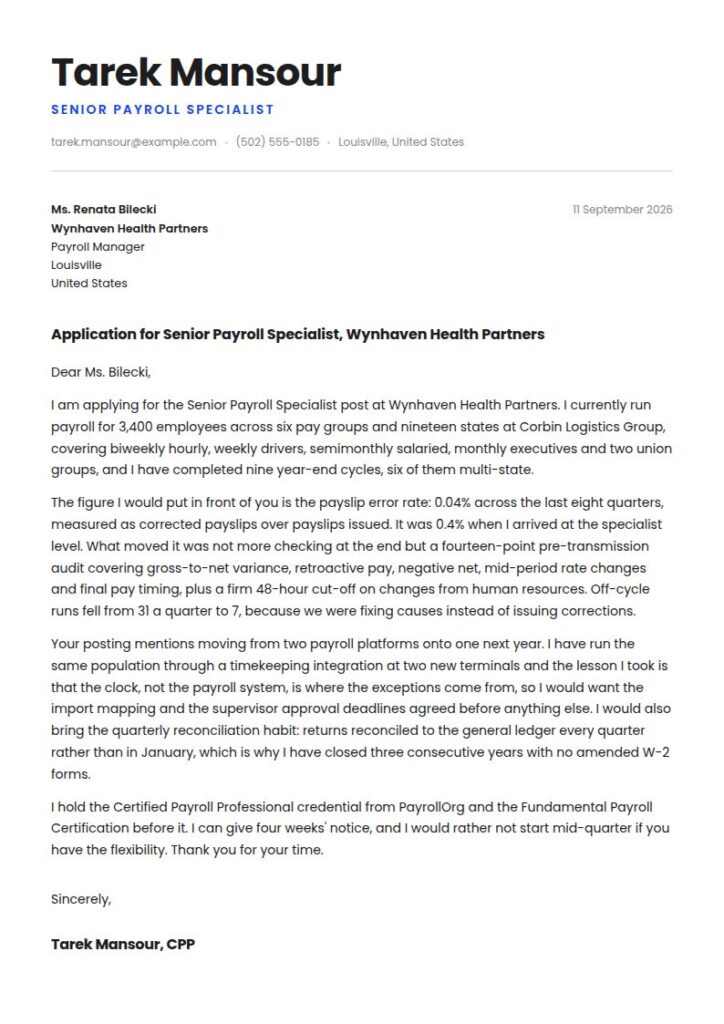
A payroll specialist cover letter is a one-page letter that tells a payroll manager how many people you pay, how often, in how many states, and how often that goes out without a correction behind it.
Payroll managers hire under pressure, usually because somebody left mid-quarter and a deadline is approaching that cannot move. A letter that answers the size and accuracy questions in the first three sentences is doing exactly what the reader needs.
Guide to a payroll specialist cover letter
This guide and the corresponding payroll specialist cover letter example will cover:
- How to structure the letter, paragraph by paragraph
- Why headcount, pay groups and states belong in the opening
- How to state an accuracy figure a payroll manager can test
- The privacy rule that governs everything you write about this job
- What to say when your employer never measured an error rate
How to write a payroll specialist cover letter
| Paragraph | Its job | Length |
|---|---|---|
| Opening | The role, your headcount, pay groups, frequencies and states | 2 to 3 sentences |
| Evidence | One accuracy or cycle figure, defined, with the mechanism | 4 to 5 sentences |
| Fit | Something specific about their situation and what you would do first | 3 to 4 sentences |
| Close | Certification, year ends completed, availability, thank you | 2 sentences |
Count your year ends, not just your years
Anyone can learn a pay run in a quarter. Year end is learned once a year, and it is where the expensive mistakes live: quarterly returns that do not reconcile, a W-2 file that does not balance to the fourth quarter return, amended forms in February.
So write "seven year-end cycles, three of them multi-state" rather than "seven years in payroll". It is a more precise claim and it is the one a payroll manager is actually trying to assess.
If you have been through a system conversion, say so in the same breath. Conversion experience is rare, it is directly transferable, and any employer changing platforms in the next two years will read that sentence twice.
A payroll specialist cover letter example you can adapt
Dear Ms. Bilecki,
I am applying for the Senior Payroll Specialist post at Wynhaven Health Partners. I currently run payroll for 3,400 employees across six pay groups and nineteen states at Corbin Logistics Group, covering biweekly hourly, weekly drivers, semimonthly salaried, monthly executives and two union groups, and I have completed nine year-end cycles, six of them multi-state.
The figure I would put in front of you is the payslip error rate: 0.04% across the last eight quarters, measured as corrected payslips over payslips issued. It was 0.4% when I arrived at the specialist level. What moved it was not more checking at the end but a fourteen-point pre-transmission audit covering gross-to-net variance, retroactive pay, negative net, mid-period rate changes and final pay timing, plus a firm 48-hour cut-off on changes from human resources. Off-cycle runs fell from 31 a quarter to 7, because we were fixing causes instead of issuing corrections.
Your posting mentions moving from two payroll platforms onto one next year. I have run the same population through a timekeeping integration at two new terminals and the lesson I took is that the clock, not the payroll system, is where the exceptions come from, so I would want the import mapping and the supervisor approval deadlines agreed before anything else. I would also bring the quarterly reconciliation habit: returns reconciled to the general ledger every quarter rather than in January, which is why I have closed three consecutive years with no amended W-2 forms.
I hold the Certified Payroll Professional credential from PayrollOrg and the Fundamental Payroll Certification before it. I can give four weeks' notice, and I would rather not start mid-quarter if you have the flexibility. Thank you for your time.
Sincerely, Tarek Mansour, CPP
Openings that work
| Instead of | Use |
|---|---|
| I am writing to express my interest in the payroll specialist position | I run 3,400 employees across six pay groups and nineteen states, and I have closed nine year ends |
| I am highly accurate and detail-oriented | Payslip error rate of 0.04% across eight quarters, corrected payslips over payslips issued |
| I have extensive experience with payroll software | I run UKG Pro against Kronos clocks and have mapped the import for two new terminals |
| I work well under pressure and meet deadlines | Off-cycle runs fell from 31 a quarter to 7 once we fixed the input causes |
The one rule this letter has that others do not
Payroll is the only finance function whose source data is about identifiable colleagues, and that changes what you are allowed to write.
Describe volume, process and outcome: how many people, how many orders, what rules you apply, what your error rate is. Give garnishment work as a count and a procedure. Say what you own at year end. Name the payroll platform and the timekeeping system separately. Name one real thing from their posting.
Never write a colleague's pay, deduction, garnishment, tax situation, leave, medical circumstance or family circumstance into a resume, a cover letter or an interview answer. Not anonymised, not as an illustrative example, not as the story of a difficult case you handled well. Do not repeat anything you learned from a garnishment order or a benefits deduction. Do not name your employer's payroll vendor contract terms. Do not describe an underpayment in a way that would identify who it happened to.
That is not only an ethics point. A payroll manager reading a letter that contains an identifiable employee detail has just learned what you will do with their employees' data, and the interview ends there.
What counts as evidence in payroll
| Kind of evidence | What it looks like in a sentence |
|---|---|
| Scale | 3,400 employees, six pay groups, nineteen states, two union populations |
| Accuracy | 0.04% payslip error rate across eight quarters, defined as corrected payslips over payslips issued |
| Off-cycles | From 31 a quarter to 7 by fixing input causes rather than issuing corrections |
| Timekeeping | Import exceptions from 210 a run to 38 with a supervisor approval deadline |
| Year end | 3,400 W-2 forms, quarterly returns reconciled to the ledger, three years with no amended forms |
| Compliance volume | About 140 active garnishment orders administered to the limits on each notice |
| Cycles completed | Nine year ends, six of them multi-state, one platform conversion |
The deadlines that make payroll different from every other clerical job
Payroll and timekeeping clerks numbered 159,600 in 2025 with a median annual wage of $58,260 in May 2025, inside a financial clerks group of 1,144,900 that is projected to decline 4 percent by 2035 while producing about 88,000 openings a year (BLS Occupational Outlook Handbook, published 27 August 2026). That median sits near the top of the clerk group, and the reason is the calendar attached to the work.
For the 2026 tax year the IRS instructs employers to file Copy A of Forms W-2 with Form W-3 with the Social Security Administration by 1 February 2027, and to furnish Copies B, C and 2 to employees by the same date, with electronic filing required once an employer has at least 10 information returns in total (IRS, 2026 General Instructions for Forms W-2 and W-3).
Deposits run on their own clock: a Form 941 filer reporting $50,000 or less in the lookback period is a monthly depositor, more than $50,000 makes them semiweekly, and accumulating $100,000 or more of taxes on any day requires a deposit by the next business day (IRS Topic no. 757, last reviewed 5 September 2026).
None of those dates negotiate. That is why an employer pays for someone who has met them repeatedly, and why "nine year ends" is a stronger sentence than "nine years".
What to write when nobody measured an error rate
Most payroll teams do not track one, and saying so is not a weakness.
Use what is countable after the fact instead. Off-cycle runs per quarter. Manual checks issued. Amended W-2 forms in a year, ideally zero. Timekeeping exceptions at import. Days from period end to transmission. Agency notices received and closed.
Then say what you would measure: "we did not track an error rate, so I used off-cycle count, which fell from 31 a quarter to 7 over 2025." That answers the question and shows you know which number should exist.
Length, format and sending it
One page, four paragraphs, 250 to 400 words. PDF unless the portal insists otherwise, named for yourself and the role: tarek-mansour-senior-payroll-specialist-cover-letter.pdf.
Address a person, and if you can, mention your availability relative to their cycle. Offering to start at the beginning of a quarter rather than the middle of one is a small thing that tells an experienced payroll manager you understand what onboarding costs them.
Keep every figure identical between letter and resume. The payroll specialist resume example uses the same numbers as this letter for exactly that reason.
Key takeaways
- Open with headcount, pay groups, frequencies and state count.
- Count year ends rather than years, and name any conversion you survived.
- Define your accuracy figure as a ratio, over a stated number of quarters.
- Show off-cycles falling, which proves you fix causes.
- Keep every colleague's pay and personal circumstance off the page entirely.
- Name the payroll platform and the timekeeping system separately.
- Mention your notice period and, if you can, your availability by quarter.
Write your payroll specialist cover letter in 10 minutes with our AI cover letter builder.
Payroll specialist cover letter questions, answered
How long should a payroll specialist cover letter be?
One page, four paragraphs, 250 to 400 words. A payroll manager is reading between a transmission and a deposit deadline, and length does not help you.
What should I put in the first sentence?
Headcount, pay group count and state count, plus the role you are applying for. Those three numbers place you against the job instantly, and almost nobody supplies them.
Can I describe a payroll error I fixed?
Yes, if it is a systemic error described by rate. "The payslip error rate was 0.4% when I took the cycle and it is 0.06% now, and here is what changed" is a strong paragraph. An individual person's underpayment is not, no matter how well you handled it, because it is their information.
What if I only have single-state, single-frequency experience?
Say it plainly and then say what transfers: cycle discipline, timekeeping exception work, final pay timing, garnishment administration and year end. Then name what you have studied toward the gap. Multi-state knowledge is learnable and hiring managers know it; concealing a narrow footprint is what costs you the interview.
Should I mention the Certified Payroll Professional if I have not passed it yet?
Mention the sitting date. PayrollOrg sets the Fundamental Payroll Certification at 150 questions over three hours for entry-level professionals and the Certified Payroll Professional at 190 questions over four hours with experience-based eligibility routes (PayrollOrg, accessed September 2026). A booked exam with a date is credible; "working toward certification" with no date is not.