Background Check on Job Application Forms: What to Say
The background check on job application forms, explained: what the box means, what shows up, what saying no does, your FCRA rights and word-for-word scripts.

On this pageWhat does the background check on job application forms mean?
- What does the background check on job application forms mean?
- What rights does the FCRA give you?
- What shows up on a background check for a job?
- What happens if you say no to a background check?
- How do ban-the-box laws change the criminal history question?
- How do you prepare before the check runs?
- What should you say to a recruiter about your background?
- FAQ
- Sources
When a job application asks if you consent to a background check, check yes if you want the job, because a no usually ends the process. Under the Fair Credit Reporting Act, the employer must give you a stand-alone written notice, get your written permission, and send you a copy of the report before it rejects you over it. Pull your own records first and match every date on your resume.
The background check on job application forms is a consent question. Check yes if you want the job, because most employers will not move forward without it. If something old will show up, still say yes, then tell the recruiter early in one calm sentence.
Below you'll find what the box means, what a typical check covers, your rights under federal law, and word-for-word scripts. Our example is Alex, who is applying for a certified nursing assistant job at a care home.
Quick answers by situation
| Your situation | What to say/do | Example line |
|---|---|---|
| Your record is clean | Check yes and move on | "Yes, I consent to a background check." |
| An old conviction will show up | Check yes, then tell the recruiter first | "One thing will show up from 2017, and I'd like to explain it." |
| Your dates are fuzzy | Check yes, then fix your resume dates | "I've matched my dates to my W-2s so the check lines up." |
| The form asks about criminal history early | Check your state's fair-chance law | "I'm happy to discuss my background after an offer." |
| The report has an error | Dispute it with the screening company | "Page 2 lists a case that isn't mine. Here is my proof." |
| You don't want any check | Know that a no usually ends it | "Can you tell me what the check covers before I decide?" |
What does the background check on job application forms mean?
The box asks for your permission to let the employer, or a screening company it hires, look into your past. A typical check confirms your identity, searches criminal records and verifies your work and school history. Saying yes does not mean you pass. It only lets the process start.
Most forms phrase it as "Do you consent to a background check?" or "Are you willing to submit to a background check?" Both mean the same thing: can the employer verify what you wrote?
So a yes is a green light, not a promise that your record is spotless. The real review happens later, often after an interview or a conditional offer.
Where the question sits on the form
The background check on job application forms often sits near the end, close to the questions on your employment history on a job application and your references. Some employers also ask about drug screening on the same page, which our guide to the drug test question on a job application covers.
When the check really happens
Timing varies by employer. A 2026 survey of 1,500 US managers by the screening firm iprospectcheck found that 34.8% screen after the interview but before an offer6, and 16.5% wait until after a conditional offer. So if you check yes today, the check may not run for weeks.
What rights does the FCRA give you?
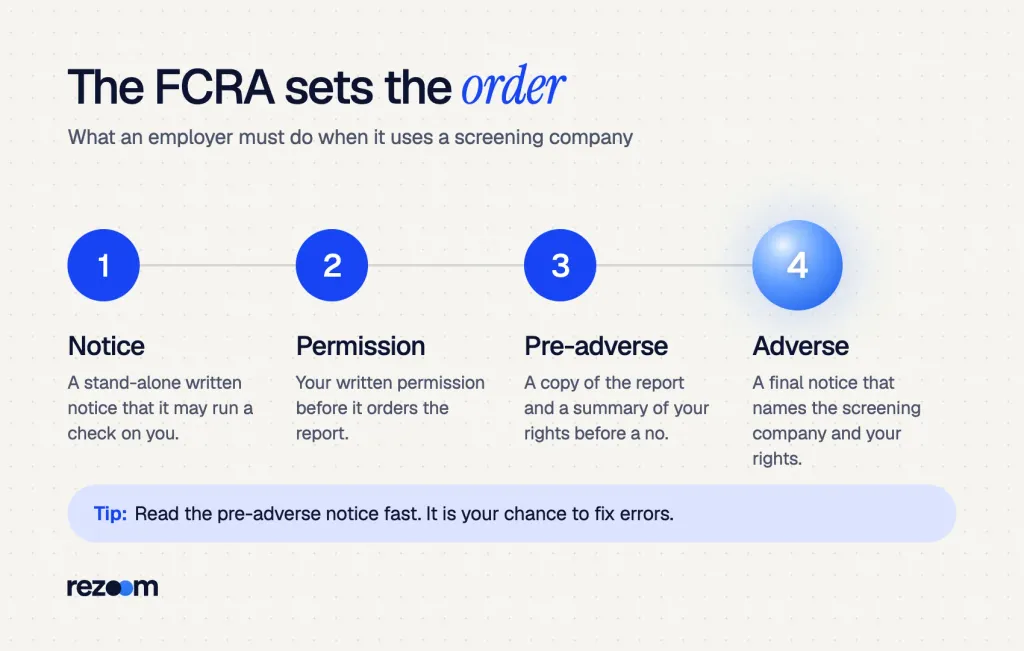
When an employer uses an outside screening company, the Fair Credit Reporting Act applies. The employer must tell you in a stand-alone written notice, get your written permission, and send you a copy of the report plus a summary of your rights before it rejects you. You also have the right to dispute errors.
The Federal Trade Commission tells employers that the notice "must be in writing and in a stand-alone format"1. That means it can't hide in the fine print of the application itself. The employer must also get your written permission before it orders the report.
The two notices before a rejection
If the employer plans to turn you down because of the report, it must first send a pre-adverse action notice. That notice includes a copy of the report and "A Summary of Your Rights Under the Fair Credit Reporting Act." Then you have a chance to spot errors and explain.
After a final decision, the employer must send an adverse action notice. Per the FTC, it names the screening company, says that company didn't make the decision, and tells you that you can dispute the report. It also says you can get a free copy from the company within 60 days.
How far back a report can go
The Consumer Financial Protection Bureau's summary of rights says screening companies generally may not report negative information that is more than seven years old4, or bankruptcies over 10 years old. But criminal convictions are an exception. The American Society of Employers explains that the seven-year limit covers items other than convictions, such as arrest records5.
Some states set tighter limits than federal law. So check your state's labor or consumer agency page before you assume an old record will or won't show up. This article is general information, not legal advice.
What shows up on a background check for a job?
Most checks confirm your identity and Social Security number trace, search county and national criminal records, and verify past jobs and degrees. Driving jobs add a motor vehicle record. Some finance roles add a credit check. Healthcare employers also search federal exclusion lists, like the HHS-OIG list.
The FTC's page for job seekers says a check can include employment history, education, criminal records, credit history and public social media2. Which parts you get depends on the job.
| Check | What it looks at | Who usually runs it |
|---|---|---|
| Identity and SSN trace | Your name, past addresses and Social Security number | Almost every employer |
| Criminal records | County, state and national court records | Most employers |
| Employment verification | Your job titles and dates | Many employers |
| Education verification | Degrees, schools and dates | Jobs that require a degree |
| Driving record | Licenses, tickets and crashes | Driving and delivery jobs |
| Credit report | Debts and payment history | Some finance and cash-handling roles |
| Exclusion lists | Federal healthcare sanctions | Hospitals, clinics and care homes |
How common screening is
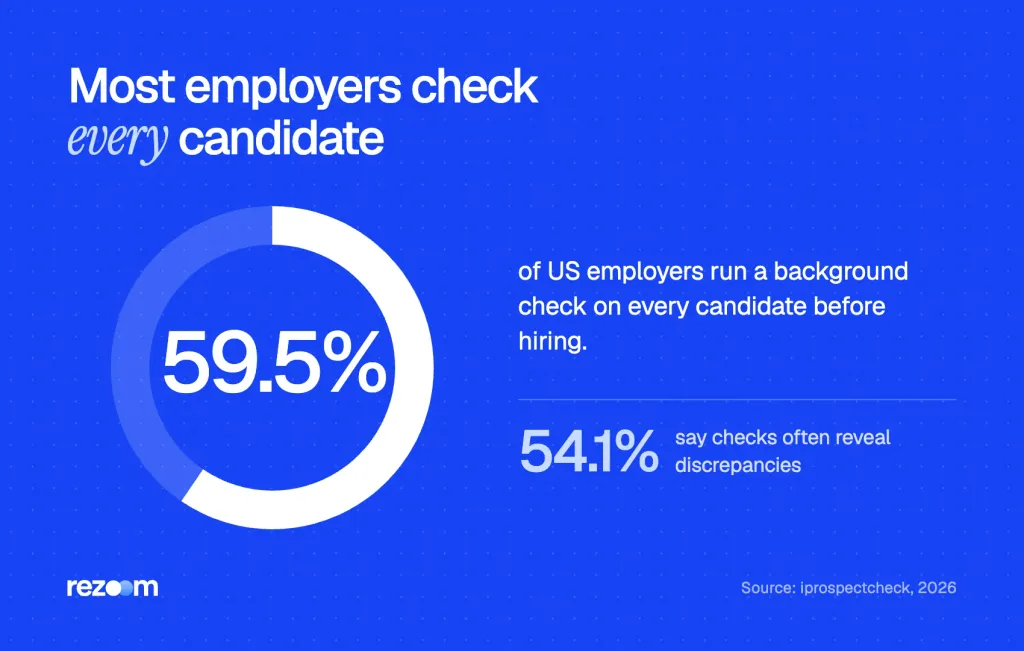
In the same iprospectcheck survey, 59.5% of employers run a check on every candidate6 before hiring. Also, 39.0% verify past employment for every hire, and 35.2% verify education every time.
Mismatches are common too. The survey found that 54.1% of employers say checks reveal discrepancies "very often" or "somewhat often." Keep in mind that a screening company ran this survey, so it has an interest in the topic.
Extra checks for healthcare jobs
Healthcare employers check the HHS Office of Inspector General's List of Excluded Individuals/Entities. The OIG warns that anyone who hires an excluded person may be subject to civil monetary penalties7, so health care entities check it for new hires. So expect it on any hospital, clinic or nursing home application.
If you work in care, these healthcare resume examples show how to list licenses and certifications so a verifier can match them fast. Alex used this CNA resume example to list the state registry number and dates in one clean line.
CNA resume example
See how to list your certification, registry number and clinical dates so they match a background check.
Write your name and license number exactly as they appear on the state registry. If you changed your name, add the old one in parentheses. Then the verifier can match you in seconds.
What happens if you say no to a background check?
You can say no, but the employer can then drop your application. Federal law lets an employer require consent before it hires you. If the check worries you, ask what it covers first. A no rarely helps, because it signals you have something to hide even when you don't.
The FTC puts the trade-off in one line.
You have the right to say no, but if you do, you may not get the job.
Federal Trade Commission, Employer Background Checks and Your Rights (2025)
The EEOC and FTC joint guide also notes that it is not illegal to ask about your background or to require a check3. But the employer must treat you the same as other applicants, whatever your race, sex, religion, disability or age.
When a no makes sense
A no can make sense if the form asks for more than the job needs. For example, a credit check for a part-time retail job may feel like too much. So ask first, then decide. Another common yes or no box covers essential job functions with or without accommodation.
"Before I sign the consent form, could you tell me what the check covers?" "I want to make sure I give you the right dates and names."
Free ATS score, the text the software extracts and your missing keywords. No sign-up.
How do ban-the-box laws change the criminal history question?
Ban-the-box and fair-chance laws remove the "Have you been convicted?" box from early application stages. Many states and cities let employers ask only after an interview or a conditional offer. The rules differ by place and by employer type, so check your state and city before you answer.
The National Employment Law Project's guide counts 37 states with ban-the-box laws or policies8 and over 150 cities and counties. Of those states, 15 extend the rule to private employers. These counts come from NELP's 2021 guide, so newer laws may not be in them.
So if your state has a fair-chance law, the early form may skip criminal history. The background check still runs later, often after a conditional offer.
How to handle the felony box if it appears
If a conviction box does appear, answer honestly. A false "no" is easy to catch once the check runs. Our guide to the felony question on a job application has full scripts for that box.
Asked about a felony on job application forms? Learn what the question covers, when sealed records count, fair-chance laws and what to write and say.
"Before the check runs, I want to tell you about one thing that will show up."
"In [year], I [what happened, in one plain sentence]."
"Since then, I have [one concrete step: finished a program, held a job for X years, earned a license]."
How do you prepare before the check runs?
Pull your own records before the employer does. Get your free credit report, check your county court records and gather W-2s or offer letters for job dates. Then make sure the dates on your resume and application match. Most failed checks start with a small mismatch, not a crime.
Alex had left one job in March but listed June. So Alex fixed it before applying.
- Pull your recordsGet your free credit report and search court records in the counties where you lived.
- Gather proof of datesFind W-2s, pay stubs or offer letters for each past job.
- Match every dateMake your resume, application and LinkedIn show the same months and years.
- Warn your referencesTell past managers and references that a verifier may call.
- Plan your one-line answerIf something old will show up, write the sentence you'll use with the recruiter.
Match your resume to your application
Dates are the most common mismatch. Run your resume through the ATS resume checker to confirm every job has clear start and end months. Then copy those exact dates into the form.
Verifiers also call past employers. Our guide on what a former employer can say about you explains what most HR teams will share.
What can a former employer say about you? Anything true in most states. See what HR confirms, when a bad reference is illegal, and how to check your record.
Your references may get a call as well. These tips on references on a job application help you pick people who confirm your story.
Before you consent to a background check
What should you say to a recruiter about your background?
Keep it short and factual. Say what will show up, when it happened and what you've done since. Don't over-explain or argue. If the report has an error, say so right away, then dispute it with the screening company and send proof.
The EEOC's advice to job seekers is direct: if something negative is in your background, be ready to explain it. Two or three calm sentences work better than a long story.
Sample script: asking about the timeline
"Thanks for the offer. Could you tell me which company runs your background checks?" "And about how long does the check usually take?"
Sample script: disputing an error
If the pre-adverse notice shows a record that isn't yours, act fast. The CFPB summary says the screening company must investigate your dispute unless it is frivolous.
"I got the pre-adverse action notice. The case on page 2 belongs to someone else with my name." "I've sent a dispute to the screening company with my ID and court records. Could you hold the decision until they reply?"
What to say if they push back
- "We can't hire anyone with a record." Ask for detail: "Is that a company rule or a law for this role? Could you look at when it happened and what I've done since?"
- "Why didn't you mention this sooner?" Stay calm: "The form didn't ask about it at that stage. I'm telling you now, before the check runs."
- "The dates on your report don't match." Bring proof: "I can send my W-2 for that year so you can see the right months."
Recruiter: "Your check shows a conviction from 2017. Can you explain?"
"Yes. I made a bad choice at 22, and I completed every condition of my sentence."
Recruiter: "Our policy is careful about patient safety."
"I understand. I've worked three years as a caregiver with no incidents, and my supervisor can confirm it."
Do
- Check yes on the consent box if you want the job.
- Tell the recruiter first if something old will show up.
- Read every page of a pre-adverse action notice.
- Dispute errors with the screening company and send proof.
Don’t
- Answer "no" to a conviction question when the record exists.
- Guess at job dates on the form.
- Pay anyone to fix errors in your report.
- Argue with the recruiter about the old case.
If you are turned down, you can get a free copy of your report from the screening company within 60 days. Read it even if you think it's right. Then you'll know what the next employer will see.
Match your cover letter
If you apply for a care job with a record, the cover letter can show who you are now. These medical cover letter examples show how to lead with patient care and reliability.
Free ATS score and your missing keywords. No sign-up.
Frequently asked questions
Do I have to consent to a background check on a job application?
No, but the employer can stop your application if you don't. Federal law lets employers require consent before hiring. If you want the job, check yes.
What happens if I say no to a background check?
The employer will most likely drop your application. You can ask what the check covers first, then decide.
What shows up on a background check for a job?
Most checks confirm your identity, search criminal records and verify past jobs and schools. Some add a driving record, a credit report or healthcare exclusion lists.
How far back does an employment background check go?
Most negative items drop off after seven years under the FCRA, and bankruptcies after 10. But the seven-year limit doesn't cover convictions, and some states set their own rules.
Can an employer reject me without telling me why?
Not if the decision is based on a screening company's report. The employer must send you a pre-adverse action notice with a copy of the report, then a final adverse action notice.
What should I do if my background check has a mistake?
Contact the screening company, explain the error and send proof. Then tell the employer and ask it to wait for the corrected report.
Sources
We opened and read each page below. The small numbers in the text point here. Pages that carry no publication date show n.d.
- Federal Trade Commission2014
Employers must give a stand-alone written notice, get written permission, and send pre-adverse and adverse action notices with a copy of the report and a summary of FCRA rights.
- Federal Trade Commission2025
A background check can include employment history, education, criminal records, credit history and public social media, and applicants can say no but may not get the job.
- US Equal Employment Opportunity Commission and FTC2014
It is not illegal to ask about your background or to require a check, but employers must treat all applicants the same.
- Consumer Financial Protection Bureau2018
Screening companies generally may not report negative information over seven years old or bankruptcies over 10 years old, and must investigate disputes.
- American Society of Employers2019
The FCRA seven-year limit applies to adverse items other than convictions, such as arrest records.
- iprospectcheck2026
In a survey of 1,500 US managers, 59.5% screen every candidate and 54.1% say checks often reveal discrepancies.
- HHS Office of Inspector General2026
Anyone who hires a person on the OIG exclusion list may face civil monetary penalties, so health care entities check it for new hires.
- National Employment Law Project2021
37 states and over 150 cities and counties have ban-the-box policies, and 15 states extend them to private employers.
Mohammad has spent more than ten years designing consumer products and leads product at Rezoom, deciding what gets built and what gets left out. His guides cover the whole job search, from resume sections and cover letters to interview answers and career moves.
Goodi, M. (2026, November 20). Background Check on Job Application Forms: What to Say. Rezoom. https://rezoom.io/background-check-question-on-job-application/