Kwabena Amankwah Lead Power BI Developer Charlotte, 28202, United States [email protected] · (704) 555-1746
11 September 2026
Ms. Devorah Kagan Director of Data and Analytics Yadkin Basin Energy Charlotte, United States
Application for Senior Power BI Developer, Yadkin Basin Energy
Dear Ms. Kagan,
I am applying for the Senior Power BI Developer post at Yadkin Basin Energy. I currently lead a three-person BI team at a regional insurance carrier, where I own 14 certified semantic models on a shared capacity serving about 730 report users, and I hold the Microsoft Certified: Power BI Data Analyst Associate credential, PL-300, renewed in March 2026.
The piece of work closest to what your posting describes is our claims model. I inherited a flat extract that four people had each rebuilt their own version of, and no two of them agreed on loss ratio. I rebuilt it at claim-transaction grain against seven dimensions, moved it to import with incremental refresh on a 36-month window, and took the published model from 4.1 GB to 890 MB by pruning 38 unused columns and re-keying two text joins. The morning refresh went from 38 minutes to 11. Nine row-level security roles now cover 730 people, from a handler who sees only their own assignments to actuarial staff who see everything except employee identifiers. We retired 46 of the 71 reports that had grown around the old extract.
Your posting mentions consolidating reporting after last year's acquisition and a gateway estate split across two sites. That is the problem I have just finished: the hard part was not the modeling, it was agreeing measure definitions with the people who had built the reports being retired, which is why I would start with a measure inventory rather than a rebuild. I have run the certification process that came out of ours, and I would expect to spend the first month listening to the report owners before changing anything.
My certification is current and I am available with four weeks' notice. Thank you for reading.
Sincerely, Kwabena Amankwah
Summary
A Power BI developer cover letter describes one semantic model you own, what it replaced and who uses it now, rather than listing the visuals you can build. This guide gives you a full adaptable letter, the openings that work, what to write when the posting names a different stack, and the questions this letter is quietly answering for the person who reads it.
Power BI Developer cover letter examples by experience level
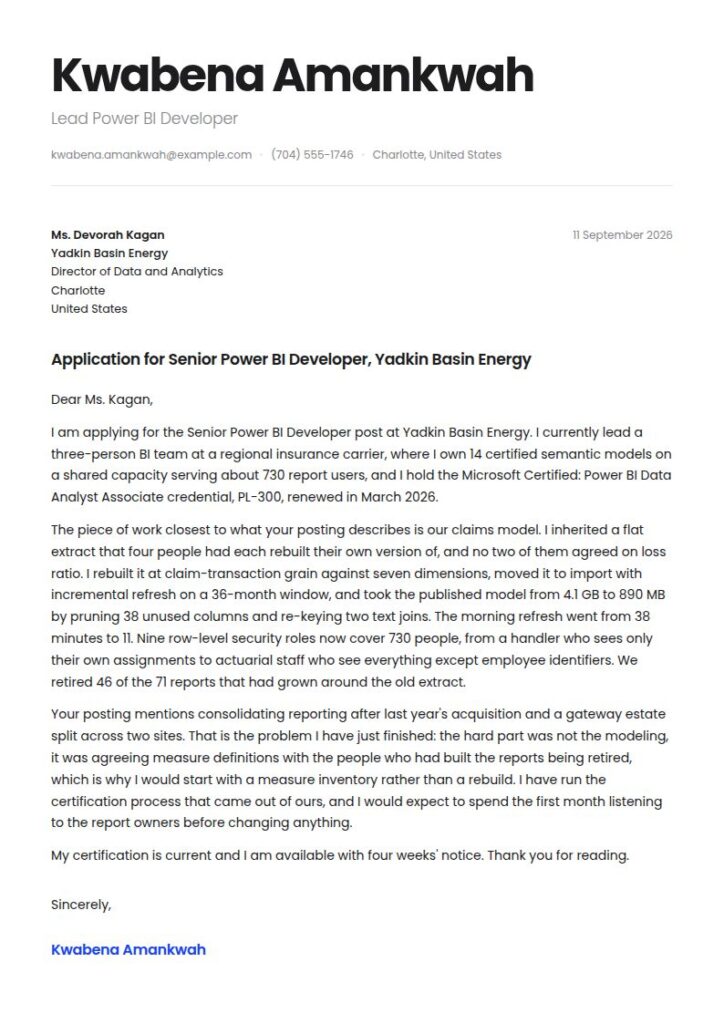
A Power BI developer cover letter is a one-page letter about one model: what it holds, how fast it refreshes, who is allowed to see which rows, and what reporting it replaced.
The letter exists because a resume cannot say why. It can say the refresh went from 51 minutes to 9. It cannot say the model was on DirectQuery because nobody trusted the overnight load, and that fixing the trust problem was the actual work.
Guide to a Power BI developer cover letter
This guide and the corresponding Power BI developer cover letter example will cover:
- How to structure the letter, paragraph by paragraph
- Why one model beats a list of dashboards
- What to write when the posting names a stack you have not used
- How to talk about a model you inherited without overclaiming
How to write a Power BI developer cover letter
| Paragraph | Its job | Length |
|---|---|---|
| Opening | The post, the estate you own, and the credential | 2 to 3 sentences |
| Evidence | One model: grain, storage mode, refresh, security, what it replaced | 4 to 6 sentences |
| Fit | Something specific about their environment, and what you would do first | 3 to 4 sentences |
| Close | Availability, certification currency, thank you | 2 sentences |
Pick one model and stay on it for the whole middle paragraph
The instinct is to summarize everything: seven models, four departments, three years. It reads as a resume repeated in sentences, which is the most common reason these letters are skimmed.
Take the model you are proudest of and describe it the way you would to another developer. What is a row in the fact table. Why a star schema rather than the flat extract you inherited. What the refresh does and how long it takes. Who the security roles cover. What people stopped doing once it existed. A technical reader will finish that paragraph, because it is the first thing in the folder that sounds like the job.
A Power BI developer cover letter example you can adapt
Dear Ms. Kagan,
I am applying for the Senior Power BI Developer post at Yadkin Basin Energy. I currently lead a three-person BI team at a regional insurance carrier, where I own 14 certified semantic models on a shared capacity serving about 730 report users, and I hold the Microsoft Certified: Power BI Data Analyst Associate credential, PL-300, renewed in March 2026.
The piece of work closest to what your posting describes is our claims model. I inherited a flat extract that four people had each rebuilt their own version of, and no two of them agreed on loss ratio. I rebuilt it at claim-transaction grain against seven dimensions, moved it to import with incremental refresh on a 36-month window, and took the published model from 4.1 GB to 890 MB by pruning 38 unused columns and re-keying two text joins. The morning refresh went from 38 minutes to 11. Nine row-level security roles now cover 730 people, from a handler who sees only their own assignments to actuarial staff who see everything except employee identifiers. We retired 46 of the 71 reports that had grown around the old extract.
Your posting mentions consolidating reporting after last year's acquisition and a gateway estate split across two sites. That is the problem I have just finished: the hard part was not the modeling, it was agreeing measure definitions with the people who had built the reports being retired, which is why I would start with a measure inventory rather than a rebuild. I have run the certification process that came out of ours, and I would expect to spend the first month listening to the report owners before changing anything.
My certification is current and I am available with four weeks' notice. Thank you for reading.
Sincerely, Kwabena Amankwah
Openings that work
| Instead of | Use |
|---|---|
| I am passionate about turning data into insights | I own 14 certified semantic models on a shared capacity serving about 730 report users |
| I am writing to express my interest in your Power BI role | I am applying for the Senior Power BI Developer post, and the claims model I rebuilt this year is the closest thing I have to your posting |
| I have strong experience in Power BI and data visualization | I hold PL-300, renewed March 2026, and I write the DAX for the calculations the visual layer cannot do |
| I am a detail-oriented analytics professional | I took a 4.1 GB model to 890 MB and its refresh from 38 minutes to 11 |
What to write when the posting names a different stack
Most postings for this work list something you have not used: Fabric, Snowflake, dbt, a semantic layer product, a warehouse you have never touched.
Do not claim it and do not apologize for it. Name the equivalent you have done and what transfers. Grain, conformed dimensions, incremental loading, security by role and measure governance are the same problems everywhere; the product names change and the problems do not. One honest sentence about what you would need to learn reads as competence, because nobody arrives fluent in the whole list.
| Their stack names | What transfers from yours |
|---|---|
| A warehouse you have not used | Dimensional modeling, incremental loading, and the source profiling you did before building |
| A semantic layer you have not used | Measure definitions, certification and the argument about which number is right |
| A governance product you have not used | Row-level security design, release review, and workspace or environment separation |
Talking about a model you inherited
Say what you inherited and what you changed, because the rebuild is usually the more interesting story. Give the refresh duration before and after. Name the storage mode. Say how many people the security roles cover. Name what the organization stopped doing. Use one number per sentence and let the reader ask for more.
Do not describe a model you inherited as one you designed, since one screen share ends that claim. Do not list visual types or custom visuals; they are the least transferable thing on the page. Do not say "actionable insights" or "data-driven decision making". Do not send a letter with no model in it. Do not name the tool more than twice.
The published occupations behind the title, and why the letter should sound like modeling
The Bureau of Labor Statistics publishes no Occupational Outlook Handbook profile for a Power BI developer, or for any job named after a vendor tool, so the seat you are applying to is classified as something else. The three published occupations whose work this job overlaps carried median annual wages of $126,760 for database administrators and architects, $120,230 for data scientists and $105,850 for computer systems analysts in May 2025 (BLS Occupational Outlook Handbook, May 2025 wage data).
Which reading you get is decided partly by how you describe the work. A letter about visuals and stakeholder dashboards reads as report production. A letter about grain, storage mode, security roles and what a model replaced reads as data modeling, which is usually the more accurate description anyway.
Length, format and sending it
One page, four paragraphs, 250 to 400 words. PDF unless the portal says otherwise, named for yourself and the post: kwabena-amankwah-power-bi-developer-cover-letter.pdf.
Address a person; analytics teams are small and their leads are usually named on the company site or in the posting.
Keep the letter's numbers identical to the resume's. Our Power BI developer resume example uses the same model and the same figures, which is what a reader comparing the two documents should find.
Key takeaways
- Write about one model, not seven.
- Give its grain in a sentence, because it tells a technical reader everything.
- Put the refresh duration before and after, with the storage mode named.
- Say who the security roles cover and how many people that is.
- Name what the organization stopped doing once the model existed.
- Say plainly what you inherited and what you rebuilt.
- Name one real detail from their environment and what you would do first.
Write your Power BI developer cover letter in 10 minutes with our AI cover letter builder.
Power BI developer cover letter questions, answered
How long should a Power BI developer cover letter be?
One page, four paragraphs, 250 to 400 words. The middle paragraph carries the letter, so give it the most room and keep the opening to two or three sentences.
Should I attach a portfolio or a published report link?
Attach one thing if you have something genuinely publishable, and describe the model behind it rather than the look of it. Most work models cannot be shared, which every reader knows, so a written description at the level of grain, storage mode and refresh is accepted as evidence. Never publish employer data to a public workspace to make a portfolio.
What if my Power BI work was a side of a broader analyst job?
Say so, and it will help rather than hurt. Someone who built the model and also negotiated the measure definitions with finance has done the part most developers avoid. Write one paragraph about the model and one sentence about the wider role.
How do I write this letter for a first Power BI job?
Use a model you built yourself on a public dataset and describe it with the same discipline: what a row in the fact table is, what the dimensions are, how it refreshes, how big it is. Then add whatever reporting you have maintained in another job, even in Excel.
Should I mention PL-300 in the letter?
Once, with the renewal date. Microsoft role-based certifications expire unless renewed, and the frequency shown for this one is 12 months, by passing a free online assessment on Microsoft Learn (Microsoft Learn, retrieved 16 September 2026). "PL-300, renewed March 2026" carries a sentence of information in five words.