Oluwaseun Bakare Electrical Engineer, Power Systems and Protection, PE Raleigh, 27604, United States [email protected] · (919) 555-0146
11 September 2026
Ms. Helena Pickering Engineering Director Watauga Power Consulting Charlotte, United States
Application for Senior Power Systems Engineer, Watauga Power Consulting
Dear Ms. Pickering,
I am applying for the Senior Power Systems Engineer post at Watauga Power Consulting. I am a licensed PE with Power depth, registered in North Carolina with comity in South Carolina and Virginia through an NCEES Record, and I have spent eight years in protection and substation work from 480 V to 115 kV.
The project I would most want to bring across is a 230/115 kV substation rebuild where I led the protection and coordination study and wrote settings for 34 SEL 400 and 700 series relays. The station has now run a full year in service with no relay misoperations, which is the only measure of a settings package that anyone should care about. Alongside that I maintain ETAP models covering 610 buses across nine client facilities, and I produce the IEEE 1584-2018 arc-flash results and NFPA 70E labelling packages that come out of them.
Your recent work on data centre interconnections is the reason I am writing rather than renewing where I am. I have carried three data centre distribution designs through construction support and I know where those schedules break. I would also be glad to keep running an engineer in training programme; I currently supervise two and sign off their qualifying experience.
My North Carolina registration is current and my NCEES Record is open for a Georgia comity application if your work needs it. I could start with eight weeks' notice. Thank you for your time.
Sincerely, Oluwaseun Bakare, PE
Summary
An electrical engineer cover letter names the specialism you practise, the codes and tools that go with it, and one delivered result the reader can check. This guide gives you a full adaptable letter, what changes between a licensed power role and an unlicensed product role, and the openings that get a strong file read twice.
Electrical Engineer cover letter examples by experience level
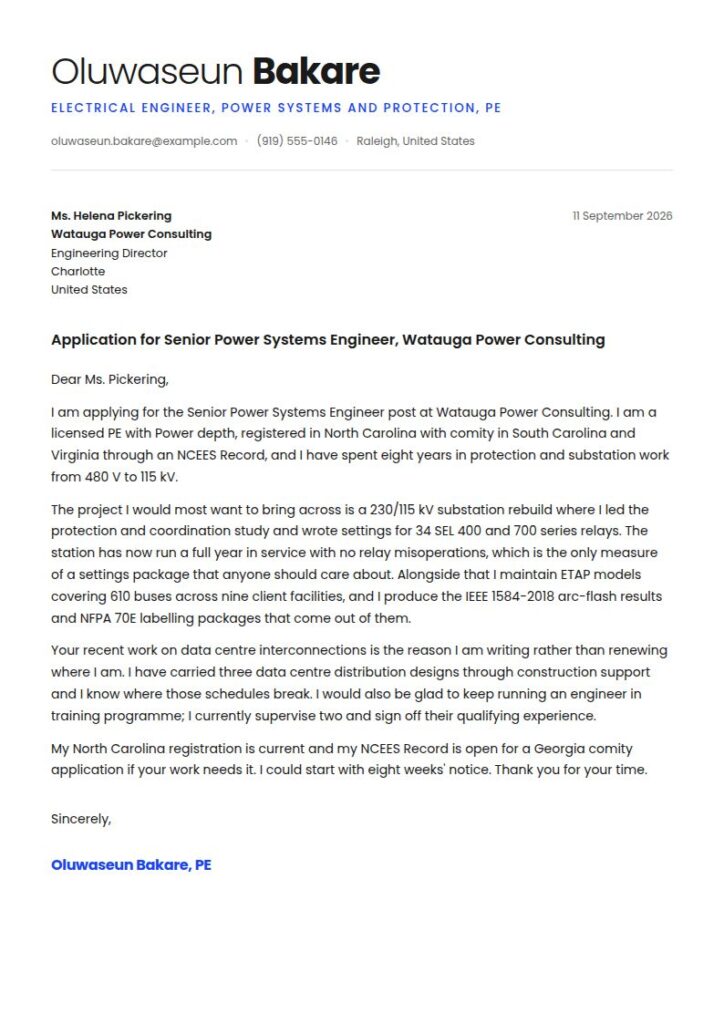
An electrical engineer cover letter is a one-page letter that tells a hiring manager which of the several electrical engineering disciplines you practise, what standards you work to, and what you have delivered in that discipline.
The person reading it hires one kind of electrical engineer. A protection group does not hire firmware. A semiconductor team does not hire substation designers. The letter's first job is not persuasion, it is routing.
Guide to an electrical engineer cover letter
This guide and the corresponding electrical engineer cover letter example will cover:
- How to structure the letter, paragraph by paragraph
- Why the specialism belongs in the first sentence
- What counts as a checkable technical result
- How the letter changes between licensed and unlicensed work
- The openings that get a strong file read twice
How to write an electrical engineer cover letter
| Paragraph | Its job | Length |
|---|---|---|
| Opening | The post, your specialism, and your licence or clearance status | 2 to 3 sentences |
| Evidence | One system, one scale, one standard, one outcome | 4 to 5 sentences |
| Fit | Something specific about their work, and what you would take on | 3 to 4 sentences |
| Close | Registration, availability, thank you | 2 sentences |
Name the specialism before you name yourself as an engineer
The opening sentence of most electrical engineering letters says the writer is an electrical engineer with several years of experience applying for the advertised role. That sentence is true of every applicant in the folder and it routes nowhere.
Replace it with the specialism and the gate: "I am applying for the Senior Power Systems Engineer post. I am a PE with Power depth, registered in North Carolina with comity in South Carolina and Virginia, and I have been engineer of record on 27 substation and industrial distribution projects from 480 V to 115 kV."
If your specialism has no licence, the gate is something else: shipped units, tape-outs, a clearance level, a platform. Name that instead and keep the structure.
An electrical engineer cover letter example you can adapt
Dear Ms. Pickering,
I am applying for the Senior Power Systems Engineer post at Watauga Power Consulting. I am a licensed PE with Power depth, registered in North Carolina with comity in South Carolina and Virginia through an NCEES Record, and I have spent eight years in protection and substation work from 480 V to 115 kV.
The project I would most want to bring across is a 230/115 kV substation rebuild where I led the protection and coordination study and wrote settings for 34 SEL 400 and 700 series relays. The station has now run a full year in service with no relay misoperations, which is the only measure of a settings package that anyone should care about. Alongside that I maintain ETAP models covering 610 buses across nine client facilities, and I produce the IEEE 1584-2018 arc-flash results and NFPA 70E labelling packages that come out of them.
Your recent work on data centre interconnections is the reason I am writing rather than renewing where I am. I have carried three data centre distribution designs through construction support and I know where those schedules break. I would also be glad to keep running an engineer in training programme; I currently supervise two and sign off their qualifying experience.
My North Carolina registration is current and my NCEES Record is open for a Georgia comity application if your work needs it. I could start with eight weeks' notice. Thank you for your time.
Sincerely, Oluwaseun Bakare, PE
Openings that work
| Instead of | Use |
|---|---|
| I am an electrical engineer with eight years of experience | I am a PE with Power depth applying for the Senior Power Systems Engineer post |
| I am writing to express my interest in your open engineering position | I have been engineer of record on 27 substation projects from 480 V to 115 kV |
| I have strong technical skills and work well in teams | I wrote the relay settings for 34 SEL devices on a 230/115 kV rebuild |
| I am familiar with industry codes and standards | I design to the 2026 National Electrical Code, NFPA 70E and IEEE 1584-2018 |
| I would be an asset to your organisation | Your data centre interconnection work is the reason I am writing rather than renewing |
What counts as a checkable result
Electrical work produces evidence that can be verified, which is rarer than it sounds. Use it.
| Kind of evidence | What it looks like in a sentence |
|---|---|
| Service record | 34 relays set on a 230/115 kV rebuild, first year in service with no misoperations |
| Scale of model | ETAP models covering 610 buses across nine facilities |
| Sealed output | Engineer of record on 27 packages from 480 V to 115 kV |
| Schedule | 230 kV interconnection for a 180 MW facility delivered to energisation on schedule |
| Yield or defect | Board respin rate cut from three per programme to one across six products |
| Shipped product | Firmware on 240,000 units in the field with a 0.4 percent field return rate |
| Process | Arc-flash study procedure rebuilt to IEEE 1584-2018, average duration six weeks to four |
Licensed and unlicensed work need different letters
In power and building systems, put the licence in the first paragraph with the depth module and every state, because the firm is buying a seal. In product work, put the shipped thing in the first paragraph instead: the units, the tape-out, the platform, the certification your corner of the field recognises. In defence and aerospace, put the clearance level and the year of the last investigation in the first paragraph, because it is the gate that decides the shortlist. Read the posting for the standards it names and mirror them exactly.
Do not apologise for having no PE in a specialism that does not use one; most product engineering runs under the industrial exemption in state practice acts and nobody is waiting for your licence. Do not write a letter that lists three specialisms. Do not claim responsible charge over work someone else sealed. Do not send the same letter to a utility and a semiconductor firm; they are not the same profession.
The two halves of the occupation hire from different industries
BLS counts electrical engineers and electronics engineers as separate occupations, and their employers barely overlap. Electrical engineers held about 199,700 jobs in 2025 and electronics engineers, except computer, about 98,200 (BLS Occupational Outlook Handbook, 2025).
The largest employers of electrical engineers were engineering services at 22 percent and electric power generation, transmission and distribution at 10 percent. For electronics engineers they were the federal government at 15 percent, telecommunications at 14 percent and semiconductor and other electronic component manufacturing at 14 percent (BLS Occupational Outlook Handbook, May 2025).
Pay follows the same split. Electrical engineers had a median of $120,630 in May 2025 and electronics engineers $130,220, and inside those figures aerospace manufacturing paid electrical engineers a median of $141,160 while semiconductor manufacturing paid electronics engineers $146,700 (BLS, May 2025). A letter that does not say which of those columns you belong in is asking the reader to guess.
Length, format and sending it
One page, four paragraphs, 250 to 400 words. PDF unless the portal specifies otherwise, named for you and the post: oluwaseun-bakare-power-systems-engineer-cover-letter.pdf.
Address a person. Engineering leadership is usually visible on a firm's own site or in a project team page, and "Dear Hiring Manager" on an otherwise specific letter reads as a letter sent to twenty firms.
Keep the numbers identical to your resume. Our electrical engineer resume example uses the figures in this letter.
Key takeaways
- Name the specialism in the first sentence, before anything else.
- State the gate: the licence with its depth module, the clearance, or the shipped product.
- Give one system, one scale, one standard and one outcome.
- Use a result that can be checked, such as service record, schedule or defect rate.
- Mirror the standards the posting names, including the edition year.
- Say one accurate thing about their work, taken from their own pages.
- Address a named person and keep it to one page.
Write your electrical engineer cover letter in 10 minutes.
Electrical engineer cover letter questions, answered
How long should an electrical engineer cover letter be?
One page, four paragraphs, 250 to 400 words. Engineering managers read these between design reviews, and length reads as padding rather than effort.
Do I need a cover letter if I am applying through a portal?
Attach one wherever there is a field for it. The portal collects the same structured fields from everyone. The letter is the only place you can declare your specialism in a sentence, which is the fact that decides whether the rest of your file is read by the right person.
Should I mention my PE licence if the job does not require one?
Mention it once, in the close, without building the letter on it. In an exempt industry it signals discipline rather than capability, and it can quietly help. Building the letter around it in a product role suggests you have misread what the team does.
What do I write with no full-time engineering experience yet?
Write the co-op, internship or senior design project as work: the requirement, the design, the test and the measured outcome. Add your FE result with the month if you sat it, your EIT number, and the tools you can produce in rather than the ones you have seen. One specific project beats four lines of coursework.
How do I write to a company whose work I do not know?
Spend twenty minutes on their site before writing: the service list, recent project pages, any published technical papers, and the job posting's own vocabulary. One accurate sentence about what they build is worth more than a paragraph of admiration, and it is the part of the letter that cannot be reused.