Process Engineer, Semiconductor Etch Dmitri Balan
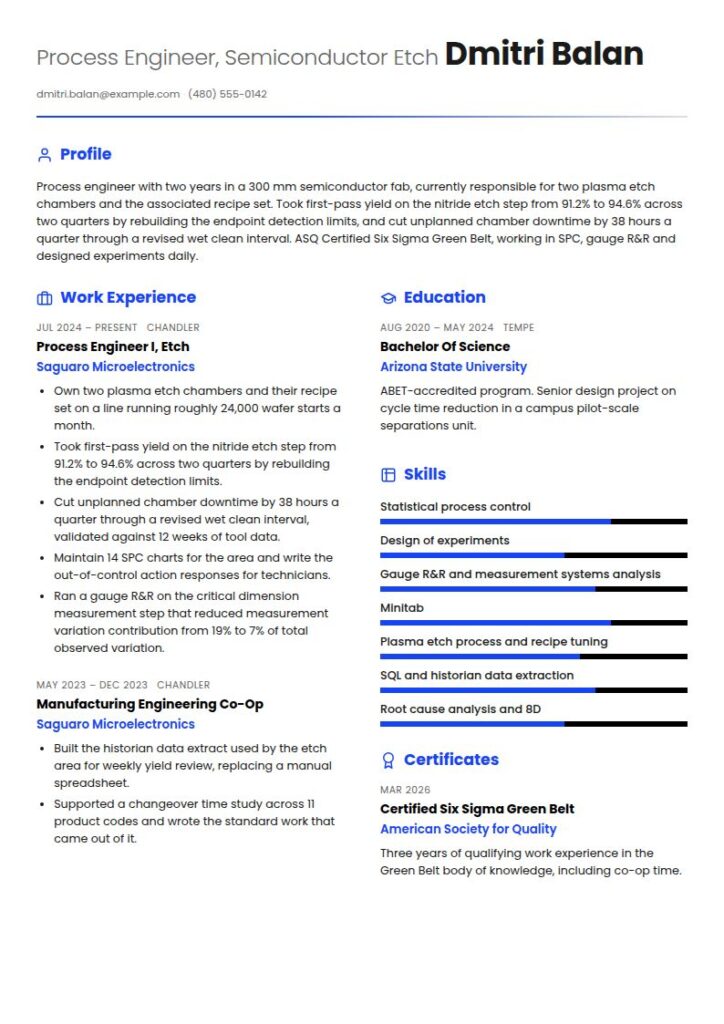
Process Engineer I, Etch
[email protected] | (480) 555-0142 | Chandler, United States
Profile
Process engineer with two years in a 300 mm semiconductor fab, currently responsible for two plasma etch chambers and the associated recipe set. Took first-pass yield on the nitride etch step from 91.2% to 94.6% across two quarters by rebuilding the endpoint detection limits, and cut unplanned chamber downtime by 38 hours a quarter through a revised wet clean interval. ASQ Certified Six Sigma Green Belt, working in SPC, gauge R&R and designed experiments daily.
Work Experience
07/2024 - Present, Process Engineer I, Etch, Saguaro Microelectronics, Chandler, United States
- Own two plasma etch chambers and their recipe set on a line running roughly 24,000 wafer starts a month.
- Took first-pass yield on the nitride etch step from 91.2% to 94.6% across two quarters by rebuilding the endpoint detection limits.
- Cut unplanned chamber downtime by 38 hours a quarter through a revised wet clean interval, validated against 12 weeks of tool data.
- Maintain 14 SPC charts for the area and write the out-of-control action responses for technicians.
- Ran a gauge R&R on the critical dimension measurement step that reduced measurement variation contribution from 19% to 7% of total observed variation.
05/2023 - 12/2023, Manufacturing Engineering Co-op, Saguaro Microelectronics, Chandler, United States
- Built the historian data extract used by the etch area for weekly yield review, replacing a manual spreadsheet.
- Supported a changeover time study across 11 product codes and wrote the standard work that came out of it.
Education
08/2020 - 05/2024, Bachelor of Science, Chemical Engineering, Arizona State University, Tempe, United States
ABET-accredited program. Senior design project on cycle time reduction in a campus pilot-scale separations unit.
Skills
Statistical process control, 75
Design of experiments, 60
Gauge R&R and measurement systems analysis, 70
Minitab, 75
Plasma etch process and recipe tuning, 65
SQL and historian data extraction, 70
Root cause analysis and 8D, 60
Languages
English, native
Romanian, native
Certificates
03/2026, Certified Six Sigma Green Belt, American Society for Quality, CSSGB-118734
Three years of qualifying work experience in the Green Belt body of knowledge, including co-op time.
Summary
A process engineer resume is a numbers document. It has to show yield, throughput, cycle time, scrap and cost per unit, with a baseline, a change and a period attached to each. This guide gives you three adaptable versions, the methodology lines that get read, and current Bureau of Labor Statistics pay and outlook for the occupation.
Process Engineer resume examples by experience level
A process engineer resume is a one to two page document that shows what a process did before you touched it, what it did afterward, and how you know the difference was real.
That is a higher bar than most engineering resumes have to clear, and it is why a weak one is obvious in about four seconds. Everything the job is judged on has a number attached to it already: yield, throughput, cycle time, scrap rate, cost per unit, uptime. The plant tracks all of them daily. A resume that describes process work without any of those numbers is telling the reader that either you did not own the metric or you did not move it.
Resume guide for a process engineer resume
This guide and the corresponding process engineer resume example will cover:
- How to write a process engineer resume, section by section
- The five numbers that belong on the page and how to write each one
- Three adaptable summaries: early career, practicing engineer and lead
- What a Six Sigma belt actually certifies, and what it does not
- Why validated and optimized are different claims in a regulated plant
- What the job market looks like and what you can expect to earn
How to write a process engineer resume
Six sections: contact header, summary, process experience, methodology and certifications, education, and technical skills. One page for your first five or six years, two once you own a process area and have a project record worth listing.
Methodology sits high, because a plant manager reading your file is deciding whether you know how to prove a change worked or whether you are going to adjust three variables at once and call the result an improvement.
| Section | What it is answering | Where it goes |
|---|---|---|
| Summary | Which processes, which industry, which numbers moved | Top, four lines |
| Process experience | What was the baseline, what did you change, what happened | Reverse chronological, one metric per bullet |
| Methodology and certifications | Do they know how to prove a change worked? | Directly under experience, or above it if the belt is the hook |
| Technical skills | Which tools, which control systems, which standards | Grouped, near the end |
| Education | ABET-accredited degree, and which discipline | Short, unless you are early career |
Write the baseline, not just the improvement
"Improved first-pass yield by 4 percent" is not a claim a reader can weigh. Four points on a line running at 62 percent is a different piece of work from four points on a line running at 96 percent, and the second one is much harder.
Write all three numbers: where it started, where it ended, and over what period. "First-pass yield on the nitride etch module from 91.2% to 95.8% over two quarters" tells the reader the scale of the problem, the size of the win, and how long you needed. It also tells them you were close enough to the process to know the figure to one decimal place, which is its own signal.
An engineer who says a cycle time gain cost two points of tool availability is more credible than one whose every number went the right way at once.
Run the finished file through the free Rezoom ATS resume checker before you send it. Manufacturers and contract manufacturers parse applications into a system before anyone reads one.
Choosing the best resume format for a process engineer resume
Reverse chronological. A process career reads as a sequence of areas owned: one tool set, then a module, then a line, then a plant. That progression is the argument, and a functional format destroys it.
Two pages are justified once you have owned a process area, run capital projects or carried a validated process through qualification. Before that, one page, with numbers in it rather than a list of software.
Include your contact information
| ✅ Right | ❌ Wrong |
|---|---|
| Dmitri Balan | Dmitri Balan |
| Process Engineer, Semiconductor Etch and Thin Film | Results-driven engineering professional |
| ASQ Certified Six Sigma Green Belt #CSSGB-118734 | Six Sigma certified |
| (480) 555-0142, [email protected], Chandler, AZ | (480) 555-0142, [email protected] |
Put the certification number on the page. ASQ certifications are verifiable, and the file that lets a recruiter check in ten seconds moves faster than the one that makes them ask.
Make use of a summary
Four lines: the process and industry, years, the metrics you own, and one result with a baseline attached.
Process engineer with two years in a 300 mm semiconductor fab, currently responsible for two plasma etch chambers and the associated recipe set. Took first-pass yield on the nitride etch step from 91.2% to 94.6% across two quarters by rebuilding the endpoint detection limits, and cut unplanned chamber downtime by 38 hours a quarter through a revised wet clean interval. ASQ Certified Six Sigma Green Belt, working in SPC, gauge R&R and designed experiments daily.
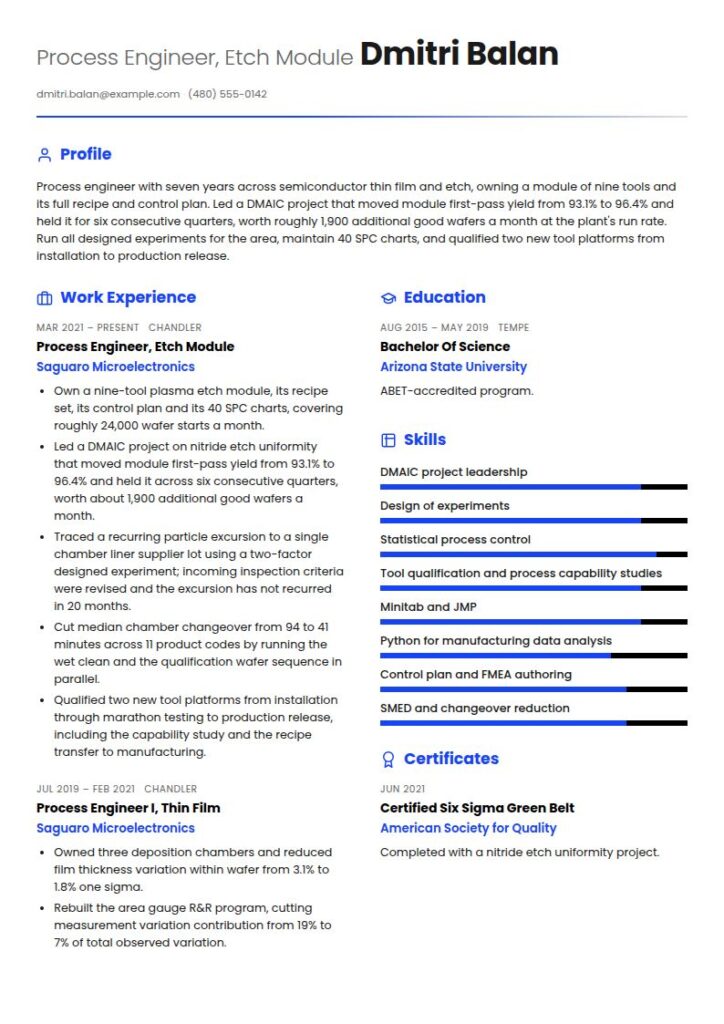
Process engineer with seven years across semiconductor thin film and etch, owning a module of nine tools and its full recipe and control plan. Led a DMAIC project that moved module first-pass yield from 93.1% to 96.4% and held it for six consecutive quarters, worth roughly 1,900 additional good wafers a month at the plant's run rate. Run all designed experiments for the area, maintain 40 SPC charts, and qualified two new tool platforms from installation to production release.
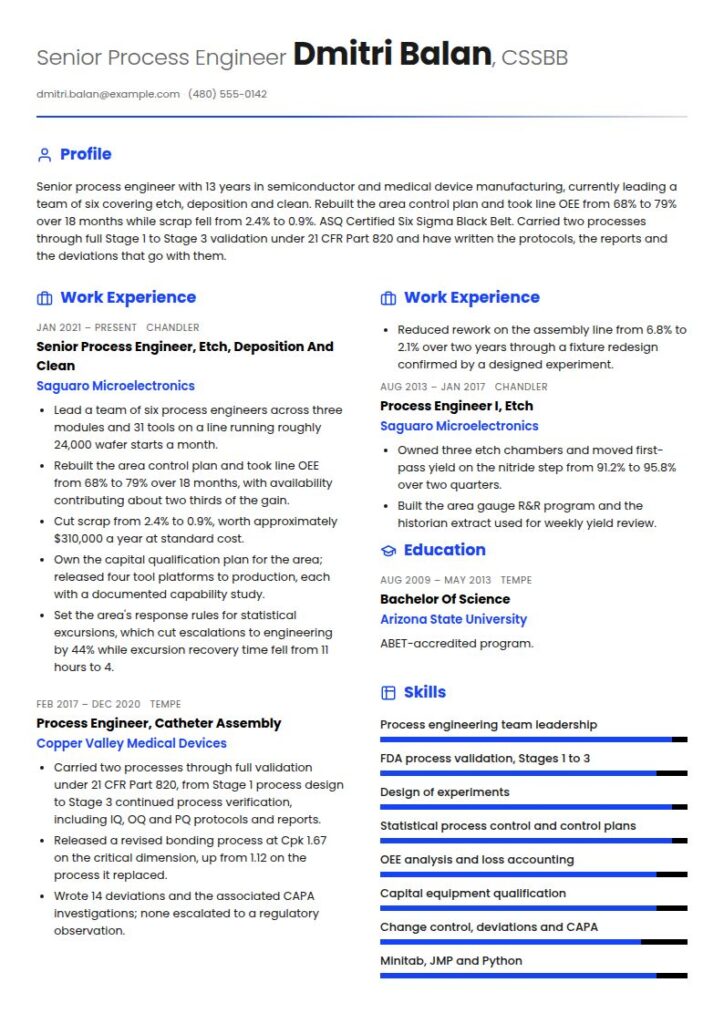
Senior process engineer with 13 years in semiconductor and medical device manufacturing, currently leading a team of six covering etch, deposition and clean. Rebuilt the area control plan and took line OEE from 68% to 79% over 18 months while scrap fell from 2.4% to 0.9%. ASQ Certified Six Sigma Black Belt. Carried two processes through full Stage 1 to Stage 3 validation under 21 CFR Part 820 and have written the protocols, the reports and the deviations that go with them.
Right vs wrong: the same process engineer summary, twice
| ✅ Right | ❌ Wrong |
|---|---|
| Owns a module of nine tools and its full recipe and control plan. | Responsible for various manufacturing processes and continuous improvement. |
| Moved module first-pass yield from 93.1% to 96.4% and held it for six quarters. | Significantly improved yield and reduced defects through process optimization. |
| Worth roughly 1,900 additional good wafers a month at the plant's run rate. | Delivered substantial cost savings to the organization. |
| Maintains 40 SPC charts and runs all designed experiments for the area. | Utilizes Six Sigma tools and lean methodologies. |
The right column can be checked. The left column is what a plant manager is trying to find, and the absence of a single number in a process resume is read as an answer rather than an omission.
Outline your process engineering experience
Company, site, process area, and dates. Then three to five bullets, each one carrying a metric with a baseline and a period.
| Instead of | Use |
|---|---|
| Improved manufacturing processes | Took nitride etch first-pass yield from 91.2% to 95.8% over two quarters |
| Reduced waste and scrap | Cut scrap on the deposition line from 2.4% to 0.9%, about $310,000 a year at standard cost |
| Increased production efficiency | Raised line OEE from 68% to 79% over 18 months, availability being the largest component |
| Supported validation activities | Wrote and executed IQ, OQ and PQ protocols for a new sterilization process, released with Cpk 1.67 on the critical parameter |
Process Engineer, Etch Module, Saguaro Microelectronics, Chandler, AZ, March 2021 to Present
Own a nine-tool plasma etch module, its recipe set, its control plan and its 40 SPC charts, covering roughly 24,000 wafer starts a month.
Led a DMAIC project on nitride etch uniformity: moved module first-pass yield from 93.1% to 96.4% and held it across six consecutive quarters, worth about 1,900 additional good wafers a month.
Traced a recurring particle excursion to a single chamber liner supplier lot using a two-factor designed experiment; incoming inspection criteria revised and the excursion has not recurred in 20 months.
Qualified two new tool platforms from installation through marathon testing to production release, including the process capability study and the transfer of the recipe set to manufacturing.
Give the five numbers, and say whether the process was validated
Every process engineering job is measured on some subset of five numbers. Name the ones you owned, and be specific about which were yours and which you contributed to.
| Number | What it means | How to write it |
|---|---|---|
| Yield | Good units out over units in, usually first-pass | Baseline, result, period, and which step |
| Throughput | Units per hour, per shift or per day | Give the run rate too, so the reader can size it |
| Cycle time | Elapsed time from start to finish for a unit or lot | Say whether it is queue time or process time you cut |
| Scrap and rework | Material lost or reworked as a percent or a cost | Convert to money at standard cost if you know it |
| Cost per unit | Everything above, expressed the way finance sees it | Only claim it if you were in the costing conversation |
Overall equipment effectiveness sits on top of three of those. OEE is availability multiplied by performance multiplied by quality, so an OEE figure on its own hides which of the three moved (OEE.com, accessed September 2026). Say which factor carried it: availability gains are maintenance and changeover work, performance gains are rate and minor stop work, quality gains are yield work. They are three different skill sets and the reader knows it.
Then the line that separates regulated work from everything else. In a regulated plant a process is not finished when it is better. It is finished when it is validated.
Optimized and validated are different claims, and only one of them is a regulatory state
The FDA defines process validation as "the collection and evaluation of data, from the process design stage through commercial production which establishes scientific evidence that a process is capable of consistently delivering quality product," and structures it in three stages: Stage 1 Process Design, Stage 2 Process Qualification, and Stage 3 Continued Process Verification (FDA, Process Validation: General Principles and Practices, January 2011).
A validated process cannot simply be improved on a Tuesday because you found a better setpoint. A change goes through assessment, possibly revalidation, and a documented change control record. Hiring managers in pharmaceutical and medical device plants screen for that distinction hard.
If you have done it, write it in those words: which stage, which protocol, IQ, OQ and PQ, the capability index at release, and whether you wrote the deviation and the CAPA when something failed. If you have not, do not imply that you have. Say "optimized" and mean it.
Food and automotive have their own versions of the same idea. In food manufacturing the frame is HACCP, whose seven principles run from conducting a hazard analysis and determining critical control points through critical limits, monitoring, corrective actions, verification and record keeping (FDA, HACCP Principles and Application Guidelines, last updated February 2022). If you set or defended a critical limit at a CCP, that is a checkable line. In automotive, IATF 16949 sites run on the AIAG core tools, and naming APQP, PPAP, FMEA, MSA and control plans tells a supplier quality manager you have sat through a customer audit rather than read about one.
Build a snapshot of your key skills
Twelve to sixteen entries in four groups: methodology, statistics and software, the plant systems, and the standards you have worked under.
Methodology: DMAIC, Design of experiments, Statistical process control, Root cause analysis and 8D, SMED and changeover reduction, FMEA
Statistics and software: Minitab, JMP, Python for data analysis, Gauge R&R, Process capability studies, SQL for manufacturing data
Plant systems: SPC and FDC systems, MES, SCADA and historian data, CMMS
Standards and compliance: 21 CFR Part 820, FDA process validation stages, ISO 9001, IATF 16949 core tools, HACCP, Change control and deviation writing
"Design of experiments" on a resume invites the question of what factorial design you ran last and why you chose it. Do not list a methodology you cannot be questioned on.
List your education and certifications
Degree, institution, discipline. Then the belt with its number and date, then anything industry-specific.
Bachelor of Science, Chemical Engineering, Arizona State University, Tempe, AZ, 2019. ABET-accredited program.
ASQ Certified Six Sigma Black Belt, American Society for Quality, #CSSBB-207918, 2024
ASQ Certified Six Sigma Green Belt, American Society for Quality, #CSSGB-118734, 2019
Lean manufacturing practitioner certificate, 2021. SEMI equipment and process safety training, 2022.
A belt is an experience credential, not a course certificate
The ASQ Certified Six Sigma Black Belt requires three years of on-the-job experience in one or more areas of the Black Belt body of knowledge, plus either one completed project with a signed affidavit or two completed projects with signed affidavits, and a 165-question exam of which 150 questions are scored (ASQ, accessed September 2026).
The Certified Six Sigma Green Belt requires three years of full-time paid work experience in one or more areas of the Green Belt body of knowledge, has no educational waiver, and runs to a 110-question computer-based exam with 100 scored questions (ASQ, accessed September 2026).
That matters because "Six Sigma certified" on a resume can mean either of those, a two-day internal course, or a weekend online purchase. Naming the issuing body and the certificate number is what separates them. If your belt came from an employer's internal program rather than ASQ, say so plainly and name the project you completed for it.
Choose the right layout and design
Single column, plain type at 11 point, clear headings, no photograph and no skills bar charts. Manufacturers parse these into an applicant system first, and two-column layouts and graphics are where that parsing breaks. Keep the numbers in the bullets rather than in a sidebar, because a reader scanning for evidence wants it next to the work it came from.
Give every metric a baseline, a result and a period. Name the process area and the tool count you owned. Say which factor of OEE actually moved. Name the methodology and be ready to be questioned on it. Use the word validated only for work that went through a validation protocol. Convert scrap to money at standard cost when you know the figure. Name the industry standard you worked under, since the vocabulary differs between a fab, a pharmaceutical plant and a food line.
Do not write "process optimization" with no number attached; it is the single most common reason a process resume is skipped. Do not claim a plant-level result you contributed one piece of, unless you say which piece. Do not list Minitab and call it statistics. Do not confuse a two-day internal course with an ASQ belt. Do not hide a failed project; the project that did not work, honestly described, is often the most interesting thing on the page.
Process engineer job market and outlook
There is no separate federal occupation called process engineer. The Bureau of Labor Statistics counts most of the work inside industrial engineers, and the chemical, pharmaceutical and refining side inside chemical engineers, so those are the two data sets to read before you negotiate.
| Measure | Industrial engineers | Chemical engineers |
|---|---|---|
| Jobs, 2025 | 365,100 | 21,900 |
| Projected jobs, 2035 | 410,600 | 22,900 |
| Projected change, 2025-35 | +12% | +5% |
| Projected annual openings | ~23,100 | ~1,100 |
| Typical entry-level education | Bachelor's degree | Bachelor's degree |
| Median annual wage, May 2025 | $102,440 | $125,040 |
Source: U.S. Bureau of Labor Statistics, Occupational Outlook Handbook, May 2025 wage data and 2025-35 employment projections.
Where the industrial engineering jobs sit:
| Industry | Share of employment | Median annual wage (May 2025) |
|---|---|---|
| Transportation equipment manufacturing | 15% | $102,390 |
| Professional, scientific and technical services | 14% | $107,610 |
| Computer and electronic product manufacturing | 11% | $105,370 |
| Machinery manufacturing | 8% | $99,070 |
| Fabricated metal product manufacturing | 6% | $93,170 |
Source: U.S. Bureau of Labor Statistics, Occupational Outlook Handbook, May 2025.
The chemical engineering side concentrates differently: chemical manufacturing holds 28 percent of that occupation at a $112,300 median, engineering services 11 percent at $127,090 and research and development 9 percent at $124,540 (BLS Occupational Outlook Handbook, May 2025).
What salary you can expect as a process engineer
It depends almost entirely on which of those two occupations your job is counted in. Industrial engineers had a median annual wage of $102,440 in May 2025, with the lowest 10 percent under $74,370 and the highest 10 percent over $159,860. Chemical engineers had a median of $125,040, with the lowest 10 percent under $79,420 and the highest 10 percent over $182,880 (BLS Occupational Outlook Handbook, May 2025).
The same title pays differently depending on what the plant makes and how hard the process is to control. Semiconductor, pharmaceutical and specialty chemical work sits at the top of the range because the tolerance bands are narrow and a bad process is expensive in a hurry.
What moves you inside a band is evidence of ownership rather than years. An engineer who can say which module they owned, how many tools, what the run rate was and what the numbers did over a named period is arguing from a different position than one who lists methodologies.
Key takeaways for a process engineer resume
- Put a baseline, a result and a period on every metric; an improvement percentage on its own means nothing.
- Name the five numbers you owned: yield, throughput, cycle time, scrap and cost per unit.
- Say which factor of OEE moved, because availability, performance and quality are different work.
- Use validated only for work that went through a validation protocol, and name the stage.
- Give your belt an issuing body, a number and a project, not just the word certified.
- Name the standard the plant runs under, since the vocabulary differs by industry.
- Keep it single column and parseable, and hold the long project list separately.
Build your process engineer resume in 15 minutes.
Related engineering resume examples
- Civil engineer resume
- Mechanical engineer resume
- Electrical engineer resume
- Chemical engineer resume
- Project engineer resume
- Systems engineer resume
- Facility engineer resume
- Research engineer resume
- Health and safety engineer resume
- CNC machinist resume
- Technician resume
- Engineering resume
Pair it with a matching process engineer cover letter.
Process engineer resume questions, answered
How long should a process engineer resume be?
One page for your first five or six years. Two once you own a process area, have run capital or qualification projects, or have a validation record worth listing. The second page has to earn itself with numbers, not with a longer skills list.
What if I cannot share exact yield numbers because they are confidential?
Use relative figures and say that is what you are doing. "First-pass yield up 3.3 points on a module running in the low nineties" gives the reader what they need without a figure your employer would object to. A blank where the number should be is not defensible.
Do I need a Six Sigma belt to work as a process engineer?
No, and plenty of strong process engineers do not hold one. It matters most in automotive, medical device and large contract manufacturing, where it is often written into the job posting. The ASQ Black Belt requires three years of relevant on-the-job experience plus a completed project with a signed affidavit (ASQ, accessed September 2026), so it is a record of work rather than a course, which is why employers weight it.
How do I move from unregulated manufacturing into pharmaceutical or medical device work?
Learn the vocabulary and be honest about the gap. The FDA's three-stage framework of Process Design, Process Qualification and Continued Process Verification (FDA, January 2011) is the structure the whole industry works in, and a candidate who can say where their existing work would sit in it reads as trainable. Change control, deviations and CAPA are the daily reality, and a resume that never mentions documentation is the one that gets passed over.
What belongs on a process engineer resume with no full-time experience yet?
Co-ops, internships and the senior design project, written as jobs with numbers: the process area, the tools, what you measured, what you changed and what happened. A capstone that cut a pilot line's cycle time by a stated amount is real evidence.
Should I write a different resume for semiconductor, pharmaceutical and food roles?
Yes. The numbers are the same but the language is not. A fab wants recipe ownership, tool qualification, SPC and excursion response. A pharmaceutical plant wants validation stages, protocols and capability at release. A food plant wants HACCP, critical limits and sanitation cycles. The wrong vocabulary is the clearest sign that you have not worked in their industry.