Facilities Engineer Marcus Odhiambo EIT
Facilities Engineer
[email protected] | (614) 555-0127 | Columbus, United States
Profile
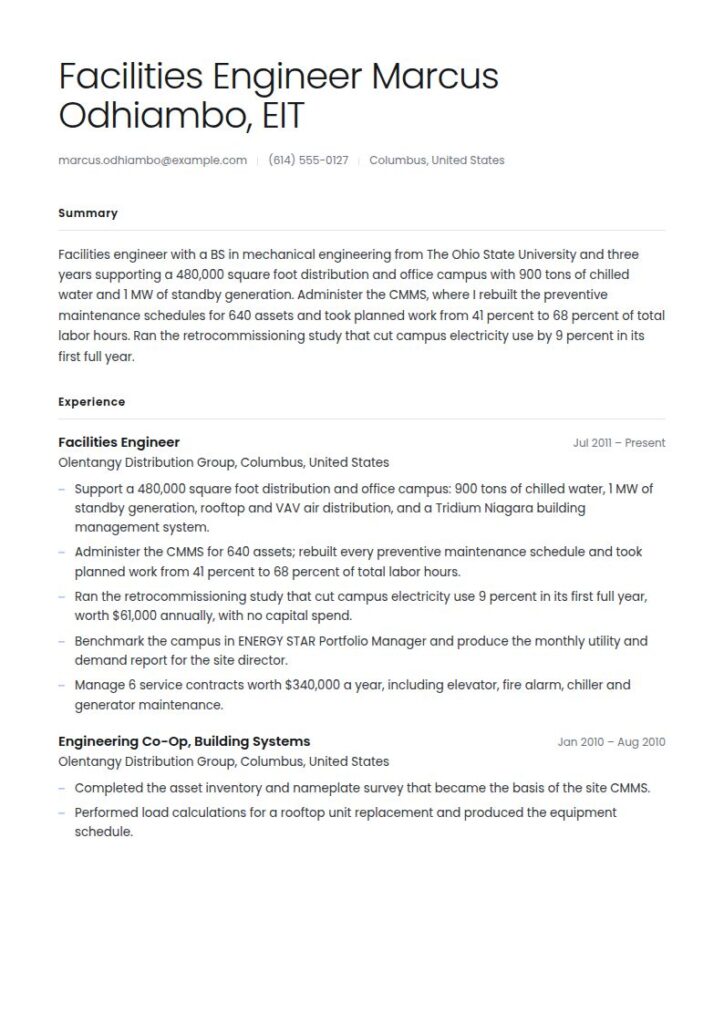
Facilities engineer with a BS in mechanical engineering from The Ohio State University and three years supporting a 480,000 square foot distribution and office campus with 900 tons of chilled water and 1 MW of standby generation. Administer the CMMS, where I rebuilt the preventive maintenance schedules for 640 assets and took planned work from 41 percent to 68 percent of total labor hours. Ran the retrocommissioning study that cut campus electricity use by 9 percent in its first full year.
Work Experience
07/2011 - Present, Facilities Engineer, Olentangy Distribution Group, Columbus, United States
- Support a 480,000 square foot distribution and office campus: 900 tons of chilled water, 1 MW of standby generation, rooftop and VAV air distribution, and a Tridium Niagara building management system.
- Administer the CMMS for 640 assets; rebuilt every preventive maintenance schedule and took planned work from 41 percent to 68 percent of total labor hours.
- Ran the retrocommissioning study that cut campus electricity use 9 percent in its first full year, worth $61,000 annually, with no capital spend.
- Benchmark the campus in ENERGY STAR Portfolio Manager and produce the monthly utility and demand report for the site director.
- Manage 6 service contracts worth $340,000 a year, including elevator, fire alarm, chiller and generator maintenance.
01/2010 - 08/2010, Engineering Co-op, Building Systems, Olentangy Distribution Group, Columbus, United States
- Completed the asset inventory and nameplate survey that became the basis of the site CMMS.
- Performed load calculations for a rooftop unit replacement and produced the equipment schedule.
Education
09/2007 - 05/2011, Bachelor of Science, Mechanical Engineering, The Ohio State University, Columbus, United States
EAC/ABET-accredited program. HVAC and thermal systems electives.
Skills
CMMS administration and PM scheduling, 85
Chilled water and air distribution systems, 75
Tridium Niagara building management, 70
Retrocommissioning and energy analysis, 70
ENERGY STAR Portfolio Manager benchmarking, 75
Load calculations and equipment selection, 70
Service contract management, 70
Languages
English, native
Swahili, native
Spanish, beginner
Certificates
06/2011, Engineer in Training, Ohio State Board of Registration for Professional Engineers and Surveyors, OH-EI-30417
FE Mechanical passed April 2011. Qualifying experience from July 2011.
03/2012, OSHA 30-Hour General Industry, OSHA Training Institute Education Center
Summary
A facilities engineer resume is a one to two page document measured in uptime, energy and compliance rather than in design output. This guide gives you three adaptable versions, the maintenance and energy metrics that belong on the page, what changes in a data center, a hospital or a regulated manufacturing site, and current Bureau of Labor Statistics pay data.
Facilities Engineer resume examples by experience level
A facilities engineer resume is a one to two page document that reports three things: how much the building stayed up, how much energy it used doing so, and whether it passed everything it had to pass.
That is the whole job, and it is why this resume reads differently from every other engineering resume on the site. A design engineer is judged on what they produced. A facilities engineer is judged on what did not happen: the chiller that did not fail in August, the outage that did not take the production line down, the survey finding that did not get written. Absence is hard to put on a page, which is why so many facilities resumes fall back on lists of systems and end up sounding like a maintenance technician's.
Resume guide for a facilities engineer resume
This guide and the corresponding facilities engineer resume example will cover:
- How to write a facilities engineer resume, section by section
- The three numbers this job is measured by, and where to find yours
- Three adaptable summaries: early career, site engineer and portfolio lead
- What changes in a data center, a hospital and a regulated manufacturing site
- What the job market looks like and what you can expect to earn
How to write a facilities engineer resume
Six sections: contact header, summary, site and systems scope, experience with performance numbers, education and licensure, and technical skills. One page for the first five years, two once you run a site or a portfolio.
Scope comes early, because it is the fastest way to size you. Square footage, number of buildings, critical systems, headcount supported, annual operating budget and annual capital budget. A reader who knows facilities can place you almost exactly from those six numbers.
| Section | What it is answering | Where it goes |
|---|---|---|
| Site and systems scope | How big is the plant this person has actually run? | Directly under the summary |
| Experience with numbers | Uptime, energy, compliance and cost: what moved? | Reverse chronological, at least one metric per role |
| Capital planning | Can they build and defend a five-year plan, or only fix things? | Inside experience, with dollar values |
| Licensure and credentials | PE, LEED, trade licenses | Near the end, with the state and discipline |
Give the six numbers that size a facilities engineer
Most facilities resumes describe systems. Better ones describe scale, and they do it in one line under the summary.
Square footage and number of buildings. Critical systems by capacity: chiller tonnage, generator kilowatts, switchgear service size, air changes per hour in controlled spaces. Occupants or beds or racks supported. Team size, including how many are your employees and how many are contract. Annual operating budget. Annual capital budget.
"1.1 million square feet across 7 buildings, 3,400 tons of chilled water, 2 MW of standby generation, 4,200 occupants, 9 direct staff plus 3 contracts, $6.4 million operating and $4.1 million capital" takes two lines and answers every sizing question a hiring manager has.
Run the finished file through the free Rezoom ATS resume checker before you submit. Large employers, health systems and public agencies all parse applications into a system before a human opens one.
Choosing the best resume format for a facilities engineer resume
Reverse chronological, one to two pages. The reader wants to see continuity at a site, because facilities performance takes years to move and a two-year stint rarely shows a real trend.
Avoid the systems-list format that this occupation attracts, where the resume becomes a column of equipment types with no numbers attached. Naming a system proves you have seen one. Naming what it did under you proves you ran it.
Include your contact information
| ✅ Right | ❌ Wrong |
|---|---|
| Marcus Odhiambo, PE | Marcus Odhiambo |
| Facilities Engineer, Critical Systems and Energy | Hardworking facilities professional with strong technical skills |
| PE, Ohio #PE.84119, mechanical. LEED AP O+M. | Licensed engineer, LEED certified |
| (614) 555-0127, [email protected], Columbus, OH | (614) 555-0127, [email protected] |
Two details worth getting right. A person is LEED accredited, not LEED certified; buildings get certified and people get credentialed, and reversing it is a small tell that a reader in this field will notice. And put the PE number on the page, because a licensed professional engineer or registered architect is required to verify an ENERGY STAR certification application before it can be approved (ENERGY STAR, building certification, accessed September 2026), which makes your license directly useful rather than decorative.
Make use of a summary
Four lines: your scope, your critical systems, one uptime or reliability number, and one energy or cost number.
Facilities engineer with a BS in mechanical engineering from The Ohio State University and three years supporting a 480,000 square foot distribution and office campus with 900 tons of chilled water and 1 MW of standby generation. Administer the CMMS, where I rebuilt the preventive maintenance schedules for 640 assets and took planned work from 41 percent to 68 percent of total labor hours. Ran the retrocommissioning study that cut campus electricity use by 9 percent in its first full year.
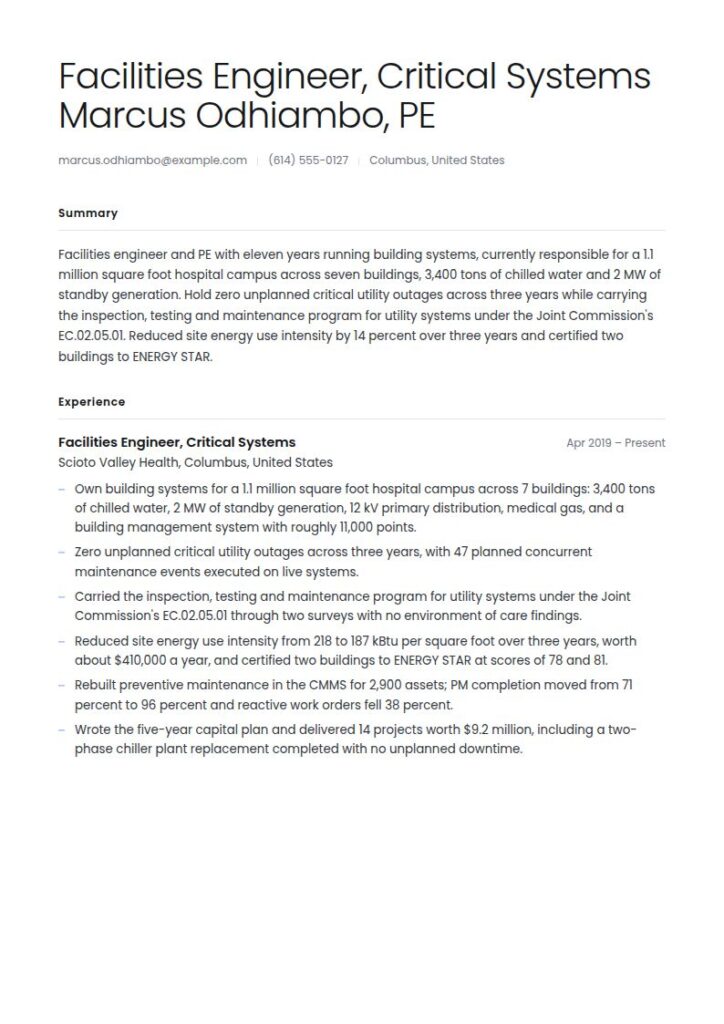
Facilities engineer and PE with eleven years running building systems, currently responsible for a 1.1 million square foot hospital campus across seven buildings, 3,400 tons of chilled water and 2 MW of standby generation. Hold zero unplanned critical utility outages across three years while carrying the inspection, testing and maintenance program for utility systems under the Joint Commission's EC.02.05.01. Reduced site energy use intensity by 14 percent over three years and certified two buildings to ENERGY STAR.
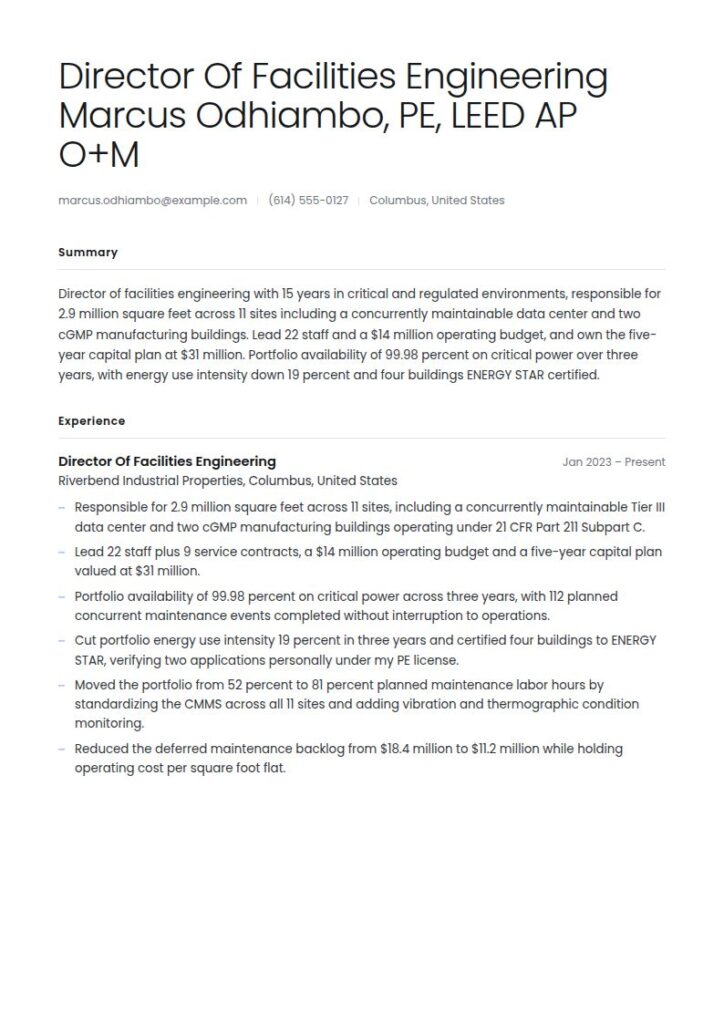
Director of facilities engineering with 15 years in critical and regulated environments, responsible for 2.9 million square feet across 11 sites including a concurrently maintainable data center and two cGMP manufacturing buildings. Lead 22 staff and a $14 million operating budget, and own the five-year capital plan at $31 million. Portfolio availability of 99.98 percent on critical power over three years, with energy use intensity down 19 percent and four buildings ENERGY STAR certified.
Right vs wrong: the same facilities engineer summary, twice
| ✅ Right | ❌ Wrong |
|---|---|
| Responsible for a 1.1 million square foot hospital campus, 3,400 tons of chilled water and 2 MW of standby generation. | Experienced in managing all aspects of building operations and maintenance. |
| Zero unplanned critical utility outages across three years. | Maintained a high level of system reliability and uptime. |
| Reduced site energy use intensity by 14 percent over three years and certified two buildings to ENERGY STAR. | Implemented various energy efficiency initiatives throughout the facility. |
The right column can be compared against the reader's own building. The left column is a list of things every applicant claims, and it is why so many facilities engineers are screened out by people who would have hired them.
Outline your experience
Employer, site type, square footage, dates and title. Then bullets, each with a number and, where possible, a trend rather than a snapshot.
| Instead of | Use |
|---|---|
| Managed building maintenance and repairs | Ran the maintenance program for 7 buildings and 2,900 assets, taking planned work from 41% to 74% of labor hours |
| Responsible for HVAC and electrical systems | Owned 3,400 tons of chilled water, 2 MW of standby generation and 12 kV primary distribution across 7 buildings |
| Reduced energy costs at the facility | Cut site energy use intensity from 218 to 187 kBtu per square foot over three years, worth $410,000 a year |
| Used a CMMS to track work orders | Rebuilt PM schedules for 2,900 assets in the CMMS; PM completion rose from 71% to 96% and reactive work orders fell 38% |
| Ensured regulatory compliance | Carried the utility systems inspection, testing and maintenance program through two Joint Commission surveys with no EC findings |
| Managed capital projects | Delivered 14 capital projects worth $9.2 million, including a chiller plant replacement completed with no unplanned downtime |
Facilities Engineer, Critical Systems, Scioto Valley Health, Columbus, OH, April 2019 to Present
Own building systems for a 1.1 million square foot hospital campus across 7 buildings: 3,400 tons of chilled water, 2 MW of standby generation, 12 kV primary distribution, medical gas, and a Johnson Controls building management system with roughly 11,000 points.
Zero unplanned critical utility outages across three years, with 47 planned concurrent maintenance events executed on live systems.
Carried the inspection, testing and maintenance program for utility systems under the Joint Commission's EC.02.05.01 through two triennial surveys with no environment of care findings.
Reduced site energy use intensity from 218 to 187 kBtu per square foot over three years, worth about $410,000 a year, and certified two buildings to ENERGY STAR at scores of 78 and 81.
Rebuilt preventive maintenance in the CMMS for 2,900 assets; PM completion moved from 71 percent to 96 percent and reactive work orders fell 38 percent.
Wrote the five-year capital plan and delivered 14 projects worth $9.2 million, including a two-phase chiller plant replacement completed with no unplanned downtime.
Report uptime, energy and the planned to reactive ratio
These are the three numbers the job is measured by, and a resume that carries all three is unusual enough to be memorable on its own.
Uptime and reliability. Give unplanned outage count and duration for critical systems, planned concurrent maintenance events executed without interruption, and mean time to repair if you track it. In a data center this is expressed against the Uptime Institute's Tier classification, where a Tier III facility is concurrently maintainable with redundant components and redundant distribution paths so any part can be shut down without affecting IT operations, and a Tier IV facility is fault tolerant, with physically isolated systems so a single equipment failure or distribution path interruption does not affect operations (Uptime Institute, Tier Classification System, accessed September 2026). Saying which tier you have operated is worth more than any adjective.
Energy. Give energy use intensity in kBtu per square foot with a before, an after and a period, plus the dollar value. If you have certified a building, say the ENERGY STAR score. A building must earn a score of 75 or higher on the EPA's 1 to 100 scale, meaning it performs better than at least 75 percent of similar buildings nationally, the application must be verified by a licensed professional engineer or registered architect, and the certification must be renewed annually (ENERGY STAR, building certification, accessed September 2026). Certified office buildings use 35 percent less energy and cost $0.54 less per square foot to operate than their peers (ENERGY STAR, accessed September 2026).
The planned to reactive ratio. This is the single most diagnostic number in facilities engineering and almost nobody puts it on a resume. Express it as the share of maintenance labor hours that were planned rather than reactive, with a before and an after.
Why the maintenance mix is worth real money
The Department of Energy's Federal Energy Management Program guidance, prepared by Pacific Northwest National Laboratory, puts numbers on the maintenance approaches. A functional preventive maintenance program yields savings of 12 to 18 percent over a reactive-only program. A predictive, condition-based program yields a further 8 to 12 percent over preventive, and for a facility heavily dependent on reactive maintenance the potential savings run 30 to 40 percent (PNNL and DOE FEMP, Operations and Maintenance Best Practices, accessed September 2026).
The same guidance finds that a well-executed operations and maintenance program can save 5 to 20 percent on energy bills without significant capital investment (PNNL and DOE FEMP, accessed September 2026).
That is the business case behind your resume. When you write "took planned work from 41 percent to 74 percent of labor hours", a reader who knows this literature is mentally converting it into a percentage of their own maintenance budget. It is the closest thing this occupation has to a profit and loss statement.
What the numbers become in each regulated setting:
| Setting | The binding constraint | What to put on the resume |
|---|---|---|
| Data center | Availability and concurrent maintainability | Tier level operated, unplanned outages, planned concurrent maintenance events, PUE trend |
| Hospital | The Joint Commission's utility systems standard, EC.02.05.01 | Inventory of critical utility components, inspection and testing completion rate, survey outcomes, emergency power testing |
| Pharmaceutical and cGMP manufacturing | 21 CFR Part 211 Subpart C, buildings and facilities | Environmental monitoring excursions, pressure cascade and air change compliance, qualification and requalification of HVAC, deviation closure |
| Higher education and government | Deferred maintenance backlog and capital budget cycles | Backlog value and trend, facility condition index, capital plan delivered against approved budget |
| Commercial real estate | Operating cost per square foot and tenant satisfaction | Cost per square foot, energy use intensity, ENERGY STAR scores, service response times |
Sources: Uptime Institute, Tier Classification System; The Joint Commission, Environment of Care utility systems standard EC.02.05.01; U.S. Food and Drug Administration, 21 CFR 211.46 on ventilation, air filtration, air heating and cooling; all accessed September 2026.
Lead with scope in numbers: square footage, buildings, tonnage, generation, occupants, budgets. Give energy as intensity with a before, an after and a period. State the planned to reactive labor ratio. Name the CMMS and the building management system by product, because the reader is checking whether you can start without training. Say which regulated framework you have worked under and what the survey or audit result was. Separate operating budget from capital budget.
Do not list equipment types with no performance attached. Do not claim uptime without saying what counted as an outage. Do not write "LEED certified" about yourself; people are accredited and buildings are certified. Do not put total project value next to your name when you were one of several owners. Do not describe maintenance work in technician language when you were the engineer who planned it.
Build a snapshot of your key skills
Twelve to sixteen entries in four groups: building systems, controls and software, energy and analysis, and compliance.
Building systems: Central chilled water plants, air handling and VAV distribution, steam and hot water, 12 kV primary distribution and switchgear, standby generation and automatic transfer switches, UPS, fire alarm and sprinkler systems, medical gas
Controls and software: Johnson Controls Metasys, Siemens Desigo, Tridium Niagara, IBM Maximo, Fiix, ServiceChannel, AutoCAD, Bluebeam Revu, ENERGY STAR Portfolio Manager
Energy and analysis: Energy use intensity benchmarking, retrocommissioning, measurement and verification, utility rate and demand analysis, life cycle cost analysis, load calculations
Compliance and planning: NFPA 110 emergency power testing, Joint Commission environment of care, cGMP facility qualification support, capital planning and facility condition assessment, vendor and service contract management
List your education and certifications
Degree with the discipline, then licensure, then credentials, each with the issuing body.
| Credential | Issuer | What it signals |
|---|---|---|
| PE, professional engineer, mechanical or electrical | State licensing board | You can seal design work, and you can verify an ENERGY STAR certification application |
| LEED Green Associate | U.S. Green Building Council | Foundational green building literacy |
| LEED AP with a specialty, commonly Operations and Maintenance | U.S. Green Building Council | Existing building performance rather than new construction |
| Trade and safety cards such as NFPA 70E or OSHA 30 | Training provider | You can be in the electrical room and on a construction site legally |
Professional Engineer, Ohio, #PE.84119, mechanical, issued 2018
LEED Accredited Professional, Operations and Maintenance, U.S. Green Building Council, 2021
Master of Science, Mechanical Engineering, The Ohio State University, Columbus, OH, 2016
Bachelor of Science, Mechanical Engineering, The Ohio State University, Columbus, OH, 2011. EAC/ABET-accredited program.
Training: NFPA 70E arc flash and electrical safety, renewed 2025. OSHA 30-hour General Industry, 2020. Certified Energy Manager coursework completed 2023.
Choose the right layout and design
Single column, 10 or 11 point body type, no photograph, and no equipment icons. Put the scope line immediately under the summary where a skimming reader will find it.
Keep a separate one-page project and capital list if your record is long, the same way a design engineer keeps a project list. Hiring managers in facilities frequently ask for one at interview, and having it ready reads as someone who has defended a capital plan before.
Facilities engineer job market and outlook
There is no Bureau of Labor Statistics occupation called facilities engineer. The work straddles two that the Occupational Outlook Handbook does track, and the honest way to read the market is through both.
| Measure | Facilities managers | Mechanical engineers |
|---|---|---|
| Employment, 2025 | 165,900 | 298,500 |
| Projected change, 2025-35 | +7,600 within a group growing 5% | +11% (+33,500) |
| Projected annual openings | ~36,100 across the wider management group | ~17,800 |
| Median annual wage, May 2025 | $106,660 | $104,110 |
| Lowest 10 percent | less than $64,480 | less than $73,990 |
| Highest 10 percent | more than $176,120 | more than $164,340 |
Source: U.S. Bureau of Labor Statistics, Occupational Outlook Handbook, May 2025 wage data and 2025-35 employment projections.
Where facilities managers sit, by industry median (May 2025): manufacturing $129,620, local government $107,700, educational services $100,780, healthcare and social assistance $98,190, and administrative and support services $95,240 (BLS Occupational Outlook Handbook, May 2025).
That spread is the most actionable thing on this page. The same competence is worth roughly $34,000 more a year in manufacturing than in outsourced facility services, and the gap is almost entirely about whether the building is a cost center or a production asset. If you have run critical or regulated space, say so in the first line, because that is the qualification that moves you between those columns.
What salary you can expect as a facilities engineer
Facilities managers had a median annual wage of $106,660 in May 2025, with the lowest 10 percent under $64,480 and the highest 10 percent over $176,120. Mechanical engineers, the closest engineering occupation, had a median of $104,110 (BLS Occupational Outlook Handbook, May 2025).
Four things move you up that range, and all four are things a resume can state. Criticality: a facility where downtime stops production or endangers patients pays more than one where it does not. Regulation: cGMP, Joint Commission and data center environments carry a premium because the pool of people who have worked inside them is small. Budget authority: owning a capital plan is a different job from executing work orders, and the dollar figure is the proof. Licensure: the PE is not required for most facilities posts, but it is what lets you seal work and verify an ENERGY STAR application, which changes what a site can do without hiring a consultant.
Key takeaways for a facilities engineer resume
- Put scope in numbers directly under the summary: square footage, buildings, tonnage, generation, occupants, budgets.
- Report uptime as unplanned outages and planned concurrent maintenance, not as an adjective.
- Give energy as intensity in kBtu per square foot with a before, an after, a period and a dollar value.
- State the planned to reactive maintenance ratio; almost nobody does, and it is the most diagnostic number you have.
- Name the CMMS and building management system by product.
- Say which regulated framework you have worked under and what the survey or audit found.
- Separate operating budget from capital budget, and say which one you own.
Build your facilities engineer resume in 15 minutes.
Related engineering resume examples
- Civil engineer resume
- Mechanical engineer resume
- Electrical engineer resume
- Chemical engineer resume
- Process engineer resume
- Structural engineer resume
- Project engineer resume
- Systems engineer resume
- CNC machinist resume
- Technician resume
- Agricultural engineer resume
- Engineering resume
Pair it with a matching facilities engineer cover letter.
Facilities engineer resume questions, answered
How long should a facilities engineer resume be?
One page for the first five years. Two once you run a site or a portfolio, own a capital plan, or have a performance history long enough to show trends rather than single years. Keep a separate project and capital list rather than stretching to three pages.
Do I need a PE to work as a facilities engineer?
No, and most postings do not ask for one. It matters in two specific ways: it lets you seal design work your site would otherwise send to a consultant, and a licensed professional engineer or registered architect is required to verify an ENERGY STAR certification application before approval (ENERGY STAR, accessed September 2026). If you hold it, say the state and the discipline.
What metrics should a facilities engineer put on a resume?
Unplanned critical outages and their duration, planned concurrent maintenance events completed on live systems, PM completion rate, the share of maintenance labor hours that were planned rather than reactive, energy use intensity with a before and after, ENERGY STAR scores, operating cost per square foot, and capital delivered against approved budget. Each one needs a period attached.
How do I move from facilities technician to facilities engineer?
Change what you report. A technician resume lists work completed; an engineer resume reports what the system did. Take ownership of something measurable, usually the CMMS data, the PM schedule or the energy benchmark, and write the result as a trend. A degree or a PE helps, but the clearest signal is a candidate who talks about the building's performance rather than their own task list.
Does experience in one regulated environment transfer to another?
Partly, and you should say which part. The method transfers: inventories of critical components, documented inspection and testing intervals, deviation and corrective action handling, qualification of changes. The specific framework does not. Someone who has run utility systems under the Joint Commission's EC.02.05.01 in a hospital will recognize the structure of a cGMP facility qualification under 21 CFR Part 211 Subpart C, but not the content, and saying so honestly reads far better than implying they are the same.
Should I list every system I have worked on?
No. Group them and attach capacities to the ones you owned. "3,400 tons of chilled water, 2 MW of standby generation, 12 kV primary distribution" tells a reader more than twenty equipment types with no numbers. Systems you have only supported can go in the skills block without capacities.