Marcus Odhiambo Director of Facilities Engineering, PE, LEED AP O+M Columbus, 43215, United States [email protected] · (614) 555-0127
11 September 2026
Ms. Annika Lindqvist Director of Operations Harrow Creek Manufacturing Dublin, United States
Application for Senior Facilities Engineer, Harrow Creek Manufacturing
Dear Ms. Lindqvist,
I am applying for the Senior Facilities Engineer post at Harrow Creek Manufacturing. I currently run 2.9 million square feet across eleven sites, including a concurrently maintainable data center and two cGMP manufacturing buildings, with 22 staff, a $14 million operating budget and a $31 million five-year capital plan. I am a licensed PE in Ohio and a LEED Accredited Professional in operations and maintenance.
Two results are the reason I am writing. Portfolio availability on critical power has been 99.98 percent across three years, with 112 planned concurrent maintenance events completed without interrupting operations, which came from standardizing the CMMS across all eleven sites and moving planned maintenance from 52 percent to 81 percent of labor hours. Over the same period energy use intensity fell 19 percent and four buildings were certified to ENERGY STAR, two of which I verified personally under my PE license.
Your posting describes a chiller plant replacement on a site that cannot take extended downtime, alongside a deferred maintenance backlog you want reduced. I have done both: a two-phase chiller plant replacement on a live hospital campus with no unplanned downtime, and a backlog cut from $18.4 million to $11.2 million while holding operating cost per square foot flat. The backlog work is slower and less visible than the plant replacement, and in my experience it is the one that decides whether the next five years are planned or reactive.
My license is active, my compliance record includes two Joint Commission surveys with no environment of care findings, and I can give four weeks' notice. Thank you for your time.
Sincerely, Marcus Odhiambo, PE, LEED AP O+M
Summary
A facilities engineer cover letter names the size of the plant you have run, one uptime result, one energy result and the compliance framework you worked under. This guide gives you a full adaptable letter, the openings that work, and what changes between a data center, a hospital and a regulated manufacturing site.
Facilities Engineer cover letter examples by experience level
A facilities engineer cover letter is a one-page letter that says how big the plant you have run is, what stayed up, what it cost to run, and what you passed.
The reader is usually a director of facilities or a plant manager with a specific problem: a chiller plant at the end of its life, an energy budget that has moved the wrong way, a survey coming, a data center that cannot take another unplanned outage. A letter that answers one of those beats a letter that lists every system you have touched.
Guide to a facilities engineer cover letter
This guide and the corresponding facilities engineer cover letter example will cover:
- How to structure the letter, paragraph by paragraph
- Why scope in numbers has to come first
- Which single result to lead with, depending on what they are hiring for
- What changes between a data center, a hospital and a regulated manufacturing site
- The openings that get a technical file read to the end
How to write a facilities engineer cover letter
| Paragraph | Its job | Length |
|---|---|---|
| Opening | The post, the scope you have run, licensure | 2 to 3 sentences |
| Evidence | One uptime result and one energy or cost result, both with periods | 4 to 5 sentences |
| Fit | Something specific about their site, and what you would take on first | 3 to 4 sentences |
| Close | Compliance record, availability, thank you | 2 sentences |
Open with the size of the plant, not the list of systems
A facilities hiring manager sizes candidates before they assess them. They want to know whether you have run something comparable to what they have.
So put it in the first two sentences: square footage, number of buildings, chiller tonnage, standby generation, occupants or racks or beds, team size, operating and capital budget. Six numbers, one sentence.
Everything after that is easier to read, because the reader now has a frame to put your results into. A 9 percent energy reduction on a 480,000 square foot campus and the same figure across 2.9 million square feet are different achievements, and the reader can only tell which one you mean if you told them the denominator first.
A facilities engineer cover letter example you can adapt
Dear Ms. Lindqvist,
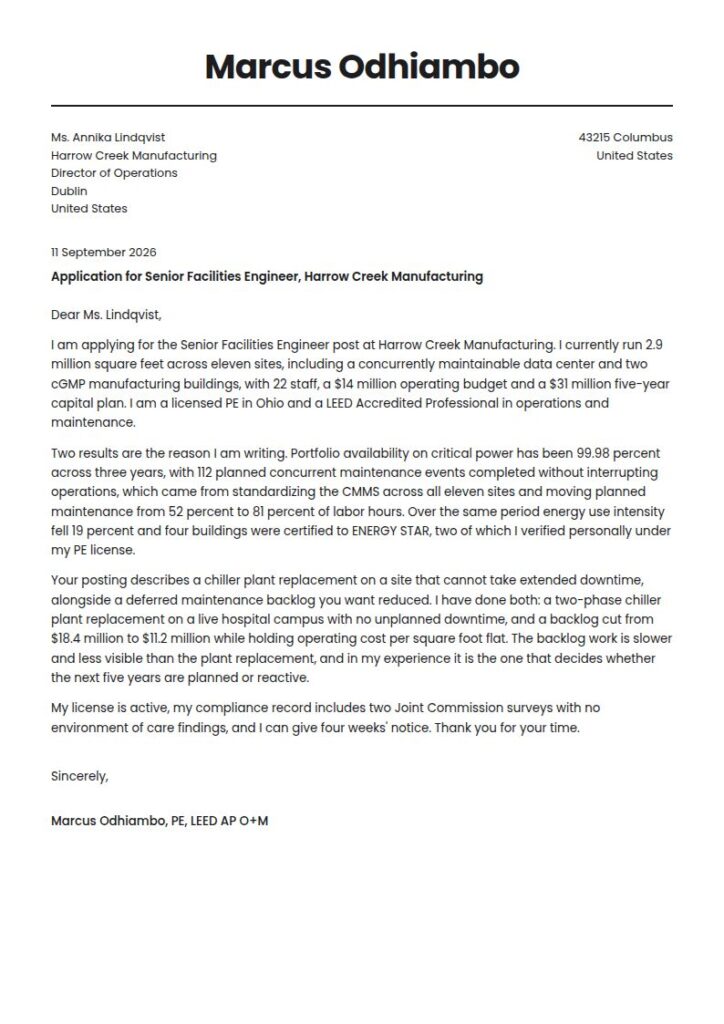
I am applying for the Senior Facilities Engineer post at Harrow Creek Manufacturing. I currently run 2.9 million square feet across eleven sites, including a concurrently maintainable data center and two cGMP manufacturing buildings, with 22 staff, a $14 million operating budget and a $31 million five-year capital plan. I am a licensed PE in Ohio and a LEED Accredited Professional in operations and maintenance.
Two results are the reason I am writing. Portfolio availability on critical power has been 99.98 percent across three years, with 112 planned concurrent maintenance events completed without interrupting operations, which came from standardizing the CMMS across all eleven sites and moving planned maintenance from 52 percent to 81 percent of labor hours. Over the same period energy use intensity fell 19 percent and four buildings were certified to ENERGY STAR, two of which I verified personally under my PE license.
Your posting describes a chiller plant replacement on a site that cannot take extended downtime, alongside a deferred maintenance backlog you want reduced. I have done both: a two-phase chiller plant replacement on a live hospital campus with no unplanned downtime, and a backlog cut from $18.4 million to $11.2 million while holding operating cost per square foot flat. The backlog work is slower and less visible than the plant replacement, and in my experience it is the one that decides whether the next five years are planned or reactive.
My license is active, my compliance record includes two Joint Commission surveys with no environment of care findings, and I can give four weeks' notice. Thank you for your time.
Sincerely, Marcus Odhiambo, PE, LEED AP O+M
Openings that work
| Instead of | Use |
|---|---|
| I am a hardworking facilities professional with strong technical skills | I currently run 2.9 million square feet across eleven sites, including a concurrently maintainable data center |
| I am writing to express my interest in your facilities engineer opening | I am applying for the Senior Facilities Engineer post at Harrow Creek Manufacturing |
| I have extensive experience with HVAC, electrical and life safety systems | Portfolio availability on critical power has been 99.98 percent across three years |
| I am committed to sustainability and energy efficiency | Energy use intensity fell 19 percent in three years and four buildings were certified to ENERGY STAR |
Choose the one result that matches what they are hiring for
Most facilities postings are written because something specific is wrong. Read the posting for it, then lead your evidence paragraph with the matching result.
| If the posting emphasizes | Lead with |
|---|---|
| Uptime, critical power, a data center or a hospital | Unplanned outages, planned concurrent maintenance events, the tier or framework you operated under |
| Energy, sustainability or utility cost | Energy use intensity with a before, an after, a period and a dollar value, plus ENERGY STAR scores |
| A survey, an audit or a regulated environment | The framework by name and the outcome: findings, observations, or none |
| Deferred maintenance, capital planning or an aging plant | Backlog value and trend, the capital plan you wrote, and projects delivered against approved budget |
| A new CMMS, reliability or too much firefighting | The planned to reactive labor ratio, PM completion rate, and what you changed to move it |
Why the maintenance mix is the number that persuades
Department of Energy guidance prepared by Pacific Northwest National Laboratory for the Federal Energy Management Program puts figures on maintenance strategy. A functional preventive maintenance program saves 12 to 18 percent against a reactive-only program; a predictive, condition-based program saves a further 8 to 12 percent over preventive; and for a facility heavily dependent on reactive maintenance the potential savings run 30 to 40 percent (PNNL and DOE FEMP, Operations and Maintenance Best Practices, accessed September 2026).
The same guidance finds a well-executed operations and maintenance program can save 5 to 20 percent on energy bills without significant capital investment (PNNL and DOE FEMP, accessed September 2026).
So when you write that you moved planned maintenance from 52 percent to 81 percent of labor hours, you are quoting the one figure that a director can convert into their own budget while reading. Very few letters give them anything they can do arithmetic with.
Data center, hospital and regulated manufacturing want different letters
For a data center, lead with availability, concurrent maintainability and the tier you have operated. For a hospital, lead with the utility systems program and your survey record. For cGMP manufacturing, lead with qualification, environmental monitoring and deviation handling. For commercial property or campuses, lead with operating cost per square foot, energy intensity and tenant or occupant service levels. Name one real thing about their site, from the posting or their own published material.
Do not list systems with no performance attached. Do not claim an uptime figure without saying what counted as an outage. Do not write that you are LEED certified; buildings are certified, people are accredited. Do not imply that one regulated framework is interchangeable with another. Do not send a letter with no numbers in it, because in this occupation a letter with no numbers reads as a technician applying for an engineer's job.
Length, format and sending it
One page, four paragraphs, 250 to 400 words. PDF unless the portal says otherwise, named for yourself and the post.
Put your license and credentials in the signature block with the state, since a PE is directly useful in this job rather than ornamental: a licensed professional engineer or registered architect must verify an ENERGY STAR certification application before it can be approved (ENERGY STAR, building certification, accessed September 2026).
Use the same figures as your resume so the two agree. Our facilities engineer resume example is written with the numbers used here.
Key takeaways
- Put scope in numbers in the first two sentences.
- Lead your evidence with the result that matches what the posting is worried about.
- Give uptime as outages and planned concurrent maintenance, not as an adjective.
- Give energy as intensity with a before, an after, a period and a dollar value.
- Quote the planned to reactive labor ratio; it is the figure a director can price.
- Name the compliance framework and say what the survey or audit found.
- Keep it to one page and make every number checkable at interview.
Write your facilities engineer cover letter in 10 minutes.
Facilities engineer cover letter questions, answered
How long should a facilities engineer cover letter be?
One page, four paragraphs, 250 to 400 words. The reader is usually the person you would report to, and they are reading for whether your plant resembles theirs.
Do I need a cover letter if my resume already has the numbers?
Yes, because the letter is where you choose which number matters. A resume presents everything; a letter says which of your results answers the problem they wrote the posting about. That choice is itself evidence of judgment.
What do I write with no uptime or energy figures?
Write what you owned and what changed. PM completion rate, work order backlog, asset inventory completeness, service contract cost, response times, a commissioning or retrocommissioning result. If you have never had access to the utility data, say what you would benchmark first; that is a reasonable answer and a common situation in smaller sites.
How do I move from a technician or trades background into a facilities engineer role?
Lead with the systems you have run at capacity and with any data ownership you have had, usually the CMMS or the PM schedule. Then be direct about the transition and what supports it: a degree in progress, an FE result, a commissioning or energy credential. Directors hire from the trades regularly, and the letters that work are the ones that name the gap instead of hoping it is not noticed.
Should I mention a specific compliance framework I have worked under?
Yes, by name, with the outcome. "Two Joint Commission surveys with no environment of care findings" or "three cGMP audits with no critical observations" is concrete and rare. If you are moving between frameworks, say which part of the method transfers and which part you would have to learn, because a reader in a regulated site will test exactly that in the interview.