Electromechanical Test Technician, Aerospace Manufacturing Priscilla Oyelowo
Electromechanical Test Technician
[email protected] | (316) 555-0193 | Wichita, United States
Profile
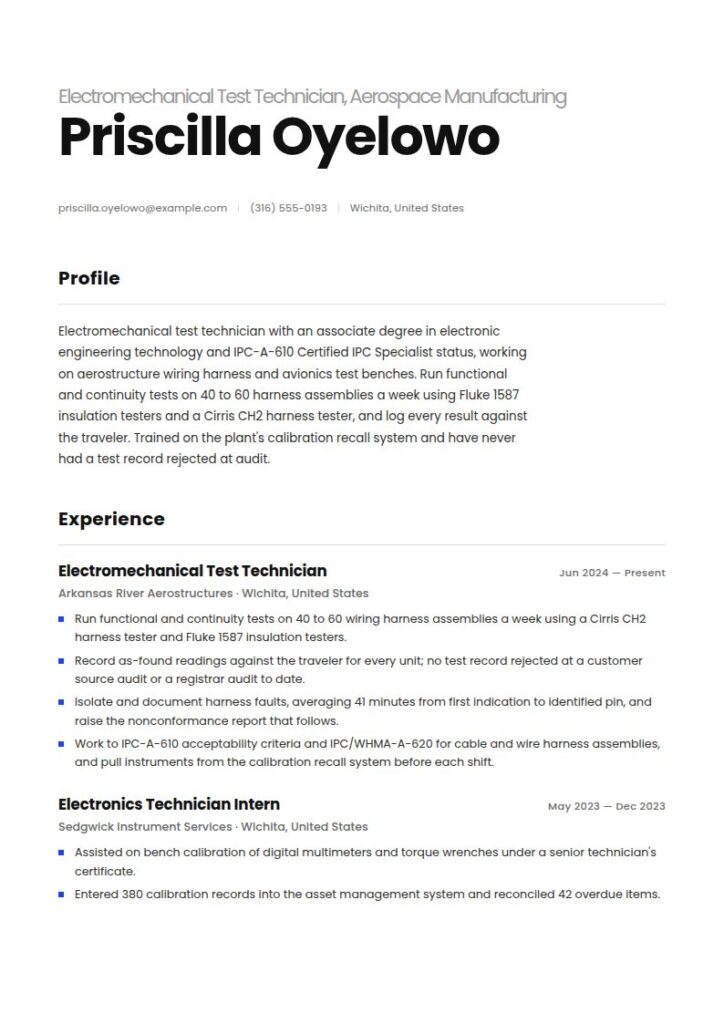
Electromechanical test technician with an associate degree in electronic engineering technology and IPC-A-610 Certified IPC Specialist status, working on aerostructure wiring harness and avionics test benches. Run functional and continuity tests on 40 to 60 harness assemblies a week using Fluke 1587 insulation testers and a Cirris CH2 harness tester, and log every result against the traveler. Trained on the plant's calibration recall system and have never had a test record rejected at audit.
Work Experience
06/2024 - Present, Electromechanical Test Technician, Arkansas River Aerostructures, Wichita, United States
- Run functional and continuity tests on 40 to 60 wiring harness assemblies a week using a Cirris CH2 harness tester and Fluke 1587 insulation testers.
- Record as-found readings against the traveler for every unit; no test record rejected at a customer source audit or a registrar audit to date.
- Isolate and document harness faults, averaging 41 minutes from first indication to identified pin, and raise the nonconformance report that follows.
- Work to IPC-A-610 acceptability criteria and IPC/WHMA-A-620 for cable and wire harness assemblies, and pull instruments from the calibration recall system before each shift.
05/2023 - 12/2023, Electronics Technician Intern, Sedgwick Instrument Services, Wichita, United States
- Assisted on bench calibration of digital multimeters and torque wrenches under a senior technician's certificate.
- Entered 380 calibration records into the asset management system and reconciled 42 overdue items.
Education
08/2022 - 05/2024, Associate of Applied Science, Electronic Engineering Technology, WSU Tech, Wichita, United States
Coursework in instrumentation, analog and digital circuits, measurement systems and quality documentation.
Skills
Cirris CH2 harness testing, 80
Fluke 1587 insulation resistance testing, 80
Continuity and hipot testing, 75
IPC-A-610 acceptability criteria, 75
IPC/WHMA-A-620 cable and harness criteria, 70
As-found and as-left recording, 80
Nonconformance reporting, 70
Languages
English, native
Yoruba, intermediate
Certificates
09/2024, Certified IPC Specialist, IPC-A-610, IPC
Acceptability of Electronics Assemblies.
04/2025, Certified IPC Specialist, IPC/WHMA-A-620, IPC
Requirements and Acceptance for Cable and Wire Harness Assemblies.
Summary
A technician resume is a one to two page document that names the equipment you can work on, the certifications that let you, and the documentation discipline that keeps the record defensible. This guide gives you three adaptable versions, the specialization statement that makes a generic file hireable, and current Bureau of Labor Statistics pay and outlook by technician occupation.
Technician resume examples by experience level
A technician resume is a one to two page document that names the equipment you can work on, the certifications that allow you to touch it, and the records you keep while you do.
Before any of that, it has to say what kind of technician you are. "Technician" on its own is one of the least hireable words you can put on a resume, because it describes a level of responsibility rather than a trade. A hiring manager staffing a calibration lab, a service van, a production line and a field crew are four different people, and none of them can do anything with a file that just says technician.
Resume guide for a technician resume
This guide and the corresponding technician resume example will cover:
- How to write a technician resume, section by section
- How to specialize in the first line so the right manager keeps reading
- Three adaptable summaries: entry level, working technician and lead
- The equipment list, the certification block and the documentation discipline
- What the job market looks like across technician occupations and what you can expect to earn
How to write a technician resume
Six sections: contact header, summary, certifications, equipment and systems, work experience, and education. One page for your first five years, two once you hold multiple certifications and a long equipment list.
Certifications move above experience on a technician resume, which is the opposite of most professional formats. Many technician jobs are legally or contractually gated on a credential, and the reader checks for it before deciding whether the experience is worth reading.
| Section | What it is answering | Where it goes |
|---|---|---|
| Specialization line | What kind of technician is this? | The title line, under your name |
| Certifications | Are they allowed to do the work? | Directly under the summary |
| Equipment and systems | Can they touch our machines without training? | Its own block, named by make and class |
| Experience | What did they fix, maintain, build or verify, and how much? | Reverse chronological, with counts |
Name equipment by make, model family and class
The single biggest upgrade to a technician resume is replacing categories with names.
"Experienced with test equipment" tells a manager nothing. "Keysight 34465A digital multimeters, Fluke 5522A multi-product calibrators, Tektronix MDO3000 series oscilloscopes, and a Zeiss Contura coordinate measuring machine" tells them which of their benches you can sit at on day one.
Do it in two layers. Give the class, because that is what a search matches on, and then the makes and model families, because that is what a supervisor believes. A technician who can name the calibrator they use every week has used it. A technician who writes "various test instruments" is asking to be trained.
Run the finished file through the free Rezoom ATS resume checker before you apply. Manufacturers, utilities, hospitals and defense suppliers all parse applications into a system before a human opens one.
Choosing the best resume format for a technician resume
Reverse chronological, with a certification block promoted to the top. One page early, two once the equipment list and the certifications justify it.
A skills-only format fails, because technician hiring is partly about continuity of environment. A manager wants to see that you have worked under a quality system, in a regulated plant, or on a service route for a sustained period. The dates are part of the evidence.
Include your contact information
| ✅ Right | ❌ Wrong |
|---|---|
| Priscilla Oyelowo | Priscilla Oyelowo |
| Calibration and Test Technician, Aerospace Manufacturing | Technician |
| IPC-A-610 CIS, J-STD-001 CIS, ISA CCST Level I | Certified technician |
| (316) 555-0193, [email protected], Wichita, KS | (316) 555-0193, [email protected] |
The second line is the entire argument of this page. Everything below it is only read if that line matched what the reader is hiring.
Make use of a summary
Four lines: specialization and industry, certifications, the equipment classes you own, and one number that describes volume or reliability.
Electromechanical test technician with an associate degree in electronic engineering technology and IPC-A-610 Certified IPC Specialist status, working on aerostructure wiring harness and avionics test benches. Run functional and continuity tests on 40 to 60 harness assemblies a week using Fluke 1587 insulation testers and a Cirris CH2 harness tester, and log every result against the traveler. Trained on the plant's calibration recall system and have never had a test record rejected at audit.
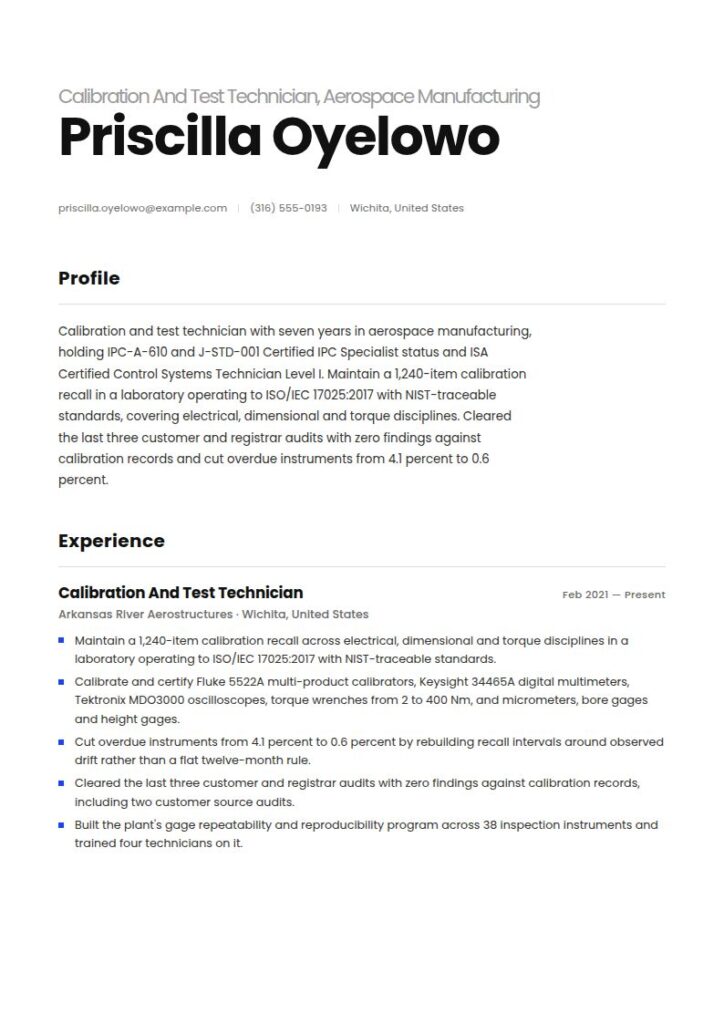
Calibration and test technician with seven years in aerospace manufacturing, holding IPC-A-610 and J-STD-001 Certified IPC Specialist status and ISA Certified Control Systems Technician Level I. Maintain a 1,240-item calibration recall in a laboratory operating to ISO/IEC 17025:2017 with NIST-traceable standards, covering electrical, dimensional and torque disciplines. Cleared the last three customer and registrar audits with zero findings against calibration records and cut overdue instruments from 4.1 percent to 0.6 percent.
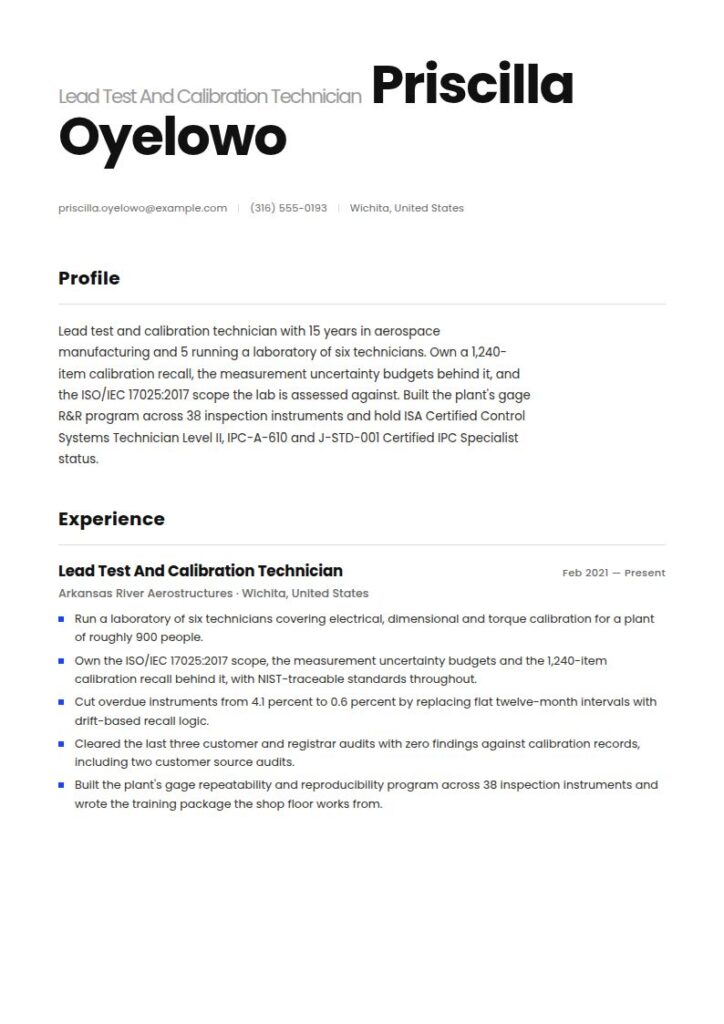
Lead test and calibration technician with 15 years in aerospace manufacturing and 5 running a laboratory of six technicians. Own a 1,240-item calibration recall, the measurement uncertainty budgets behind it, and the ISO/IEC 17025:2017 scope the lab is assessed against. Built the plant's gage R&R program across 38 inspection instruments and hold ISA Certified Control Systems Technician Level II, IPC-A-610 and J-STD-001 Certified IPC Specialist status.
Right vs wrong: the same technician summary, twice
| ✅ Right | ❌ Wrong |
|---|---|
| Calibration and test technician with seven years in aerospace manufacturing, IPC and ISA certified. | Hardworking technician with several years of hands-on experience. |
| Maintain a 1,240-item calibration recall in a laboratory operating to ISO/IEC 17025:2017 with NIST-traceable standards. | Responsible for testing and maintaining equipment to company standards. |
| Cleared three audits with zero findings and cut overdue instruments from 4.1 percent to 0.6 percent. | Detail-oriented and committed to quality and safety. |
The right column names a trade, a standard, a volume and an audit result. The left column could be written by anyone who has ever held a screwdriver.
Outline your experience
Employer, city, dates and title first. Then four or five bullets, each naming equipment, a count, and what the count did.
| Instead of | Use |
|---|---|
| Performed calibration on various instruments | Maintain a 1,240-item calibration recall across electrical, dimensional and torque disciplines |
| Used test equipment to troubleshoot problems | Diagnosed 63 harness faults with a Cirris CH2 tester and a Fluke 1587, average 41 minutes to isolation |
| Followed safety and quality procedures | Worked to ISO/IEC 17025:2017 with NIST-traceable standards and signed every certificate issued |
| Maintained production equipment | Ran preventive maintenance on 18 CNC machining centers, uptime from 91.2 percent to 96.8 percent |
| Kept records of work performed | Cut overdue instruments from 4.1 percent to 0.6 percent by rebuilding the recall interval logic |
| Assisted engineers with testing | Built and ran 46 qualification test sequences and wrote the data packages the engineers signed |
| Worked well as part of a team | Trained four technicians to IPC-A-610 CIS and wrote the bench procedures they work from |
Calibration and Test Technician, Arkansas River Aerostructures, Wichita, KS, February 2021 to Present
Maintain a 1,240-item calibration recall across electrical, dimensional and torque disciplines in a laboratory operating to ISO/IEC 17025:2017 with NIST-traceable standards.
Calibrate and certify Fluke 5522A multi-product calibrators, Keysight 34465A digital multimeters, Tektronix MDO3000 oscilloscopes, torque wrenches from 2 to 400 Nm, and micrometers, bore gages and height gages.
Cut overdue instruments from 4.1 percent to 0.6 percent by rebuilding recall intervals around observed drift rather than a flat twelve-month rule.
Cleared the last three customer and registrar audits with zero findings against calibration records, including two customer source audits.
Built the plant's gage repeatability and reproducibility program across 38 inspection instruments and trained four technicians on it.
Specialize in your first line, because technician alone is unhireable
This is the section that decides a technician job search, and it is one line of text.
The federal statistical system does not recognize a general technician occupation, and neither does any hiring manager. It tracks a series of separate ones, each with its own education level, its own credential and its own pay. Pick yours and write it into the line under your name.
| Technician occupation | What it actually does | The credential that gates it |
|---|---|---|
| Engineering technologists and technicians, electrical and electronic | Test, troubleshoot and build electronic assemblies and instrumentation | IPC certification on the standard you work to; ISA CCST for controls work |
| Industrial engineering technologists and technicians | Time studies, layout, process improvement, quality data on a production line | Six Sigma belts; ASQ credentials; employer process certification |
| Mechanical engineering technologists and technicians | Build, instrument and run test rigs, support design and validation | Employer and equipment training; ASME Y14.5 print reading |
| Civil engineering technologists and technicians | Survey, materials testing, construction inspection | NICET certification in asphalt, concrete, soils or highway construction inspection |
| Environmental engineering technologists and technicians | Sampling, monitoring, pollution control equipment operation | State and EPA sampling and operator credentials by medium |
| Aerospace engineering and operations technologists and technicians | Operate and maintain test facilities, instrumentation and flight hardware | Employer and program training; security clearance in defense work |
| HVAC and refrigeration mechanics and installers | Install, service and commission heating, cooling and refrigeration plant | EPA Section 608, in Type I, II, III or Universal form |
| Automotive service technicians and mechanics | Diagnose and repair vehicle systems | ASE tests A1 to A9; A1 through A8 make a Master Automobile Technician |
Two of those credentials are worth stating precisely, because most applicants describe them loosely and the exact wording is checkable.
EPA Section 608 certification comes in four types: Type I for servicing small appliances, Type II for high or very high pressure appliances except small appliances and motor vehicle air conditioning, Type III for low pressure appliances, and Universal for servicing all types of equipment. The credentials do not expire (U.S. Environmental Protection Agency, accessed September 2026). Write your type, not just "EPA certified".
ASE certifies automobile technicians through tests A1 to A9, and a technician certified in A1 through A8 is recognized as an ASE-Certified Master Automobile Technician. Certification requires documented hands-on work experience and technicians must retest every five years to retain it (ASE, accessed September 2026). Write the specific test numbers you hold and the year of your last recertification.
Once the specialization is set, three things carry every technician resume regardless of trade.
The equipment, by name and class. Give it its own block. Group by class so a search matches, then name makes and model families inside each group so a supervisor believes you.
The certifications, with issuing body and date. IPC certifies individuals as Certified IPC Specialists against specific standards, including J-STD-001 for soldered electrical and electronic assemblies, IPC-A-610 for acceptability of electronics assemblies, IPC-A-600 for printed boards, and IPC/WHMA-A-620 for cable and wire harness assemblies (IPC, accessed September 2026). NICET certifies civil technicians in asphalt, concrete, soils and highway construction inspection, and requires recertification every three years (NICET, accessed September 2026). ISA certifies control systems technicians at three levels, with minimum education and experience requirements of five years at Level I, seven at Level II and thirteen at Level III (ISA, accessed September 2026). Name the standard, not just the acronym.
The documentation and calibration discipline. This is the quiet differentiator, and it is the one experienced technicians underwrite. Every serious technical environment runs on records: travelers, work orders, calibration certificates, recall intervals, as-found and as-left readings, uncertainty budgets, deviation reports. ISO/IEC 17025:2017, the general requirements for the competence of testing and calibration laboratories, is the standard behind most of that in a laboratory setting (ISO, third edition, 2017). A technician who can say what system they logged into, what interval logic they used, and what happened at the last audit is describing the part of the job that separates a reliable hire from a capable one.
Put the specialization in the line under your name and rewrite it for each application. Give equipment a dedicated block, by class and then by make and model family. State certifications with the issuing body, the standard, the level and the date, including the recertification date where one exists. Give counts: instruments on recall, machines maintained, units tested a week, mean time to isolation. Say what your records survived, such as an audit, a customer source inspection or a regulatory inspection.
Do not write "technician" alone as your title line. Do not write "various equipment" or "all types of testing"; the reader treats it as no equipment and no testing. Do not claim a certification level you have not been issued, since IPC, ASE, NICET and ISA registries are checkable. Do not leave a lapsed credential undated. Do not describe safety and quality as personal qualities when they are documented procedures you either followed or did not.
Build a snapshot of your key skills
Twelve to sixteen entries in four groups: the equipment classes, the measurement and diagnostic methods, the standards and systems, and the documentation tools.
Equipment: Fluke 5522A multi-product calibrators, Keysight 34465A digital multimeters, Tektronix MDO3000 oscilloscopes, Cirris CH2 harness testers, Zeiss Contura coordinate measuring machine, torque transducers from 2 to 400 Nm
Measurement and diagnostics: As-found and as-left recording, measurement uncertainty budgets, gage repeatability and reproducibility, drift analysis and recall interval setting, continuity and insulation resistance testing, fault isolation
Standards and systems: ISO/IEC 17025:2017, NIST-traceable standards, IPC-A-610, J-STD-001, IPC/WHMA-A-620, AS9100 quality system working knowledge
Documentation: Calibration certificates, recall and asset management software, travelers and work orders, deviation and nonconformance reports, audit preparation and response
List your education and certifications
Certifications first, with the issuing body, the standard, the level and the date. Then education, then training.
Certified IPC Specialist, IPC-A-610 Acceptability of Electronics Assemblies, IPC, recertified 2025
Certified IPC Specialist, J-STD-001 Requirements for Soldered Electrical and Electronic Assemblies, IPC, recertified 2025
Certified Control Systems Technician, Level I, International Society of Automation, 2023
Associate of Applied Science, Electronic Engineering Technology, WSU Tech, Wichita, KS, 2018
Training: Measurement uncertainty and ISO/IEC 17025 internal auditing (2024). Fluke Calibration 5522A operation and maintenance (2022). Gage R&R and measurement systems analysis (2021).
Choose the right layout and design
Single column, 10 or 11 point type, clear headings, no photograph. Plant and hospital applicant systems parse these before a supervisor sees them, and two-column layouts and text boxes are where the parsing breaks.
Give the equipment block room to breathe. It is the section a supervisor reads twice, and cramming it into a comma-separated paragraph makes it unreadable at exactly the moment it matters most.
Technician job market and outlook
There is no single technician occupation, so there is no single outlook. The picture changes completely by trade.
| Technician occupation | Jobs, 2025 | Change, 2025-35 | Annual openings | Median wage, May 2025 |
|---|---|---|---|---|
| Automotive service technicians and mechanics | 825,800 | +5% (+40,900) | ~66,200 | $50,620 |
| HVAC and refrigeration mechanics and installers | 440,900 | +11% (+48,200) | ~40,600 | $61,010 |
| Electrical and electronic engineering technologists and technicians | 96,900 | +2% (+2,300) | ~8,100 | $78,190 |
| Industrial engineering technologists and technicians | 76,700 | +3% (+2,400) | ~6,600 | $66,120 |
| Civil engineering technologists and technicians | 70,900 | +3% (+2,300) | ~6,100 | $64,950 |
| Mechanical engineering technologists and technicians | 36,900 | +1% (+500) | ~3,100 | $74,510 |
| Aerospace engineering and operations technologists and technicians | 11,600 | +12% (+1,300) | ~1,100 | $82,890 |
Source: U.S. Bureau of Labor Statistics, Occupational Outlook Handbook, May 2025 wage data and 2025-35 employment projections.
The word on your resume is worth about $32,000 a year
The median annual wage across these occupations runs from $50,620 for automotive service technicians and mechanics to $82,890 for aerospace engineering and operations technologists and technicians, a spread of $32,270 for the same job title (BLS Occupational Outlook Handbook, May 2025).
Growth is just as uneven. Aerospace technicians are projected to grow 12 percent between 2025 and 2035 and HVAC and refrigeration mechanics 11 percent, while mechanical engineering technologists and technicians are projected to grow 1 percent (BLS Occupational Outlook Handbook, 2025-35 projections).
The entry route differs too. Most engineering technologist and technician occupations list an associate degree as typical entry-level education, while automotive and HVAC list a postsecondary nondegree award (BLS, 2025). That is why a resume that says only "technician" is doing active damage. It puts you in a pool with a different education level, a different credential and a different wage, and the reader has no way to tell which one you belong to.
Electrical and electronic engineering technologists and technicians are the clearest example of how much the employer matters. The largest employers were the federal government at 12 percent, engineering services at 11 percent, semiconductor and other electronic component manufacturing at 10 percent, navigational, measuring, electromedical and control instruments manufacturing at 8 percent, and utilities at 7 percent (BLS Occupational Outlook Handbook, May 2025).
What salary you can expect as a technician
Pay depends almost entirely on which technician occupation you are in. Electrical and electronic engineering technologists and technicians had a median annual wage of $78,190 in May 2025, with the lowest 10 percent under $49,510 and the highest 10 percent above $115,700. Industrial engineering technologists and technicians had a median of $66,120, with a range from under $47,300 to over $99,150, and mechanical engineering technologists and technicians a median of $74,510, from under $48,400 to over $106,050 (BLS Occupational Outlook Handbook, May 2025).
Inside any one of those bands, three things move an offer, and all three are resume decisions. The first is the certification, because many of these credentials are contractually required and an employer who has to pay for and wait on your certification is buying a lesser asset. The second is the equipment list, because a technician who can run the bench unsupervised in week one is worth more than one who cannot. The third is the documentation record, because in a regulated plant a technician whose paperwork has survived audits is insurance, and insurance is priced.
Key takeaways for a technician resume
- Never write "technician" alone in your title line; name the trade and the industry.
- Put certifications above experience, with the issuing body, standard, level and date.
- Give equipment its own block, by class and then by make and model family.
- Put a count in every experience bullet: instruments, machines, units, minutes to isolation.
- Name the standard your work is governed by, such as ISO/IEC 17025:2017, IPC-A-610 or EPA Section 608.
- Say what your records survived, such as an audit or a customer source inspection.
- Keep it single column and parseable, since plant and hospital systems read it first.
Build your technician resume in 15 minutes.
Related engineering resume examples
- Civil engineer resume
- Mechanical engineer resume
- Electrical engineer resume
- Structural engineer resume
- Process engineer resume
- Project engineer resume
- Systems engineer resume
- Chemical engineer resume
- Facility engineer resume
- Research engineer resume
- CNC machinist resume
- Engineering resume
Pair it with a matching technician cover letter.
Technician resume questions, answered
How long should a technician resume be?
One page for your first five years. Two once you hold several certifications and an equipment list worth reading. The equipment block is the section that earns the second page, not extra description of duties.
What do I put on a technician resume with no experience?
The certification if you hold one, the equipment you were trained on by name, and any lab, shop or program coursework written as work: what you set up, what you measured, what you recorded. Then the documentation habits, because a trainee who already logs as-found and as-left readings without being asked is a genuinely different hire.
Should I list every certification I hold?
List every one that is current and relevant to the trade you are applying in, with the issuing body and date. Drop the ones from an unrelated trade unless the posting touches it. Expired certifications can stay if you state the expiry year and that you are renewing, because the underlying training is still evidence.
Is an associate degree necessary to work as a technician?
It depends on the occupation. BLS lists an associate degree as typical entry-level education for most engineering technologist and technician occupations, and a postsecondary nondegree award for automotive service technicians and HVAC and refrigeration mechanics (BLS Occupational Outlook Handbook, 2025). In practice the certification and the equipment record often carry more weight than the degree once you have a few years behind you.
How do I show quality and safety without sounding generic?
Replace the adjective with a record. Instead of saying you are detail-oriented, say your calibration records cleared three audits with zero findings, or that you cut overdue instruments from 4.1 percent to 0.6 percent. Quality on a technician resume is a documented outcome, not a personality trait.
How do I move from one technician trade to another?
Rewrite the title line for the target trade, then show the transferable core explicitly: the measurement discipline, the documentation habits, and the equipment classes that overlap. Add the target trade's entry credential if you can get it before you apply, because in most technician hiring the credential is the gate and everything else is the argument.