Structural Designer, Engineer in Training Fiona Brannigan EIT
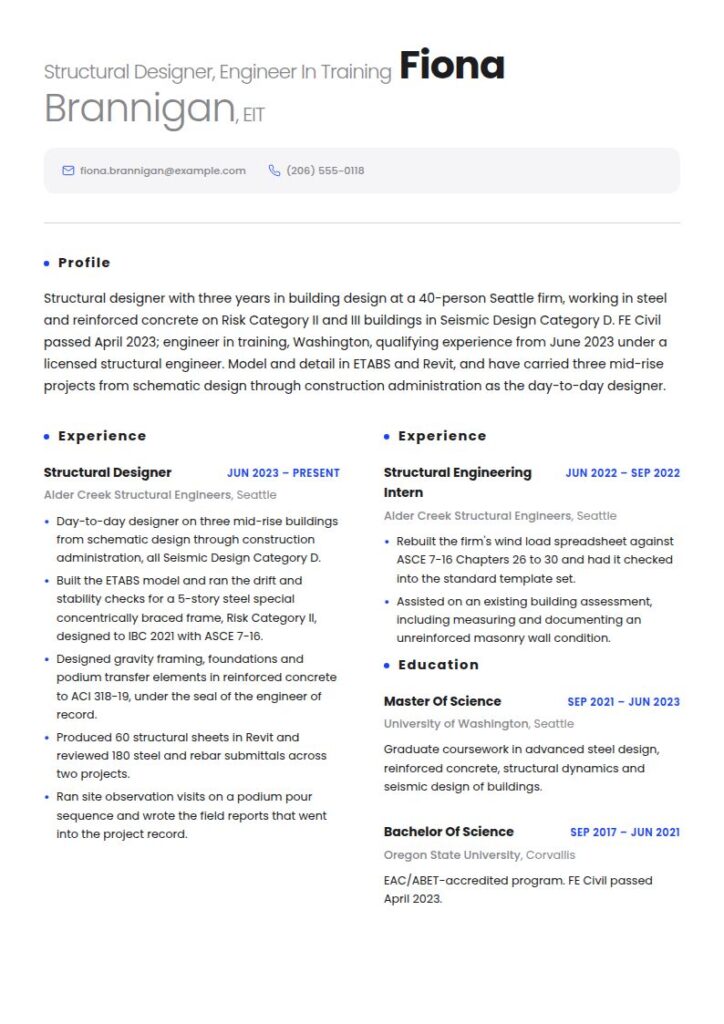
Structural Designer
[email protected] | (206) 555-0118 | Seattle, United States
Profile
Structural designer with three years in building design at a 40-person Seattle firm, working in steel and reinforced concrete on Risk Category II and III buildings in Seismic Design Category D. FE Civil passed April 2023; engineer in training, Washington, qualifying experience from June 2023 under a licensed structural engineer. Model and detail in ETABS and Revit, and have carried three mid-rise projects from schematic design through construction administration as the day-to-day designer.
Work Experience
06/2023 - Present, Structural Designer, Alder Creek Structural Engineers, Seattle, United States
- Day-to-day designer on three mid-rise buildings from schematic design through construction administration, all Seismic Design Category D.
- Built the ETABS model and ran the drift and stability checks for a 5-story steel special concentrically braced frame, Risk Category II, designed to IBC 2021 with ASCE 7-16.
- Designed gravity framing, foundations and podium transfer elements in reinforced concrete to ACI 318-19, under the seal of the engineer of record.
- Produced 60 structural sheets in Revit and reviewed 180 steel and rebar submittals across two projects.
- Ran site observation visits on a podium pour sequence and wrote the field reports that went into the project record.
06/2022 - 09/2022, Structural Engineering Intern, Alder Creek Structural Engineers, Seattle, United States
- Rebuilt the firm's wind load spreadsheet against ASCE 7-16 Chapters 26 to 30 and had it checked into the standard template set.
- Assisted on an existing building assessment, including measuring and documenting an unreinforced masonry wall condition.
Education
09/2021 - 06/2023, Master of Science, Civil Engineering, structural emphasis, University of Washington, Seattle, United States
Graduate coursework in advanced steel design, reinforced concrete, structural dynamics and seismic design of buildings.
09/2017 - 06/2021, Bachelor of Science, Civil Engineering, Oregon State University, Corvallis, United States
EAC/ABET-accredited program. FE Civil passed April 2023.
Skills
ETABS, 75
Revit and Revit structure, 80
Reinforced concrete design to ACI 318-19, 70
Structural steel design to AISC 360, 70
ASCE 7 wind and seismic load derivation, 75
Submittal and RFI review, 70
Construction site observation, 60
Languages
English, native
Certificates
06/2023, Engineer in Training, Washington, Washington State Board of Registration for Professional Engineers and Land Surveyors, EIT-33907
FE Civil passed April 2023. Qualifying experience from June 2023 under a licensed structural engineer.
Summary
A structural engineer resume is a one to two page document that says which codes and editions you design to, which materials you have detailed, and where you sit on the licensure route. This guide gives you three adaptable versions, the code and materials matrix that most applicants leave out, and current Bureau of Labor Statistics pay and outlook.
Structural Engineer resume examples by experience level
A structural engineer resume is a one to two page document that names the codes and editions you design to, the materials you have actually detailed, and where you sit on the licensure route.
Those three things are read together and they are read fast. A principal at a structural firm is deciding whether they can hand you a steel-framed Risk Category III building in a high seismic zone on Monday, or whether you will need six months of supervision first. Everything else is supporting evidence for that one question.
Resume guide for a structural engineer resume
This guide and the corresponding structural engineer resume example will cover:
- How to write a structural engineer resume, section by section
- The code and materials matrix, and why it decides who gets interviewed
- Three adaptable summaries: engineer in training, licensed PE and SE
- How the SE license differs from the PE, and where it is required
- The four kinds of structural work, and how each one is hired
- What the job market looks like and what you can expect to earn
How to write a structural engineer resume
Six sections: contact header, summary, licensure, project experience, code and materials competence, and education with software. One page until you hold a PE, two once you are engineer of record on buildings worth listing.
Licensure goes above experience. It is a gate: a firm cannot bill you the same way, cannot seal your work without a reviewer, and cannot let your hours count the same way toward somebody else's qualifying experience.
| Section | What it is answering | Where it goes |
|---|---|---|
| Licensure | PE, SE, which states, and how far along | Directly under the summary |
| Project experience | What did they design, how big, in what role | Reverse chronological, project lines inside each job |
| Code and materials | Which editions and which materials can they be handed? | Its own block, not buried in a skills list |
| Software | Which analysis packages and which detailing platform | Grouped with education, near the end |
The SE is a separate exam and a separate license, and saying which one you hold matters
The NCEES structural exam is not a longer PE exam. It has two components, Vertical Forces (Gravity/Other) and Lateral Forces (Wind/Earthquake), each with a breadth section and a depth section taken separately, and acceptable results are required on both components to pass. The breadth sections run to a six-hour appointment with 55 questions, of which 45 are scored; the depth sections run to a six-and-a-half-hour appointment. Breadth sections have been administered year-round since April 2024 and depth sections are offered twice a year. Examinees choose either buildings or bridges and must keep that choice across both depth components (NCEES, accessed September 2026).
That structure is why "SE" on a resume means something different from "PE". Write which one you hold, in which states, and if you are mid-sequence, say which component you have passed. "Vertical component passed October 2025, lateral scheduled April 2027" is a genuinely useful line to a firm planning its seal coverage.
Run the finished file through the free Rezoom ATS resume checker before you send it. Large multidisciplinary firms and every public agency parse applications before a human opens one.
Choosing the best resume format for a structural engineer resume
Reverse chronological, with project lines nested inside each job. A structural career reads as a progression through building types and structural systems, and that progression is the argument.
Two pages once you hold a license and are engineer of record on projects worth naming. If your project list runs longer than a page on its own, keep it as a separate document and say on the resume that one is available.
Include your contact information
| ✅ Right | ❌ Wrong |
|---|---|
| Fiona Brannigan, PE, SE | Fiona Brannigan |
| Structural Engineer, Buildings, Seismic Design Categories D and E | Experienced engineering professional |
| WA PE #46218, WA SE #1704, OR PE #91556 | Licensed professional engineer |
| (206) 555-0118, [email protected], Seattle, WA | (206) 555-0118, [email protected] |
Put the license numbers on the page. Every state board runs a public lookup, and the file that lets a reader verify in ten seconds moves faster than the one that makes them ask.
Make use of a summary
Four lines: building types, structural systems, licensure, and one project with a number attached.
Structural designer with three years in building design at a 40-person Seattle firm, working in steel and reinforced concrete on Risk Category II and III buildings in Seismic Design Category D. FE Civil passed April 2023; engineer in training, Washington, qualifying experience from June 2023 under a licensed structural engineer. Model and detail in ETABS and Revit, and have carried three mid-rise projects from schematic design through construction administration as the day-to-day designer.
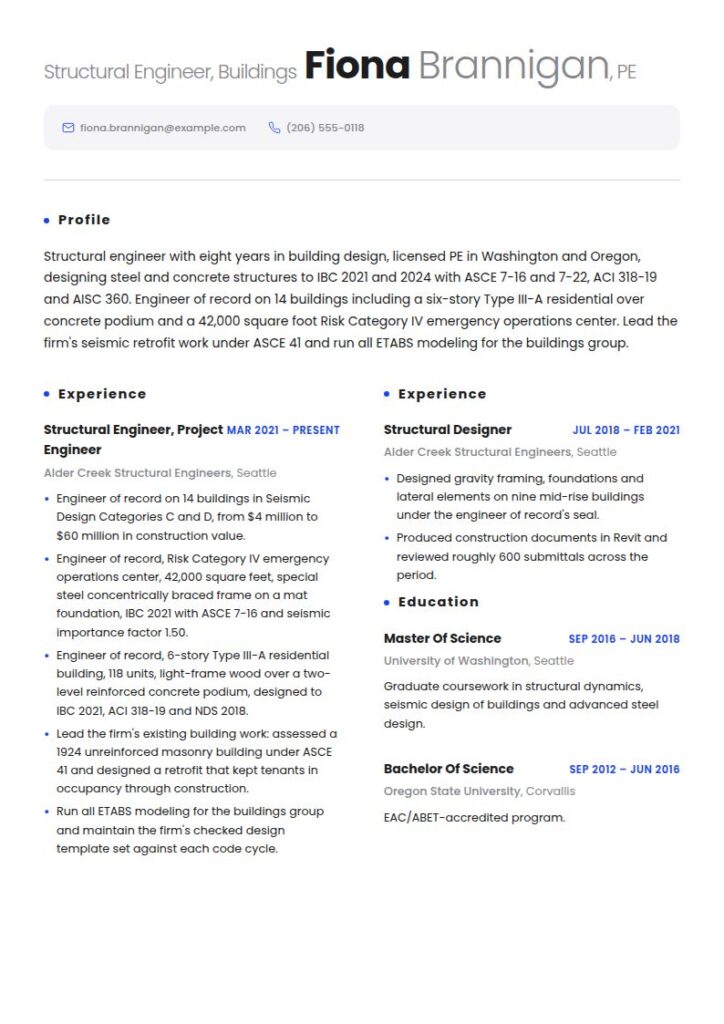
Structural engineer with eight years in building design, licensed PE in Washington and Oregon, designing steel and concrete structures to IBC 2021 and 2024 with ASCE 7-16 and 7-22, ACI 318-19 and AISC 360. Engineer of record on 14 buildings including a six-story Type III-A residential over concrete podium and a 42,000 square foot Risk Category IV emergency operations center. Lead the firm's seismic retrofit work under ASCE 41 and run all ETABS modeling for the buildings group.
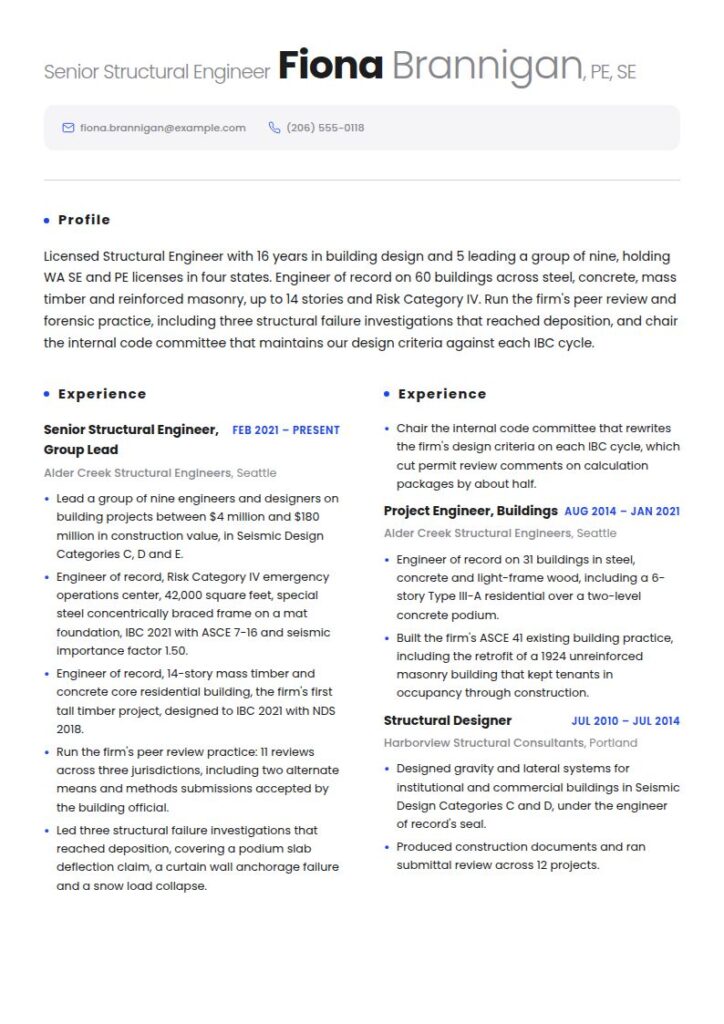
Licensed Structural Engineer with 16 years in building design and 5 leading a group of nine, holding WA SE and PE licenses in four states. Engineer of record on 60 buildings across steel, concrete, mass timber and reinforced masonry, up to 14 stories and Risk Category IV. Run the firm's peer review and forensic practice, including three structural failure investigations that reached deposition, and chair the internal code committee that maintains our design criteria against each IBC cycle.
Right vs wrong: the same structural engineer summary, twice
| ✅ Right | ❌ Wrong |
|---|---|
| Licensed PE in Washington and Oregon, designing to IBC 2021 and 2024. | Licensed professional engineer with strong technical skills. |
| Steel and concrete, ASCE 7-16 and 7-22, ACI 318-19, AISC 360. | Proficient in industry-standard codes and design standards. |
| Engineer of record on 14 buildings including a Risk Category IV facility. | Experience with a wide variety of commercial and institutional projects. |
| Lead the firm's seismic retrofit work under ASCE 41. | Knowledge of seismic design principles. |
The right column can be assigned work on Monday. The left column has to be interviewed to find out what it means, and a busy principal has four files and one interview slot.
Outline your structural engineering experience
Firm, city, dates, and your role. Then project lines. Each project line carries the building type, the structural system, the size, the seismic and wind parameters, and what part was yours.
| Instead of | Use |
|---|---|
| Designed various commercial buildings | Engineer of record, 6-story Type III-A residential, 118 units, wood over a two-level concrete podium, SDC D |
| Performed structural analysis using software | Built and ran the ETABS model for a 9-story steel special moment frame, including the drift and stability checks |
| Worked on seismic design | Designed the lateral system for a Risk Category IV emergency operations center to ASCE 7-22, importance factor 1.50 |
| Experience with renovations | Assessed an unreinforced masonry building under ASCE 41 and designed the retrofit that let it stay occupied |
| Prepared calculations and drawings | Sealed the calculation package and 38 structural sheets for a 42,000 square foot building permit set |
The kinds of work are not interchangeable, and a firm hiring for one does not necessarily value the others.
| Kind of work | What it actually is | What the resume has to show |
|---|---|---|
| New build | Design from schematic through construction administration | System selection, code edition, the number and type of buildings |
| Renovation and retrofit | Existing buildings, often ASCE 41, often partial information | Investigation skill, what you did when the drawings were missing |
| Forensic | Failure and distress investigation, often for litigation | What failed, how you established it, and whether you testified |
| Peer review | Independent review of another engineer's design | Which jurisdictions, which building types, and the review scope |
Senior Structural Engineer, Alder Creek Structural Engineers, Seattle, WA, February 2021 to Present
Lead a group of nine engineers and designers on building projects between $4 million and $180 million in construction value, in Seismic Design Categories C, D and E.
Engineer of record, Risk Category IV emergency operations center, 42,000 square feet, special steel concentrically braced frame on a mat foundation, designed to IBC 2021 with ASCE 7-16 and seismic importance factor 1.50.
Engineer of record, 6-story Type III-A residential building, 118 units, light-frame wood over a two-level reinforced concrete podium, designed to IBC 2021, ACI 318-19 and NDS 2018.
Assessed a 1924 unreinforced masonry building under ASCE 41 and designed a retrofit that allowed the tenants to remain in occupancy through construction, which was the condition the owner had been told was impossible.
Chair the internal code committee that rewrites the firm's design criteria on each IBC cycle, which cut the calculation review comments on permit submissions by about half.
Put a code and materials matrix on the page
This is the block almost no structural resume includes, and it is the one that gets you assigned to a project rather than to a review.
Structural work is defined by two axes: the code you design to and the material you detail. A firm that does mass timber does not care much that you are excellent in post-tensioned concrete. A firm chasing hospital work needs someone who has designed to Risk Category IV and knows what that means for the importance factor and for nonstructural anchorage.
Codes: IBC 2018, 2021 and 2024. ASCE 7-16 and 7-22. ASCE 41 for existing buildings. Washington and Oregon state amendments.
Materials designed and detailed: Structural steel to AISC 360 and the Seismic Provisions. Reinforced concrete to ACI 318-19, including special moment frames and shear walls. Light-frame and mass timber to NDS 2018 and 2024 with the special design provisions for wind and seismic. Reinforced masonry to TMS 402. Cold-formed steel framing.
Seismic: Seismic Design Categories C, D and E. Risk Categories II, III and IV. Equivalent lateral force and modal response spectrum analysis. Nonstructural component anchorage and Ip determination.
Wind: ASCE 7 Chapters 26 to 30, directional and envelope procedures, Exposure B and C, components and cladding.
Not yet designed: bridges, post-tensioned slabs, blast and progressive collapse.
That last line is deliberate. A firm would rather know than find out, and an applicant who marks their own boundary reads as someone whose other claims can be trusted.
The editions matter, and the NCEES adopted list tells you which ones the profession is on
The NCEES specification for the PE Civil Structural exam effective April 2027 adopts the 2024 International Building Code, ASCE 7-22, ACI 318-19, the AISC Steel Construction Manual 16th edition, the AWC NDS 2024, TMS 402/602-2022, the AASHTO LRFD Bridge Design Specifications 10th edition and the PCI Design Handbook 8th edition (NCEES, PE Civil Structural exam specifications, April 2027).
That list tells you which editions the profession treats as current, even though the edition a given project is designed to is whatever the local jurisdiction has adopted, which is frequently a cycle or two behind.
Write both. "IBC 2021 with local amendments; familiar with the 2024 changes to Risk Category assignment" is accurate, says what you have actually done, and shows you follow the code cycle rather than the code you learned.
Build a snapshot of your key skills
Twelve to sixteen entries in three groups: analysis and design software, detailing and documentation, and the practice skills.
Analysis and design: ETABS, SAP2000, RAM Structural System, RISA-3D, SAFE, Enercalc, spreadsheet-based design tools with checked templates
Detailing and documentation: Revit and Revit structure, AutoCAD, Tekla Structures, Bluebeam for submittal review
Practice: Engineer of record and seal responsibility, Construction administration and site observation, Submittal and RFI review, Existing building assessment under ASCE 41, Peer review, Structural condition and forensic investigation, Fee and scope writing
"ETABS for buildings, RAM for steel gravity framing, SAP2000 for anything that is not a building" tells a reader more about how you work than a list of eight logos. Say what you use each package for.
List your education and certifications
Degree with ABET accreditation, then licensure in full sequence, then anything specialist.
Licensed Structural Engineer, Washington, SE #1704, 2022. Licensed Professional Engineer: Washington PE #46218 (2014), Oregon #91556, Idaho, Alaska. NCEES Record holder.
NCEES 16-hour structural exam: vertical component passed October 2020, lateral component passed April 2021, buildings depth.
Master of Science, Civil Engineering, structural emphasis, University of Washington, Seattle, WA, 2010
Bachelor of Science, Civil Engineering, Oregon State University, Corvallis, OR, 2008. EAC/ABET-accredited program.
Continuing education: ASCE 41 seismic evaluation and retrofit, 2024. AISC Seismic Provisions update, 2023.
Where the SE license is actually required, and why you should name your state’s category
The National Council of Structural Engineers Associations sorts jurisdictions into three categories: full practice restriction, where only engineers who have passed the NCEES structural exam may seal structural drawings for any type of structure; partial practice restriction, where SE credentials are required for designated structures defined by importance, such as essential facilities or buildings over a certain height; and title restriction, which governs who may use the title Professional Engineer or Structural Engineer (NCSEA, accessed September 2026).
The categories are not evenly distributed and they change, so check your own jurisdiction rather than assuming. Washington, for example, maintains a separate structural engineer registration whose experience requirement is written around the design of structures integrated within "significant structures" as defined in state law (Washington Administrative Code 196-12-047, accessed September 2026).
On the resume, name the category you work under, not just the license. "WA SE, which is required here for significant structures" tells an out-of-state reader what your license means. "SE" alone means nothing to a firm in a state that does not issue one.
Choose the right layout and design
Single column, plain type at 11 point, clear headings, no photograph. Firms and public agencies parse these into a system before a human opens one, and two columns, text boxes and graphics are where that parsing breaks. One page until you hold a license; two after that, with the project lines carrying the weight.
Put license type, number and state in the header. Say which NCEES structural components you have passed if you are mid-sequence. Give every project a building type, a structural system, a size and a seismic design category. Say whether you were engineer of record or working under someone else's seal. Name the code editions you designed to, not just the code. Mark the materials and structure types you have not done.
Do not write "seismic design experience" without a seismic design category attached; the term covers everything from SDC B to SDC E and they are not the same job. Do not say engineer of record unless you sealed it. Do not list eight analysis packages you have opened once. Do not describe a project without saying what part was yours, because a firm reads an unattributed project list as a firm's portfolio rather than a person's. Do not use a two-column template for an agency portal.
Structural engineer job market and outlook
There is no separate federal occupation for structural engineers. The Bureau of Labor Statistics counts them within civil engineers, so that is the data set to read, with the understanding that it mixes structural work with transportation, water and geotechnical practice.
| Measure | Value |
|---|---|
| Civil engineer jobs, 2025 | 380,600 |
| Projected employment, 2035 | 405,100 |
| Projected change, 2025-35 | +6% (+24,500) |
| Projected annual openings | ~22,700 |
| Typical entry-level education | Bachelor's degree |
| Median annual wage, May 2025 | $100,840 |
Source: U.S. Bureau of Labor Statistics, Occupational Outlook Handbook, May 2025 wage data and 2025-35 employment projections.
Where the jobs sit:
| Industry | Share of employment | Median annual wage (May 2025) |
|---|---|---|
| Engineering services | 51% | $100,620 |
| State government, excluding education and hospitals | 11% | $102,440 |
| Local government, excluding education and hospitals | 10% | $113,640 |
| Nonresidential building construction | 7% | $82,400 |
| Federal government, excluding postal service | 3% | $117,790 |
Source: U.S. Bureau of Labor Statistics, Occupational Outlook Handbook, May 2025.
Structural practice concentrates more heavily in that first row than the occupation as a whole does. Buildings work is consulting work, and the agency roles that make up a fifth of civil engineering employment are mostly transportation and water rather than structures.
What salary you can expect as a structural engineer
Civil engineers, the occupation structural engineers are counted in, had a median annual wage of $100,840 in May 2025, with the lowest 10 percent under $68,240 and the highest 10 percent over $163,220 (BLS Occupational Outlook Handbook, May 2025).
Inside that range, two things move a structural engineer more than years do. The first is the seal: before licensure your work is reviewed and sealed by someone else and a firm bills you accordingly, and after it you can be engineer of record, which is what a firm is actually selling.
The second is the SE in jurisdictions that require it. Where a state restricts designated or significant structures to SE holders, the pool of people who can sign that work is small and the firm's ability to take it depends on them. That is why the licensure block belongs at the top of the page.
Key takeaways for a structural engineer resume
- Put licensure directly under the summary, with type, number and state.
- Say which NCEES structural components you have passed if you are mid-sequence.
- Build a code and materials matrix, with editions, and put it in its own block.
- Give every project a building type, a system, a size and a seismic design category.
- Say whether you were engineer of record or working under another seal.
- Separate new build, retrofit, forensic and peer review work; they are hired differently.
- Name your jurisdiction's licensure category, because SE means nothing in a state that does not issue one.
Build your structural engineer resume in 15 minutes.
Related engineering resume examples
- Civil engineer resume
- Mechanical engineer resume
- Electrical engineer resume
- Chemical engineer resume
- Project engineer resume
- Systems engineer resume
- Facility engineer resume
- Research engineer resume
- Health and safety engineer resume
- CNC machinist resume
- Technician resume
- Engineering resume
Pair it with a matching structural engineer cover letter.
Structural engineer resume questions, answered
How long should a structural engineer resume be?
One page until you hold a PE. Two once you are engineer of record on buildings worth naming, hold licenses in more than one state, or lead a group. Keep a longer project list as a separate document and offer it on the resume.
What is the difference between a PE and an SE?
The PE is the general professional engineering license. The SE comes from the NCEES 16-hour structural exam, taken as two components, Vertical Forces and Lateral Forces, each with breadth and depth sections, and both components must be passed (NCEES, accessed September 2026). Some jurisdictions restrict the design of designated or significant structures to SE holders, some restrict all structural practice, and some only restrict the title (NCSEA, accessed September 2026).
How do I show seismic experience properly?
With a category, not an adjective. Name the seismic design categories you have designed in, the risk categories of the buildings, the analysis procedure you used, and the code edition. "SDC D, Risk Category III, modal response spectrum analysis, ASCE 7-16" is a sentence a reviewer can act on.
What do I put on a structural engineer resume with no experience?
Your internship or co-op written as a job, the senior or graduate design project with its structural system and code, the analysis software you have genuinely used and what you used it for, and your FE result with a date. Then the licensure sequence: when you passed the FE, when your qualifying experience started, and under whom.
Should forensic work go on the same resume as design work?
Only partly. Applying to a design firm, one or two lines about failure investigation reads as depth. Applying to a forensic practice, the investigation work becomes the main event and the design projects become the credibility behind it. Write two versions rather than one that tries to do both.
Do I need to list code editions, or is the code name enough?
List editions. A firm whose jurisdiction is on IBC 2021 wants to know you have designed to it, and a firm moving to IBC 2024 wants to know whether you have read the Risk Category changes. The edition is the part that tells the reader when you last did the work.