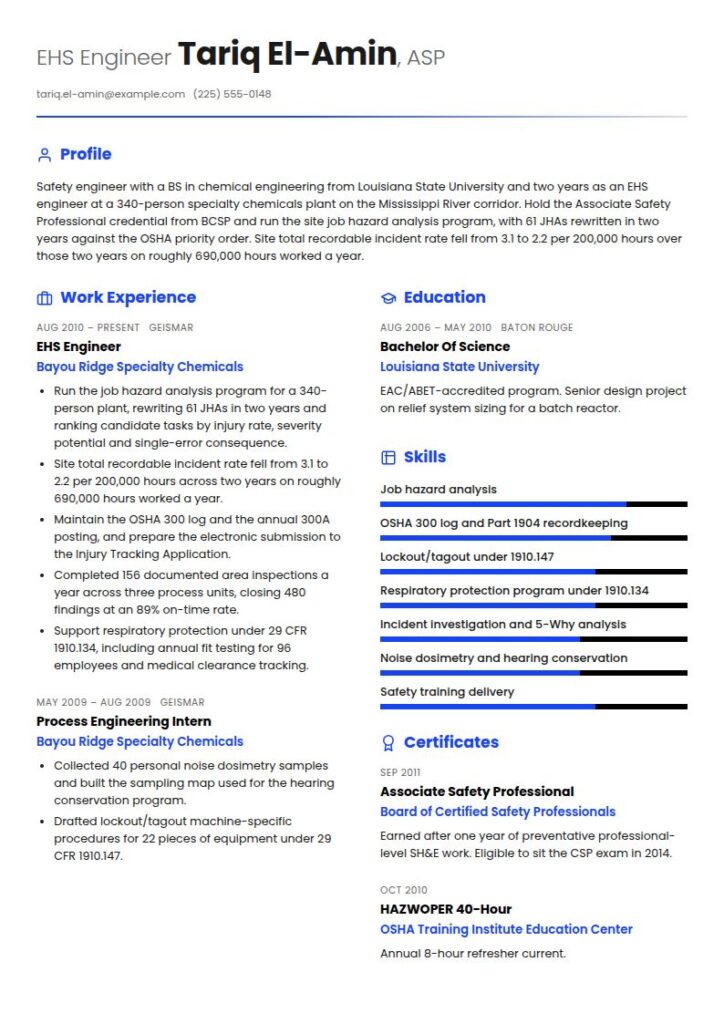
EHS Engineer Tariq El-Amin ASP
EHS Engineer
[email protected] | (225) 555-0148 | Baton Rouge, United States
Profile
Safety engineer with a BS in chemical engineering from Louisiana State University and two years as an EHS engineer at a 340-person specialty chemicals plant on the Mississippi River corridor. Hold the Associate Safety Professional credential from BCSP and run the site job hazard analysis program, with 61 JHAs rewritten in two years against the OSHA priority order. Site total recordable incident rate fell from 3.1 to 2.2 per 200,000 hours over those two years on roughly 690,000 hours worked a year.
Work Experience
08/2010 - Present, EHS Engineer, Bayou Ridge Specialty Chemicals, Geismar, United States
- Run the job hazard analysis program for a 340-person plant, rewriting 61 JHAs in two years and ranking candidate tasks by injury rate, severity potential and single-error consequence.
- Site total recordable incident rate fell from 3.1 to 2.2 per 200,000 hours across two years on roughly 690,000 hours worked a year.
- Maintain the OSHA 300 log and the annual 300A posting, and prepare the electronic submission to the Injury Tracking Application.
- Completed 156 documented area inspections a year across three process units, closing 480 findings at an 89% on-time rate.
- Support respiratory protection under 29 CFR 1910.134, including annual fit testing for 96 employees and medical clearance tracking.
05/2009 - 08/2009, Process Engineering Intern, Bayou Ridge Specialty Chemicals, Geismar, United States
- Collected 40 personal noise dosimetry samples and built the sampling map used for the hearing conservation program.
- Drafted lockout/tagout machine-specific procedures for 22 pieces of equipment under 29 CFR 1910.147.
Education
08/2006 - 05/2010, Bachelor of Science, Chemical Engineering, Louisiana State University, Baton Rouge, United States
EAC/ABET-accredited program. Senior design project on relief system sizing for a batch reactor.
Skills
Job hazard analysis, 80
OSHA 300 log and Part 1904 recordkeeping, 75
Lockout/tagout under 1910.147, 70
Respiratory protection program under 1910.134, 70
Incident investigation and 5-Why analysis, 65
Noise dosimetry and hearing conservation, 65
Safety training delivery, 70
Languages
English, native
Arabic, native
French, intermediate
Certificates
09/2011, Associate Safety Professional, Board of Certified Safety Professionals, ASP-38114
Earned after one year of preventative professional-level SH&E work. Eligible to sit the CSP exam in 2014.
10/2010, HAZWOPER 40-Hour, OSHA Training Institute Education Center
Annual 8-hour refresher current.
Summary
A health and safety engineer resume is a one to two page document that shows which measurable rate you moved, over what period, and under which standard. This guide gives you three adaptable versions, the TRIR and DART formulas written out so you can compute your own numbers, and current Bureau of Labor Statistics pay and outlook for the occupation.
Health and Safety Engineer resume examples by experience level
A health and safety engineer resume is a one to two page document that names the rates you moved, the regulation you moved them under, and the certification that lets a company put your name on a program.
This is one of the few engineering resumes that is read almost entirely as arithmetic. A plant manager or an EHS director is not asking whether you care about safety. Everyone in the folder cares about safety. They are asking whether your arrival at a previous site was followed by a measurable fall in a rate they also report, and whether you can hold up your side of an OSHA inspection or an insurance underwriting review without supervision.
Resume guide for a health and safety engineer resume
This guide and the corresponding health and safety engineer resume example will cover:
- How to write a health and safety engineer resume, section by section
- The TRIR and DART formulas, written out, so you can compute your own numbers
- Three adaptable summaries: early career, practicing engineer and program owner
- Which certifications gate which jobs, and what each one actually requires
- What the job market looks like and what you can expect to earn
How to write a health and safety engineer resume
Six sections: contact header, summary, certifications and licensure, experience with rates attached, regulatory and standards scope, education, and technical skills. One page for the first five years, two once you own a program across more than one site.
Certifications go above experience, because in this occupation they function as a screen. A large employer filtering for CSP does it in the applicant system before anyone reads a bullet.
| Section | What it is answering | Where it goes |
|---|---|---|
| Certifications | Does this person hold the credential the posting screens on? | Directly under the summary |
| Experience with rates | Did a number move, by how much, over what period? | Reverse chronological, one rate per role minimum |
| Regulatory scope | Which standards have they actually worked under? | A named block, not implied by job titles |
| Education | Is the degree an engineering degree? | Near the end, with the discipline stated |
Name the standard, not the word compliance
"Ensured OSHA compliance" tells a reader nothing, because OSHA is roughly 2,000 pages of standards covering everything from ladder angles to benzene exposure monitoring.
Name the parts you worked in. Process safety management under 29 CFR 1910.119. Control of hazardous energy under 1910.147. Permit-required confined spaces under 1910.146. Respiratory protection under 1910.134. Hazard communication under 1910.1200. Recordkeeping under Part 1904.
Each of those names a different working life. A reader who runs a PSM-covered site is scanning for 1910.119 and nothing else will substitute for it, because the standard carries 14 distinct elements and a person who has never run one does not know what a pre-startup safety review costs in hours.
Run the finished file through the free Rezoom ATS resume checker before you submit. Industrial employers and every public agency parse applications into a system before a human opens one, and certification acronyms are often the literal filter.
Choosing the best resume format for a health and safety engineer resume
Reverse chronological. The reader needs to line up your dates against the rate history you are claiming, and a functional format makes that impossible.
There is a second reason here. A rate that fell in your second year at a site is a stronger claim than one that fell in your ninth month, because a ninth-month fall is usually somebody else's work arriving late. Show the dates and let the reader do the arithmetic in your favor.
Include your contact information
| ✅ Right | ❌ Wrong |
|---|---|
| Tariq El-Amin, CSP | Tariq El-Amin |
| Health and Safety Engineer, Process Safety | Safety professional with a strong commitment to zero harm |
| CSP #38114, BCSP. CIH #11907, BGC. | Certified safety professional |
| (225) 555-0148, [email protected], Baton Rouge, LA | (225) 555-0148, [email protected] |
Put the certificate numbers in the header. BCSP and the Board for Global EHS Credentialing both publish searchable public rosters, so a recruiter verifies you in about forty seconds, and the file that makes that possible moves ahead of the one that does not.
Make use of a summary
Four lines: your discipline, your certification, the regulatory environment you work in, and one rate with a before, an after and a period.
Safety engineer with a BS in chemical engineering from Louisiana State University and two years as an EHS engineer at a 340-person specialty chemicals plant on the Mississippi River corridor. Hold the Associate Safety Professional credential from BCSP and run the site job hazard analysis program, with 61 JHAs rewritten in two years against the OSHA priority order. Site total recordable incident rate fell from 3.1 to 2.2 per 200,000 hours over those two years on roughly 690,000 hours worked a year.
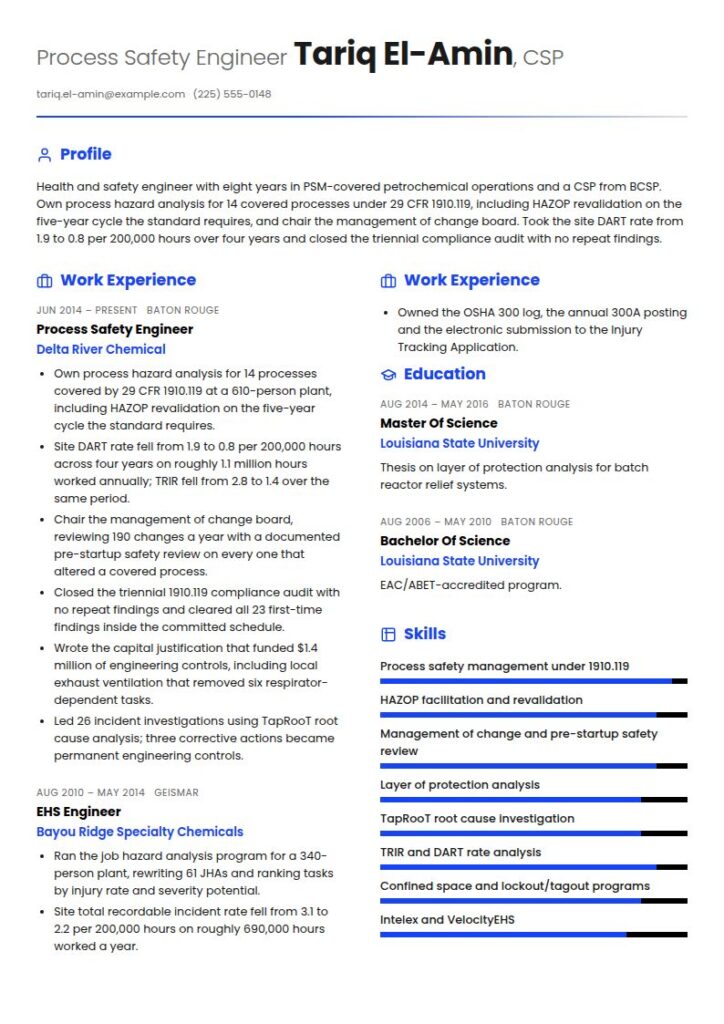
Health and safety engineer with eight years in PSM-covered petrochemical operations and a CSP from BCSP. Own process hazard analysis for 14 covered processes under 29 CFR 1910.119, including HAZOP revalidation on the five-year cycle the standard requires, and chair the management of change board. Took the site DART rate from 1.9 to 0.8 per 200,000 hours over four years and closed the triennial compliance audit with no repeat findings.
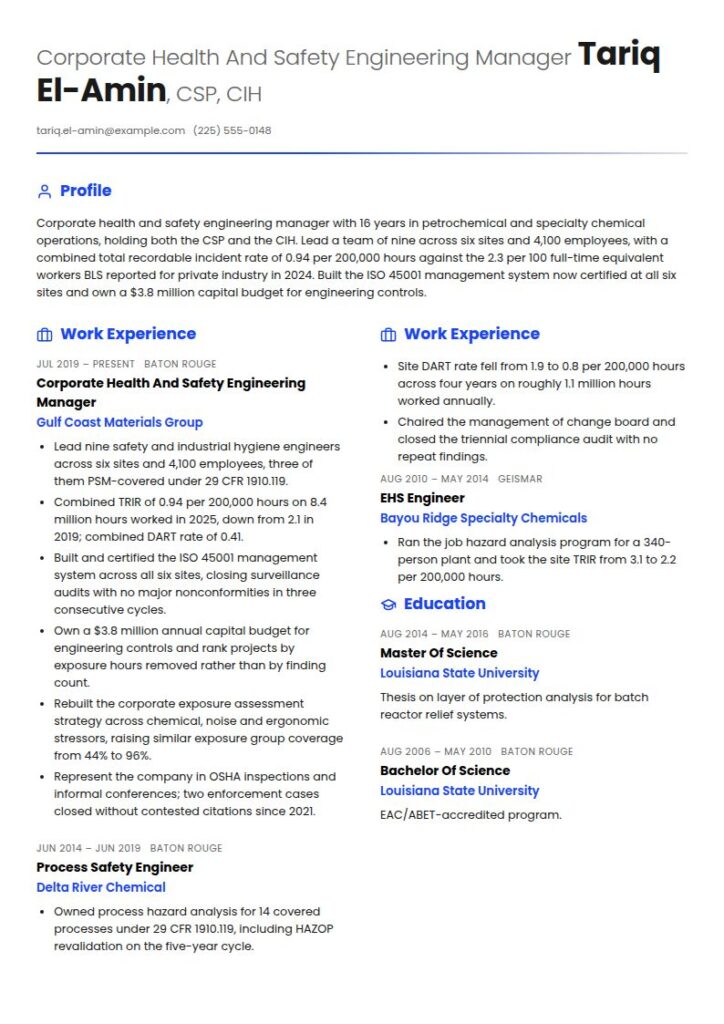
Corporate health and safety engineering manager with 16 years in petrochemical and specialty chemical operations, holding both the CSP and the CIH. Lead a team of nine across six sites and 4,100 employees, with a combined total recordable incident rate of 0.94 per 200,000 hours against the 2.3 per 100 full-time equivalent workers BLS reported for private industry in 2024. Built the ISO 45001 management system now certified at all six sites and own a $3.8 million capital budget for engineering controls.
Right vs wrong: the same health and safety engineer summary, twice
| ✅ Right | ❌ Wrong |
|---|---|
| Health and safety engineer with eight years in PSM-covered petrochemical operations and a CSP from BCSP. | Experienced safety professional with a passion for protecting people. |
| Own process hazard analysis for 14 covered processes under 29 CFR 1910.119. | Responsible for regulatory compliance across the facility. |
| Took the site DART rate from 1.9 to 0.8 per 200,000 hours over four years. | Successfully improved the site safety culture and reduced incidents. |
The right column can be compared against the reader's own numbers. The left column cannot, and every safety posting in the country attracts a folder full of the left column.
Outline your experience
Employer, site type, headcount, city and dates. Then bullets that each carry a number, and at least one rate per role.
| Instead of | Use |
|---|---|
| Conducted safety inspections of the facility | Ran 312 documented area inspections across 4 process units, closing 1,140 findings at a 94% on-time rate |
| Ensured compliance with OSHA regulations | Owned PSM under 29 CFR 1910.119 for 14 covered processes, including the five-year PHA revalidation cycle |
| Investigated workplace accidents | Led 26 incident investigations using TapRooT root cause analysis; 3 corrective actions became engineering controls |
| Reduced workplace injuries | Took the site DART rate from 1.9 to 0.8 per 200,000 hours over four years on 1.1 million hours worked a year |
| Delivered safety training to employees | Rebuilt confined space entry training under 1910.146 for 280 operators and 41 contractors, with an annual requalification |
| Managed personal protective equipment | Replaced respirator-dependent tasks with local exhaust ventilation on 6 of 9 jobs, cutting cartridge-change exposure hours by 71% |
Process Safety Engineer, Delta River Chemical, Baton Rouge, LA, June 2014 to Present
Own process hazard analysis for 14 processes covered by 29 CFR 1910.119 at a 610-person plant, including HAZOP revalidation on the five-year cycle the standard requires.
Site DART rate fell from 1.9 to 0.8 per 200,000 hours across four years on roughly 1.1 million hours worked annually; TRIR fell from 2.8 to 1.4 over the same period.
Chair the management of change board, reviewing 190 changes a year with a documented pre-startup safety review on every one that altered a covered process.
Closed the triennial 1910.119 compliance audit with no repeat findings, and cleared all 23 first-time findings inside the committed schedule.
Wrote the capital justification that funded $1.4 million of engineering controls, including local exhaust ventilation that removed six respirator-dependent tasks.
Put the rate on the page, and the formula behind it
This is the section that separates two safety resumes with identical job titles, and it is the reason most of them fail: they describe activity instead of reporting a rate.
Safety performance has a standard arithmetic, and every employer you apply to already uses it. Write your numbers in it.
The incidence rate formula the Bureau of Labor Statistics publishes for employers is:
(Number of injuries and illnesses x 200,000) / employee hours worked = incidence rate
The 200,000 in the numerator is not arbitrary. It is the equivalent of 100 employees working 40 hours a week for 50 weeks a year (BLS, How To Compute Your Firm's Incidence Rate for Safety Management, accessed September 2026). That is what makes rates comparable across a 40-person shop and a 4,000-person plant, and it is why a rate always has to be stated per 200,000 hours rather than as a raw count.
Two rates matter on a resume, and they take their numerators from different columns of the OSHA 300 log:
| Rate | Numerator | What it measures |
|---|---|---|
| TRIR, total recordable incident rate | Column H plus Column I plus Column J: all recordable cases | Everything that met the recording criteria |
| DART rate | Column H plus Column I only: days away, restricted or transferred | The serious end, where work actually changed |
Source: U.S. Bureau of Labor Statistics, How To Compute Your Firm's Incidence Rate for Safety Management, accessed September 2026.
So a site with 9 recordable cases on 900,000 hours worked has a TRIR of (9 x 200,000) / 900,000, which is 2.0. If 4 of those 9 involved days away, restriction or transfer, the DART rate is (4 x 200,000) / 900,000, which is 0.89.
Give the hours as well as the rate, or the rate means nothing
BLS reported 2.5 million nonfatal workplace injuries and illnesses in private industry in 2024, a total recordable case rate of 2.3 cases per 100 full-time equivalent workers, down 3.1 percent from 2023 (U.S. Bureau of Labor Statistics, Employer-Reported Workplace Injuries and Illnesses, released 22 January 2026).
That national figure is the benchmark your reader has in their head. A claimed TRIR of 0.4 at a 60-person site is roughly two recordable cases avoided in a year, which is inside normal variation. The same 0.4 across 2 million hours is a genuine result.
So write the denominator. "TRIR 1.4 on 1.1 million hours worked" is a sentence an EHS director trusts. "Achieved industry-leading safety performance" is one they have read four hundred times, and it is usually attached to a site small enough that one slip on a stairwell would double the rate.
Give a before, an after, a period and the hours worked for every rate you claim. Say which rate it is, TRIR or DART, and state it per 200,000 hours. Name the standard by its CFR citation. Distinguish what you owned from what you supported. Say how many sites, how many employees and how many contractors were in scope.
Do not claim a rate for a period you were not there for. Do not quote a rate without the hours behind it, because a reader who knows the formula will discount it. Do not put "zero incidents" on a resume without the hours and the headcount; on a small site it reads as luck. Do not write "OSHA compliant" as an achievement, since compliance is the baseline, not the outcome. Do not describe a near-miss reporting increase as a safety improvement without explaining why a rise in reporting is the goal.
Leading indicators belong on the page too: near-miss reporting rate, corrective actions closed on time, JHA coverage of high-risk tasks, training currency, inspection completion. A candidate who reports only lagging rates looks like someone who counts injuries. One who reports both looks like someone who prevents them.
Build a snapshot of your key skills
Twelve to sixteen entries in four groups: regulatory, analysis, industrial hygiene, and the systems your employer actually runs.
Regulatory: 29 CFR 1910.119 process safety management, 1910.147 lockout/tagout, 1910.146 confined space, 1910.134 respiratory protection, 1910.1200 hazard communication, Part 1904 recordkeeping, EPA Risk Management Program
Analysis: HAZOP, what-if and checklist, FMEA, fault tree analysis, layer of protection analysis, job hazard analysis, TapRooT and 5-Why root cause investigation
Industrial hygiene: Personal exposure monitoring, noise dosimetry, local exhaust ventilation design review, respirator fit testing program, sampling strategy under NIOSH methods
Management systems and tools: ISO 45001, ANSI/ASSP Z10.0, Intelex, Enablon, VelocityEHS, OSHA 300 log and Injury Tracking Application submission, Power BI rate dashboards
List your education and certifications
Degree with the engineering discipline named, then certifications in the order a reader screens for them, with the issuing board and the number.
The credentials are not interchangeable, and knowing which one a posting actually wants is half the job of applying.
| Credential | Issuer | What it requires |
|---|---|---|
| ASP, Associate Safety Professional | BCSP | A bachelor's degree in any field or an associate in SH&E, plus one year of SH&E experience at least half of which is preventative professional-level work; a five-hour exam |
| CSP, Certified Safety Professional | BCSP | A bachelor's degree in any field, a BCSP-approved credential such as the ASP, and four years of SH&E experience at least half of which is preventative professional-level work; a five and a half hour exam |
| CHST, Construction Health and Safety Technician | BCSP | No degree required, three years of construction safety experience where at least 35 percent of duties require technical SH&E skill; a four-hour exam |
| CIH, Certified Industrial Hygienist | Board for Global EHS Credentialing | A bachelor's degree, at least 60 semester credits of science and mathematics, at least 12 semester credits or 180 contact hours of industrial hygiene coursework, and four years of professional-level comprehensive IH practice across at least two stressor categories |
Sources: Board of Certified Safety Professionals, Credentials At-A-Glance, accessed September 2026; Board for Global EHS Credentialing, CIH eligibility requirements, accessed September 2026.
Certified Safety Professional, Board of Certified Safety Professionals, #38114, 2017. Recertification current through 2027.
Certified Industrial Hygienist, Board for Global EHS Credentialing, #11907, 2023.
Master of Science, Occupational Safety and Health, Louisiana State University, Baton Rouge, LA, 2016
Bachelor of Science, Chemical Engineering, Louisiana State University, Baton Rouge, LA, 2010. EAC/ABET-accredited program.
Training: OSHA 511 General Industry Standards (2021). HAZWOPER 40-hour, current through 2027. TapRooT Advanced Root Cause Analysis (2022). ISO 45001 Lead Auditor (2023).
The PE license is optional in this occupation and most postings do not ask for it, though some states require licensure for engineers practicing fire protection engineering (BLS Occupational Outlook Handbook, accessed September 2026). If you hold one, list it; if you do not, the CSP is the credential that carries weight.
Choose the right layout and design
Single column, 10 or 11 point body type, a clear heading per section, no photograph. Keep rates in plain text rather than in a chart image, because the parser reads text and drops graphics.
If you work under a management system, say which. ISO 45001 was written for third-party certification in the way ISO 9001 and ISO 14001 are, while ANSI/ASSP Z10.0 is the United States consensus standard and is not currently used by certification bodies; Z10 places noticeably greater emphasis on worker participation and on occupational health (ASSP, comparison of ANSI Z10 and ISO 45001, accessed September 2026). A site chasing certification wants the first. A site building a program wants someone who has read the second.
Health and safety engineer job market and outlook
A small occupation, growing faster than average, with hiring driven mostly by retirements and transfers rather than by new positions.
| Measure | Value |
|---|---|
| Health and safety engineer jobs, 2025 | 22,300 |
| Projected change, 2025-35 | +5% (+1,200) |
| Projected annual openings | ~1,200 |
| Typical entry-level education | Bachelor's degree |
| Median annual wage, May 2025 | $115,160 |
Source: U.S. Bureau of Labor Statistics, Occupational Outlook Handbook, May 2025 wage data and 2025-35 employment projections.
Where the jobs sit:
| Industry | Share of employment | Median annual wage (May 2025) |
|---|---|---|
| Manufacturing | 22% | $116,050 |
| Government, excluding state and local education | 12% | $116,020 |
| Engineering services | 10% | $113,690 |
| Construction | 9% | $103,450 |
Source: U.S. Bureau of Labor Statistics, Occupational Outlook Handbook, May 2025.
Those four settings buy different evidence. Manufacturing wants a rate history and a standard you have lived inside. Government wants inspection, enforcement and rulemaking literacy. Engineering services wants billable project work and client-facing hazard analysis. Construction wants the CHST or an OSHA 500 trainer card and multi-employer worksite experience, which is a different problem from a fixed plant.
What salary you can expect as a health and safety engineer
The median annual wage for health and safety engineers was $115,160 in May 2025. The lowest 10 percent earned less than $68,420 and the highest 10 percent more than $171,250 (BLS Occupational Outlook Handbook, May 2025).
That is above the $99,520 median for architecture and engineering occupations as a whole and more than double the $50,980 median for all occupations in May 2025 (BLS Occupational Outlook Handbook, May 2025). Most of the spread inside the occupation is scope rather than industry: the four largest industries sit within about $13,000 of each other, while the gap from the tenth to the ninetieth percentile is over $100,000.
What moves you up that range is the number of sites, the number of employees and contractors in scope, whether the operation is PSM-covered or highly regulated, and whether you hold the CSP. Those four facts are worth stating explicitly, because a reader cannot infer headcount or regulatory exposure from a job title.
Key takeaways for a health and safety engineer resume
- Put certifications directly under the summary; they are the screen, not a decoration.
- Give every rate a before, an after, a period and the hours worked behind it.
- Say which rate you mean, TRIR or DART, and state it per 200,000 hours.
- Name standards by CFR citation instead of writing "compliance".
- Report leading indicators alongside lagging rates.
- State the scope: sites, employees, contractors, and whether the process is covered.
- Keep it single column and parseable, since the acronym filter runs before a person reads.
Build your health and safety engineer resume in 15 minutes.
Related engineering resume examples
- Civil engineer resume
- Mechanical engineer resume
- Electrical engineer resume
- Chemical engineer resume
- Process engineer resume
- Structural engineer resume
- Project engineer resume
- Systems engineer resume
- CNC machinist resume
- Technician resume
- Agricultural engineer resume
- Engineering resume
Pair it with a matching health and safety engineer cover letter.
Health and safety engineer resume questions, answered
How long should a health and safety engineer resume be?
One page for the first five years. Two once you own a program across more than one site, hold the CSP, or have a rate history long enough to show a trend rather than a single year.
Do I need a CSP to get hired as a health and safety engineer?
Not for entry-level work, but it is the most common screening credential above it. The CSP requires a bachelor's degree in any field, a BCSP-approved credential such as the ASP, and four years of SH&E experience at least half of which is preventative professional-level work (BCSP, accessed September 2026). Listing the ASP and the date you become CSP-eligible tells a reader exactly when you clear the bar.
How do I write safety results when the site rate did not move?
Report what did. Corrective action closure rate, near-miss reporting volume, JHA coverage of high-risk tasks, training currency, audit findings closed, exposure hours removed by an engineering control. A site already at a low rate cannot improve much, and a candidate who understands that reads as more experienced than one claiming a dramatic fall.
What is the difference between the CSP and the CIH?
The CSP is a safety engineering credential from BCSP. The CIH is an industrial hygiene credential from the Board for Global EHS Credentialing and requires 60 semester credits of science and mathematics, at least 180 contact hours of industrial hygiene coursework, and four years of comprehensive IH practice across at least two stressor categories (Board for Global EHS Credentialing, accessed September 2026). Safety is about injury; hygiene is about exposure. Sites with chemical, noise or airborne hazards often want both.
Should I list the standards I have worked under?
Yes, by citation, in their own block. A PSM-covered site screens for 29 CFR 1910.119, a standard with 14 elements including process hazard analysis, management of change and mechanical integrity, with PHAs revalidated at least every five years and compliance audits at least every three (OSHA, 29 CFR 1910.119). Nothing in a job title substitutes for having done that.
What belongs on an entry-level health and safety engineering resume?
Your engineering degree with the discipline named, the ASP if you have it or your eligibility date if you do not, and any internship written as a job with counts attached: inspections completed, JHAs written, samples collected, training sessions delivered. A job hazard analysis program is a good first assignment to claim, because OSHA's own guidance ranks candidate jobs by injury rate, severity potential, single-error consequence, novelty and complexity, and a candidate who prioritized that way has demonstrated judgment rather than effort (OSHA, Job Hazard Analysis, publication 3071).