Electrical Engineer, Power Systems Oluwaseun Bakare EIT
Engineer in Training, Power Systems
[email protected] | (919) 555-0146 | Raleigh, United States
Profile
Electrical engineer in power systems with a BS from the ABET-accredited programme at North Carolina State University, FE Electrical and Computer passed October 2024, and Engineer in Training registration in North Carolina. Two years of qualifying experience under a licensed PE building short-circuit, protective device coordination and arc-flash models in ETAP for industrial and utility clients. Modelled 41 substations and 610 buses across nine studies, and produced the NFPA 70E labelling packages that came out of them.
Work Experience
07/2024 - Present, Engineer in Training, Power Systems, Cardinal Grid Engineering, Raleigh, United States
- Build short-circuit, protective device coordination and arc-flash models in ETAP under a licensed PE: 41 substations and 610 buses across nine client studies.
- Produce NFPA 70E labelling packages from IEEE 1584-2018 incident energy results, including the field walkdown and equipment schedule behind each one.
- Draft single line diagrams, panel schedules and conduit schedules in AutoCAD Electrical for 480 V and 4.16 kV industrial distribution.
- Support relay setting files for SEL 400 and 700 series feeder devices, checked and sealed by the engineer of record.
01/2023 - 12/2023, Engineering Co-op, Substation Design, Piedmont Power Cooperative, Raleigh, United States
- Three rotations across substation physical design, protection and field commissioning support.
- Produced ground grid calculations and 36 as-built markup sheets for two 115 kV stations.
Education
08/2020 - 05/2024, Bachelor of Science, Electrical Engineering, North Carolina State University, Raleigh, United States
EAC/ABET-accredited programme. Power systems concentration. Senior design: distribution feeder reconfiguration study for a 12.47 kV rural circuit.
Skills
ETAP short-circuit and coordination modelling, 70
IEEE 1584-2018 arc-flash studies, 70
National Electrical Code (NFPA 70), 65
AutoCAD Electrical, 75
Field walkdown and equipment data collection, 80
MATLAB, 65
Languages
English, native
Yoruba, native
Certificates
01/2025, Engineer in Training, North Carolina, North Carolina Board of Examiners for Engineers and Surveyors, EI-21844
FE Electrical and Computer passed October 2024. Qualifying experience from July 2024 under a licensed PE.
03/2025, NFPA 70E Electrical Safety for Qualified Persons, National Fire Protection Association training provider
Summary
An electrical engineer resume is a one to two page document that names your specialism, the standards you design to and the tools you produce in. This guide gives you three adaptable versions, the specialism declaration that stops a good file being screened out by the wrong reader, and current Bureau of Labor Statistics pay and outlook for the occupation.
Electrical Engineer resume examples by experience level
An electrical engineer resume is a one to two page document that says which kind of electrical engineering you do, what standards you design to, and what you have actually produced.
The first of those three is the one that decides whether the rest gets read. Electrical engineering is not one occupation. It is six or seven largely unrelated jobs that happen to share a degree, and a hiring manager in one of them cannot evaluate evidence from another. A power systems engineer reads a firmware resume and sees nothing usable. A semiconductor group reads a substation resume the same way. Both files may be excellent, and both get screened out in seconds.
Resume guide for an electrical engineer resume
This guide and the corresponding electrical engineer resume example will cover:
- How to write an electrical engineer resume, section by section
- How to declare your specialism so the right reader keeps reading
- Three adaptable summaries: engineer in training, licensed engineer and lead
- Which specialisms need a PE, which do not, and why
- What the job market looks like and what you can expect to earn
How to write an electrical engineer resume
Six sections: contact header, summary, licensure and clearance, engineering experience, education, and technical skills. One page for your first five years, two once you hold a licence or a project record worth listing.
The order changes by specialism, and that is the point. In power the licence block goes directly under the summary because it is a gate. In embedded work there is no licence, so the toolchain and the silicon you have shipped take that slot instead.
| Section | What it is answering | Where it goes |
|---|---|---|
| Specialism line | Which electrical engineering is this? | The title line, above everything |
| Licensure or clearance | Can they seal work, or enter the building? | Under the summary, if either applies |
| Experience | What have they designed, at what scale, with whose sign-off? | Reverse chronological, with numbers |
| Standards and tools | Can they start on our stack without a year of training? | Grouped, near the end |
Put the standard in the bullet, not just the software
Every electrical specialism is governed by documents, and naming them is the cheapest way to prove you have worked inside a real design review rather than a classroom.
In power that means the National Electrical Code, currently the 2026 edition (NFPA 70, NFPA), plus NFPA 70E for electrical safety in the workplace and IEEE 1584-2018, the IEEE Guide for Performing Arc-Flash Hazard Calculations, which gives the models for arc-flash boundary and incident energy on three-phase AC systems from 208 V to 15 kV (IEEE Standards Association, accessed September 2026).
In board design it means the IPC family, and in aerospace or defence it means the programme's own requirements documents. "Performed arc-flash studies" is a duty. "Performed arc-flash studies on 34 buses to IEEE 1584-2018 and produced the NFPA 70E labelling package" is evidence.
Run the finished file through the free Rezoom ATS resume checker before you send it. Large manufacturers, utilities and defence primes all parse applications into a system before a human opens one.
Choosing the best resume format for an electrical engineer resume
Reverse chronological. One page until you have five or six years, two after that.
A functional format is tempting here, because many electrical engineers have moved between specialisms and a skills-first layout seems to hide the switching. It does not. It reads as someone who cannot show a continuous record in any one of them. Show the sequence and label each move.
Include your contact information
| ✅ Right | ❌ Wrong |
|---|---|
| Oluwaseun Bakare, PE | Oluwaseun Bakare |
| Electrical Engineer, Power Systems and Protection | Electrical Engineering Professional |
| PE, North Carolina #PE-048221, Power depth. NCEES Record #61330. | Licensed engineer |
| (919) 555-0146, [email protected], Raleigh, NC | (919) 555-0146, [email protected] |
The second line is the whole argument of this page. “Electrical Engineer” tells a reader nothing they can act on. “Electrical Engineer, Power Systems and Protection” routes the file to the right desk in under a second.
Make use of a summary
Four lines: specialism, licence or clearance status, the systems you work on and their scale, and one delivered result with a number.
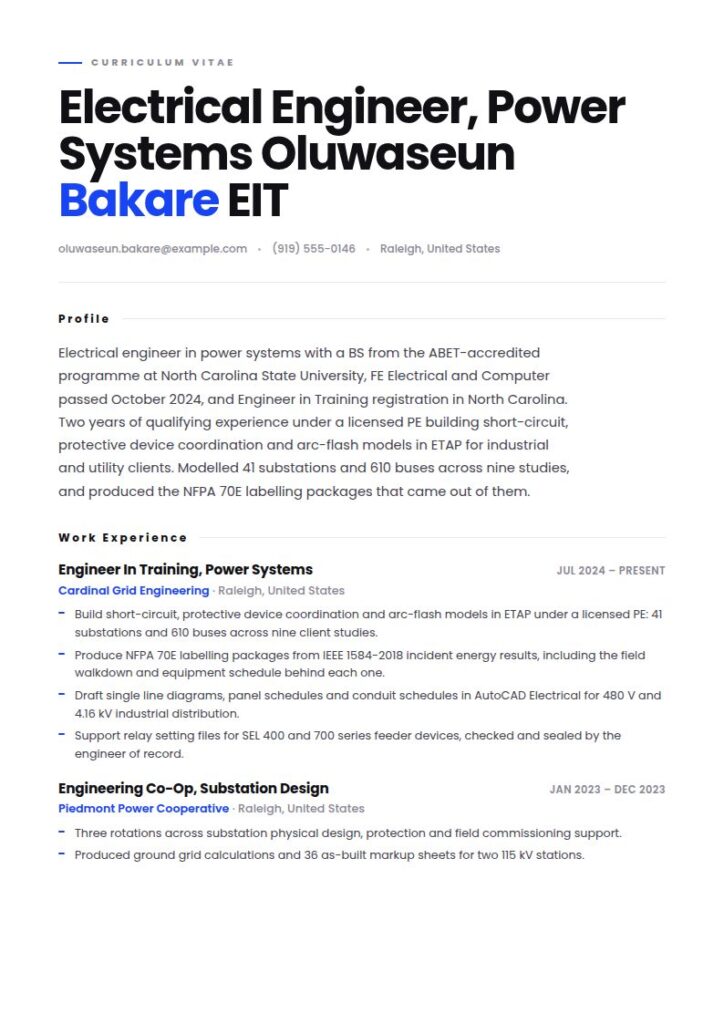
Electrical engineer in power systems with a BS from the ABET-accredited programme at North Carolina State University, FE Electrical and Computer passed October 2024, and Engineer in Training registration in North Carolina. Two years of qualifying experience under a licensed PE building short-circuit, protective device coordination and arc-flash models in ETAP for industrial and utility clients. Modelled 41 substations and 610 buses across nine studies, and produced the NFPA 70E labelling packages that came out of them.
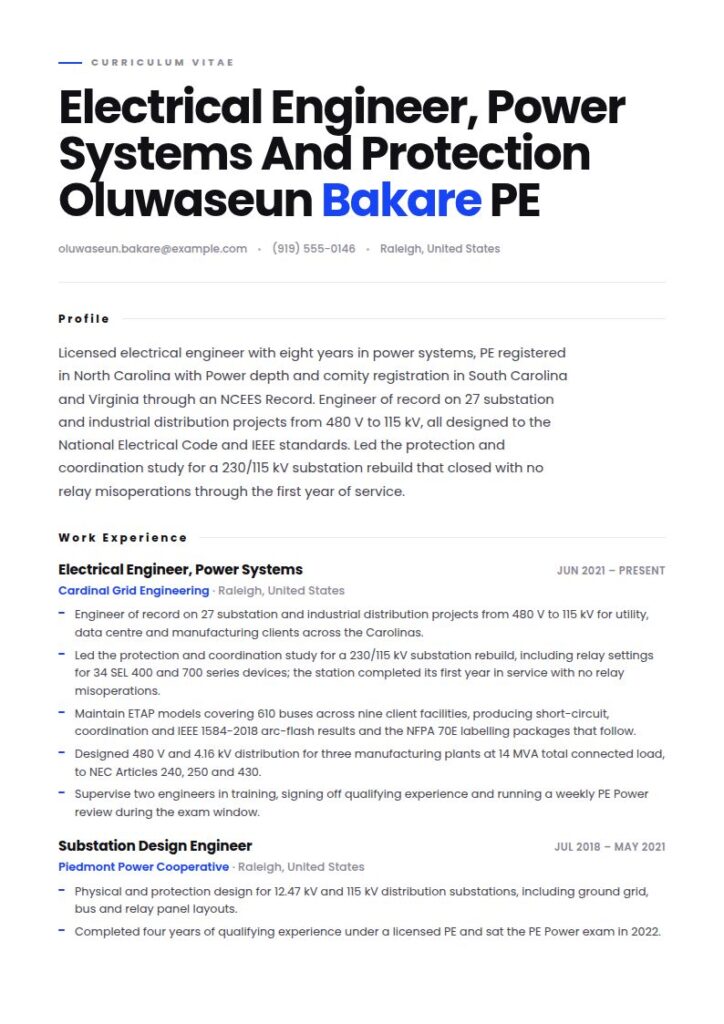
Licensed electrical engineer with eight years in power systems, PE registered in North Carolina with Power depth and comity registration in South Carolina and Virginia through an NCEES Record. Engineer of record on 27 substation and industrial distribution projects from 480 V to 115 kV, all designed to the National Electrical Code and IEEE standards. Led the protection and coordination study for a 230/115 kV substation rebuild that closed with no relay misoperations through the first year of service.
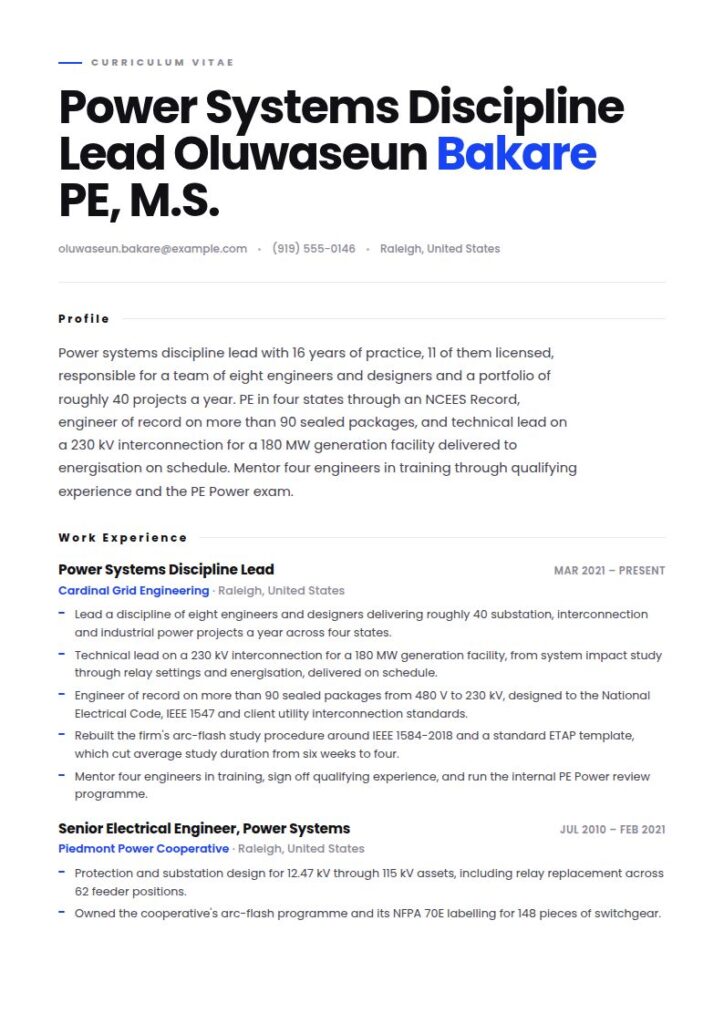
Power systems discipline lead with 16 years of practice, 11 of them licensed, responsible for a team of eight engineers and designers and a portfolio of roughly 40 projects a year. PE in four states through an NCEES Record, engineer of record on more than 90 sealed packages, and technical lead on a 230 kV interconnection for a 180 MW generation facility delivered to energisation on schedule. Mentor four engineers in training through qualifying experience and the PE Power exam.
Right vs wrong: the same electrical engineer summary, twice
| ✅ Right | ❌ Wrong |
|---|---|
| Licensed electrical engineer with eight years in power systems, PE with Power depth, comity in South Carolina and Virginia. | Experienced electrical engineer with a strong background in a variety of areas. |
| Engineer of record on 27 substation and industrial distribution projects from 480 V to 115 kV. | Worked on numerous electrical projects across multiple voltage levels. |
| Led the protection and coordination study for a 230/115 kV rebuild that closed with no relay misoperations in year one. | Responsible for protection studies and other electrical engineering tasks. |
The right column can be staffed onto a job next month. The left column could be any of six different engineers, and the reader will not spend the time working out which.
Outline your engineering experience
Employer, city, dates and title first. Then four or five bullets, each naming a system, a scale and a standard.
| Instead of | Use |
|---|---|
| Performed electrical engineering calculations | Built short-circuit, coordination and arc-flash models for 610 buses across nine facilities in ETAP |
| Designed electrical systems for industrial clients | Designed 480 V and 4.16 kV distribution for three manufacturing plants, 14 MVA connected load, to NEC Article 240 and 250 |
| Used AutoCAD for electrical drawings | Produced 186 sealed sheets of single line, schematic, panel schedule and conduit plan in AutoCAD Electrical |
| Familiar with industry codes | Designed to the National Electrical Code, IEEE 1584-2018 and the client’s utility interconnection standard |
| Worked with contractors during construction | Ran construction support on a $22 million substation: 63 RFIs, 141 submittals, three field change notices |
| Involved in testing and commissioning | Witnessed relay acceptance testing on 28 SEL and GE feeder relays and signed the commissioning punch list |
Electrical Engineer, Power Systems, Cardinal Grid Engineering, Raleigh, NC, June 2021 to Present
Engineer of record on 27 substation and industrial distribution projects from 480 V to 115 kV for utility, data centre and manufacturing clients across the Carolinas.
Led the protection and coordination study for a 230/115 kV substation rebuild, including relay settings for 34 SEL 400 and 700 series devices; the station has run its first year in service with no relay misoperations.
Built and maintained ETAP models covering 610 buses across nine client facilities, producing short-circuit, coordination and IEEE 1584-2018 arc-flash results and the NFPA 70E labelling packages that followed.
Designed 480 V and 4.16 kV distribution for three manufacturing plants at 14 MVA total connected load, to NEC Articles 240, 250 and 430.
Supervise two engineers in training, signing off qualifying experience and running a weekly PE Power review during the exam window.
Declare which electrical engineering you do, in the title line
This is the section that decides an electrical engineering job search, and it is the one almost nobody writes on purpose.
The degree is shared. The work is not. A resume that says only “Electrical Engineer” forces the reader to reconstruct your specialism from your bullets, and readers screening forty files do not reconstruct anything. Put the specialism in the title line under your name, then make the rest of the page agree with it.
| Specialism | What the reader wants named | Typical tools | Licence position |
|---|---|---|---|
| Power systems and utilities | Voltage classes, study types, interconnection work | ETAP, SKM PowerTools, CDEGS, AutoCAD Electrical | PE is often required; PE Power is offered year round (NCEES) |
| Embedded and firmware | Architecture, peripherals, RTOS, shipped units | C, Embedded C++, ARM toolchains, JTAG debuggers, Git | No licence; the shipped product is the credential |
| Analogue and RF | Frequency bands, noise figure, link budgets, silicon | Cadence Virtuoso, ADS, network analysers, SPICE | No licence |
| PCB design and hardware | Layer counts, signal integrity, DFM yield | Altium Designer, Cadence Allegro, OrCAD, HyperLynx | No licence; IPC certification carries the weight |
| Controls and automation | Platforms, I/O counts, machines commissioned | Rockwell Studio 5000, Siemens TIA Portal, Ignition, MATLAB and Simulink | Usually no licence; ISA certification is common |
| Semiconductors | Node, block, tape-outs, verification coverage | Cadence, Synopsys, Verilog and SystemVerilog, MATLAB | No licence |
Two things follow from that table, and both belong on the page.
The first is the licence. The standard United States path runs through a bachelor’s degree from an ABET-accredited programme, the FE exam, four years of acceptable, progressive and verifiable work experience, and then the PE exam (NCEES, accessed September 2026). The PE Electrical and Computer exam is offered in three modules: Power, an 80-question exam delivered year round; Electronics, Controls and Communications, an 85-question exam offered once a year; and Computer Engineering, also 85 questions and once a year (NCEES, accessed September 2026). That release schedule is itself a map of where the licence matters. Power work in buildings, utilities and public infrastructure needs a seal. Most product engineering does not, because of the industrial exemption, the provision in most state practice acts that lets manufacturers design and build without any individual sealing the documents. NSPE, which campaigns against it, estimated in May 2011 that roughly half of the country’s 450,000 PEs worked in exempt industries. If you are in one of them, say so plainly and stop apologising for an unlicensed record.
The second is clearance, which functions as a gate in defence and aerospace work in exactly the way a licence does in power. If you hold one, put the level and the year of your last investigation in the header. If you do not, and the posting requires one, apply anyway only where the employer sponsors, and say you are eligible rather than claiming a status you do not have.
Put the specialism in the title line under your name, and rewrite it for each application. Name voltage classes, frequency bands, node sizes, I/O counts or layer counts, whichever your specialism counts in. Give the standard and its edition. Say engineer of record only where you sealed the drawings. State your clearance level and investigation year if you hold one. List the FE date and EIT number while you have one.
Do not write a resume that covers all six specialisms in the hope of being versatile; it reads as none of them. Do not list a tool you used once in a university module beside one you produce in daily. Do not claim a clearance that has lapsed without saying the year it was last adjudicated. Do not say you stamped a project someone else sealed. Do not put "proficient in MATLAB" where a project would fit.
Build a snapshot of your key skills
Twelve to sixteen entries in four groups, and every group has to match the specialism in your title line. This is where a generic list does the most damage.
Analysis and modelling: ETAP, SKM PowerTools, short-circuit and protective device coordination, IEEE 1584-2018 arc-flash, load flow, motor starting, grounding grid design
Codes and standards: National Electrical Code (NFPA 70), NFPA 70E, IEEE 1547 interconnection, IEEE C57 transformers, NESC clearances, client utility interconnection standards
Design and production: AutoCAD Electrical, Revit MEP, single line and schematic development, panel schedules, conduit and cable schedules, specification writing
Field and commissioning: Relay settings for SEL and GE devices, acceptance testing witness, construction support, RFI and submittal review, punch list closeout
List your education and certifications
Degree with the accreditation named, then licences in date order, then certifications a client or an employer asks for by name.
Professional Engineer, North Carolina, #PE-048221, Power depth, issued 2022. Comity registration in South Carolina #38119 and Virginia #0402-064118 through NCEES Record #61330.
Master of Science, Electrical Engineering, Power Systems, North Carolina State University, Raleigh, NC, 2021
Bachelor of Science, Electrical Engineering, North Carolina State University, Raleigh, NC, 2018. EAC/ABET-accredited programme.
Certifications and training: NFPA 70E Electrical Safety for Qualified Persons (2025). OSHA 30-hour Construction (2023). ETAP Power System Analysis, advanced protection module (2022).
If you sit outside power, this block changes shape entirely. A board designer lists IPC designer certification, which IPC describes as most useful to PCB designers with at least two years of hands-on experience and which is examined with a paper of more than 100 multiple-choice questions requiring 73 percent to pass (IPC, accessed September 2026). A controls engineer lists the ISA Certified Control Systems Technician tiers or vendor certification on the platform they run. A defence hardware engineer lists the clearance. Pick the credential your specialism actually recognises and skip the rest.
Choose the right layout and design
Single column, 10 or 11 point type, a heading for every section, no photograph, no skills bar charts. Utilities, primes and manufacturers all run applicant tracking systems, and multi-column layouts and text boxes are where the parsing breaks.
Electrical engineer job market and outlook
A growing occupation, and the growth is not evenly spread across the specialisms.
| Measure | Value |
|---|---|
| Electrical and electronics engineer jobs, 2025 | 297,900 |
| Projected employment, 2035 | 321,300 |
| Projected change, 2025-35 | +8% (+23,400) |
| Projected annual openings | ~16,300 |
| Typical entry-level education | Bachelor’s degree |
| Median annual wage, electrical engineers, May 2025 | $120,630 |
| Median annual wage, electronics engineers except computer, May 2025 | $130,220 |
Source: U.S. Bureau of Labor Statistics, Occupational Outlook Handbook, May 2025 wage data and 2025-35 employment projections.
The two halves of the occupation sit in different industries
BLS counts electrical engineers and electronics engineers separately, and the split is the clearest evidence that this is not one job. Electrical engineers held about 199,700 jobs in 2025 and electronics engineers, except computer, about 98,200 (BLS Occupational Outlook Handbook, 2025).
Their employers barely overlap. The largest employers of electrical engineers were engineering services at 22 percent and electric power generation, transmission and distribution at 10 percent, followed by research and development, instruments manufacturing and aerospace manufacturing at 5 percent each. For electronics engineers the largest employers were the federal government at 15 percent, telecommunications at 14 percent and semiconductor and other electronic component manufacturing at 14 percent (BLS Occupational Outlook Handbook, May 2025).
That is why the specialism line earns its place. The federal government employs one in seven electronics engineers and almost no power designers. Utilities employ one in ten electrical engineers and almost no RF designers. Your resume is applying into one of those columns, not into an occupation.
Where the jobs sit for electrical engineers:
| Industry | Share of employment | Median annual wage (May 2025) |
|---|---|---|
| Engineering services | 22% | $105,780 |
| Electric power generation, transmission and distribution | 10% | $122,430 |
| Research and development in the physical, engineering and life sciences | 5% | $135,230 |
| Navigational, measuring, electromedical and control instruments manufacturing | 5% | $121,610 |
| Aerospace product and parts manufacturing | 5% | $141,160 |
Source: U.S. Bureau of Labor Statistics, Occupational Outlook Handbook, May 2025.
What salary you can expect as an electrical engineer
The median annual wage for electrical engineers was $120,630 in May 2025, with the lowest 10 percent under $76,550 and the highest 10 percent above $184,300. Electronics engineers, except computer, had a median of $130,220, a lowest decile under $81,840 and a highest decile above $206,960 (BLS Occupational Outlook Handbook, May 2025).
The industry spread inside those medians is wide enough to be a career decision rather than a negotiation. Aerospace product and parts manufacturing paid electrical engineers a median of $141,160 against $105,780 in engineering services, which employs more than one in five of them. On the electronics side, semiconductor and other electronic component manufacturing paid a median of $146,700 while telecommunications paid $109,040 (BLS, May 2025).
What a resume can move is the match. The same eight years of experience is worth different money in different columns of that table, and the file that declares a specialism gets read by the people who pay the most for it. Where a licence applies, it is the second step change: before the PE your work is sealed by somebody else, and after it your name goes on the drawing, which is what a consulting firm is actually buying.
Key takeaways for an electrical engineer resume
- Put the specialism in the title line under your name; it is the first filter.
- Rewrite that line for every application rather than covering all six specialisms at once.
- Name the standard and its edition, not just the software.
- Count in the units your specialism counts in: voltage class, MVA, layer count, node, I/O points.
- Write the whole licence sequence where it applies: FE date, EIT number, qualifying experience start, PE depth module.
- Say plainly if you work under the industrial exemption; an unlicensed product record is not a gap.
- Put clearance level and investigation year in the header if you hold one.
Build your electrical engineer resume in 15 minutes.
Related engineering resume examples
- Civil engineer resume
- Mechanical engineer resume
- Electrical engineer resume
- Structural engineer resume
- Process engineer resume
- Project engineer resume
- Systems engineer resume
- Chemical engineer resume
- Facility engineer resume
- Research engineer resume
- CNC machinist resume
- Engineering resume
Pair it with a matching electrical engineer cover letter.
Electrical engineer resume questions, answered
How long should an electrical engineer resume be?
One page for your first five years. Two once you hold a licence, seal drawings, own a product line, or manage people. Keep the exhaustive project or tape-out list as a separate document rather than running to three pages.
Do I need a PE licence to work as an electrical engineer?
It depends entirely on the specialism. Power work for buildings, utilities and public infrastructure generally needs a seal, which is why the PE Power exam is the only one of the three electrical modules offered year round (NCEES, accessed September 2026). Product engineering usually does not, because of the industrial exemption in most state practice acts. NSPE estimated in May 2011 that roughly half of the country's 450,000 PEs worked in exempt industries.
How do I move from one electrical specialism to another?
Write the target specialism in the title line and make the summary argue for the transfer in one sentence, naming the shared analysis or tooling rather than the shared degree. Then put a project in the target area on the page, even a small one, because the reader is buying evidence and a degree is not evidence of the specific work.
Should I list a security clearance on my resume?
Yes, with the level and the year of the last adjudicated investigation, if you hold one and it is current. It is a gate in defence and aerospace work, and it takes time and money for an employer to sponsor, so it changes what you are worth. Do not list a lapsed clearance without saying when it lapsed.
What goes on an entry-level electrical engineer resume?
Your FE result with the month if you sat it, your EIT registration, internships and co-ops written as jobs with named deliverables, and the senior design project described the way you would describe work: the requirement, the design, the test and the result. Then the tools you can actually produce in, separated from the ones you have only seen.