Dmitri Balan Process Engineer, Etch Module Chandler, 85224, United States [email protected] · (480) 555-0142
11 September 2026
Ms. Rosalind Achterberg Manufacturing Engineering Copper Valley Medical Devices Tempe, United States
Application for Process Engineer, Copper Valley Medical Devices
Dear Ms. Achterberg,
I am applying for the Process Engineer post on your catheter assembly line. I have spent seven years in process engineering at a 300 mm semiconductor fab, most recently owning a nine-tool etch module and its full control plan, and I am moving toward regulated manufacturing deliberately rather than by accident.
The project I would most want to describe is a yield problem on nitride etch. The module was running first-pass yield at 93.1% and everyone assumed the cause was chamber-to-chamber variation. I ran a two-factor designed experiment on endpoint detection threshold and wet clean interval instead of adjusting setpoints one at a time, and the interaction turned out to matter more than either factor alone. Yield moved to 96.4% and held for six consecutive quarters, worth about 1,900 additional good wafers a month at our run rate. The same work found a particle excursion that traced back to a single chamber liner supplier lot, which has not recurred in 20 months.
I am not going to claim validation experience I do not have. I have written control plans, capability studies and change records, and I have worked inside an ISO 9001 quality system, but I have not carried a process through Stage 2 qualification under 21 CFR Part 820. I know the framework, I have read your DHF-adjacent job posting carefully, and I would expect to spend my first months learning your protocol and deviation practice properly rather than pretending it is the same as a fab qualification.
I hold an ASQ Certified Six Sigma Green Belt and a chemical engineering degree from Arizona State, and I am available at four weeks' notice. Thank you for reading this.
Sincerely, Dmitri Balan
Summary
A process engineer cover letter takes one process, gives its baseline, says what you changed and what happened, and names the method that proved the change was real. This guide gives you a full adaptable letter, the openings that work, and what changes when you are writing to a regulated plant rather than an unregulated one.
Process Engineer cover letter examples by experience level
A process engineer cover letter is a one-page letter that takes a single process, gives the number it ran at before you touched it, says what you changed, and says what the number did afterward.
That is the whole job of the letter. A hiring manager in manufacturing is not reading for enthusiasm. They have a line that is losing money somewhere and they are trying to work out whether you have fixed something similar and can explain how you knew it was fixed.
Guide to a process engineer cover letter
This guide and the corresponding process engineer cover letter example will cover:
- How to structure the letter, paragraph by paragraph
- Why one process beats a summary of your whole career
- What counts as evidence when the numbers are confidential
- How the letter changes for a regulated plant
- The openings that get a strong file read twice
How to write a process engineer cover letter
| Paragraph | Its job | Length |
|---|---|---|
| Opening | The role, your process area, and the headline number | 2 to 3 sentences |
| Evidence | One process: baseline, change, result, period, method | 4 to 6 sentences |
| Fit | Something specific about their plant or product, and what you would take on | 3 to 4 sentences |
| Close | Certification, availability, thank you | 2 sentences |
Pick one process and stay in it for the whole middle paragraph
The common failure in a process engineering letter is breadth. Three projects in one paragraph, each described in a sentence, none of them with enough detail to be believed.
One process, told properly, is far stronger. What it ran at, what you suspected, how you tested the suspicion, what you changed, what happened, and how long you held it. Six sentences, all of them checkable.
The method sentence is the one that does the work. "We ran a two-factor designed experiment rather than changing the setpoint and watching" tells the reader something about how you think that no adjective can.
A process engineer cover letter example you can adapt
Dear Ms. Achterberg,
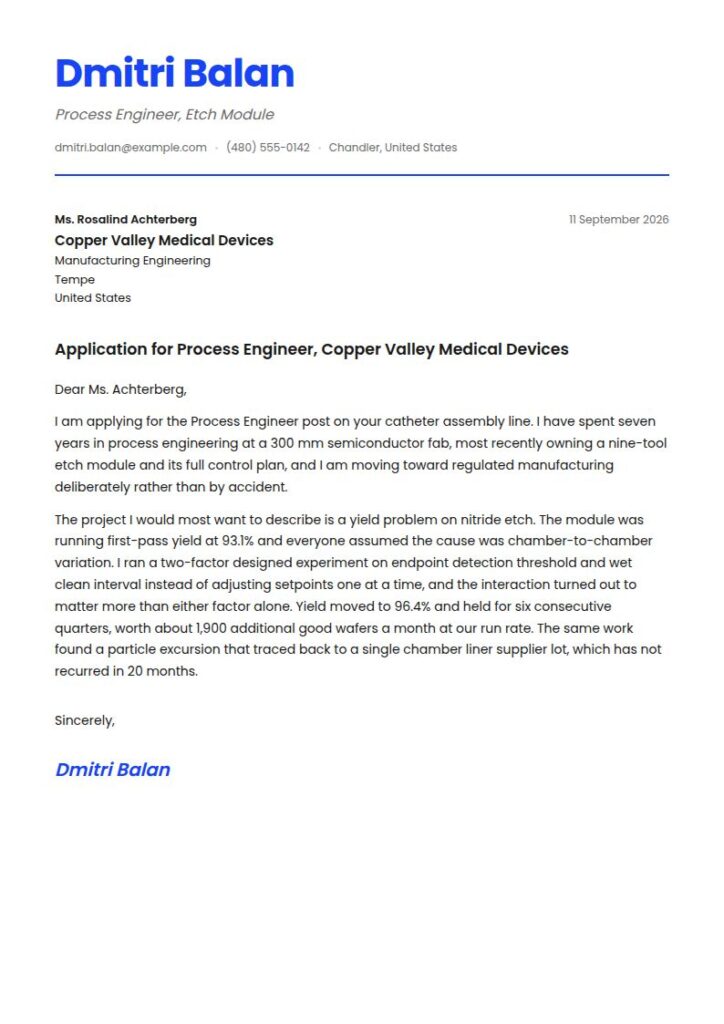
I am applying for the Process Engineer post on your catheter assembly line. I have spent seven years in process engineering at a 300 mm semiconductor fab, most recently owning a nine-tool etch module and its full control plan, and I am moving toward regulated manufacturing deliberately rather than by accident.
The project I would most want to describe is a yield problem on nitride etch. The module was running first-pass yield at 93.1% and everyone assumed the cause was chamber-to-chamber variation. I ran a two-factor designed experiment on endpoint detection threshold and wet clean interval instead of adjusting setpoints one at a time, and the interaction turned out to matter more than either factor alone. Yield moved to 96.4% and held for six consecutive quarters, worth about 1,900 additional good wafers a month at our run rate. The same work found a particle excursion that traced back to a single chamber liner supplier lot, which has not recurred in 20 months.
I am not going to claim validation experience I do not have. I have written control plans, capability studies and change records, and I have worked inside an ISO 9001 quality system, but I have not carried a process through Stage 2 qualification under 21 CFR Part 820. I know the framework, I have read your DHF-adjacent job posting carefully, and I would expect to spend my first months learning your protocol and deviation practice properly rather than pretending it is the same as a fab qualification.
I hold an ASQ Certified Six Sigma Green Belt and a chemical engineering degree from Arizona State, and I am available at four weeks' notice. Thank you for reading this.
Sincerely, Dmitri Balan
Openings that work
| Instead of | Use |
|---|---|
| I am a results-driven engineer with a passion for continuous improvement | I am applying for the Process Engineer post on your catheter assembly line |
| I have extensive experience in process optimization | I own a nine-tool etch module and its full control plan |
| I have a proven track record of improving efficiency | Module first-pass yield went from 93.1% to 96.4% and held for six quarters |
| I would be a valuable asset to your organization | I am moving toward regulated manufacturing deliberately rather than by accident |
What counts as evidence
| Kind of evidence | What it looks like in a sentence |
|---|---|
| Yield | First-pass yield from 93.1% to 96.4%, held across six quarters |
| Scrap | Scrap on the deposition line from 2.4% to 0.9%, about $310,000 a year at standard cost |
| Cycle time | Median changeover from 94 to 41 minutes across 11 product codes |
| Availability | 38 fewer hours of unplanned chamber downtime per quarter |
| Method | A two-factor designed experiment rather than one setpoint at a time |
| Durability | The excursion has not recurred in 20 months |
Durability is the underrated one. Anybody can move a number for a month. An engineer who says how long the gain held is telling the reader they built a control plan rather than a temporary fix.
Regulated and unregulated plants read the letter differently
Name the standard the plant runs under and use its vocabulary: validation stages and protocols for pharmaceutical and medical device, HACCP and critical limits for food, the core tools and customer audits for automotive, recipe and tool qualification for semiconductor. Give one process in full rather than four in outline. Say how long the improvement held. Say plainly what you have not done, because the reader will find out in the interview anyway.
Do not use the word validated for work that was optimized; in a regulated plant that is not loose language, it is a false claim about a regulatory state. Do not write a letter with no number in it. Do not summarize your resume; the letter is for the one story the resume cannot hold. Do not send the same letter to a fab and a food plant, because the vocabulary gives it away immediately.
Two occupations, two very different pay bands
There is no federal occupation called process engineer. The Bureau of Labor Statistics counts most of this work inside industrial engineers, which had 365,100 jobs in 2025, a projected 12 percent growth to 2035 and about 23,100 openings a year, at a median annual wage of $102,440 (BLS Occupational Outlook Handbook, May 2025 wages and 2025-35 projections).
The chemical, pharmaceutical and refining side is counted inside chemical engineers: 21,900 jobs in 2025, 5 percent projected growth and roughly 1,100 openings a year, at a median of $125,040 (BLS Occupational Outlook Handbook, May 2025 wages and 2025-35 projections).
That gap of more than $22,000 at the median is the practical reason to be precise in your letter about which kind of process you run. A reader deciding between two similar files is also deciding which band the role sits in, and vague language costs you the benefit of the doubt.
Length, format and sending it
One page, four paragraphs, 250 to 400 words. PDF unless the portal insists otherwise, named for yourself and the post: dmitri-balan-process-engineer-cover-letter.pdf.
Address a person. Manufacturing engineering managers are usually findable, and a named reader is worth the ten minutes it takes.
Use the same figures as your resume so the two agree. Our process engineer resume example is written with the numbers used here, and the Rezoom ATS resume checker will tell you whether the pair parses cleanly.
Key takeaways
- Open with the role, your process area and one headline number.
- Spend the middle paragraph on one process, not four.
- Give the baseline, the change, the result and the period.
- Name the method that proved the change was real.
- Say how long the improvement held.
- Use the vocabulary of their industry, not yours.
- Be explicit about what you have not done, especially validation.
Write your process engineer cover letter in 10 minutes.
Process engineer cover letter questions, answered
How long should a process engineer cover letter be?
One page, four paragraphs, 250 to 400 words. Manufacturing managers read these between meetings, and a second page is almost always a summary of the resume they already have.
What if my numbers are confidential?
Write them relatively and say so. "First-pass yield up 3.3 points from a baseline in the low nineties" carries the same information as the exact figure and gives away nothing your employer would object to. The method sentence is not confidential at all, and it is the part that persuades.
Should I mention a Six Sigma belt in the letter?
Once, in the closing, with the issuing body. The ASQ Black Belt requires three years of relevant on-the-job experience plus a completed project with a signed affidavit (ASQ, accessed September 2026), so it is a record of work rather than a course. What it is not is a substitute for the story in your middle paragraph.
How do I write to a regulated plant from an unregulated background?
Name the gap and show you know its shape. The FDA's three-stage framework of Process Design, Process Qualification and Continued Process Verification (FDA, Process Validation: General Principles and Practices, January 2011) is the structure the whole industry works in, so a candidate who can say where their existing work would sit in it reads as trainable rather than as a risk.
Do I need a cover letter if I am applying through a plant's portal?
Attach one wherever there is a field. The portal collects the same structured data from everyone. The letter is the only place you get to say which process you fixed, what it cost before, and how you proved the fix was real.