Rhiannon Castellanos Software Engineer San Antonio, 78209, United States [email protected] · (210) 555-1034
17 September 2026
Ms. Priyanka Venkatesan Engineering Hollowmere Technologies San Antonio, United States
Application for Software Engineer, Hollowmere Technologies
Dear Ms. Venkatesan,
I am applying for the Software Engineer role at Hollowmere Technologies. During a twelve-week internship at Quillmark Software I shipped a retry and dead-letter path for the billing webhook consumer in week 7, and it is still in production a year later.
The problem was that failed webhook deliveries were being replayed by hand, roughly 40 events a week, and nobody could tell which failures were transient. I added exponential backoff with a dead-letter queue and a small reconciliation query that matched received events against billed ones nightly. The manual queue fell to under 5 events a week, and the reconciliation found 1,900 historic events that had never been matched at all. The part I did not expect was how much of the work was deciding what counted as a failure, and I would do that part differently now: I would agree the definition with the billing team before writing any of it, rather than after.
Your engineering blog describes moving your payment events onto an idempotent consumer last year, which is the same shape of problem from the other end. That is the work I would want to be near. I have also merged two pull requests into an open source date parsing package with about 40,000 weekly downloads, one a timezone bug fix with a regression test.
My degree is in mathematics rather than computer science, and I closed the gap with a 24-week part-time engineering program and a reading list I still work through. The things I would need to learn here are your deployment tooling and Go at production standard, and I would expect that to take a few weeks rather than a few days. I can start immediately. Thank you for reading.
Sincerely, Rhiannon Castellanos
Summary
An entry-level software engineer cover letter leads with the single most checkable thing you have built, says plainly where it ended up, and never asks to be graded on potential. This guide gives you a full adaptable letter, the openings that work, the ones that cost you a reader, and what to write when your strongest evidence is a project rather than a job.
Entry-Level Software Engineer cover letter examples by experience level
An entry-level software engineer cover letter is a one-page letter that opens with the most checkable thing you have built, says where it ended up, and explains why that work is relevant to this team.
The instinct here is to write about wanting the job. Everyone in the folder wants the job. The letters read to the end are the ones whose second sentence is a fact the reader could verify, with the rest of the page spent on what it means.
Guide to an entry-level software engineer cover letter
This guide and the corresponding entry-level software engineer cover letter example will cover:
- How to structure the letter, paragraph by paragraph
- Why your most checkable work goes first, even if it is not the biggest
- What to write when your strongest evidence is a project, not a job
- How to handle a degree that is not in computer science
- The openings that ask to be graded on potential, and what to use instead
How to write an entry-level software engineer cover letter
| Paragraph | Its job | Length |
|---|---|---|
| Opening | The role, your most checkable work, its ending | 2 to 3 lines |
| Evidence | The problem, what you did, what changed, what it taught | 5 to 6 lines |
| Fit | Something real about their codebase, and why your work maps to it | 3 to 4 lines |
| Close | What you would need to learn, availability, thanks | 2 to 3 lines |
Give the work an ending in the first two sentences
The commonest failure in an entry-level letter is the missing ending. Applicants describe the project and stop, and the reader never learns whether anything shipped or whether it still runs.
Write the ending into the opening: still in production, merged within a week, kept by the sponsor, used by 340 people a month for six months. One clause, and the letter changes register. It also stops a reader wondering whether the work was real: nobody can confirm a description, but anyone can confirm a change still running in a named company's billing system.
An entry-level software engineer cover letter example you can adapt
Dear Ms. Venkatesan,
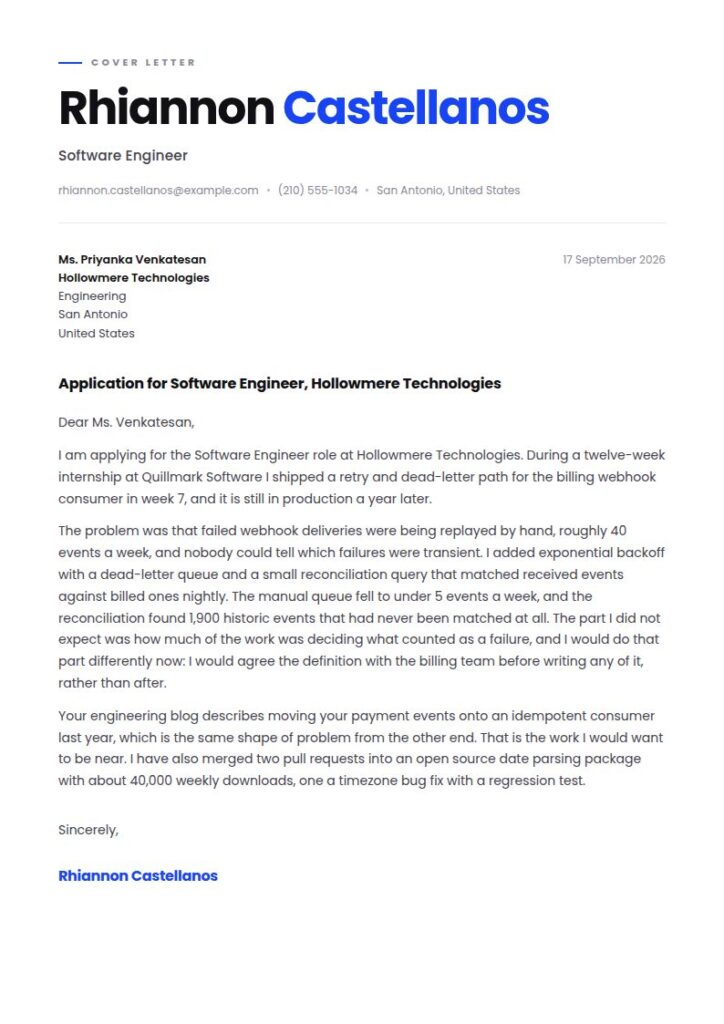
I am applying for the Software Engineer role at Hollowmere Technologies. During a twelve-week internship at Quillmark Software I shipped a retry and dead-letter path for the billing webhook consumer in week 7, and it is still in production a year later.
The problem was that failed webhook deliveries were being replayed by hand, roughly 40 events a week, and nobody could tell which failures were transient. I added exponential backoff with a dead-letter queue and a small reconciliation query that matched received events against billed ones nightly. The manual queue fell to under 5 events a week, and the reconciliation found 1,900 historic events that had never been matched at all. The part I did not expect was how much of the work was deciding what counted as a failure, and I would do that part differently now: I would agree the definition with the billing team before writing any of it, rather than after.
Your engineering blog describes moving your payment events onto an idempotent consumer last year, which is the same shape of problem from the other end. That is the work I would want to be near. I have also merged two pull requests into an open source date parsing package with about 40,000 weekly downloads, one a timezone bug fix with a regression test.
My degree is in mathematics rather than computer science, and I closed the gap with a 24-week part-time engineering program and a reading list I still work through. The things I would need to learn here are your deployment tooling and Go at production standard, and I would expect that to take a few weeks rather than a few days. I can start immediately. Thank you for reading.
Sincerely, Rhiannon Castellanos
Openings that work
| Instead of | Use |
|---|---|
| I am an aspiring software engineer eager to begin my career | I shipped a change during an internship, still in production a year later |
| I recently graduated and am passionate about technology | I have two merged pull requests in a package with 40,000 weekly downloads |
| I am excited to apply for this entry-level opportunity | I am applying for the Software Engineer role; here is my most checkable work |
| I am a quick learner with strong problem-solving skills | The manual replay queue fell from about 40 events a week to under 5 |
The word "aspiring" is the most expensive word in an entry-level letter. It asks to be graded on potential, which is slower and less favorable than being graded on a shipped change.
When your strongest evidence is not a job
Most people here have no internship with a shipped change. The letter still works; it leads with whatever is next on the ladder.
| What you have | How the letter opens | What to add in paragraph two |
|---|---|---|
| A merged open source contribution | The repository, how many depend on it, what your change fixed | The review thread, what the maintainer asked for, what you changed |
| A sponsored capstone | The sponsor, your part, what they did with it afterwards | The constraint that made it hard, and the decision you got wrong |
| A deployed personal project | The user count, the window, where it runs | An outage, a deprecation absorbed, or the support you had to do |
| Coursework only | The role and one thing you built for yourself | Be honest about scale; spend the space on how you work |
Every row there beats a paragraph about wanting to grow. None should inflate: a reader who works out that the "team of engineers" was a group assignment stops believing the rest.
The published entry requirement is a degree and nothing else
The Bureau of Labor Statistics records the typical entry-level education for software developers, quality assurance analysts and testers as a bachelor's degree, with work experience in a related occupation recorded as none and on-the-job training as none (BLS Occupational Outlook Handbook, 2025-35 cycle). The occupation held 1,905,400 jobs in 2025, is projected to grow 10 percent to 2035, and has about 106,100 annual openings (BLS, 2025-35 projections).
Pay ran from under $82,460 at the tenth percentile to over $214,670 at the ninetieth as of May 2025, around a median of $134,040 (BLS, May 2025). A first offer sits near the bottom of that range, not the middle.
Both facts point the same way. No qualification is missing, and the market is large. A first reader wants evidence that you have already done the work somewhere, which is why one checkable thing with an ending beats three paragraphs of motivation.
Length, format and sending it
One page, four paragraphs, 300 to 400 words. PDF, named for you and the role: rhiannon-castellanos-software-engineer-cover-letter.pdf.
Address a person where you can, and say one accurate thing about their engineering work taken from their own writing: a blog post, a changelog, a public repository. That sentence proves the letter was written for them. Keep every figure identical to your resume. Our entry-level software engineer resume example uses the same internship and numbers.
Open with your most checkable work and give it an ending. Say what changed, with a number. Name one thing you would do differently. Take one accurate detail from their engineering writing. State what you would need to learn. Match every figure to the resume.
Do not use the word aspiring. Do not open with how much you want the role. Do not describe a project without saying where it runs or who used it. Do not inflate a group assignment into a team project. Do not apologize for a degree in another field.
Key takeaways
- Open with the most checkable thing you have built, not the biggest.
- Give it an ending in the first two sentences.
- Put a number on what changed, and the period involved.
- Name one thing you would do differently; it reads as judgment.
- Take one real detail from their engineering writing.
- Say what you would need to learn, and how long.
- One page, four paragraphs, never the word aspiring.
Write your entry-level software engineer cover letter in 10 minutes with our AI cover letter builder.
Entry-level software engineer cover letter questions, answered
How long should an entry-level software engineer cover letter be?
One page, four paragraphs, 300 to 400 words. The evidence paragraph is the longest, and there should be no paragraph about your personal qualities at all.
Do I need a cover letter for a graduate engineering role?
Where there is a field for it, yes. Graduate applications arrive in volume and look alike, because the resumes are built from the same material. The letter is the only place to say what a piece of work turned into, and what you learned getting part of it wrong.
What do I write if I have never had a software job?
Open with the next rung down: a merged contribution, a sponsored capstone, or a deployed project with a user count and a window. The structure does not change, only the evidence, and a small honest thing beats a vague large one.
Should I explain a degree in another field?
Yes, in one sentence near the end, without apology. Name the degree, name what closed the gap, and give its length. The published entry requirement is a bachelor's degree, not a specific one, and a reader wants to know you noticed the gap and did something about it.
Is it risky to say what I would do differently?
No, and it is one of the strongest moves at this level. Naming a decision you got wrong and what you would change demonstrates what a first year of work teaches. Keep it to one sentence, make it technical, and do not turn it into an apology.